BPC-157 Research Guide: Mechanism, Reconstitution & Sourcing — UAE Research Guide (2026)
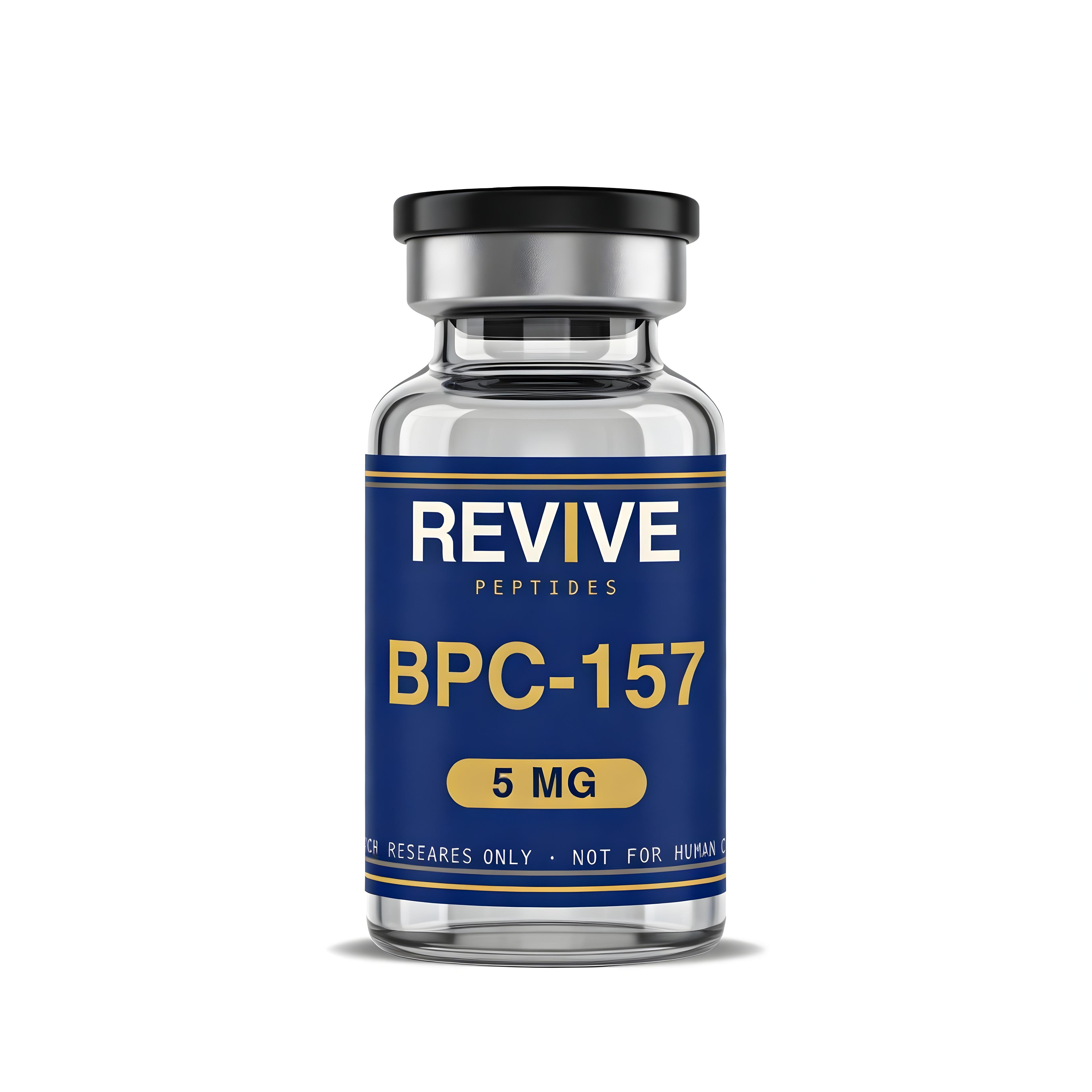
Among the research peptides generating consistent investigator interest in 2026, BPC-157 occupies a unique position: it has an unusually broad mechanistic footprint — tendon healing, gut mucosal protection, neurological signalling, vascular modulation — and a body of preclinical literature deep enough that it keeps drawing serious research attention. This guide surveys the mechanism, handling, and sourcing considerations that matter most for UAE-based research teams. REVIVE LAB UAE supplies HPLC-verified, lot-COA, cold-chain dispatched BPC-157 across all 7 emirates to support exactly this kind of rigorous research context.
What Is BPC-157? Mechanism at a Glance
BPC-157 (Body Protection Compound-157) is a synthetic pentadecapeptide comprising 15 amino acids, derived from a partial sequence of human gastric juice protein. It carries the sequence Gly-Glu-Pro-Pro-Pro-Gly-Lys-Pro-Ala-Asp-Asp-Ala-Gly-Leu-Val. Unlike many peptides in the research toolkit, BPC-157 is not a receptor-specific agonist in the classical sense — its effects appear mediated through several parallel pathways simultaneously, which is precisely what makes the route-of-administration question so interesting.
The core mechanisms identified in Sikiric et al.'s extensive preclinical programme include:
- Angiogenesis promotion — upregulation of VEGF and modulation of the VEGFR2 signalling cascade, accelerating new capillary formation at repair sites
- Nitric oxide (NO) pathway modulation — both eNOS upregulation and nNOS interaction, with downstream effects on vascular tone and tissue perfusion
- Growth hormone receptor (GHR) sensitisation — enhanced GH signalling without direct GH release, a distinction that matters for research design
- FAK/paxillin tendon fibroblast signalling — direct stimulation of tendon cell proliferation and collagen synthesis via focal adhesion kinase pathways
- NF-kB anti-inflammatory modulation — attenuation of pro-inflammatory cytokine cascades without immunosuppression
Critically, Sikiric et al. (2018) characterise BPC-157 as acting through a "stable gastric pentadecapeptide" framework — the peptide retains activity across a range of administration routes, a property that distinguishes it from receptor-site-specific compounds that lose potency when delivered away from target tissue.
Research Design Considerations for BPC-157 Studies
REVIVE LAB UAE does not provide dosing, administration-route, or injection guidance for any compound — that determination sits entirely with the researcher's own institutional protocol. What the published literature does offer is a picture of just how broadly BPC-157 has been studied: musculoskeletal models (tendon, ligament, muscle), gastrointestinal models (ulcer healing, gut motility, mucosal integrity), and central nervous system models (neuroprotection, dopaminergic signalling) all appear in the preclinical record, each with its own experimental design considerations.
Sikiric's group has repeatedly demonstrated robust improvements in tendon-to-bone reattachment strength, collagen organisation, and angiogenesis at the wound site in rodent tendon transection models. The mechanistic logic is compelling: BPC-157's FAK/paxillin fibroblast signalling, angiogenesis promotion, and NO pathway modulation are documented across multiple tissue contexts, which is part of why the compound continues to generate broad research interest rather than being confined to a single model system.
What separates a rigorous BPC-157 study from an anecdotal one is standard experimental design discipline: clear endpoint definition, appropriate controls, adequate replication, and — for any human-adjacent question — an institutional protocol that governs every variable of the research design, including compound handling. REVIVE LAB UAE's role begins and ends at supplying research-grade material; the protocol itself is the researcher's and their institution's responsibility.
Buy BPC-157 UAE — Order Now →
Reconstitution Protocol for BPC-157 5mg Vials
Proper reconstitution technique preserves peptide integrity and ensures dose accuracy across the research run. The following sequence is standard in peptide research settings:
- Pre-chill the vial — remove from refrigeration 5 minutes before reconstitution to equilibrate to room temperature, reducing thermal shock.
- Swab the septum — 70% isopropyl alcohol, allow 30 seconds to dry before inserting the needle.
- Inject BAC water slowly down the inside wall — never direct-stream onto the lyophilised cake. Direct impact degrades the peptide matrix and risks incomplete dissolution.
- Swirl gently, do not vortex — vortexing introduces air bubbles and mechanical shear stress. Gentle swirling for 30-60 seconds achieves full dissolution.
- Inspect for clarity — properly reconstituted BPC-157 is colourless and fully clear. Cloudiness indicates incomplete dissolution or contamination; do not proceed.
- Refrigerate immediately at 2-8°C — reconstituted vials are stable for approximately 14 days under optimal cold-chain conditions. Label with date and time of reconstitution.
REVIVE LAB UAE recommends aliquoting into smaller volumes if the research run will extend beyond 10 days, minimising repeated needle entry into the primary vial. Freeze-thaw of reconstituted BPC-157 is not recommended — the lyophilised form is the appropriate format for longer-term storage between research cycles.
Administration Determinations Are the Researcher's Own
REVIVE LAB UAE does not recommend or endorse any particular route, site, or technique for administering BPC-157. Route selection is one of many experimental design variables — alongside model system, tissue target, and endpoint measurement — that the published literature explores across different research contexts, and that decision belongs entirely to the investigator's own institutional protocol. The research-grade BPC-157 available from REVIVE LAB UAE in 5mg vials supplies that research with HPLC-verified material; the protocol design itself is outside REVIVE LAB UAE's scope.
Order BPC-157 Dubai →
Buying BPC-157 in the UAE — Supply Chain Matters
The route-of-administration debate is only relevant if the peptide you start with is research-grade. BPC-157's 15-amino-acid sequence is straightforward to synthesise but equally straightforward to cut with fillers or mislabel for strength — a well-documented problem in the unregulated research peptide supply chain globally. HPLC purity testing and lot-specific COA documentation are the minimum bar; cold-chain dispatch through the UAE summer (+44°C ambient) is the operational test that separates real suppliers from drop-shippers.
REVIVE LAB UAE supplies HPLC-verified, lot-COA, cold-chain dispatched BPC-157 across all 7 emirates. Whether you are in Dubai Marina, Business Bay, JBR, DIFC, JVC, Palm Jumeirah, Downtown Dubai, Jumeirah, Emirates Hills or Arabian Ranches — same-day delivery is the standard for Dubai orders placed before the daily cut-off. Payment options include cash on delivery and USDT crypto payment (TRC20 via Binance Pay, with a 5% pre-pay discount). For investigators searching bpc-157 Dubai 24h delivery or bpc-157 same day Dubai — this is the supply infrastructure that makes that possible.
| Emirate / City | Delivery Window | Cash on Delivery | Cold-Chain Dispatch |
|---|---|---|---|
| Dubai (Marina, JBR, Business Bay, DIFC, JVC, Palm, Downtown, Jumeirah) | Same-day, 4-8 hours | Yes | Yes |
| Abu Dhabi (Corniche, Yas, Saadiyat, Reem Island) | Next-day, 18-24 hours | Yes | Yes |
| Sharjah | Same-day / next-day, 8-18 hours | Yes | Yes |
| Ajman | Next-day, 18-24 hours | Yes | Yes |
| Ras Al Khaimah (RAK) | Next-day, 18-24 hours | Yes | Yes |
| Fujairah | Next-day, 24 hours | Yes | Yes |
| Umm Al Quwain (UAQ) | Next-day, 18-24 hours | Yes | Yes |
| Al Ain | Next-day, 24 hours | Yes | Yes |
Why REVIVE LAB UAE
REVIVE LAB UAE is a Dubai-based peptides UAE research supplier — not a reseller, not an offshore drop-shipper with a UAE phone number. Every BPC-157 batch is independently HPLC-tested for purity and identity, with lot-specific COA available on request before dispatch. Vials are dispatched in validated insulated cold-chain packaging that holds 2-8°C through UAE ambient temperatures, maintaining peptide stability from our stock to the investigator's refrigerator.
BPC-157 5mg vials are in stock in Dubai right now — available for same-day dispatch on weekdays. Cash on delivery is supported across all seven emirates. For investigators building a broader research stack — Retatrutide, Tesamorelin, GHK-Cu, TB-500, MOTS-c, Semax, NAD+ — see the full REVIVE LAB UAE peptides catalogue. The standard we hold ourselves to is simple: if the peptide does not arrive at research-grade purity, via a cold chain that held, to your door on the timeline we committed to — it is not worth your protocol.
Buy BPC-157 UAE — Order Now →
FAQ
Where can I buy BPC-157 in the UAE with same-day delivery?
REVIVE LAB UAE stocks HPLC-verified BPC-157 5mg vials with lot-COA documentation and cold-chain dispatch across all 7 emirates. Researchers in Dubai can receive bpc-157 same day delivery within 4-8 hours for orders placed before the daily cut-off. Abu Dhabi, Sharjah, RAK, Fujairah, Ajman and UAQ are covered on a next-day bpc-157 Dubai 24h delivery window. Cash on delivery is available across the UAE, and USDT crypto payment is also accepted at a 5% pre-pay discount via Binance Pay.
Does REVIVE LAB UAE provide guidance on how or where to administer BPC-157?
No. REVIVE LAB UAE does not provide dosing, administration-route, or injection guidance for any compound — that determination sits entirely with the researcher's own institutional protocol. The peer-reviewed literature (Sikiric et al., 2018) documents BPC-157 activity across a range of preclinical model systems, including musculoskeletal, GI, and CNS contexts — but translating any of that into a specific research design is a decision for the investigator and their institution alone.
- Sikiric P, Seiwerth S, Rucman R, et al. Stable Gastric Pentadecapeptide BPC 157 and Wound Healing: A Comprehensive Review. Current Pharmaceutical Design. 2018;24(18):1994-2006.
- Sikiric P, Seiwerth S, Rucman R, et al. Focus on ulcerative colitis: stable gastric pentadecapeptide BPC 157. Journal of Physiology and Pharmacology. 2011;62(2):125-136.