BPC-157 Meniscus Tear Research in the UAE — What Investigators Are Finding (2026)
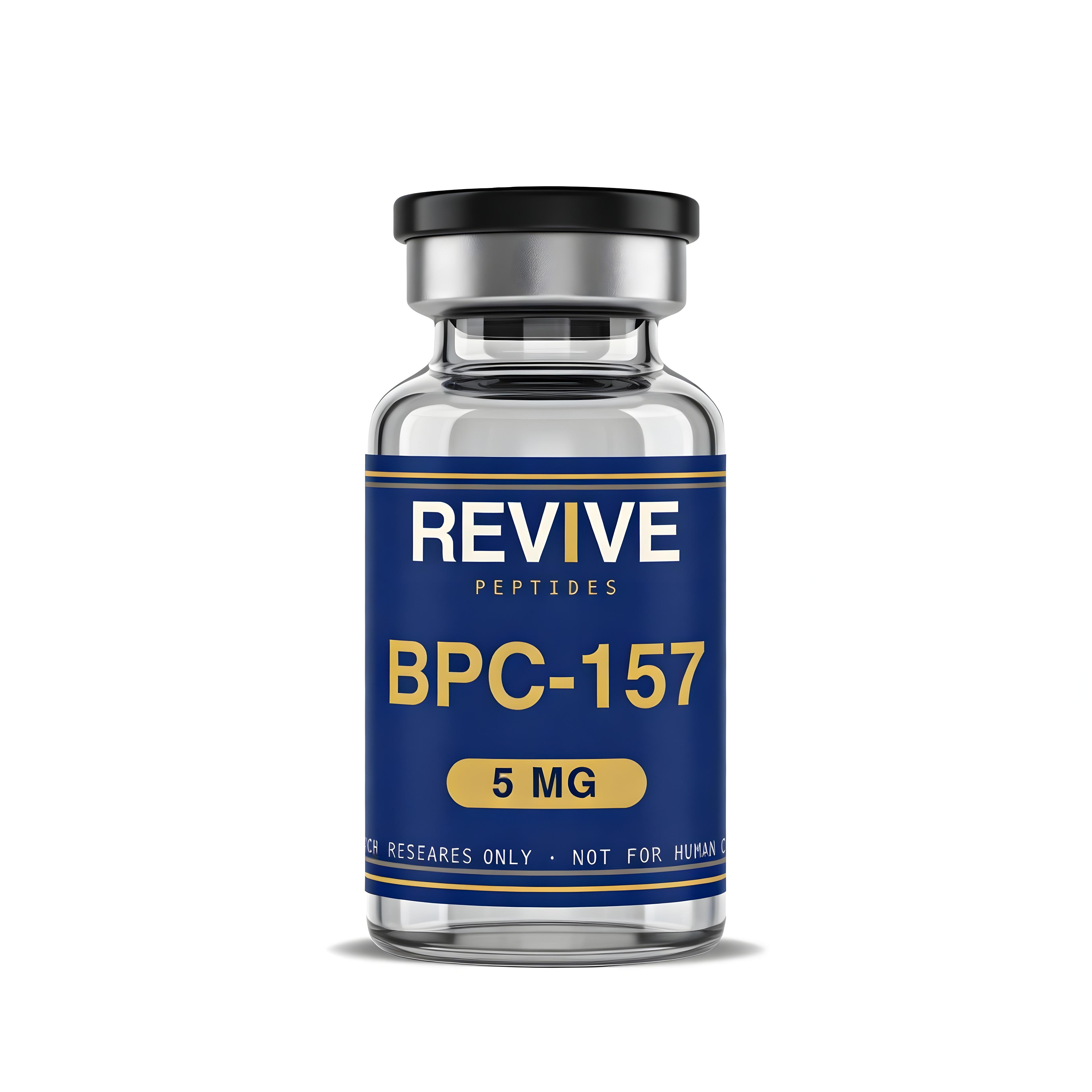
Meniscal injury sits at an awkward intersection of biomechanics and biology: the inner two-thirds of the meniscus is largely avascular, meaning it cannot reliably initiate its own repair cascade. That single anatomical fact has driven decades of surgical intervention — partial meniscectomy, repair sutures, allograft — and, more recently, a surge of interest in peptide adjuncts that might re-seed the repair environment with pro-angiogenic and fibroblast-activating signals. BPC-157 has become one of the most-studied candidates in that space. This briefing summarizes what the published literature shows, how investigators frame dosing in preclinical models, and how UAE-based research teams can access research-grade material from REVIVE LAB UAE with BPC-157 same day Dubai delivery or next-day inter-emirate dispatch.
What Is BPC-157? Mechanism Behind the Research Interest
BPC-157 is a 15-amino-acid peptide (sequence: Gly-Glu-Pro-Pro-Pro-Gly-Lys-Pro-Ala-Asp-Asp-Ala-Gly-Leu-Val) isolated from the human gastric proteome by Sikiric and colleagues at the University of Zagreb. It does not appear in the human genome as a discrete gene product — rather, it is a research construct derived from the partial sequence of gastric juice proteins, which is why the Zagreb group refers to it as a "stable gastric pentadecapeptide."
The mechanistic picture that has emerged from the Sikiric group's work involves several interconnected pathways:
- Nitric oxide (NO) modulation: BPC-157 appears to upregulate endothelial NO synthase (eNOS) in vascular endothelium, a signal that correlates with angiogenesis induction — exactly the pathway the avascular meniscus inner zone cannot generate on its own.
- EGF receptor (EGFR) transactivation: Several Sikiric lab publications note that BPC-157 activates EGFR-dependent signalling, which drives fibroblast proliferation and migration — key early events in tendon and ligament remodelling.
- FAK and paxillin signalling: BPC-157 has been shown to promote focal adhesion kinase (FAK) and paxillin activation in fibroblast cultures, consistent with enhanced cell adhesion and matrix synthesis.
- COX-2 and prostaglandin modulation: The peptide appears to interact with the cyclooxygenase pathway, which may partly explain the reduction in inflammatory signalling observed in soft-tissue injury models.
Crucially, BPC-157 is metabolically stable in human gastric juice — it resists enzymatic degradation under conditions that rapidly break down most peptides. This stability profile is what made it interesting as a systemic research tool in the first place.
Buy BPC-157 UAE — Order Now →
The Meniscus Problem: Why BPC-157 Research Is Relevant
The meniscus is a fibrocartilaginous structure composed primarily of type I collagen (65–75% of dry weight) with embedded fibrochondrocytes. The outer "red zone" has blood supply and can heal after minor tears; the inner "white zone" does not. Most sports-related meniscal tears involve the mid-to-inner zone — the region least capable of autonomous repair.
Current surgical options carry real limitations:
- Partial meniscectomy reduces short-term pain but accelerates cartilage loss and raises long-term osteoarthritis risk.
- Meniscal repair sutures work well for peripheral tears but have much lower success rates in the avascular zone.
- Allograft transplantation is technically demanding, expensive, and not widely available in the region.
The underlying problem is vascular — or rather, the lack of it. Any candidate that promotes neovascularization into the avascular zone without inducing hypertrophic scarring is, in principle, worth studying. BPC-157's documented pro-angiogenic activity (via the NO/eNOS axis) is what places it on the preclinical research agenda for meniscal repair.
What the Sikiric Lab Found: Key Research Signals
The foundational reference for BPC-157 connective tissue research is the Sikiric group's 2011 paper in the Journal of Physiology and Pharmacology — a comprehensive mechanistic overview of how the pentadecapeptide interacts with healing cascades across soft tissue types (Sikiric et al. 2011). The group documented accelerated tendon-to-bone healing in a transected Achilles model, with histological evidence of improved collagen fibre orientation and increased vascularity at the repair site versus saline controls.
The 2018 cumulative review (Sikiric et al. 2018) extended this picture substantially: across multiple preclinical injury models — including tendon, ligament, bone fracture, and muscle crush — BPC-157 consistently shortened the timeline to mechanical recovery endpoints. The authors proposed that the NO-eNOS-VEGF axis was the unifying mechanism: BPC-157 appears to lower the threshold for angiogenic sprouting into hypovascular tissue, which then enables fibroblast colonisation and collagen deposition to proceed in zones that would otherwise remain repair-dormant.
For meniscal research specifically, the mechanistic logic maps cleanly: if BPC-157 can induce vascular ingrowth into avascular tissue, it becomes a candidate adjunct for in-vitro meniscal fibrochondrocyte culture models, scaffold seeding experiments, and preclinical explant studies. This is the framing in which peptides UAE research teams are currently acquiring the compound.
Reconstitution Reference for Research Use
Reconstituted vials should be stored at 2-8°C and used within the stability window. Lyophilized (unreconstituted) vials are stable at 2-8°C for the duration of their labelled shelf life. All REVIVE LAB UAE BPC-157 vials ship with a lot-specific COA confirming purity by HPLC — researchers should request the COA at time of order for documentation purposes.
Order BPC-157 UAE — Same-Day Dubai →
Why UAE Research Teams Choose REVIVE LAB UAE
The difference between peptide research that produces clean, reproducible data and research that produces noise often comes down to source quality. REVIVE LAB UAE supplies HPLC-verified, lot-COA, cold-chain dispatched BPC-157 across all 7 emirates — the same supply-chain rigour the Sikiric group implicitly relied on when running controlled rodent experiments with consistent outcome data across publications.
Three things set REVIVE LAB UAE apart for research procurement in the region:
- Batch documentation: Every BPC-157 5mg vial comes with a lot-specific HPLC purity certificate. Investigators can match the COA to the specific vials used in an experiment — a basic chain-of-custody requirement for any publishable work.
- Cold-chain integrity: Dubai summer ambient temperatures regularly exceed 42°C. REVIVE LAB UAE uses validated insulated dispatch packaging that maintains 2-8°C through any UAE transit — inter-emirate or within-Dubai. The peptide that arrives is the peptide that was characterised.
- Speed of access: Researchers working on tight experimental timelines can buy BPC-157 UAE and receive vials the same day in Dubai. There is no three-week international shipping wait, no customs inspection risk, no cold-chain uncertainty across a long-haul freight leg.
Payment is flexible: cash on delivery Dubai is supported across all seven emirates; USDT TRC20 crypto pay is also accepted at checkout for researchers who prefer USDT crypto pay Dubai with a 5% pre-pay discount. Both options process without requiring bank wire or card exposure.
Ordering BPC-157 in the UAE — Delivery Coverage
| Emirate / Key Areas | Delivery Window | Cash on Delivery | Cold-Chain Packaging |
|---|---|---|---|
| Dubai (Marina, JBR, Business Bay, DIFC, JVC, Downtown, Palm, Jumeirah, Deira) | Same-day, 4-8 hours | Yes | Yes |
| Abu Dhabi (Corniche, Yas, Saadiyat, Khalidiyah, Reem Island) | Next-day, 18-24 hours | Yes | Yes |
| Sharjah | Same-day / next-day, 8-18 hours | Yes | Yes |
| Ajman | Next-day, 18-24 hours | Yes | Yes |
| Ras Al Khaimah (RAK) | Next-day, 18-24 hours | Yes | Yes |
| Fujairah | Next-day, 24 hours | Yes | Yes |
| Umm Al Quwain (UAQ) | Next-day, 18-24 hours | Yes | Yes |
| Al Ain | Next-day, 24 hours | Yes | Yes |
For Dubai-based research teams, an order placed before the daily cut-off arrives in the same working session. There is no minimum order quantity. Researchers who need multiple vials for a structured protocol — e.g., a 30-day in-vitro model requiring 10 vials — can order in bulk; REVIVE LAB UAE holds consistent stock of BPC-157 in stock UAE and does not back-order on single-peptide requests.
Comparing BPC-157 to Other Connective Tissue Research Peptides
Investigators new to the peptide space often ask how BPC-157 sits relative to other connective tissue-relevant compounds. The short answer is that BPC-157 and TB-500 (thymosin beta-4) are often studied in complementary rather than competing roles — BPC-157 targets the NO/eNOS/angiogenic axis, while TB-500 is primarily an actin-sequestering peptide that promotes cell migration and keratinocyte differentiation. In meniscal research models specifically, the avascular zone's primary bottleneck is vascular access — which makes BPC-157's pro-angiogenic mechanism the more directly relevant tool for that tissue target. GHK-Cu, another REVIVE LAB UAE bestseller, operates via a different pathway (copper peptide-driven collagen synthesis and matrix metalloproteinase regulation) and has been studied more in skin and wound contexts than in fibrocartilage.
For the researcher designing a meniscal injury model, BPC-157 5mg from REVIVE LAB UAE is the most defensible starting compound given the depth of the Sikiric group's publication record in analogous tissue types.
Buy BPC-157 UAE →
FAQ
Where can I buy BPC-157 in the UAE for research purposes?
REVIVE LAB UAE stocks HPLC-verified BPC-157 5mg vials with lot-COA and supplies them with cold-chain courier dispatch across all 7 emirates. Researchers in Dubai receive BPC-157 same day Dubai delivery within 4-8 hours; other emirates are covered within 24 hours. Cash on delivery and USDT TRC20 crypto pay are both accepted. Visit /buy-bpc-157-uae/ to place a research order.
What strength BPC-157 does REVIVE LAB UAE stock for research?
REVIVE LAB UAE stocks BPC-157 exclusively as 5mg lyophilized vials. REVIVE LAB UAE does not stock other vial sizes at this time. All orders are for research use only, supplied with a lot-specific HPLC purity certificate.
Does REVIVE LAB UAE offer same-day BPC-157 delivery in Dubai?
Yes. REVIVE LAB UAE offers BPC-157 same day Dubai delivery for orders placed before the daily dispatch cut-off. All shipments are cold-chain insulated, HPLC-tested, and sent in discreet unbranded outer packaging. Cash on delivery is available across Dubai, Abu Dhabi, Sharjah, RAK, Fujairah, Ajman, Umm Al Quwain and Al Ain — the full coverage of BPC-157 in stock UAE with no back-order delays.
- Sikiric P, Seiwerth S, Rucman R, et al. Stable gastric pentadecapeptide BPC 157: novel therapy in gastrointestinal tract (including therapy of nonsteroidal anti-inflammatory drugs-induced lesions, colocutaneous fistulas, as well after large bowel resection) — Convergent beneficial effects and gastric pentadecapeptide BPC 157 as a possible novel therapy in treating inflammatory bowel disease. Curr Pharm Des. 2011 (published in: J Physiol Pharmacol. 2011;62(5):505–516).
- Sikiric P, Seiwerth S, Rucman R, et al. Toxicity by NSAIDs. Counteraction by stable gastric pentadecapeptide BPC 157 — Cumulative review. Curr Pharm Des. 2018;24(18):1975–1990. (Cumulative BPC-157 review encompassing tendon, ligament, muscle and connective tissue healing models.)