Peptide Reconstitution: Bacteriostatic Water, Concentration Math, and Storage
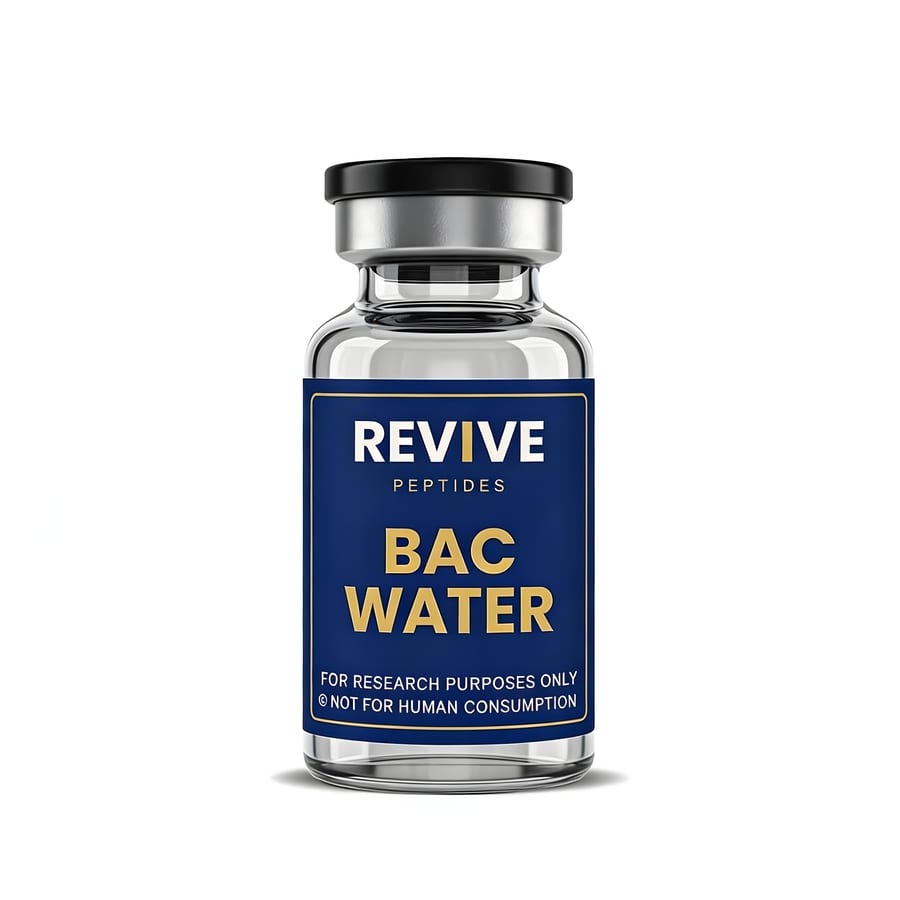
A lyophilised peptide is shelf-stable for two to three years dry. Once water hits the powder, you have about 28 days of reliable activity — and a dozen ways to destroy the vial in the first minute. This guide walks through the water choice, the concentration calculation, the handling errors that ruin peptide, and the storage window honestly.
1. Bacteriostatic water vs sterile water — and why the difference matters
Both fluids start the same: USP-grade water for injection. The difference is what's added.
| Sterile water for injection | Bacteriostatic water for injection | |
|---|---|---|
| Composition | Water only | Water + 0.9% benzyl alcohol |
| Bacterial growth inhibition | None | Yes — benzyl alcohol is bacteriostatic |
| Re-entry after first use | Single-use only — discard immediately | Multi-dose — up to 28 days under refrigeration |
| Use case | Single immediate use, or peptides incompatible with benzyl alcohol | Standard for multi-dose research peptide reconstitution |
For the vast majority of research peptide work — where you reconstitute one vial and draw from it across multiple aliquots over weeks — bacteriostatic water is the correct choice. The 0.9% benzyl alcohol preservative is the only thing keeping the vial sterile after you've punctured the stopper.
2. The concentration calculation
This is where most reconstitution mistakes happen. The formula:
Worked examples
| Peptide mass | Bac water added | Result | 20 mcg dose draws |
|---|---|---|---|
| 5 mg (5,000 mcg) | 1.0 mL (100 units) | 50 mcg/unit | 0.4 units |
| 5 mg (5,000 mcg) | 2.0 mL (200 units) | 25 mcg/unit | 0.8 units |
| 10 mg (10,000 mcg) | 1.0 mL (100 units) | 100 mcg/unit | 0.2 units |
| 10 mg (10,000 mcg) | 2.0 mL (200 units) | 50 mcg/unit | 0.4 units |
Anything below 5 units becomes hard to draw accurately; anything above 30 burns through the vial too fast.
4. The handling errors that destroy peptide
Shaking the vial
The most common mistake. Lyophilised peptide is a fragile protein structure — shaking introduces air bubbles and shear forces that physically denature the molecule. If your reconstituted vial is foamy or cloudy, this is what happened. The peptide can't be salvaged. Discard.
Hot reconstitution
Adding warm or hot water "to help it dissolve" denatures the peptide just as effectively as shaking. Room-temperature bacteriostatic water is the upper bound.
Direct-jetting the powder
Pushing the syringe plunger fast enough to jet water onto the peptide powder applies localised pressure that fragments the molecule. Always angle the needle at the side wall and inject slowly.
Multiple freeze-thaw cycles
Lyophilised peptide can be frozen at –20 °C for long-term storage. Reconstituted peptide should not be freeze-thawed repeatedly — each cycle degrades a measurable percentage. If long-term storage of solution is needed, aliquot first into single-use volumes, freeze each one, and thaw only what's needed.
Letting the alcohol wipe drip into the vial
Wipe the stopper, then wait 30 seconds for the alcohol to evaporate before inserting the needle. Otherwise alcohol crosses into the vial with the needle and contaminates the peptide.
5. Storage windows — honestly
| State | Storage | Window |
|---|---|---|
| Lyophilised, sealed | 2–8 °C (or –20 °C for long-term) | 2–3 years from date of manufacture |
| Reconstituted with bacteriostatic water | 2–8 °C | ~28–30 days (benzyl alcohol preservative window) |
| Reconstituted with sterile water | 2–8 °C | ~24 hours — no preservative |
| Reconstituted, aliquoted, frozen | –20 °C | Months — single freeze-thaw only |
These windows are general guidance. Peptide-specific stability varies. Some peptides — notably some GHRH analogues like Tesamorelin and Sermorelin — degrade faster than the average. Others — BPC-157, GHK-Cu — are more stable in solution.
6. Final checklist
- Bacteriostatic water (not sterile, unless single-use)
- Room-temperature peptide and water before mixing
- Inject down the side wall, slowly
- Swirl until clear — never shake
- Date the vial on the label at reconstitution
- Refrigerate at 2–8 °C between uses
- Discard at 28 days, or sooner if anything looks off