Semax: The Russian ACTH-Derived Nootropic Peptide
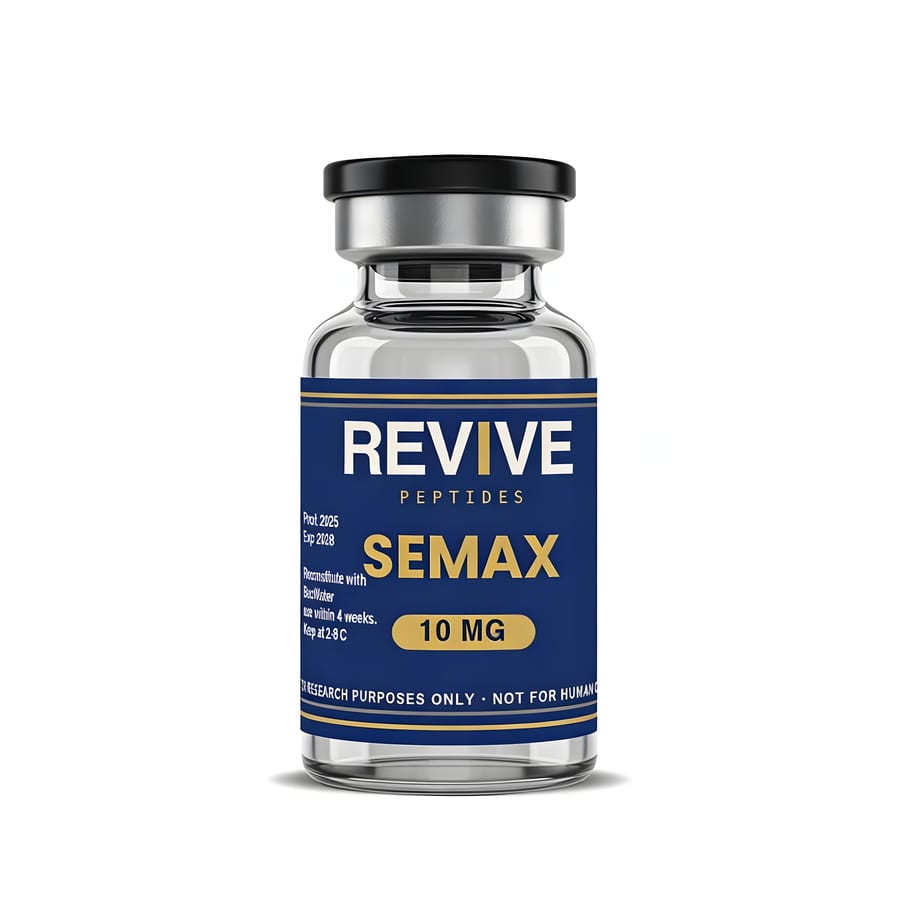
Semax sits in an unusual position in the research peptide market. In Russia it's an approved medicine on the essential drugs register, used clinically for stroke and cognitive disorders for over 30 years. Everywhere else, it's a research peptide with a literature heavily concentrated in Russian-language journals. This is what the published English-indexed research actually documents.
1. Structure and origin
Semax is a synthetic heptapeptide: Met-Glu-His-Phe-Pro-Gly-Pro (MEHFPGP). The first four residues (Met-Glu-His-Phe) correspond to residues 4–7 of natural adrenocorticotropic hormone (ACTH). The C-terminal Pro-Gly-Pro extension was added by the developers at the Institute of Molecular Genetics, Russian Academy of Sciences, and Lomonosov Moscow State University to make the molecule metabolically stable — natural ACTH fragments are rapidly degraded.
The structural key: by stripping ACTH down to residues 4–7, Semax loses the hormonal effects of full ACTH (no adrenal stimulation, no glucocorticoid release) but retains the central nervous system effects that were initially attributed to the ACTH(4–10) fragment.
2. The mechanism — BDNF, NGF, and dopaminergic modulation
Neurotrophin upregulation
The most-cited mechanistic finding is upregulation of brain-derived neurotrophic factor (BDNF) and nerve growth factor (NGF) in rat brain. Dolotov OV et al. published a series of papers documenting BDNF mRNA increases in the hippocampus and frontal cortex after Semax administration in rats. Shadrina MI et al. extended this with gene-expression array work showing that Semax modulates expression of dozens of CNS-related genes including BDNF, NGF, and synaptic proteins.
Dopaminergic and serotonergic effects
Eremin KO, Bobyntsev II, and colleagues documented Semax effects on dopaminergic transmission in rat models — modulation of extracellular dopamine in the nucleus accumbens, effects on D1 and D2 receptor signalling. Behavioural correlates include changes in attention, learning, and stress-response measures in standard rodent paradigms (Morris water maze, passive avoidance, open field).
Neuroprotection in stroke models
Semax's clinical use in Russia is grounded in animal-model stroke work showing reduced infarct volume and improved neurological recovery in middle cerebral artery occlusion (MCAO) models. The mechanism converges on the BDNF/NGF pathway and anti-inflammatory effects on microglia.
3. The Russian clinical literature
Semax has been used clinically in the Russian Federation for over 30 years. Russian peer-reviewed clinical papers report on its use in:
- Ischaemic stroke — administered intranasally during the acute phase. This is the on-label indication.
- Cognitive disorders — vascular cognitive impairment, post-stroke cognitive recovery.
- Optic nerve atrophy — an unusual but documented Russian clinical use.
- Pediatric attention/learning disorders — documented in Russian pediatric neurology literature.
4. Bioavailability and route
Intranasal administration is the documented and clinical route. Semax has acceptable bioavailability through nasal mucosa, and crosses into the CSF rapidly via the olfactory pathway (avoiding first-pass metabolism). Russian clinical formulations are 0.1% solutions delivered as drops into the nostrils.
Parenteral routes — subcutaneous, intraperitoneal — are used in animal research but are less common than intranasal for clinical work. Oral bioavailability is negligible.
5. What Semax is and isn't compared to other nootropic peptides
- Compared to Selank (another Russian-origin peptide, anxiolytic-leaning): structurally distinct — Selank is a Tuftsin analogue. Both share the Pro-Gly-Pro stabilising motif.
- Compared to Cerebrolysin: completely different category — Cerebrolysin is a complex porcine brain-derived preparation; Semax is a defined synthetic heptapeptide.
- Compared to racetams (piracetam, aniracetam): different mechanism entirely. Racetams are small-molecule AMPA modulators; Semax acts via BDNF/NGF upregulation and ACTH-derived signalling.
6. Practical research considerations
- Reconstitution: Bacteriostatic water, standard handling. See reconstitution guide.
- Storage: Refrigerated at 2–8 °C after reconstitution. Stable for ~28 days.
- Common research route: Intranasal in animal studies replicating the clinical route.
- Vial sizes: Typically 10 mg or 30 mg lyophilised.
7. The honest summary
- Heptapeptide ACTH(4–7) analogue + Pro-Gly-Pro stabilisation tail.
- Russian-approved medicine for stroke and cognitive disorders since the 1990s.
- Outside Russia: research peptide, not an approved drug.
- Strongest mechanistic data: BDNF/NGF upregulation, dopaminergic modulation, neuroprotection in stroke models.
- Literature heavily concentrated in Russian-language journals — English-indexed papers are a partial view.
- Western RCTs to ICH-GCP standards are thinner than Russian clinical use volume implies.
References (English-indexed)
- Dolotov OV, Karpenko EA, Inozemtseva LS, et al. Semax, an analog of adrenocorticotropin (4-10), binds specifically and increases levels of brain-derived neurotrophic factor protein in rat basal forebrain. J Neurochem. 2006;97 Suppl 1:82–86. PubMed
- Shadrina MI, Dolotov OV, Grivennikov IA, et al. Rapid induction of neurotrophin mRNAs in rat glial cell cultures by Semax, an adrenocorticotropic hormone analog. Neurosci Lett. 2001;308(2):115–118. PubMed
- Eremin KO, Kudrin VS, Saransaari P, et al. Semax, an ACTH(4-10) analogue with nootropic properties, activates dopaminergic and serotoninergic brain systems in rodents. Neurochem Res. 2005;30(12):1493–1500. PubMed
- Asmarin IP, Nezavibatko VN, Myasoedov NF, et al. Nootropic analog of adrenocorticotropin 4-10-Semax (15 years of experience in development and study). Zh Vyssh Nerv Deiat Im I P Pavlova. 1997;47(2):420–430. PubMed
- Gusev EI, Skvortsova VI, Miasoedov NF, et al. Effectiveness of Semax in acute period of hemispheric ischemic stroke (clinical and electrophysiological study). Zh Nevrol Psikhiatr Im S S Korsakova. 1997;97(6):26–34. PubMed