Tesamorelin After Gastric Bypass — Research Protocol UAE
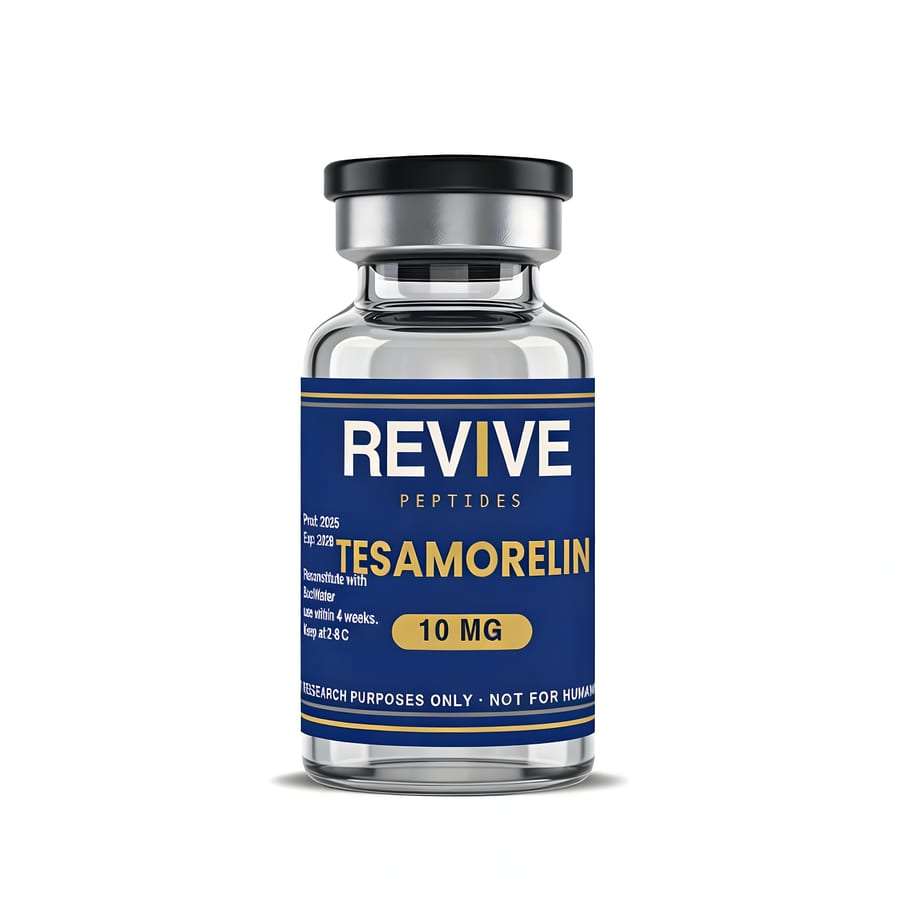
Why the Post-Bariatric Model Is a Priority Research Focus
Gastric bypass surgery — most commonly Roux-en-Y gastric bypass (RYGB) or sleeve gastrectomy — produces an initial metabolic phenotype that looks, on the surface, like a clean success story. Body weight drops dramatically in the first six to twelve months. Inflammatory markers improve. Glycaemic control often normalises faster than caloric restriction alone would predict. But over an 18-to-36-month horizon, a well-documented subset of post-bariatric subjects shows persistent or recurrent visceral adipose tissue (VAT) accumulation even while overall BMI remains suppressed. Trunk fat, particularly in the omental and mesenteric compartments, reestablishes itself in ways that are not fully explained by caloric rebound.
This divergence between total adiposity and visceral fat trajectory has put the growth hormone (GH) axis squarely in the sights of researchers studying post-bariatric biology. What makes tesamorelin particularly interesting in this context is that it works upstream: as a growth hormone-releasing hormone (GHRH) analogue, it stimulates the pituitary to produce GH in a pulsatile, physiologically-patterned fashion rather than delivering exogenous GH directly at supraphysiological levels. The distinction matters scientifically and analytically.
For research groups operating out of Dubai Healthcare City, university-affiliated labs in Abu Dhabi, or biotech suites in Business Bay and the knowledge parks around Al Quoz, the post-bariatric model offers a highly controlled experimental context with well-characterised baseline variables and clinically relevant endpoints. REVIVE LAB UAE maintains consistent tesamorelin stock precisely to support this kind of protocol — researchers in the Gulf should not be sourcing from European or North American suppliers with 10-to-14-day cold-chain transit times when same-day dispatch is available domestically.
Tesamorelin as a GHRH Analog: Mechanistic Relevance to Visceral Fat
Tesamorelin (TH9507) is a synthetic analogue of endogenous GHRH(1-44) with a trans-3-hexenoic acid modification at the N-terminus. This structural change confers resistance to dipeptidyl peptidase IV (DPP-IV) enzymatic cleavage, substantially extending the compound's active half-life relative to native GHRH while preserving full agonist activity at the pituitary GHRH receptor. The downstream effect is a pronounced pulsatile increase in endogenous GH secretion that mirrors — rather than overrides — normal hypothalamic-pituitary GH release dynamics.
This visceral selectivity is not incidental — it is the core mechanistic reason why tesamorelin research in post-bariatric VAT accumulation models is scientifically logical rather than speculative.
Researchers should also account for the insulin-like growth factor 1 (IGF-1) axis, which is engaged downstream of GH stimulation via hepatic production. IGF-1 has its own metabolic effects, including anabolic signalling in lean tissue compartments, and should be tracked as a secondary biomarker in any well-designed tesamorelin protocol. In post-bariatric subjects — who often show suppressed IGF-1 at baseline due to protein absorption deficits — changes in IGF-1 over the course of a protocol can themselves be informative about the restoration of GH axis function.
What the Peer-Reviewed Literature Establishes
The evidence base for tesamorelin in visceral fat research is unusually robust. The landmark study is Falutz et al. 2007, published in the New England Journal of Medicine, which reported statistically significant and clinically meaningful reductions in visceral adipose tissue (measured by CT cross-sectional area) in subjects with HIV-associated lipodystrophy — a metabolic phenotype characterised by pathological deep fat accumulation that maps conceptually to the post-bariatric VAT redistribution pattern. The Falutz trial used a randomised, double-blind, placebo-controlled design and remains the foundational reference for tesamorelin's visceral specificity.
The Falutz et al. 2010 continuation trial, also in the New England Journal of Medicine, extended these findings in a critically important direction: it demonstrated that VAT reductions were sustained with continued GHRH analog administration and that discontinuation led to measurable VAT reaccumulation over subsequent months. For researchers designing post-bariatric protocols, this finding has direct relevance to study duration decisions — short-term protocols may capture an initial signal that does not represent the steady-state biology of GHRH analog engagement.
Stanley et al. 2014 in JAMA added metabolic context. In a trial examining tesamorelin in abdominal obesity and metabolic dysfunction, VAT reductions were accompanied by improvements in triglyceride profiles and cognitive function markers. Crucially, the compound showed a relatively neutral profile with respect to glucose metabolism — a significant finding for post-bariatric research subjects, who often have surgically altered glucose handling that could be confounded by GH-axis modulation. Stanley et al. 2019 in The Lancet HIV then provided 26-week longitudinal safety data that reinforced the tolerability picture across an extended administration window.
Taken together, these four publications represent a coherent and well-replicated body of evidence. Researchers in Dubai and Abu Dhabi looking to build institutional justification for a tesamorelin post-bariatric protocol have a strong peer-reviewed foundation to cite in ethics submissions and grant proposals.
Order before noon for same-day dispatch to Dubai Marina, JBR, Business Bay, Palm Jumeirah, DIFC. Cold-chain packaging, discreet labelling, cash on delivery available across the UAE. Buy Tesamorelin UAE — Same-Day Dubai Dispatch
Post-Bariatric-Specific Variables That Protocol Designers Must Manage
Designing a tesamorelin protocol within a post-bariatric research model introduces several confounders that are absent or less prominent in standard metabolic obesity models. Managing these systematically is what separates publishable data from noisy pilot observations.
The first is surgical timeline. The early post-operative phase — typically the first six months — is characterised by rapid total fat mass reduction that will dominate any VAT signal. Most research groups find the 12-to-24-month post-operative window more informative, corresponding to the plateau phase where rapid loss has ended and the VAT redistribution pattern has stabilised. Enrolling subjects too early produces a floor effect that obscures GHRH analog-specific biology.
The second is protein absorption efficiency. RYGB substantially reduces proximal small bowel surface area available for protein absorption. This has downstream consequences for GH axis function: amino acid availability — particularly arginine and leucine — is a partial regulator of GH secretion, and chronically reduced protein absorption can suppress baseline GH pulse amplitude independently of fat mass. Establishing accurate serum albumin and pre-albumin baselines, and tracking these across the protocol, is essential for separating nutritional confounding from compound-specific effects.
| Confounding Variable | Post-Bariatric-Specific Risk | Mitigation Approach |
|---|---|---|
| Surgical timeline | Early phase rapid weight loss masks VAT signal | Enroll 12–24 months post-surgery |
| Protein absorption | Reduced in RYGB; suppresses baseline GH | Serial albumin & pre-albumin tracking |
| Baseline GH pulse amplitude | May be altered by gut-hypothalamic axis changes | GHRH stimulation test pre-protocol |
| IGF-1 baseline | Often suppressed; confounds GH-axis readouts | Baseline + weeks 4, 12, 26 measurement |
| Insulin sensitivity | Surgically improved; modifies GH-glucose interactions | HbA1c and HOMA-IR at baseline and endpoint |
A pre-protocol GHRH stimulation test is worth the logistical cost. Knowing each subject's pituitary reserve capacity before beginning tesamorelin administration allows researchers to stratify the cohort by GH axis responsiveness and to identify subjects with blunted pituitary function in whom the compound mechanism may be attenuated. This stratification can rescue statistical power in smaller cohorts by enabling subgroup analyses that would otherwise require a much larger enrollment.
UAE Researcher Workflow: Sourcing, Cold Chain, and Delivery Logistics
The most consistently underestimated variable in UAE peptide research is supply chain reliability. Lyophilised peptides like tesamorelin are stable at ambient temperature in their sealed, lyophilised form — but cold-chain integrity matters enormously once a vial is reconstituted, and even pre-reconstitution stability can be compromised if extended transit times expose vials to temperature cycling. Sourcing from suppliers outside the region means accepting 10-to-14-day international cold-chain transit, customs clearance delays, and the associated risk of batch degradation. This is not an acceptable quality risk for research protocols where compound integrity is a core methodological assumption.
REVIVE LAB UAE operates from within the UAE and dispatches same-day for orders received before 4 PM local time. Delivery is available across Dubai — including to labs and research facilities in Business Bay, DIFC, Dubai Marina, JBR, and the Palm Jumeirah corridor — as well as to Abu Dhabi, Sharjah, and other Emirates on a 24-hour basis. All tesamorelin shipments travel in insulated cold-chain packaging with gel packs dimensioned for UAE ambient temperatures, which is a non-trivial detail in a country where ambient air temperatures exceed 45°C for several months of the year.
Discreet packaging is standard without needing to request it. Outer cartons carry no product-identifying labelling, which is operationally important for research facilities where incoming parcels are processed by general institutional receiving staff. For teams at university research centres in Abu Dhabi or research parks in Sharjah, this means product arrives through normal procurement channels without flagging. Cash on delivery is available for Dubai orders. Researchers who prefer digital settlement can use Binance Pay (USDT TRC20) for a 5% pre-payment discount — a meaningful saving for labs ordering multiple vials for extended cohort protocols.
Purity documentation is available for every batch. Researchers requiring HPLC trace data or mass spectrometry confirmation for institutional research compliance or ethics board submissions should note this requirement at the time of ordering via the product page at revivelab.ae. Batch certificates can typically be provided within one business day of request.
Complementary Research Axes in Post-Bariatric Protocol Design
Some research groups studying post-bariatric metabolic biology elect to design multi-compound protocols that address more than one biological axis in parallel. This is scientifically valid when each compound is assigned a distinct mechanistic hypothesis and its own set of readout variables — it becomes methodologically problematic when compounds are combined without clear attribution logic.
BPC-157 is occasionally included in post-bariatric research protocols because of its studied role in gastrointestinal mucosal integrity and anastomotic healing (Sikiric et al. 2018). Given that RYGB involves surgical alteration of gut anatomy, a compound with potential relevance to mucosal adaptation represents a distinct and non-redundant research axis from the GHRH biology addressed by tesamorelin. Similarly, GHK-Cu — studied in connective tissue remodelling contexts including wound healing at surgical sites (Pickart 2018, Cosmetics) — addresses a third mechanistic axis that is independent of both gut mucosal biology and the GH-VAT axis.
The principle for post-bariatric multi-arm protocols is mechanistic independence: tesamorelin addresses the GH-axis VAT accumulation question, BPC-157 addresses the gut mucosal adaptation question, and GHK-Cu addresses the tissue remodelling question. All three are tracked with separate biomarker panels, and the protocol is powered to detect effects on each axis independently. REVIVE LAB UAE stocks all three compounds for researchers who need to build out a complete multi-axis post-bariatric protocol without managing multiple suppliers across different time zones.
FAQ
Can I order tesamorelin in UAE with same-day delivery to Dubai?
Yes. REVIVE LAB UAE stocks tesamorelin 5mg and 10mg vials and dispatches same-day for orders placed before 4 PM. Delivery covers the full Dubai research corridor — Marina, JBR, Business Bay, DIFC, DXB — as well as Abu Dhabi, Sharjah, and all other Emirates via 24h cold-chain courier. Cash on delivery is available for Dubai orders. Binance Pay (USDT TRC20) is accepted for a 5% pre-payment discount. If you search for tesamorelin same-day delivery or order tesamorelin Dubai, REVIVE LAB UAE is the only in-region supplier with consistent batch stock and cold-chain logistics calibrated for UAE ambient temperatures.
What vial sizes does REVIVE LAB UAE stock for tesamorelin research?
REVIVE LAB UAE carries tesamorelin in 5mg and 10mg lyophilised vials, sealed under inert gas with purity certificates available on request. Both vial sizes are shipped with cold-chain packaging and discreet outer labelling. The 10mg vial is the preferred format for cohort-level protocols running 12 weeks or longer, as it reduces reconstitution frequency and cumulative handling risk. The 5mg vial is appropriate for dose-ranging pilots or single-arm preliminary studies. Tesamorelin from REVIVE LAB UAE is supplied for research-use only.
What does the published research say about tesamorelin in post-bariatric metabolic research models?
The direct post-bariatric dataset is an active area of investigation, but the foundational mechanistic literature is well-established. Falutz et al. 2007 (NEJM) demonstrated significant VAT reduction with GHRH analog administration in a metabolic dysfunction model characterised by pathological deep fat accumulation. Falutz et al. 2010 (NEJM) confirmed sustained VAT reduction with continued administration. Stanley et al. 2014 (JAMA) established metabolic specificity — visceral fat reduction with neutral glucose effects. Stanley et al. 2019 (Lancet HIV) provided 26-week tolerability data. These publications are cited for scientific reference purposes only and do not constitute medical advice or a treatment recommendation of any kind.
- Falutz J, et al. Metabolic effects of a growth hormone-releasing factor in patients with HIV. N Engl J Med. 2007;357(23):2359–2370.
- Falutz J, et al. Long-term safety and effects of tesamorelin, a growth hormone-releasing factor analogue, in HIV-infected patients with abdominal fat accumulation. N Engl J Med. 2010;362(3):277–280. [Continuation trial]
- Stanley TL, et al. Effects of tesamorelin on non-alcoholic fatty liver disease in HIV-infected patients with abdominal fat accumulation. JAMA. 2014;312(4):380–389.
- Stanley TL, et al. Trial of tesamorelin for HIV-associated neurocognitive disorders. Lancet HIV. 2019;6(11):e737–e745.
- Sikiric P, et al. Stable gastric pentadecapeptide BPC 157 and wound healing. Front Pharmacol. 2018. [BPC-157 review]
- Pickart L, Margolina A. Regenerative and protective actions of the GHK-Cu peptide in the light of the new gene data. Cosmetics. 2018;5(2):29.
5mg & 10mg vials in stock. Same-day dispatch to Dubai Marina, JBR, Business Bay, Palm, DIFC. 24h delivery to Abu Dhabi, Sharjah & all Emirates. Discreet packaging. Cash on delivery Dubai. Purity certificates available. Buy Tesamorelin UAE — In Stock at REVIVE LAB UAE