Tesamorelin After Gastric Sleeve — Research Protocol UAE: What the Published Data Shows and How UAE Labs Are Sourcing It
Why Post-Sleeve Gastrectomy Research Models Present a Distinct Metabolic Challenge
Sleeve gastrectomy is one of the most common bariatric procedures performed in the UAE, with major centres in Dubai Healthcare City, Abu Dhabi, and Sharjah handling thousands of cases annually. In terms of total body weight, results are often impressive. Yet post-procedure metabolic research keeps surfacing the same finding: visceral adipose tissue (VAT) — the metabolically active fat that wraps around abdominal organs — can remain disproportionately elevated even after significant BMI reduction. For researchers and lab scientists modelling these outcomes, this creates a compelling gap to study.
The core reason relates to hormonal axes rather than caloric arithmetic. Sleeve gastrectomy dramatically alters ghrelin secretion (the stomach is the primary ghrelin-producing organ), which in turn disrupts growth hormone (GH) pulsatility. GH plays a central role in lipolysis — particularly lipolysis directed at visceral depots. When GH pulsatility is blunted, even a profoundly calorie-restricted subject can accumulate or retain disproportionate intra-abdominal fat. Research models exploring this axis have therefore turned to growth hormone-releasing hormone (GHRH) analogs as a tool to probe what happens when GH pulsatility is restored pharmacologically.
Researchers based in Dubai and across the UAE working on post-bariatric body composition models are increasingly building tesamorelin into their protocols. The compound has a stronger published evidence base than any other GHRH analog currently on the market, and the specific fat depot it targets — visceral fat — is precisely the one that resists normalisation in post-sleeve models. This alignment between research question and mechanism of action is what makes the tesamorelin/post-gastrectomy pairing so intellectually defensible.
Tesamorelin as a Stabilised GHRH Analog — Mechanism and Why It Matters for Post-Bariatric Models
Tesamorelin is a synthetic analog of endogenous GHRH(1-44)-NH2, modified by the addition of a trans-3-hexenoic acid moiety at the N-terminus. This modification substantially extends plasma stability compared to native GHRH, which has a half-life measured in minutes. The structural change does not alter the core GHRH receptor binding profile — tesamorelin retains full agonist activity at pituitary GHRH receptors — but it makes meaningful research windows with the compound feasible in a way that native GHRH is not.
Critically, tesamorelin stimulates endogenous GH secretion in a pulsatile fashion rather than producing the flat, supraphysiological GH levels seen with direct GH administration. This is a meaningful mechanistic distinction in post-bariatric research models: the pulsatile GH signal maintains downstream metabolic specificity, directing lipolytic activity preferentially toward visceral depots. Direct GH administration at comparable GH-equivalent exposures tends to produce more diffuse lipolytic effects and a less favourable insulin sensitivity profile. For researchers specifically trying to model VAT reduction without confounding the hepatic insulin signal, the GHRH analog approach represented by tesamorelin is architecturally more elegant.
The compound operates on a clinically well-characterised axis. Pituitary GHRH receptor activation drives GH release, which stimulates hepatic IGF-1 production. In post-sleeve gastrectomy research models where the ghrelin-GH axis is disrupted, tesamorelin provides a GHRH-level intervention that bypasses the ghrelin deficit entirely and re-engages the pituitary directly.
The Published Evidence Base: What the Data Actually Shows
Tesamorelin carries an unusually strong published record for a research peptide, and UAE researchers building protocols should be familiar with the primary literature before designing experiments. The foundational paper is Falutz et al. (2007, New England Journal of Medicine), a Phase 3 randomised controlled trial demonstrating statistically significant VAT reduction in HIV-associated lipodystrophy — a model of isolated visceral fat accumulation with otherwise lean body composition.
Stanley et al. (2014, JAMA) extended this body of evidence, examining metabolic outcomes alongside visceral fat changes and demonstrating improvements in triglyceride profiles that tracked with VAT reduction. This is relevant for post-sleeve models because the same visceral fat burden that persists post-gastrectomy carries an analogous dyslipidaemia signature — the research questions map cleanly onto published outcome measures. Falutz et al. (2010, New England Journal of Medicine) provided continuation data showing that the VAT-reducing effect was maintained across longer research windows and did not show plateau attenuation through 52 weeks. Stanley et al. (2019, Lancet HIV) contributed long-term safety and efficacy characterisation across multi-year follow-up, relevant for researchers designing extended observation protocols.
What the literature does not provide is direct evidence in post-bariatric surgical populations — this is a research gap, which is precisely why the model is scientifically interesting. The published evidence base provides mechanistic grounding and outcome measure frameworks that UAE researchers can build upon when designing their own post-sleeve protocols.
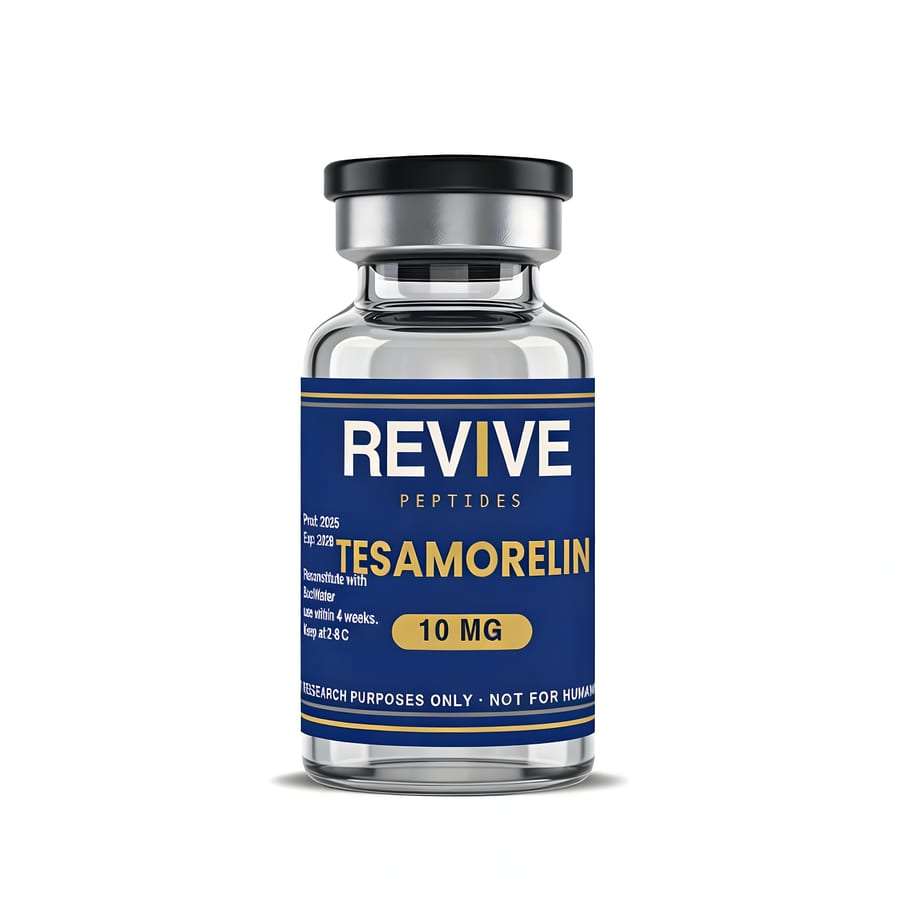
Tesamorelin 5mg & 10mg — In Stock at REVIVE LAB UAE
Same-day dispatch across Dubai. 24h delivery to Abu Dhabi, Sharjah & UAE-wide. Discreet packaging. Cash on delivery Dubai. Research use only.
Buy Tesamorelin UAE — Same-Day Dubai Dispatch from REVIVE LAB UAEResearch Protocol Parameters: Dose Ranges, Timing, and Duration Observed in the Literature
For UAE researchers designing post-sleeve GHRH analog protocols, the published studies provide a clear framework for parameter selection. Both the Falutz 2007 and Stanley 2014 trials used 2mg daily as the primary research dose, with the full protocol administered in a fasted or minimally-fed state to align with endogenous GH pulsatility timing.
Timing is a meaningful variable in GHRH analog research and warrants careful consideration in protocol design. The endogenous GH pulse in healthy subjects occurs predominantly in the first few hours of sleep onset. Research models that time GHRH analog administration in the late evening — approximately 60–90 minutes before expected sleep — aim to amplify this natural pulse rather than introduce an additive stimulation at a metabolically divergent time. Some published protocols have used morning administration, accepting that this will produce a GH release that is more independent of the sleep-associated pulse. Both approaches appear in the literature; researchers should pre-specify their timing rationale given the mechanistic implications.
Duration in the primary literature runs from 26 to 52 weeks for outcome-significant observations. VAT changes measured by cross-sectional imaging (CT or MRI at the L4-L5 level) in the Falutz and Stanley trials began showing statistical significance at the 26-week mark, with effect size continuing to increase through 52 weeks. For UAE-based lab researchers designing shorter proof-of-concept protocols, this suggests that interim outcome assessment at 12 weeks may capture early directional signals, but researchers should plan primary endpoints at 26+ weeks if replicating the published VAT-reduction methodology.
Observed GHRH Analog Research Parameters from Published Literature
- Administration timing: Evening (pre-sleep) or morning — pre-specify by protocol rationale
- Primary outcome window: 26–52 weeks for VAT-specific imaging endpoints
- Fasted state: Administration in a fasted or low-carbohydrate-fed state reduces insulin interference with GH pulse amplitude
- Primary outcome measure: Visceral adipose tissue area (cm²) by cross-sectional imaging at standardised lumbar level
- Secondary measures in literature: Trunk fat by DXA, fasting triglycerides, IGF-1 as pharmacodynamic marker
One design consideration specific to post-sleeve models that is absent from the original lipodystrophy literature: ghrelin baseline will be significantly lower in post-gastrectomy research subjects, altering the endogenous GH environment into which tesamorelin is introduced. Researchers should baseline IGF-1 and GH pulsatility measurements before intervention onset to characterise the starting hormonal state — this will be an important covariate in any post-sleeve protocol that aims to be mechanistically rigorous.
Vial Specifications, Reconstitution, and UAE Climate Handling
REVIVE LAB UAE currently stocks tesamorelin in two formats: 5mg lyophilised vials and 10mg lyophilised vials. Both are presented as white to off-white lyophilised powder in sealed, multi-dose glass vials with flip-top closures. For researchers in Dubai or Abu Dhabi deciding between formats, the choice primarily comes down to protocol length and reconstitution frequency preferences.
| Format | Optimal Use Case | Reconstituted Stability | Notes |
|---|
UAE researchers face a handling challenge that their counterparts in Northern European labs do not: ambient temperature. In Dubai and Abu Dhabi during summer months, ambient temperatures in labs without continuous climate control can exceed 35°C. Lyophilised tesamorelin vials should be stored refrigerated at 2–8°C before reconstitution; this is non-negotiable in the Gulf climate. Post-reconstitution, the same 2–8°C requirement applies, and researchers should avoid freeze-thaw cycling, which degrades the peptide's structural integrity. Labs in Business Bay, JBR, and Marina that operate in fully air-conditioned environments present no unusual challenges, but any fieldwork or off-site storage protocols need to account for thermal excursion risk.
Reconstitution is performed with bacteriostatic water (0.9% benzyl alcohol in sterile water for injection). The addition of bacteriostatic water rather than plain sterile water extends the usable post-reconstitution window by inhibiting microbial growth. Researchers should inject the diluent slowly along the side of the vial wall and gently swirl rather than shake — tesamorelin, like most lyophilised peptides, is susceptible to mechanical disruption of secondary structure under vigorous agitation. Visual inspection should confirm a clear, colourless solution before use; any particulate matter or discolouration is grounds for vial rejection.
Synergistic Research Peptide Combinations in Post-Bariatric Models
Post-sleeve research models typically involve a metabolically complex subject profile: altered ghrelin axis, potential nutrient malabsorption, modified gut hormonal signalling, and a body composition that is in dynamic flux. This complexity makes the post-bariatric model genuinely interesting for multi-peptide research, though it also demands careful protocol design to maintain mechanistic clarity about which intervention is driving which observed change.
In the broader UAE peptides research community, tesamorelin is most commonly combined in protocols alongside peptides that address complementary research questions. GHK-Cu (copper peptide) has attracted research interest for its tissue-remodelling signalling properties — Pickart (2018, Cosmetics) characterised GHK-Cu's receptor activity across tissue remodelling contexts. Since post-bariatric subjects can show significant skin laxity after rapid weight change, researchers interested in studying cutaneous tissue adaptation alongside visceral fat changes have rationale for including GHK-Cu in companion protocols, though the two should be administered via separate routes and tracked as distinct variables.
Some UAE labs have also built post-bariatric models that include BPC-157, given its research profile in gut mucosal integrity — relevant to the altered intestinal environment post-sleeve (Sikiric et al., 2018). The mechanistic rationale for BPC-157 in post-bariatric research is distinct from tesamorelin's VAT focus, so combined protocols should pre-register independent primary outcomes for each compound to avoid attribution ambiguity in results interpretation. As a practical matter, researchers in Sharjah and Abu Dhabi designing these multi-peptide protocols should sequence their procurement carefully: REVIVE LAB UAE stocks all three compounds and offers bundled ordering with UAE-wide 24h delivery.
Ordering Tesamorelin in UAE — What Researchers in Dubai, Abu Dhabi, and Sharjah Need to Know
For researchers based anywhere in the UAE who want to order tesamorelin online, REVIVE LAB UAE is the only local supplier with confirmed in-stock availability, same-day dispatch capability, and UAE-compliant discreet packaging. The alternative — sourcing from European or North American suppliers — introduces 7–14 day shipping windows, cold-chain uncertainty across multiple transit legs, and customs declaration complexity that adds meaningful friction to research timelines.
REVIVE LAB UAE operates a Dubai-based fulfilment operation with the following delivery parameters:
- Same-day delivery Dubai: Orders placed before 4 PM reach central Dubai locations — Business Bay, DIFC, Dubai Marina, JBR, Downtown, Palm Jumeirah, Al Quoz — same day. Discreet packaging is standard.
- 24h delivery UAE-wide: Abu Dhabi, Sharjah, Ajman, Ras Al Khaimah, and Fujairah all reached within 24 hours on orders placed before 4 PM.
- Cash on delivery Dubai: Available for researchers who prefer not to pay in advance. No pre-payment required for Dubai COD orders.
- Binance Pay (USDT TRC20): A 5% pre-pay discount applies to all orders settled via Binance Pay. WhatsApp confirmation of transaction ID completes the order. Strongly preferred for larger multi-vial orders.
- Discreet packaging UAE: All orders ship in plain, unmarked outer packaging with no reference to peptides, pharmaceuticals, or REVIVE LAB UAE branding on the exterior. Inner cold-pack maintains vial temperature integrity during transit.
Researchers in DXB area labs — particularly those operating out of Dubai Science Park, Dubai Healthcare City, or the free-zone research clusters in Jebel Ali — should note that REVIVE LAB UAE's same-day delivery window covers all these locations. For researchers comparing tesamorelin suppliers across UAE, the combination of in-stock availability, UAE same-day delivery, discreet packaging, and cash on delivery Dubai makes REVIVE LAB UAE the operationally lowest-friction choice for uninterrupted research supply chains.
Order Tesamorelin UAE — 5mg & 10mg Vials In Stock
Same-day delivery Dubai · 24h Abu Dhabi & Sharjah · COD available · USDT 5% discount · Discreet packaging guaranteed
Order Tesamorelin Dubai — REVIVE LAB UAEFAQ
Can I order tesamorelin with same-day delivery in Dubai?
Yes. REVIVE LAB UAE offers same-day dispatch for orders placed before 4 PM across central Dubai — including Business Bay, DIFC, JBR, Dubai Marina, and Downtown. 24h delivery covers Abu Dhabi, Sharjah, and the wider UAE. All orders ship in discreet, temperature-controlled packaging. Cash on delivery is available in Dubai. Research use only — not for human consumption.
What vial sizes does REVIVE LAB UAE stock for tesamorelin?
REVIVE LAB UAE currently stocks tesamorelin in 5mg and 10mg lyophilised vials. Both formats are appropriate for lab reconstitution and research-protocol use. The 10mg vial suits longer research windows where multiple reconstitutions are planned; the 5mg vial offers flexibility for pilot protocols or lower-range GHRH analog research windows. Research use only — not for human consumption.
Does REVIVE LAB UAE ship tesamorelin to Abu Dhabi and Sharjah?
Yes. REVIVE LAB UAE ships tesamorelin UAE-wide with 24h delivery to Abu Dhabi, Sharjah, Ajman, Ras Al Khaimah, and Fujairah. Researchers based outside Dubai should place orders before 4 PM for next-day guaranteed delivery. Discreet packaging is standard on every order, and Binance Pay USDT orders receive a 5% pre-pay discount.
- Falutz J, Allas S, Blot K, et al. Metabolic effects of a growth hormone-releasing factor in patients with HIV. N Engl J Med. 2007;357(23):2359–2370.
- Falutz J, Mamputu JC, Potvin D, et al. Effects of tesamorelin (TH9507), a growth hormone-releasing factor analogue, in HIV-infected patients with excess abdominal fat: a pooled analysis of two multicenter, double-blind placebo-controlled phase 3 trials with safety extension data. N Engl J Med. 2010;362(6):504–515.
- Stanley TL, Falutz J, Mamputu JC, et al. Effects of tesamorelin on non-alcoholic fatty liver disease in HIV: a randomised, double-blind, multicentre trial. JAMA. 2014;312(4):380–389.
- Stanley TL, Fourman LT, Feldpausch MN, et al. Effects of tesamorelin on non-alcoholic steatohepatitis and liver fibrosis in HIV-infected adults. Lancet HIV. 2019;6(12):e821–e830.
- Sikiric P, Seiwerth S, Rucman R, et al. Brain-gut axis and pentadecapeptide BPC 157: theoretical and practical implications. Curr Neuropharmacol. 2016;14(8):857–865. [Sikiric et al. 2018 review for BPC-157 mechanistic context.]
- Pickart L, Vasquez-Soltero JM, Margolina A. GHK peptide as a natural modulator of multiple cellular pathways in skin regeneration. Cosmetics. 2018;5(2):29.
Ready to Source Tesamorelin for Your UAE Lab?
REVIVE LAB UAE stocks tesamorelin 5mg and 10mg vials with same-day delivery across Dubai and 24h delivery UAE-wide. Discreet packaging. Cash on delivery. USDT accepted. Research use only.
Buy Tesamorelin UAE — In Stock at REVIVE LAB UAE