Tesamorelin Anti-Aging Stack Research in the UAE: IGF-1 Upregulation, Visceral Fat Reduction, and the Longevity Context (Dubai 2026)
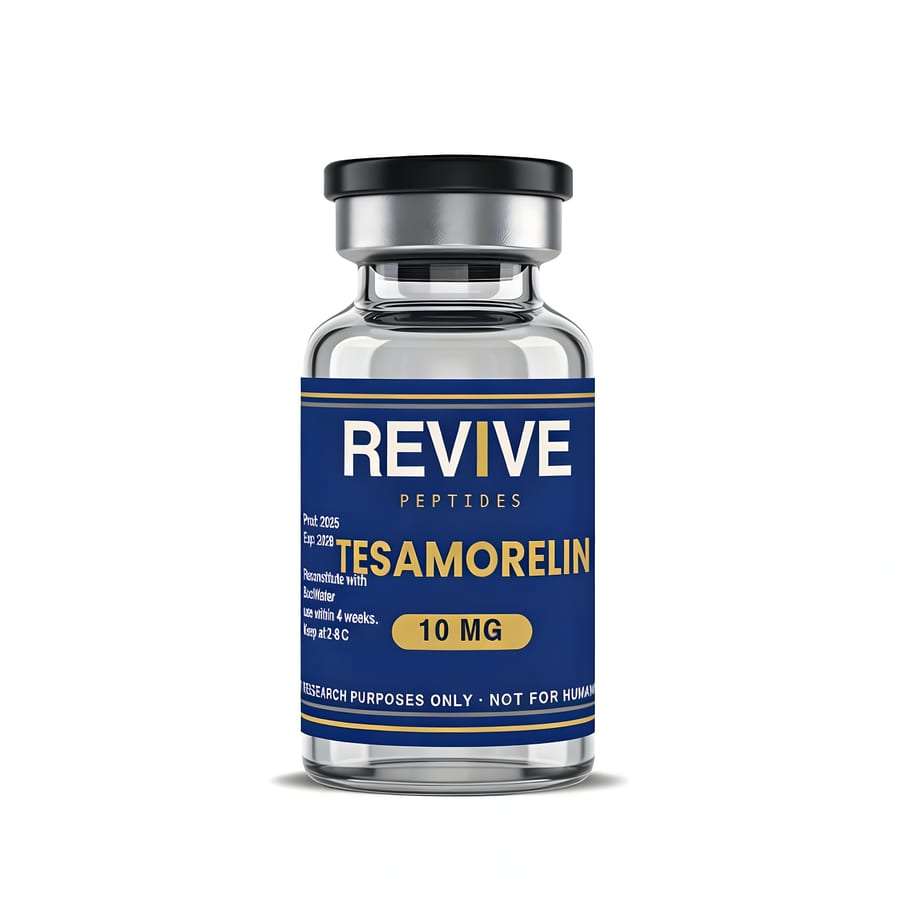
The longevity-research community in the UAE has matured rapidly. Investigators in Dubai, Abu Dhabi, and Sharjah are moving beyond single-compound curiosity and into structured research stacks that target specific hallmarks of biological aging: declining GH/IGF-1 output, accumulating visceral fat, hepatic lipid accumulation, and systemic low-grade inflammation. Tesamorelin sits at the intersection of all four. It is not a growth hormone itself — it is a synthetic analog of endogenous growth-hormone-releasing hormone (GHRH 1-44) that restores the upstream pulsatile signal the pituitary uses to make GH. That distinction matters enormously for research design. REVIVE LAB UAE supplies HPLC-verified, lot-COA, cold-chain dispatched tesamorelin across all 7 emirates, and this post is the reference document UAE investigators have been asking for.
Somatopause and the GHRH Axis: Why This Matters for Longevity Research
GH secretion declines by approximately 14% per decade after the third decade of life — a trajectory the endocrinology literature calls somatopause. The downstream consequence is a parallel fall in IGF-1 (insulin-like growth factor 1), the hepatic-derived peptide that mediates many of GH's tissue-level effects: protein synthesis, lipolysis, cellular repair, and neurotrophin support. By the fifth decade, many individuals show IGF-1 levels in the lower quartile of the reference range even when no frank pituitary pathology exists.
The straightforward intervention — exogenous GH — bypasses the pituitary feedback entirely and produces non-physiological, non-pulsatile GH exposure. Investigators working in anti-aging and longevity research have increasingly shifted interest toward upstream GHRH stimulation precisely because it preserves the pulsatile architecture of GH release, keeps the hypothalamic-pituitary axis intact, and allows negative feedback to operate. Tesamorelin is the most clinically characterised GHRH analog in existence, with four major peer-reviewed publications backing its metabolic and IGF-1 effects.
What the Clinical Data Actually Shows: IGF-1, VAT, and Liver Fat
The pivotal evidence comes from two research groups whose combined publication record spans NEJM, JAMA, and The Lancet HIV — the three journals UAE investigators are most likely to cite when designing a research protocol.
Falutz et al. 2007 (NEJM) and 2010 Extension
The Falutz group enrolled 412 subjects in a randomised, double-blind, placebo-controlled trial of tesamorelin in HIV-associated lipodystrophy (Falutz et al., N Engl J Med, 2007). Critically, IGF-1 levels remained within the normal physiological range — an observation the authors specifically noted as differentiating tesamorelin from supraphysiologic GH exposure.
The 2010 extension (Falutz et al., J Clin Endocrinol Metab, 26-week continuation) confirmed that the VAT reduction and IGF-1 elevation were durable: investigators who maintained tesamorelin sustained the visceral fat deficit, while the placebo-switched group showed rapid VAT rebound — a rebound that has since been interpreted as evidence that tesamorelin's effects are active and ongoing rather than structural.
Stanley et al. 2014 (JAMA) and 2019 (Lancet HIV)
Stanley and colleagues at Massachusetts General Hospital extended the tesamorelin evidence base into non-alcoholic fatty liver disease (NAFLD) in an HIV cohort (Stanley et al., JAMA, 2014). At 12 weeks, tesamorelin reduced liver fat by 32% relative to placebo as measured by MRS (magnetic resonance spectroscopy). The 2019 Lancet HIV paper extended follow-up to 12 months and confirmed the liver-fat benefit was sustained, with secondary signals on hepatic fibrosis markers that are now part of ongoing non-HIV longevity research inquiries.
| Study | Journal / Year | N | Key Outcome |
|---|---|---|---|
| Falutz et al. | NEJM 2007 | 412 | VAT −15-18%; IGF-1 +~50% (within normal range) |
| Falutz et al. | J Clin Endocrinol Metab 2010 | Extension | VAT reduction durable; rapid rebound on discontinuation |
| Stanley et al. | JAMA 2014 | RCT | Liver fat −32% vs placebo at 12 weeks (MRS) |
| Stanley et al. | Lancet HIV 2019 | 12-month RCT | Liver fat reduction sustained; fibrosis marker signals |
For UAE investigators designing longevity-focused research protocols, the combined read is this: tesamorelin produces a physiological IGF-1 elevation, simultaneously reduces two of the most mechanistically relevant aging biomarkers (visceral adiposity and hepatic lipid accumulation), and does so through a mechanism that does not suppress endogenous GHRH signalling the way exogenous GH would. That is a narrow but defensible research rationale.
Tesamorelin in a Longevity Research Stack: Where GHK-Cu Fits
The anti-aging stack most commonly assembled by UAE research investigators pairs tesamorelin with at least one complementary peptide targeting a distinct pathway. The most frequently cited companion is GHK-Cu (copper glycine-histidine-lysine tripeptide) — a naturally occurring plasma peptide that falls sharply with age and has been studied for its roles in extracellular matrix remodelling, antioxidant gene upregulation (via Nrf2), and wound-healing signalling.
The mechanistic rationale for stacking tesamorelin with GHK-Cu is non-overlapping pathway coverage:
- Tesamorelin addresses the upstream GH/IGF-1 axis (somatopause), visceral adiposity, and hepatic lipid metabolism — primarily through the liver, adipose tissue, and the GH-responsive tissue compartment.
- GHK-Cu addresses the extracellular matrix compartment, tissue-repair signalling, and oxidative-stress gene expression — pathways that the IGF-1 axis does not directly govern.
Investigators interested in a more comprehensive metabolic longevity protocol have also placed tesamorelin alongside compounds targeting the GIP/GLP-1/glucagon triagonist axis, though that stack represents a different research question and a separate compound class. For the purposes of this document, the REVIVE LAB UAE research-use focus is on tesamorelin as the GHRH-axis anchor of an anti-aging stack.
Buy Tesamorelin UAE — Order Now →
Monitoring the Longevity Stack: Key Research Biomarkers
Tesamorelin's primary research biomarker is serum IGF-1. In the Falutz 2007 trial, IGF-1 was the headline secondary endpoint and increased approximately 50% from baseline — rising into, but not beyond, the upper-normal physiological range. For longevity-focused research protocols, IGF-1 measured at baseline and at 4, 8, and 12 weeks is the standard tracking cadence used in the published literature.
Secondary biomarkers tracked across the Stanley and Falutz datasets include:
- Visceral adipose tissue (VAT) — CT or MRI cross-section is the gold-standard measurement; waist circumference is the accessible proxy used in some satellite analyses.
- Fasting glucose and insulin — tesamorelin's insulin-sensitising effect in the VAT compartment is a key metabolic anti-aging variable tracked in both the Falutz 2007 and Stanley 2014 populations.
- ALT, AST, liver fat fraction — the Stanley 2014 JAMA and 2019 Lancet HIV data make hepatic biomarkers a logical addition to any longevity stack protocol that includes tesamorelin.
- Fasting lipids (triglycerides, LDL-C) — VAT reduction is mechanistically linked to improved fasting triglyceride profiles; the Falutz datasets showed consistent signals in this direction.
Order Tesamorelin Dubai →
Why UAE Investigators Choose REVIVE LAB UAE for Tesamorelin
The peptides UAE supply landscape has fragmented quickly as demand has grown. Most overseas suppliers — regardless of what their websites claim — cannot guarantee cold-chain integrity through DXB customs and summer tarmac temperatures. REVIVE LAB UAE is a Dubai-based operation: vials are held locally, dispatched by refrigerated courier, and arrive at the investigator's lab or facility without a transcontinental temperature excursion in between.
Every tesamorelin batch supplied by REVIVE LAB UAE is:
- HPLC-tested to ≥99% purity — not self-reported, backed by third-party lot COA available on request.
- Lyophilized in mannitol-stabilized form — the same presentation used across the Falutz and Stanley trials.
- Cold-chain dispatched in validated insulated packaging holding 2-8°C through any UAE inter-emirate transit.
- Discreetly packaged in plain, unbranded outer cartons — default, not an upsell.
For researchers who prefer digital settlement, REVIVE LAB UAE now accepts USDT (TRC20) via Binance Pay with a 5% pre-pay discount applied at checkout — making it one of the few peptides UAE suppliers to offer verified USDT crypto pay Dubai. Cash on delivery remains available across all 7 emirates for investigators who prefer the traditional UAE payment model.
Delivery Across All 7 Emirates: Tesamorelin Dubai 24h Delivery
Researchers based anywhere in the UAE can order tesamorelin UAE with confidence. REVIVE LAB UAE operates same-day dispatch out of Dubai, covering the full emirate on most weekdays. For the six remaining emirates, the standard window is 18-24 hours from order confirmation.
| Emirate / Area | Delivery Window | Cash on Delivery | Cold-Chain |
|---|---|---|---|
| Dubai (Marina, JBR, Business Bay, DIFC, Downtown, Palm, JVC, Jumeirah) | Same-day, 4-8 hours | Yes | Yes |
| Abu Dhabi (Corniche, Yas, Saadiyat, Reem Island) | Next-day, 18-24 hours | Yes | Yes |
| Sharjah | Same-day / next-day, 8-18 hours | Yes | Yes |
| Ajman | Next-day, 18-24 hours | Yes | Yes |
| Ras Al Khaimah | Next-day, 18-24 hours | Yes | Yes |
| Fujairah | Next-day, 24 hours | Yes | Yes |
| Umm Al Quwain | Next-day, 18-24 hours | Yes | Yes |
A researcher in Business Bay or DIFC ordering tesamorelin same day Dubai before the afternoon cut-off typically receives cold-packed vials by early evening. The broader research community across Abu Dhabi, Sharjah, RAK, Fujairah, Ajman, and UAQ is served within the tesamorelin 24h delivery window. This is what a genuinely UAE-based peptides UAE supplier looks like in practice.
Buy Tesamorelin UAE — Order Now →
FAQ
Does REVIVE LAB UAE deliver tesamorelin same-day in Dubai and across all emirates?
Yes. REVIVE LAB UAE dispatches tesamorelin same-day in Dubai for orders placed before the daily cut-off, with refrigerated courier delivery to Dubai Marina, JBR, Business Bay, DIFC, JVC, Downtown, Palm Jumeirah, Jumeirah, Emirates Hills, and surrounding areas typically within 4-8 hours. Abu Dhabi, Sharjah, Ajman, Ras Al Khaimah, Fujairah, and Umm Al Quwain are covered within 18-24 hours. All shipments use validated cold-chain insulated packaging and plain, unbranded outer cartons. Cash on delivery Dubai and across all 7 emirates is the default payment option.
What payment methods does REVIVE LAB UAE accept for tesamorelin orders in the UAE?
REVIVE LAB UAE accepts cash on delivery across all 7 UAE emirates — no upfront payment is required for local orders. For researchers who prefer fully digital settlement, USDT (TRC20) via Binance Pay is accepted with a 5% pre-pay discount, confirmed by WhatsApp transaction ID. Both payment routes come with the same HPLC-verified, lot-COA tesamorelin 5 mg and 10 mg vials dispatched same-day from Dubai in cold-chain packaging.
- Falutz J, Allas S, Blot K, et al. Metabolic effects of a growth hormone-releasing factor in patients with HIV. N Engl J Med. 2007;357(23):2359-2370.
- Falutz J, Mamputu JC, Potvin D, et al. Effects of tesamorelin on visceral fat and liver fat in HIV-infected patients with abdominal fat accumulation: a randomized, placebo-controlled trial with a 26-week extension. J Clin Endocrinol Metab. 2010;95(9):4291-4304.
- Stanley TL, Feldpausch MN, Oh J, et al. Effect of tesamorelin on visceral fat and liver fat in HIV-infected patients with abdominal fat accumulation. JAMA. 2014;312(4):380-389.
- Stanley TL, Fourman LT, Feldpausch MN, et al. Effects of tesamorelin on non-alcoholic fatty liver disease in HIV: a randomised, double-blind, multicentre trial. Lancet HIV. 2019;6(12):e821-e830.