Tesamorelin Apartment Fridge Storage in Dubai — The Complete Marina, JLT & JVC Researcher's Guide
Why Tesamorelin Cold Storage Is Non-Negotiable in UAE's Climate
Dubai in late June sits at a sustained 42–46°C ambient temperature. The concrete of Marina and JLT towers radiates heat well past midnight. Abu Dhabi, Sharjah, and Ajman are no cooler. For UAE-based researchers working with tesamorelin — a synthetic GHRH analog that has been studied extensively in peer-reviewed literature for its effects on visceral adipose tissue accumulation — the cold chain is not a formality. It is the single biggest variable between a research-viable compound and a degraded vial that produces meaningless results.
Tesamorelin is a 44-amino-acid peptide. Peptide bonds are hydrolytically sensitive: heat and aqueous environments together accelerate hydrolysis and aggregation in a predictable, fast, and irreversible way. The clinical research program on tesamorelin — built on landmark peer-reviewed work including Falutz et al. (2007) in the New England Journal of Medicine and Stanley et al. (2014) in JAMA — relied on rigorously maintained cold chains because potency loss between batch preparation and the point of use directly compromises research validity. UAE researchers running serious protocols are operating under the same constraint, but in an ambient environment that punishes any lapse in cold-chain discipline far harder than a temperature-controlled European or North American laboratory.
The good news: a standard UAE apartment fridge, used correctly, is completely adequate for tesamorelin storage. The problem is that most researchers in Marina towers, JLT clusters, and JVC mid-rises are not using their fridge correctly for research compounds. This guide provides the specific, opinionated guidance needed to fix that before your next order arrives.
The UAE Apartment Fridge Reality — Why Your Postcode Changes the Calculation
Marina, JLT, and JVC are three of Dubai's densest residential corridors. They share a common residential profile: a mix of furnished short-stay units, long-term professional rentals, and flat-shares, often in towers built between 2005 and 2018. The refrigerators found in these apartments vary enormously in quality, age, and calibration. Understanding the specific failure modes of UAE apartment fridges is the starting point for any serious researcher.
Four Common UAE Apartment Fridge Failure Modes
- Degraded door seals. The combination of high humidity and daily temperature cycling wears rubber door gaskets within 18–24 months in most UAE apartments. A compromised seal forces the compressor to cycle more aggressively, causing interior temperature to swing between 1°C and 11°C rather than holding a steady midpoint. Research vials in a fridge with a bad seal are experiencing repeated thermal stress even when the door is closed.
- Back-wall freezing. Many budget refrigerators common in JLT and JVC furnished units — Hisense, Toshiba, basic Samsung models from the 2015–2020 era — do not have frost-free fan circulation. The evaporator coil runs along the back wall, which can drop to -2°C or below, while the door shelf simultaneously sits at 10°C or warmer. A tesamorelin vial pressed against or near the back wall can freeze, and freeze-thaw cycling destroys peptide structural integrity in ways that are invisible to the eye but devastating to research outcomes.
- Compressor overload during peak hours. Between 1pm and 7pm in a UAE summer, when ambient temperatures peak and DEWA demand is highest, apartment fridge compressors in poorly insulated kitchen spaces run near-continuously. In kitchens that are not air-conditioned — common in smaller JVC and older JLT units — the fridge is fighting 38–40°C ambient air through the radiator coils at the back. During this window, door-adjacent temperatures can reach 12–14°C.
- Flat-share door-open frequency. In a JLT or Marina flat-share — extremely common among researchers and young professionals in Dubai — your fridge is accessed by multiple people throughout the day with no coordination. Every door-open event in summer introduces a thermal spike of 3–6°C inside the fridge for 2–5 minutes before recovery. Twenty or thirty uncoordinated door openings daily, stacked against a compressor already working hard, adds up to serious cumulative temperature stress for anything stored near the door or at the top of the fridge.
Researchers based in Business Bay, Palm Jumeirah, JBR, or DIFC tend to have newer builds with better appliances and more reliably air-conditioned kitchens — but even premium LG or Bosch fridge-freezers develop cold spots and hot zones when loaded and positioned incorrectly. The principles in this guide apply across all Dubai residential storage contexts, whether your research base is a studio in JVC or a penthouse on the Palm.
Tesamorelin Vial Formats — Research Storage Parameters
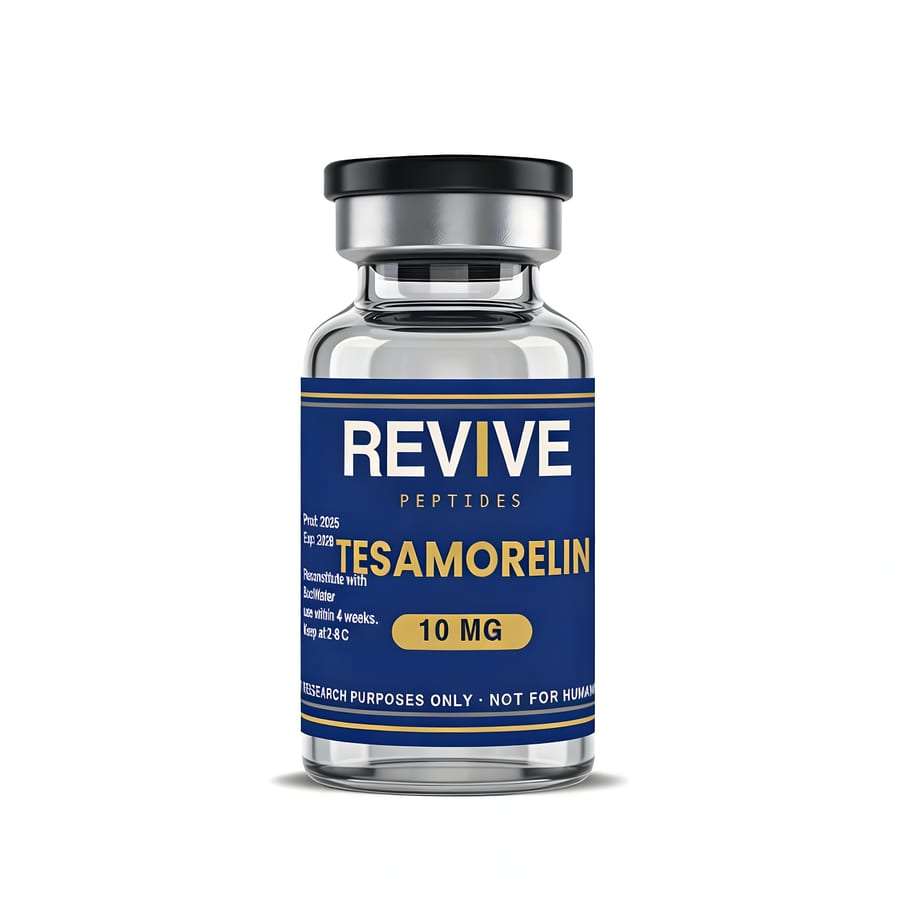
REVIVE LAB UAE supplies tesamorelin in two lyophilized vial formats for research procurement: 5mg and 10mg. Both are supplied as freeze-dried powder, sealed under controlled atmosphere to minimise oxidative degradation prior to reconstitution. Lyophilized peptides are substantially more stable than reconstituted solutions, but they are not shelf-stable at room temperature — and at UAE ambient temperatures, degradation is not a theoretical risk, it is an active process.
The peer-reviewed clinical work on tesamorelin consistently used refrigerated storage for both lyophilized stock and reconstituted compound throughout multi-site, long-duration research protocols. Stanley et al. (2019) in Lancet HIV and the continuation trial published by Falutz et al. (2010) in the New England Journal of Medicine both depended on cold-chain integrity at every site to produce reproducible results across extended research windows. This matters for UAE researchers because it establishes that the same attention to storage that underpinned major peer-reviewed outcomes is the appropriate standard, not an optional refinement.
| Vial Format | State | Research Storage Target | UAE Apartment Notes |
|---|---|---|---|
| 5mg lyophilized | Pre-reconstitution | 2–8°C, refrigerated, dark | Middle interior shelf, away from back wall and door |
| 10mg lyophilized | Pre-reconstitution | 2–8°C, refrigerated, dark | Same placement; larger vial mass does not change thermal sensitivity of the peptide itself |
| Either format, reconstituted | Post-reconstitution | 2–8°C, use promptly per protocol | Never freeze reconstituted solution; degradation rate increases significantly versus lyophilized state |
All storage parameters described here are for research-integrity purposes only. REVIVE LAB UAE supplies tesamorelin for laboratory research use exclusively. No human use is implied or endorsed.
Cold-packed, discreet, same-day dispatch from REVIVE LAB UAE across Dubai, Abu Dhabi & Sharjah. Cash on delivery Dubai available.
Buy Tesamorelin UAE — 24h Dubai Delivery from REVIVE LAB UAE
Setting Up Your UAE Apartment Fridge for Peptide Research Storage
Getting the fridge setup right before your order arrives costs less than AED 20 and fifteen minutes of attention. Researchers in Marina, JLT, and JVC who do this once report zero cold-chain concerns across months of continuous research supply management. Here is the exact protocol.
Step 1 — Verify Your Actual Fridge Temperature
Do not trust the dial setting. Fridge thermostats in UAE apartment units are notoriously miscalibrated, especially in units that have been rented by multiple tenants over several years. Buy a small digital thermometer with min/max memory logging — available for AED 15–35 at Carrefour Dubai, Ace Hardware, or via Amazon.ae with next-day delivery to Marina and JLT. Place it on the middle interior shelf and leave it for 24 hours without excessive door opening. Your target is a consistent 2–8°C band across the full 24-hour period, including peak afternoon hours. If the max reading exceeds 9–10°C, adjust the thermostat dial one step colder, wait 24 hours, and recheck. If the fridge is running warm despite dial adjustment, contact your building maintenance desk — in JLT and Marina towers, fridge maintenance is typically covered by building services contracts.
Step 2 — Map the Stable Cold Zone
Every fridge has an internal microclimate. In a standard UAE apartment unit the zones break down predictably:
- Door shelves: The warmest zone in any fridge. Door shelves sit 3–5°C warmer than the interior mid-shelf in normal use, and spike higher during busy door-open cycles. Never store tesamorelin or any research peptide here.
- Back wall (non-frost-free models): Can reach 0°C or below. Direct contact with vials risks freeze-thaw damage. Keep vials at least 3–5 cm away from the back wall surface.
- Middle interior shelf, centre: The best zone in most UAE apartment fridges. Buffered from both the door-open thermal influx and the back-wall freeze risk. Temperature here is the most stable across 24 hours.
- Crisper drawer: Usually 4–6°C but often carries high humidity from produce. Acceptable for peptide storage if the drawer is clean and dry, and if it holds temperature well in your specific unit — check with the thermometer first.
- Top shelf: In many UAE apartment fridges, warm air settles here due to poor internal air circulation. Avoid unless your thermometer confirms it holds 2–8°C.
Step 3 — Create a Dedicated Research Storage Zone
Clear a 20x20cm section of the middle shelf and place a small labelled container — a clean Tupperware or glass jar with a lid works perfectly — to isolate your research vials from food items. This serves two purposes simultaneously: it protects vials from accidental physical disturbance (critical in a flat-share where other people access the fridge), and the container's thermal mass buffers temperature fluctuations during door-open cycles. A small labelled box also makes clear to flatmates that the contents are research materials not to be moved.
Researchers in JVC and JLT flat-share arrangements may want to consider a small padlock on the container. This is not paranoia — it is basic research-integrity hygiene that prevents accidental disturbance and eliminates ambiguity about who has accessed the vials.
Step 4 — Manage Door-Open Frequency
This is the step that most researchers overlook, and in a UAE summer it is the one that matters most. Every fridge door opening during midday hours introduces a thermal event: warm, humid Dubai air rushes into the fridge cavity, temperature spikes 3–6°C for 2–5 minutes, and the compressor has to work against the ambient heat to recover. In a busy household opening the fridge 25–35 times per day, your research vials experience dozens of these events. The cumulative stress over weeks of storage is meaningful. Habit change: plan fridge access in batches. Retrieve everything you need for the next few hours in a single opening. In flat-shares, a brief conversation with flatmates about fridge access habits during peak afternoon hours pays real research-quality dividends.
Power Interruptions and Delivery Windows — The Two Edge Cases That Ruin Cold Chains
DEWA's grid reliability in Dubai is genuinely excellent by any global benchmark. Sustained power outages are rare, and most UAE researchers will never experience a multi-hour blackout. However, brief interruptions of 5–30 minutes do occur during peak summer demand on the Dubai grid, and in older JLT and JVC towers, internal building electrical faults occasionally cut fridge power for longer windows. Researchers in Sharjah and outer Abu Dhabi districts face somewhat higher exposure. Planning for these edge cases takes five minutes and completely eliminates the associated risk.
Power Cut Protocol for UAE Researchers
- A well-loaded, properly sealed fridge maintains its internal temperature for approximately 4 hours after power loss if the door remains closed. Research vials stored in a thermally buffered container on the middle shelf have a slightly extended stable window versus loose items near the door.
- Resist the instinct to open the fridge during a power cut to check on vials. Every unnecessary opening accelerates temperature rise. If DEWA shows a live outage on the app for your district and it is expected to resolve within 1–2 hours, simply leave the fridge closed.
- After power restoration, give the fridge 30–45 minutes to re-stabilise before opening. Check your digital thermometer's min/max readout to confirm the temperature stayed within acceptable range throughout the interruption.
- Keep one frozen gel pack in your freezer as standard practice. If a power interruption extends beyond 2 hours — possible in older JVC or Sharjah buildings with internal wiring issues — transfer research vials to an insulated cooler bag with the frozen gel pack immediately. A standard soft-sided cool bag rated for picnic use maintains 2–8°C for 6+ hours with a single 400g gel pack at Dubai ambient temperatures.
The Last-Mile Delivery Gap in Dubai
When you order tesamorelin for same-day delivery in Dubai, there is always a gap between the REVIVE LAB UAE dispatch point and the moment the vials reach your apartment fridge. REVIVE LAB UAE uses insulated cold packs rated for UAE summer transit to bridge this window — but the cold pack has a finite hold time, and the highest-risk event in the entire cold chain is what happens during and immediately after delivery.
The scenario to avoid: ordering tesamorelin with 24h delivery, missing the delivery window, and having the package sit outside an apartment door in a Marina or JLT corridor where summertime ambient temperatures in unconditioned hallways can exceed 38–40°C. Even with a quality insulated pack, a 2–3 hour window at that temperature in an exposed position can push interior temperature above acceptable limits. The fix is simple: choose a delivery slot when you or a trusted person will be at the residence, or instruct delivery to the building reception desk with explicit written instructions that the package contains cold-sensitive research materials and must be kept refrigerated. Most Marina and JLT residential towers have a small reception fridge for exactly this purpose — it is worth confirming with your building management in advance. JVC researchers should note that many JVC buildings operate without 24/7 staffed reception; selecting a delivery time when you are personally available is the reliable option.
Reconstituting Tesamorelin in a UAE Apartment — Practical Protocol
Reconstitution is a separate cold-chain event from ongoing storage, and it introduces unique risk factors in a UAE apartment environment. When a lyophilized tesamorelin vial is reconstituted for research purposes, the resulting solution is significantly more temperature-sensitive than the lyophilized powder form. This is not a minor distinction — it is a fundamental change in the compound's stability profile. The peer-reviewed research context supports this: both the Falutz et al. (2007) NEJM study and the Stanley et al. (2014) JAMA trial treated reconstituted solutions as time-sensitive materials requiring immediate refrigeration and use within defined research windows.
For UAE researchers, a few practical reconstitution principles make a real difference:
- Cool the workspace first. If your kitchen is not air-conditioned — which is common in smaller JLT, JVC, and older Marina units where the kitchen is a corridor or galley space — bring the vial into a cooled living area for reconstitution. Sitting a cold vial on a 36°C kitchen counter while you draw up reconstitution fluid warms the vial faster than you might expect, especially with a small 5mg vial volume.
- Swirl, never shake. Gentle rotation to dissolve the lyophilized cake is the correct technique. Vigorous shaking introduces agitation that can denature peptide structure regardless of temperature. This applies equally to 5mg and 10mg vials. The 10mg vial may take marginally longer to dissolve fully; give it time rather than force.
- Label with date and time immediately. After reconstitution, apply a small piece of labelling tape to the vial with the reconstitution date and time written clearly. In an active research environment — or in any flat-share in Dubai — unlabelled vials become a traceability problem quickly. The label costs nothing and eliminates ambiguity about when the reconstitution occurred relative to your protocol window.
- Return to the stable fridge zone without delay. After reconstitution steps are complete, return the vial to your dedicated middle-shelf research container immediately. Do not leave reconstituted peptide solution sitting on the kitchen counter between measurement steps. The counter in a UAE apartment kitchen during summer can easily be 30°C or above, even with ambient air conditioning running, because kitchen heat sources and wall radiance raise surface temperatures well above air temperature.
- Do not refreeze reconstituted solution. This is non-negotiable in terms of research integrity. Freeze-thaw cycling of a reconstituted peptide solution causes aggregation and activity loss. If your research protocol requires storage of reconstituted tesamorelin beyond a single session, follow established research-protocol storage guidance for reconstituted GHRH analogs rather than improvising.
Why UAE Researchers Should Source Tesamorelin Locally — The Cold-Chain Case
UAE-based researchers ordering tesamorelin from overseas suppliers face a landscape of cold-chain uncertainty that is rarely acknowledged in marketing materials but is fundamental to research validity. An overseas order typically involves international airfreight, UAE customs processing at DXB, domestic courier handoff, and residential delivery — a chain with multiple ambient-temperature exposure points over 5–14 days. REVIVE LAB UAE eliminates every overseas leg of that chain.
| Factor | Overseas Supplier | REVIVE LAB UAE |
|---|---|---|
| Delivery time to Dubai | 5–14 days, customs variable | Same day or next day, 24h dispatch from UAE |
| Cold-chain during transit | Not guaranteed; international ambient exposure | Insulated cold packs, UAE summer-rated, confirmed at dispatch |
| Stock confirmation | Website stock levels often lag reality | Tesamorelin in stock UAE confirmed before dispatch |
| Payment options | Card only; international transaction fees apply | Cash on delivery Dubai; Binance Pay USDT TRC20 with 5% prepay discount |
| Packaging | Standard international parcel with customs labels | Tesamorelin discreet packaging UAE, no product description on exterior |
| Delivery coverage | Any UAE address, international carrier | Dubai (same day), Abu Dhabi, Sharjah, Ajman, RAK — direct local courier |
| Issue resolution | International return and reship process | WhatsApp-direct, UAE-based resolution same day |
For researchers in Marina, JLT, JVC, Business Bay, or any other Dubai district who need tesamorelin in stock with reliable 24h delivery and a fully intact cold chain, the case for REVIVE LAB UAE is not primarily about convenience — it is about research-quality assurance. Peptides that spend 10 days in international transit, including customs holding facilities at DXB where temperature control is variable by warehouse zone, arrive in genuinely unknown condition. The clinical research literature on tesamorelin was built on controlled supply chains. Your UAE research protocol deserves the same standard.
Orders from REVIVE LAB UAE are dispatched in insulated, discreet packaging to all UAE addresses. Orders placed before 4 PM typically dispatch the same day. WhatsApp order confirmation, cash on delivery Dubai, and Binance Pay USDT TRC20 prepayment (5% discount) are all available. Delivery covers Dubai — including Marina, JLT, JVC, JBR, Business Bay, DIFC, Downtown, Palm Jumeirah, and DXB-adjacent areas — as well as Abu Dhabi, Sharjah, Ajman, and Ras Al Khaimah.
FAQ
Does REVIVE LAB UAE ship tesamorelin with cold packaging to Dubai Marina and JLT?
Yes. REVIVE LAB UAE ships all tesamorelin vials in insulated cold packs designed and rated for UAE summer conditions. Orders placed before 4 PM qualify for same-day dispatch to Marina, JLT, JVC, Business Bay, JBR, and most Dubai districts. For Abu Dhabi, Sharjah, and Ajman, contact REVIVE LAB UAE via WhatsApp to confirm the delivery schedule and cold-pack transit time for your specific location. All orders ship in discreet packaging with no product information on the exterior.
Where exactly should I store tesamorelin vials in my UAE apartment fridge?
For research integrity, tesamorelin vials should be stored on the interior middle shelf of your refrigerator — away from the door, which fluctuates significantly with every opening cycle, and away from the back wall, which can drop below 0°C in non-frost-free models commonly found in JLT and JVC furnished apartments. The target storage range for research-grade tesamorelin is a stable 2–8°C. Use a digital min/max thermometer to verify your specific fridge is achieving this consistently across 24 hours — including the peak afternoon window from 1pm to 7pm when UAE ambient temperatures and compressor load are both at their highest — before your first order arrives.
Can I order tesamorelin cash on delivery in Dubai or is prepayment required?
REVIVE LAB UAE offers cash on delivery for Dubai orders and prepayment via Binance Pay (USDT TRC20) with a 5% discount applied to prepaid orders. Delivery covers Dubai, Abu Dhabi, Sharjah, and surrounding emirates. All tesamorelin orders are dispatched in discreet packaging UAE with no product markings on the exterior. Contact REVIVE LAB UAE on WhatsApp to confirm your preferred payment method, delivery address, and required vial format — 5mg or 10mg — before placing your order.
- Falutz J, et al. Metabolic effects of a growth hormone-releasing factor in patients with HIV. N Engl J Med. 2007;357(23):2359–2370.
- Stanley TL, et al. Effects of tesamorelin on visceral fat and liver fat in HIV-infected patients with abdominal fat accumulation: a randomized clinical trial. JAMA. 2014;312(4):380–389.
- Stanley TL, et al. Long-term effects of tesamorelin on visceral fat and liver fat in HIV-infected patients with abdominal fat accumulation: a pooled analysis of two randomised trials. Lancet HIV. 2019;6(12):e821–e830.
- Falutz J, et al. Effects of tesamorelin (TH9507), a growth hormone-releasing factor analog, in HIV-infected patients with excess abdominal fat: a pooled analysis of two multicenter, double-blind placebo-controlled phase 3 trials with follow-up extension. N Engl J Med. 2010;362(10):895–905.
5mg & 10mg vials in stock. Same-day dispatch from REVIVE LAB UAE to Marina, JLT, JVC, Business Bay, Abu Dhabi & Sharjah. Cash on delivery Dubai available.
Buy Tesamorelin UAE — Order Now from REVIVE LAB UAE