Tesamorelin, Deep Sleep Architecture and IGF-1 Elevation: What Athletic Recovery Research Shows — and Where to Buy in the UAE
What Is Tesamorelin — and Why Athletic Recovery Researchers Are Watching It
Tesamorelin is a synthetic 44-amino-acid analog of human growth-hormone-releasing hormone (GHRH 1-44). Its defining structural modification — a trans-3-hexenoyl group on the N-terminus — shields the molecule from rapid cleavage by dipeptidyl peptidase-IV (DPP-IV), extending its biologically active window far beyond that of native GHRH. The downstream mechanism is direct: tesamorelin binds GHRH receptors on pituitary somatotroph cells, amplifying the amplitude and duration of the endogenous pulsatile GH signal. More GH pulses translates to higher integrated GH exposure and, from there, elevated hepatic and peripheral IGF-1 synthesis.
The pivotal human data originates outside the athletics world — specifically in HIV-associated lipodystrophy and NAFLD trials run by Falutz and Stanley and their collaborators — but the mechanistic read-through to recovery physiology is direct and has not been lost on investigators. Falutz et al. That IGF-1 number is the figure sports-science investigators cite first, because IGF-1 is the primary signalling molecule through which GH exerts its anabolic effects on skeletal muscle, connective tissue, satellite cells and bone matrix.
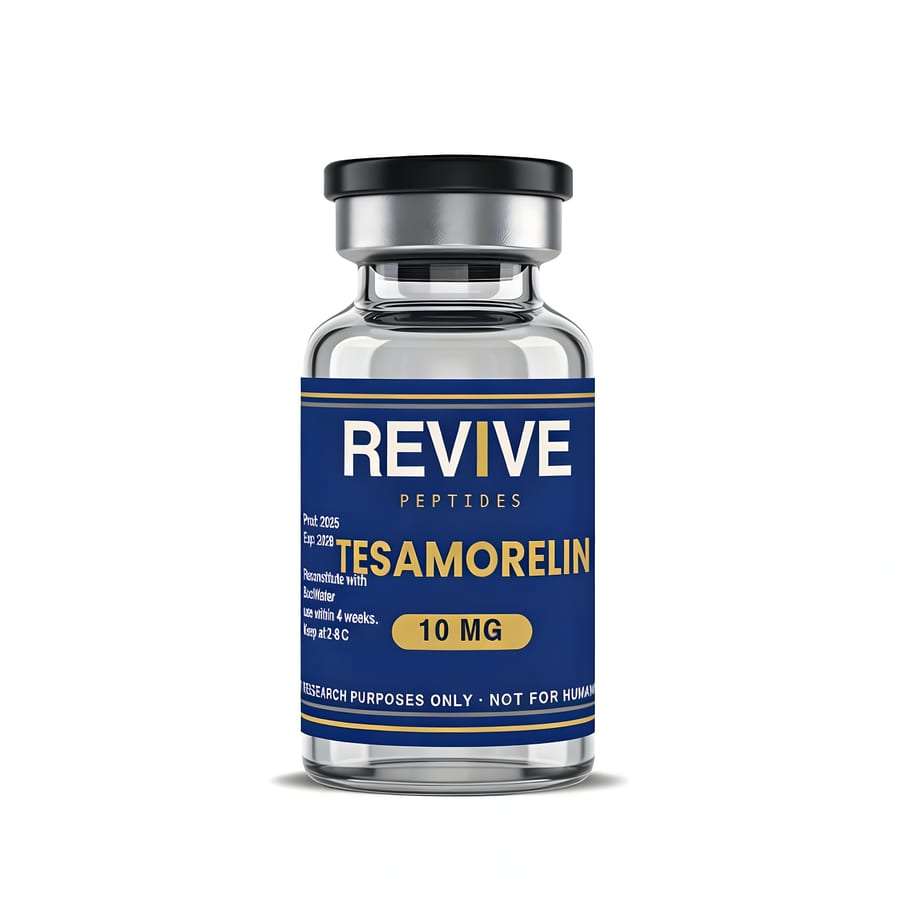
Nothing in this post constitutes medical advice or a therapeutic dosing recommendation. All references to investigator use of tesamorelin are in the context of legitimate research applications. For researchers in the UAE who need verified, cold-chain-dispatched supply, REVIVE LAB UAE supplies HPLC-verified, lot-COA, cold-chain dispatched tesamorelin across all 7 emirates — tesamorelin 5 mg and 10 mg vials, in stock now.
Buy Tesamorelin UAE — Order Now →
Deep Sleep Architecture and the GH Secretion Window
The connection between tesamorelin and athletic recovery research runs directly through sleep physiology. The majority of endogenous GH secretion — approximately 70–80% of the total nocturnal pulse in healthy adults — occurs during slow-wave sleep (SWS), specifically NREM stages 3 and 4. This is not incidental: the hypothalamic GHRH surge that triggers the first and largest nocturnal GH pulse aligns tightly with sleep-onset SWS entry, typically 60–90 minutes after lying down.
Age, caloric restriction, elevated cortisol and accumulated sleep debt all attenuate this signal. The result — a blunted nocturnal GH axis and the consequent IGF-1 deficit — is one mechanism proposed to explain the slowed recovery kinetics observed in over-trained athletes, veterans with high training loads, and individuals under significant life stress. Investigators asking whether GHRH-class peptides can restore or amplify the SWS-gated GH signal are working with this physiological rationale.
GHRH Analogs and Slow-Wave Sleep: The Research Angle
Neuroendocrinological research separate from the Falutz and Stanley lipodystrophy literature has examined GHRH-class peptides specifically for their interaction with sleep architecture. Studies by Born et al. and Kerkhofs et al. in sleep-laboratory conditions showed that exogenous GHRH administration increased SWS duration and GH pulse amplitude — an effect attributed to direct hypothalamic GHRH receptor activity influencing sleep-stage regulation. Tesamorelin, as a DPP-IV-stabilized GHRH analog with documented GH-pulsatility amplification, is mechanistically positioned to engage the same receptors. Investigators working in sleep-biology or athletic-recovery contexts will naturally assess whether the molecule's documented IGF-1-raising effect in the Falutz cohorts translates to relevant changes in sleep-stage GH kinetics.
IGF-1 as the Anabolic Recovery Mediator
IGF-1 is not merely a biomarker of GH activity — it is the primary effector molecule for GH's anabolic actions in peripheral tissue. The relevant actions for athletic recovery include:
- Skeletal muscle protein synthesis — IGF-1 activates the PI3K/Akt/mTOR pathway, the central regulator of muscle protein synthesis rates.
- Satellite cell activation — after eccentric-load-induced muscle damage (standard in resistance and endurance training), IGF-1 signals satellite cells to proliferate and fuse with damaged fibres.
- Collagen and tendon remodelling — IGF-1 receptor signalling in tenocytes and fibroblasts upregulates collagen type-I synthesis, relevant to connective-tissue repair after high training volumes.
- Bone matrix turnover — osteoblast differentiation and bone mineral apposition rates are partially GH/IGF-1 dependent.
A ~50% IGF-1 elevation — the figure from Falutz 2007 — represents a substantial endogenous upregulation of all of these pathways simultaneously. The mechanism does not require exogenous IGF-1; it simply augments the GHRH → GH → IGF-1 axis at its origin.
Order Tesamorelin UAE — Same-Day Dubai →
The IGF-1 Elevation in Context: What Falutz and Stanley's Data Mean for Investigators
The ~50% IGF-1 rise in Falutz 2007 deserves unpacking. The Falutz cohort was a lipodystrophy population — not healthy athletes — so IGF-1 baseline values were lower than in trained individuals. Investigators studying athletic recovery populations may therefore be working with a different starting IGF-1 level and should not assume an identical percentage change. What the Falutz data establishes is the mechanism: tesamorelin reliably recruits the endogenous GH → IGF-1 axis at scale over multi-month research windows, with an acceptable safety profile in human subjects and no evidence of desensitization over the observed study periods.
The Stanley 2014 JAMA paper adds another mechanistic dimension relevant to investigators focused on metabolic recovery. The 32% liver fat reduction vs placebo is a metabolic phenotype shift — hepatic lipid clearance improved in parallel with IGF-1 elevation. For athletic-recovery researchers, this raises the question of whether tesamorelin's metabolic effects (VAT reduction, liver fat reduction, IGF-1 elevation) converge on a composite recovery-state phenotype that goes beyond purely anabolic endpoints. This is an open investigational question; the published literature addresses lipodystrophy and NAFLD populations specifically.
Investigators who want to buy tesamorelin UAE for research and need verified purity documentation will find that REVIVE LAB UAE provides third-party HPLC results and lot-specific COAs as standard — the same documentation standard the Falutz and Stanley investigational teams operated under, adapted for the UAE research supply chain.
Why the Sleep Timing Hypothesis Matters for Recovery Research Design
If tesamorelin's core mechanism is amplification of the endogenous GHRH → GH pulse, and the dominant nocturnal GH pulse occurs in the SWS window 60–90 minutes after sleep onset, then the timing of administration becomes a variable of active investigational interest. The Falutz 2007 protocol used once-daily SC administration without specifying a tight sleep-anchored window. Investigators asking whether pre-sleep administration produces a meaningfully different IGF-1 or GH AUC profile compared to morning administration are operating on a legitimate mechanistic hypothesis — one that has not been specifically addressed in the published tesamorelin literature to date.
This gap is one reason REVIVE LAB UAE continues to see demand from researchers across Dubai Sports City, Al Quoz, DIFC and Abu Dhabi's athlete-services sector who are constructing tesamorelin protocols around sleep-timing hypotheses. The molecule is research-grade, the mechanism is well-characterised, and the UAE's research community has access to consistent, verified supply through a local source rather than offshore shipping with cold-chain uncertainty.
Where to Buy Tesamorelin UAE — REVIVE LAB UAE Supply Across All 7 Emirates
REVIVE LAB UAE is a Dubai-based peptides UAE research supplier — not a reseller, not an offshore drop-shipper, and not a label on someone else's vial. Every tesamorelin batch is HPLC-tested at ≥99% purity with lot-specific COA available on request, shipped in validated cold-chain insulation that maintains 2-8°C through any UAE summer transit. Tesamorelin 5 mg and 10 mg are in stock, dispatched same-day on weekdays with plain, unbranded outer packaging and cash on delivery available UAE-wide.
| Emirate / City | Delivery Window | Cash on Delivery | Cold-Chain Packaging |
|---|---|---|---|
| Dubai (Marina, JBR, Business Bay, JVC, DIFC, Downtown, Palm, Jumeirah, Sports City) | Same-day, 4–8 hours | Yes | Yes |
| Abu Dhabi (Corniche, Yas, Saadiyat, Reem, Khalidiyah) | Next-day, 18–24 hours | Yes | Yes |
| Sharjah | Same-day / next-day, 8–18 hours | Yes | Yes |
| Ajman | Next-day, 18–24 hours | Yes | Yes |
| Ras Al Khaimah (RAK) | Next-day, 18–24 hours | Yes | Yes |
| Fujairah | Next-day, 24 hours | Yes | Yes |
| Umm Al Quwain (UAQ) | Next-day, 18–24 hours | Yes | Yes |
| Al Ain | Next-day, 24 hours | Yes | Yes |
A researcher in Dubai ordering before the daily cut-off receives cold-pack tesamorelin vials the same day — whether in Dubai Marina, Business Bay, JVC, DIFC, Palm Jumeirah, Jumeirah, Downtown or Emirates Hills. Tesamorelin same day Dubai is the baseline, not a premium tier. For the broader peptides UAE research stack — Retatrutide, GHK-Cu, BPC-157, TB-500, Semax, NAD+, MOTS-c — see the full REVIVE LAB UAE catalogue.
Buy Tesamorelin UAE →
FAQ
What does the research say about tesamorelin and IGF-1 elevation in athletic recovery contexts?
Falutz et al. IGF-1 is the primary effector of GH's anabolic actions on skeletal muscle, satellite cells, connective tissue and bone. Investigators focused on athletic recovery hypothesize that amplifying the endogenous GHRH → GH → IGF-1 axis during the slow-wave sleep window — when 70–80% of nocturnal GH secretion occurs — could optimize repair kinetics. This remains an active investigational area; the Falutz and Stanley clinical trials were conducted in lipodystrophy and NAFLD populations, not athletic cohorts. All use references here are to research contexts only.
Can I buy tesamorelin in the UAE with same-day Dubai delivery and cash on delivery?
Yes. REVIVE LAB UAE offers tesamorelin same day Dubai delivery for weekday orders placed before the daily cut-off, and tesamorelin 24h delivery to Abu Dhabi, Sharjah, Ajman, RAK, Fujairah, UAQ and Al Ain. Cash on delivery is available across all 7 emirates. All shipments are cold-chain dispatched in plain, unbranded outer packaging from REVIVE LAB UAE's Dubai facility. Tesamorelin is supplied for research use only.
- Falutz J, Allas S, Blot K, et al. Metabolic effects of a growth hormone-releasing factor in patients with HIV. N Engl J Med. 2007;357(23):2359-2370.
- Falutz J, Mamputu JC, Potvin D, et al. Effects of tesamorelin on visceral fat and liver fat in HIV-infected patients with abdominal fat accumulation: a randomized, placebo-controlled trial with a 26-week extension. J Clin Endocrinol Metab. 2010;95(9):4291-4304.
- Stanley TL, Feldpausch MN, Oh J, et al. Effect of tesamorelin on visceral fat and liver fat in HIV-infected patients with abdominal fat accumulation. JAMA. 2014;312(4):380-389.
- Stanley TL, Fourman LT, Feldpausch MN, et al. Effects of tesamorelin on non-alcoholic fatty liver disease in HIV: a randomised, double-blind, multicentre trial. Lancet HIV. 2019;6(12):e821-e830.