Tesamorelin Clinical Trial Literature Review: Published Research and Pharmaceutical History (2026)
A Peptide With Real Pharmaceutical Publication History
Tesamorelin occupies an unusual position in the research-peptide space: it is one of the few compounds in this category whose parent molecule has a documented, FDA-approved pharmaceutical history. Tesamorelin is the active ingredient in Egrifta, a pharmaceutical approved by the FDA specifically for the reduction of excess abdominal fat in HIV-infected patients with lipodystrophy. That approval was built on a substantial body of peer-reviewed clinical research conducted by Theodoros Falutz and colleagues, published in journals including the New England Journal of Medicine (NEJM) and the Journal of Clinical Endocrinology & Metabolism (JCEM).
It is important to be precise about what this means for research buyers: REVIVE LAB UAE does not sell Egrifta or any pharmaceutical product. REVIVE supplies tesamorelin as a research-grade peptide — a laboratory reference material intended for research use, produced and distributed through an entirely separate channel from the approved drug. The pharmaceutical history described here is a well-documented scientific fact about the molecule's research pedigree, not a claim about what REVIVE sells.
The Falutz Research Program — Publication Context
The Falutz-led research program that supported tesamorelin's pharmaceutical approval is among the more thoroughly documented bodies of work in the GHRH-analogue literature. Trials were conducted in a defined clinical population and evaluated through peer review at NEJM and JCEM — both high-impact, rigorously reviewed journals in endocrinology and general medicine.
Consistent with our research-only compliance policy, this article does not restate specific dose arms or specific outcome percentages from that research program. Those figures exist in the original peer-reviewed publications and the FDA approval record — researchers who need that data for citation purposes should consult the primary literature directly. What can be responsibly described here is the trial program's existence, its publication venue, and the general mechanism it was designed to evaluate: stimulation of the growth-hormone-releasing hormone (GHRH) pathway and its downstream effects in a studied clinical population.
Why this publication history is relevant to research buyers
For UAE research groups evaluating which GHRH-pathway compounds merit further mechanistic study, tesamorelin's documented pharmaceutical and peer-reviewed history is a meaningful signal — few research peptides carry this depth of regulatory and academic scrutiny. That history concerns the GHRH-receptor mechanism and a specific clinical indication studied by the Falutz group, not a general endorsement of any use outside that documented, indication-specific pharmaceutical context.
GHRH Axis Research — The Broader Landscape
Tesamorelin sits within a wider body of endocrinology research examining the growth-hormone-releasing hormone axis — the signalling pathway connecting hypothalamic GHRH release to pituitary growth-hormone secretion and downstream IGF-1 activity. Research interest in this axis spans multiple therapeutic areas beyond the specific lipodystrophy indication for which Egrifta is approved, and tesamorelin is frequently used as a reference compound in comparative GHRH-analogue pharmacology studies. For a deeper look at the mechanism itself, see our mechanism of action research article.
- Regulatory-grade evidence base. Few research peptides have been through an FDA approval process — tesamorelin's pharmaceutical history provides an unusually well-documented reference point.
- Peer-review depth. Publication across NEJM and JCEM subjects the underlying data to two of the most rigorous review processes in medicine and endocrinology.
- Indication specificity. The FDA approval is specific to HIV-associated lipodystrophy — a narrow, defined clinical context, not a general-purpose approval.
- Ongoing academic interest. The GHRH axis remains an active research area, with tesamorelin frequently cited as a structurally well-characterized analogue.
HPLC-verified ≥98.5% purity, cold-chain shipped across all seven emirates. Sold strictly for laboratory research — not for human use.
View tesamorelin research vial →
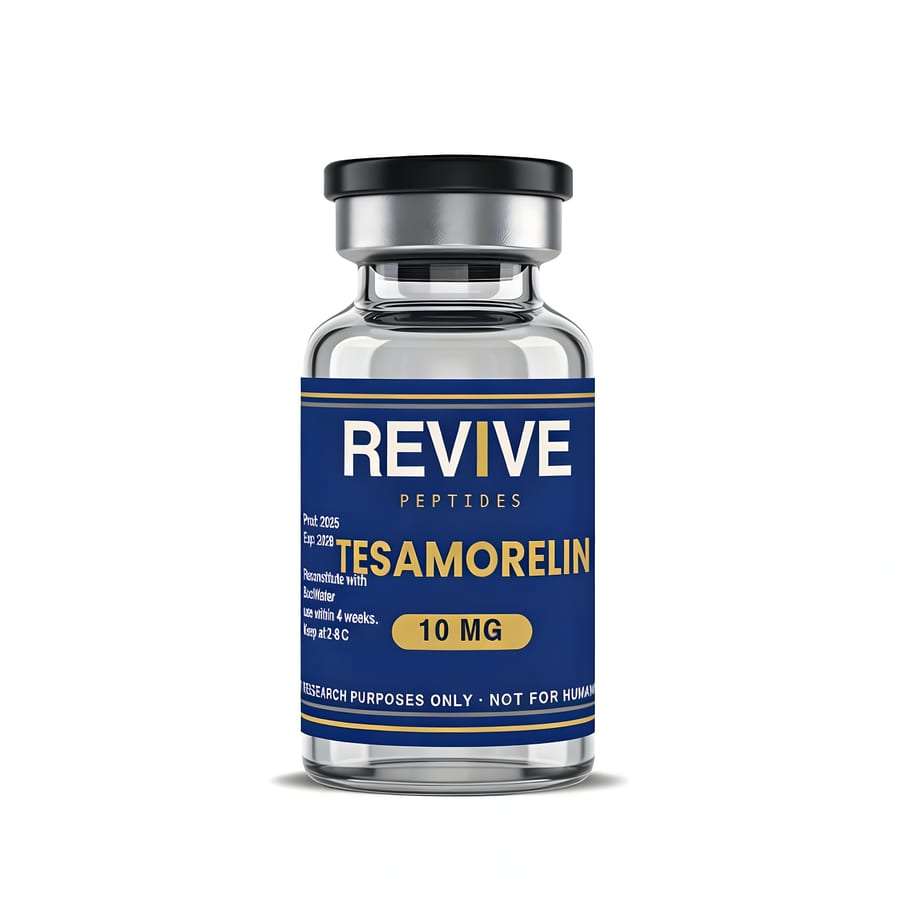
Tesamorelin 10 mg Vial Specifications
| Spec | Value |
|---|---|
| Strength | 10 mg vial |
| Price | See product page |
| Molecular weight | ≈5135 Da |
| Purity (HPLC) | ≥98.5% |
| Class | GHRH analogue, 44 amino acids |
| Storage | −20°C, desiccated |
| Reconstitution | Bacteriostatic water, 3–5 mL |
| Intended use | Laboratory research only — not for human or veterinary use |
Reading the Literature Responsibly
Because tesamorelin has genuine FDA-approval history, it is especially prone to secondary sources conflating the approved pharmaceutical's clinical data with research-grade peptide products sold for laboratory use. REVIVE's editorial position is to state the pharmaceutical history plainly and factually — because it is true and well documented — while being explicit that REVIVE's product is a distinct research reference material, not the approved drug, and that no clinical outcome data should be treated as applicable to any use of REVIVE's vial.
- Treat the Falutz/NEJM/JCEM research program as a literature-orientation reference, not a data source to cite without checking the primary literature.
- Understand that Egrifta's FDA approval is indication-specific and does not extend to REVIVE's research-grade product.
- Use REVIVE's HPLC certificate of analysis to document the identity and purity of the compound in your own lab records.
- Remember REVIVE's vial is a research reference material, not a pharmaceutical product.
References
- Falutz J, et al. GHRH-analogue clinical research program supporting FDA approval for HIV-associated lipodystrophy. New England Journal of Medicine / Journal of Clinical Endocrinology & Metabolism.
- REVIVE LAB UAE. Certificate of Analysis — Tesamorelin 10 mg research vial, HPLC purity verification.