Tesamorelin & the Cortisol Awakening Response: What the GH–Stress Axis Research Tells UAE Investigators (2026)
The morning cortisol spike is not random noise. The cortisol awakening response represents roughly 50-160% rise in serum cortisol within 20-45 minutes of waking — distinct from the broader diurnal cortisol slope — and functions as a neuroendocrine "boot sequence" that primes immune, metabolic, and cognitive systems for the day ahead. When that response is blunted, research literature consistently associates it with burnout, visceral adiposity, poor sleep architecture, and impaired GH pulsatility. The connection to tesamorelin is mechanistically direct: both GH and cortisol are secreted in ultradian pulses, both are regulated by hypothalamic releasing factors, and both are suppressed when the other runs chronically high.
For UAE-based research programs examining metabolic and neuroendocrine health in high-stress urban populations, this axis is increasingly relevant. Investigators who want to buy tesamorelin UAE for stress-axis research should understand what the existing clinical literature actually established — and what is still in the exploratory phase. This brief covers both, with precise reference to the four trials that anchor tesamorelin's evidence base.
What Is the Cortisol Awakening Response — and Why Does It Matter?
The CAR is a distinct neuroendocrine event governed by the hypothalamic-pituitary-adrenal (HPA) axis. On waking, the suprachiasmatic nucleus triggers a pulse of corticotropin-releasing hormone (CRH) from the hypothalamus, ACTH from the anterior pituitary, and a rapid cortisol surge from the adrenal cortex. The magnitude of this surge — measured as the area under the curve in the first 45 minutes post-waking — serves as a reliable biomarker of HPA reactivity.
Key research findings on CAR relevant to the GH-axis discussion:
- Blunted CAR is reproducibly associated with elevated visceral adipose tissue (VAT) — the same metabolic phenotype tesamorelin targets in the Falutz trials.
- Elevated basal cortisol suppresses hypothalamic GHRH release via negative feedback on somatostatin tone, reducing GH pulse amplitude and frequency.
- Sleep-stage disruption — a downstream consequence of HPA hyperactivation — directly reduces slow-wave sleep (SWS), which is when the largest nocturnal GH pulse occurs.
- IGF-1 is blunted in states of chronic stress-axis activation, reflecting downstream GH resistance at the hepatic level.
The implication for investigators: GH-axis insufficiency and HPA dysregulation are rarely independent variables. Researchers examining one without measuring the other are working with an incomplete picture of the neuroendocrine phenotype.
The GH–Cortisol Counter-Regulatory Relationship
Growth hormone and cortisol have a nuanced and bidirectional relationship that operates across multiple timescales. Understanding this is essential context for any tesamorelin stress-axis research protocol.
Short-Term: Acute Cortisol Stimulates GH
In the immediate stress response, cortisol and GH often co-secrete — acute psychological stressors reliably spike both hormones in parallel. This short-term co-activation appears adaptive: GH mobilizes free fatty acids and preserves lean tissue during acute energy demand, while cortisol elevates blood glucose and primes immune readiness.
Long-Term: Chronic Cortisol Suppresses GH Axis
The picture inverts when HPA activation becomes chronic. Persistently elevated glucocorticoids increase hypothalamic somatostatin tone — the main inhibitory input to GHRH pulsatility — and reduce pituitary sensitivity to GHRH. The result is blunted GH pulses, reduced IGF-1, and a metabolic shift toward visceral fat accumulation. This is precisely the phenotype characterized in the Falutz et al. 2007 NEJM lipodystrophy cohort: elevated VAT, suppressed GH secretion, and a metabolic profile driven by relative GH deficiency.
The Pulsatility Problem
Tesamorelin's key mechanistic advantage is that it restores pulsatile GH secretion rather than delivering exogenous GH continuously. Pulsatility matters: continuous GH exposure downregulates hepatic GH receptors, blunts IGF-1 production, and mimics the tonic-high-cortisol state that drives insulin resistance. GHRH analogs like tesamorelin work with the hypothalamic-pituitary pulse generator rather than overriding it — a functionally important distinction for researchers modeling the stress-axis interface.
| Hormone Axis | Governing Hypothalamic Factor | Peak Secretion Timing | Effect of Chronic Elevation on Counterpart |
|---|---|---|---|
| GH / IGF-1 | GHRH (stimulates), Somatostatin (inhibits) | Nightly SWS pulses, 23:00–02:00 | Cortisol chronically high → suppresses GHRH, raises somatostatin, blunts GH |
| Cortisol (CAR) | CRH → ACTH → Adrenal cortex | Post-waking CAR peak, 06:00–08:00 | IGF-1 chronically low → impairs HPA negative feedback → CAR dysregulated |
| Tesamorelin action | Synthetic GHRH analog (44-AA + hexenoyl) | Mimics endogenous GHRH pulse | Restores pulsatile GH; IGF-1 +50% (Falutz 2007); VAT −15-18% |
Buy Tesamorelin UAE — Order Now →
What the Clinical Trials Actually Established
The tesamorelin evidence base is unusually rigorous for a research peptide. Four well-designed trials anchor the GH-axis and metabolic effects:
Falutz et al. 2007 (NEJM) — The VAT Benchmark
VAT declined 15-18% in the treatment arm versus placebo gain. Serum IGF-1 rose approximately 50% — a reliable surrogate for GH-axis activation. The trial established that a GHRH analog can durably shift the GH/IGF-1 axis in adults with established GH-axis suppression, without the receptor downregulation seen with exogenous GH. The metabolic phenotype in this cohort — visceral adiposity, suppressed GH pulsatility, insulin resistance — shares overlapping features with the high-stress, high-cortisol metabolic profile investigators model in CAR research.
Falutz et al. 2010 (J Clin Endocrinol Metab) — 26-Week Extension
The 26-week extension confirmed that the VAT reductions seen at week 26 were maintained or extended at week 52 in continuers, while subjects who crossed over from placebo showed progressive VAT reduction. The sustained IGF-1 elevation without evidence of tachyphylaxis supports the pulsatile-GHRH mechanism — relevant for investigators modeling longer-duration GH-axis restoration in chronic-stress phenotypes.
Stanley et al. 2014 (JAMA) — Liver Fat and Metabolic Breadth
The primary finding: liver fat fell 32% relative to placebo over 12 months. Liver fat accumulation is itself a downstream consequence of chronic cortisol exposure and GH-axis suppression, reinforcing the mechanistic linkage investigators are exploring.
Stanley et al. 2019 (Lancet HIV) — 12-Month NAFLD Durability
The Lancet HIV trial extended the NAFLD observation to 12 months with rigorous MRI-PDFF liver fat quantification. Tesamorelin's liver-fat benefit was durable and progressive, with continued metabolic improvements throughout the study window. Critically, the investigators noted that GH-axis biomarkers (IGF-1) tracked with metabolic response — establishing IGF-1 as a practical monitoring biomarker for tesamorelin's GH-axis engagement, relevant to any protocol that uses cortisol/IGF-1 ratio as a stress-axis readout.
The Cortisol Awakening Response: What Investigators Are Exploring
The direct intersection of tesamorelin and the CAR remains an emerging research domain. No published RCT has yet tested tesamorelin as a primary intervention in non-HIV adults specifically selected for blunted CAR. However, the mechanistic hypothesis is grounded in the clinical evidence above:
- Hypothesis A (GH-axis restoration normalizes HPA tone): By elevating pulsatile GH and IGF-1, tesamorelin may reduce the somatostatin-mediated suppression of GHRH and improve hypothalamic sensitivity — indirectly supporting a more reactive, appropriately calibrated CAR.
- Hypothesis B (VAT reduction reduces cortisol output): Visceral adipose tissue is metabolically active and glucocorticoid-amplifying — adipose 11β-HSD1 regenerates active cortisol from cortisone locally. The 15-18% VAT reduction seen in the Falutz trials may therefore reduce the local cortisol amplification that blunts the CAR signal-to-noise ratio.
- Hypothesis C (IGF-1 as HPA modulator): IGF-1 has documented negative-feedback effects on HPA reactivity. The ~50% IGF-1 rise produced by tesamorelin in Falutz 2007 represents a substantial increase in the primary HPA-dampening signal — potentially relevant to CAR calibration in states of chronic HPA hyperactivation.
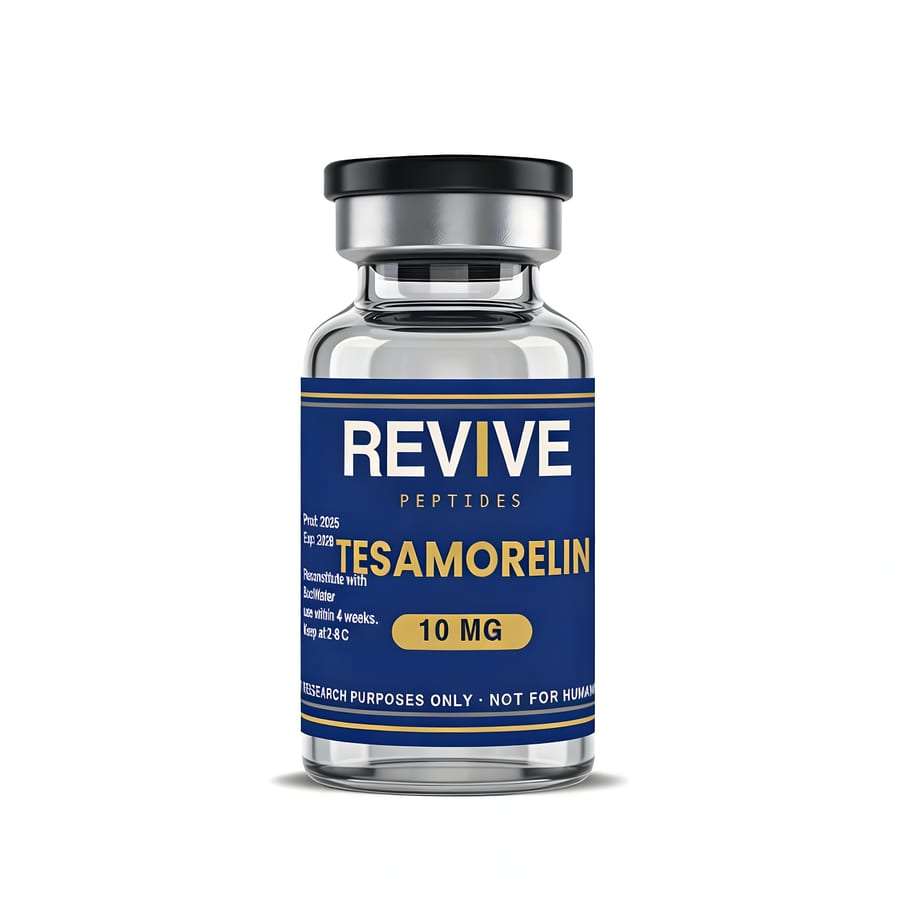
The tesamorelin UAE supply available from REVIVE LAB UAE — in 5mg and 10mg vials — maps directly onto these research-context dose ranges.
Relevant CAR Research Parameters to Co-Monitor
| Biomarker | Research Relevance | Timing |
|---|---|---|
| CAR (AUCi, salivary cortisol) | Primary HPA reactivity measure | Waking, +15, +30, +45 min |
| Serum IGF-1 | GH-axis activation surrogate; +50% in Falutz trials | Baseline, week 12, week 26 |
| Evening cortisol slope | Diurnal regulation; blunted slope = HPA dysfunction | 08:00, 12:00, 16:00, 20:00 |
| Visceral adipose tissue (MRI/CT) | VAT as cortisol amplifier and GH-axis suppressor | Baseline, week 26 (per Stanley 2014) |
| DHEA-S / Cortisol ratio | Adrenal reserve and resilience marker | Fasting morning |
| Sleep architecture (actigraphy) | SWS duration governs nocturnal GH pulse amplitude | Continuous 4-week epochs |
Order Tesamorelin Dubai →
Where to Buy Tesamorelin in the UAE — 24h Delivery Across All 7 Emirates
REVIVE LAB UAE is a Dubai-based peptides UAE supplier — not a grey-market reseller or offshore drop-shipper. Every tesamorelin batch is HPLC-tested to a minimum 99% purity with lot-COA available on request. Tesamorelin same day Dubai delivery applies to orders placed before the daily dispatch cut-off; researchers in Dubai Marina, JBR, Business Bay, DIFC, JVC, Palm Jumeirah, Downtown, Jumeirah and Emirates Hills are all within the same-day window. Tesamorelin Dubai 24h delivery covers all remaining emirates. Cash on delivery Dubai and across the wider UAE is standard, as is discreet, unbranded outer packaging.
| Location | Delivery Window | Cash on Delivery | Cold-Chain Packaging |
|---|---|---|---|
| Dubai (Marina, JBR, Business Bay, DIFC, JVC, Downtown, Palm, Jumeirah) | Same-day, 4-8 hours | Yes | Yes |
| Abu Dhabi (Corniche, Yas, Saadiyat, Reem) | Next-day, 18-24 hours | Yes | Yes |
| Sharjah | Same-day / next-day, 8-18 hours | Yes | Yes |
| Ajman | Next-day, 18-24 hours | Yes | Yes |
| Ras Al Khaimah (RAK) | Next-day, 18-24 hours | Yes | Yes |
| Fujairah | Next-day, 24 hours | Yes | Yes |
| Umm Al Quwain (UAQ) | Next-day, 18-24 hours | Yes | Yes |
| Al Ain | Next-day, 24 hours | Yes | Yes |
For researchers running multi-week tesamorelin CAR protocols — where consistent supply and lot-to-lot purity are non-negotiable — REVIVE LAB UAE's standing-order service means you are never mid-protocol with a supply gap. Tesamorelin in stock UAE is not a marketing claim; it is a courier cut-off time.
FAQ
Can I buy tesamorelin in the UAE for cortisol awakening response and stress-axis research?
Yes. REVIVE LAB UAE stocks HPLC-verified tesamorelin 5mg and 10mg vials with lot-COA documentation, dispatched cold-chain to all 7 emirates. Investigators researching the GH–HPA stress axis use tesamorelin as the reference GHRH analog based on the Falutz and Stanley clinical trial literature. Order via /buy-tesamorelin-uae/ with same-day Dubai delivery and cash on delivery UAE available.
Does REVIVE LAB UAE offer same-day tesamorelin delivery in Dubai with cash on delivery?
Yes. REVIVE LAB UAE offers tesamorelin same day Dubai delivery for orders placed before the daily dispatch cut-off, covering Dubai Marina, JBR, Business Bay, DIFC, JVC, Palm Jumeirah, Downtown, Jumeirah and Emirates Hills. Tesamorelin 24h delivery reaches Abu Dhabi, Sharjah, Ajman, RAK, Fujairah, UAQ and Al Ain. Cash on delivery Dubai and all seven emirates is standard. All shipments are plain outer packaging — discreet by default, not an upsell.
Buy Tesamorelin UAE — Order Now →
- Falutz J, Allas S, Blot K, et al. Metabolic effects of a growth hormone-releasing factor in patients with HIV. N Engl J Med. 2007;357(23):2359-2370.
- Falutz J, Mamputu JC, Potvin D, et al. Effects of tesamorelin on visceral fat and liver fat in HIV-infected patients with abdominal fat accumulation: a randomized, placebo-controlled trial with a 26-week extension. J Clin Endocrinol Metab. 2010;95(9):4291-4304.
- Stanley TL, Feldpausch MN, Oh J, et al. Effect of tesamorelin on visceral fat and liver fat in HIV-infected patients with abdominal fat accumulation. JAMA. 2014;312(4):380-389.
- Stanley TL, Fourman LT, Feldpausch MN, et al. Effects of tesamorelin on non-alcoholic fatty liver disease in HIV: a randomised, double-blind, multicentre trial. Lancet HIV. 2019;6(12):e821-e830.