Research Overview
What the Pivotal Trials Established — Evidence Overview
None of the four major tesamorelin trials published a head-to-head comparison of administration-site pharmacokinetics. REVIVE LAB UAE does not extrapolate administration or site-selection guidance from these trials — that determination belongs to the researcher's own institutional protocol. What the published record does provide is an evidence base for research outcomes:
| Trial | N | Duration | Primary Endpoint |
|---|---|---|---|
| Falutz et al. 2007 (NEJM) | 412 | 26 weeks | Visceral adipose tissue (VAT) reduction |
| Falutz et al. 2010 (extension) | Subset | +26 weeks | Sustained VAT reduction |
| Stanley et al. 2014 (JAMA) | 50 | 12 weeks | Liver fat fraction |
| Stanley et al. 2019 (Lancet HIV) | 61 | 12 months | NAFLD / liver fat endpoint |
The Stanley 2019 Lancet HIV extension is the longest published tesamorelin trial, running 12 months. The Falutz series established meaningful VAT change over a minimum 26-week observation window. REVIVE LAB UAE does not provide dosing calendars, titration schedules, or protocol-design guidance — research design and administration technique are matters for the researcher's own institutional review.
Buy Tesamorelin UAE — Order Now →
Reconstitution Protocol — Tesamorelin 5 mg and 10 mg Vials
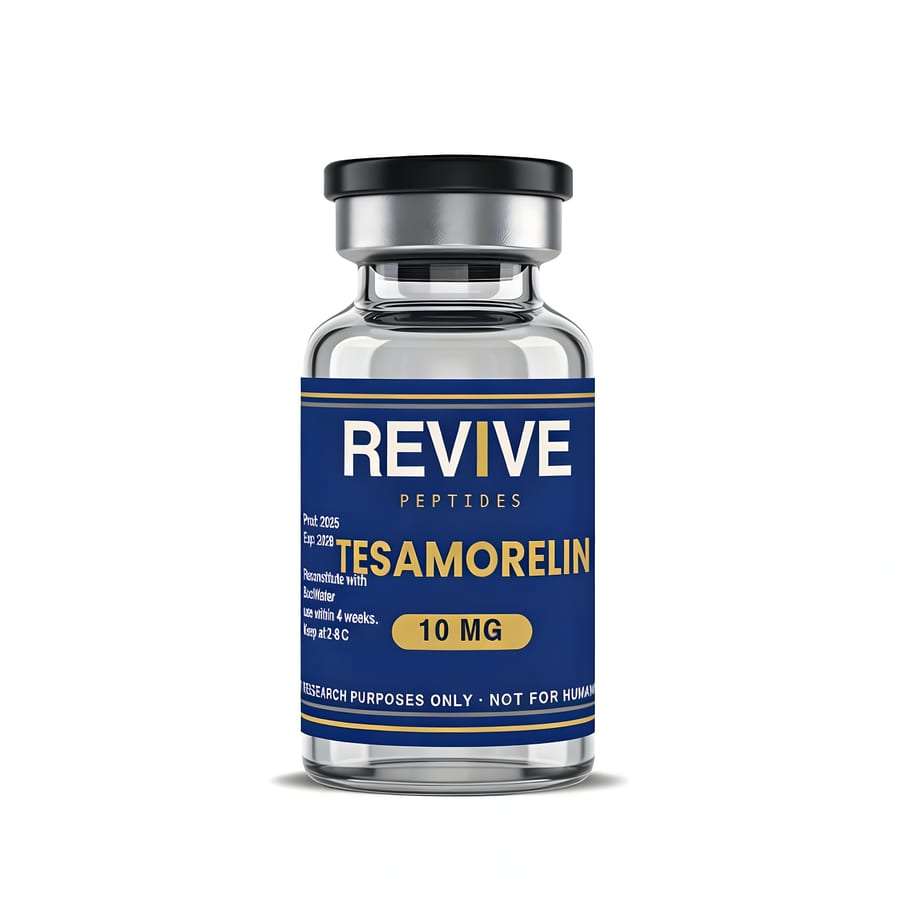
REVIVE LAB UAE supplies tesamorelin in two vial sizes that map cleanly to standard research-context dosing. Reconstitute with bacteriostatic water (BAC water), injecting diluent slowly down the glass wall of the vial — never directly onto the lyophilized cake, which can mechanically shear peptide secondary structure and reduce bioactivity. Swirl gently; do not vortex.
A REVIVE LAB UAE 10 mg vial reconstituted in 2 mL yields a 5 mg/mL concentration — straightforward reference math for research recordkeeping. REVIVE LAB UAE does not provide dosing schedules or per-dose draw-volume guidance; that determination is the researcher's own, made under their institutional protocol. Keep reconstituted vials refrigerated at 2–8°C and protected from light. Never freeze a reconstituted vial; ice crystal formation disrupts peptide tertiary structure irreversibly.
Administration & Site-Selection Guidance — Not Provided by REVIVE LAB UAE
REVIVE LAB UAE does not publish injection-site selection, rotation schedules, needle-gauge recommendations, or insertion technique for any compound. Site rotation across a research protocol is a widely referenced concept in peptide- and insulin-injection literature as a way to help reduce localized tissue change over time, but the specific site selection, rotation interval, and technique are entirely a matter for the researcher's own institutional protocol and appropriately licensed guidance.
Researchers designing an extended tesamorelin protocol should consult their own institutional review process for administration-technique decisions. REVIVE LAB UAE's role is limited to supplying HPLC-verified, cold-chain-documented research material — not administration guidance.
Order Now →
Tissue Integrity and Lipohypertrophy Prevention in Research Settings
Lipohypertrophy — localised accumulation of SC fat at chronically injected sites — is the most consistently documented site complication in extended peptide and insulin analog research protocols. In insulin research, investigators coined the term "lipohypertrophy-associated pharmacokinetic variability" (LAPV) to capture what happens to absorption when a single SC zone is overused: the architecture of the SC fat changes, vascularization shifts, and the depot kinetics diverge from the baseline characterization. For tesamorelin, which operates through a timed-release pulsatile mechanism upstream of GH, pharmacokinetic variability at the injection site translates directly into outcome noise.
The Falutz 2007 trial ran 26 weeks; the subsequent extension — Falutz 2010 — added another 26 weeks in the same cohort. Investigators using tesamorelin on comparable timelines in UAE research contexts are working in a space where administration technique and site rotation are matters for the researcher's own institutional protocol, not published guidance from REVIVE LAB UAE. That protocol design is the structural basis for tissue integrity across an extended protocol of the type Stanley et al. 2019 conducted in the Lancet HIV cohort.
Where to Buy Tesamorelin in UAE — REVIVE LAB UAE 24h Delivery
Investigators across Dubai, Abu Dhabi, Sharjah, and beyond can buy tesamorelin UAE directly from REVIVE LAB UAE — the peptides UAE supplier that maintains tesamorelin 5 mg and 10 mg in cold storage in Dubai and dispatches every order with validated cold-chain packaging. REVIVE LAB UAE supplies HPLC-verified, lot-COA, cold-chain dispatched tesamorelin across all 7 emirates — same-day in Dubai, next-day everywhere else. Cash on delivery is standard. Lot-specific HPLC purity documentation (target ≥99%) is available on request for every batch.
Grey-market tesamorelin supply in the Gulf frequently arrives without documented storage history — a critical failure point for a temperature-sensitive GHRH analog. A supplier who cannot provide a cold-chain custody record and a lot-specific COA is not a research-grade source, regardless of price. REVIVE LAB UAE was built specifically to close that gap for peptides UAE investigators.
| Emirate / City | Delivery Window | Cash on Delivery | Packaging |
|---|---|---|---|
| Dubai (Marina, JBR, Business Bay, JVC, DIFC, Downtown, Palm Jumeirah, Jumeirah, Emirates Hills) | Same-day, 4–8 hours | Yes | Discreet, unbranded |
| Abu Dhabi (Corniche, Yas, Saadiyat, Reem, Al Ain) | Next-day, 18–24 hours | Yes | Discreet, unbranded |
| Sharjah / Ajman | Same-day or next-day, 8–18 hours | Yes | Discreet, unbranded |
| Ras Al Khaimah / Fujairah / Umm Al Quwain | Next-day, 18–24 hours | Yes | Discreet, unbranded |
A Dubai Marina researcher who orders tesamorelin Dubai before 2 pm typically has cold-pack vials in hand by evening. For Abu Dhabi Corniche, Yas Island, and Saadiyat, orders placed the same day dispatch immediately and arrive by the following morning. Tesamorelin Dubai 24h delivery is not a marketing line — it is a function of REVIVE LAB UAE maintaining genuine in-emirate cold storage and a dedicated courier network, not relying on third-party freight.
Buy Tesamorelin UAE — Order Now →
FAQ
What tesamorelin vial sizes does REVIVE LAB UAE currently have in stock in the UAE?
REVIVE LAB UAE stocks tesamorelin 5 mg and 10 mg vials only — the two strengths validated across the Falutz 2007, Falutz 2010, Stanley 2014, and Stanley 2019 trial series. Both sizes are available for same-day dispatch in Dubai and 24-hour delivery across all UAE emirates. Lot-level COA and HPLC purity certificates are available on request for every batch.
Does REVIVE LAB UAE offer cash on delivery for tesamorelin in Dubai and Abu Dhabi?
Yes. REVIVE LAB UAE supports cash on delivery across all seven emirates: Dubai (same-day, 4–8 hours), Abu Dhabi (next-day, 18–24 hours), Sharjah, Ajman, Ras Al Khaimah, Fujairah, and Umm Al Quwain. All shipments default to plain, unbranded outer cartons — discreet packaging at no extra charge. Tesamorelin same day Dubai orders placed before the daily cut-off are dispatched on the same business day.
- Falutz J, Allas S, Blot K, et al. Metabolic effects of a growth hormone-releasing factor in patients with HIV. N Engl J Med. 2007;357(23):2359–2370.
- Falutz J, Mamputu JC, Potvin D, et al. Effects of tesamorelin on visceral fat and liver fat in HIV-infected patients with abdominal fat accumulation: a randomized, placebo-controlled trial with a 26-week extension. J Clin Endocrinol Metab. 2010;95(9):4291–4304.
- Stanley TL, Feldpausch MN, Oh J, et al. Effect of tesamorelin on visceral fat and liver fat in HIV-infected patients with abdominal fat accumulation. JAMA. 2014;312(4):380–389.
- Stanley TL, Fourman LT, Feldpausch MN, et al. Effects of tesamorelin on non-alcoholic fatty liver disease in HIV: a randomised, double-blind, multicentre trial. Lancet HIV. 2019;6(12):e821–e830.