Tesamorelin for Sedentary Desk Workers: Visceral Fat Research, Seated Cohort Data and the UAE Research Protocol (2026)
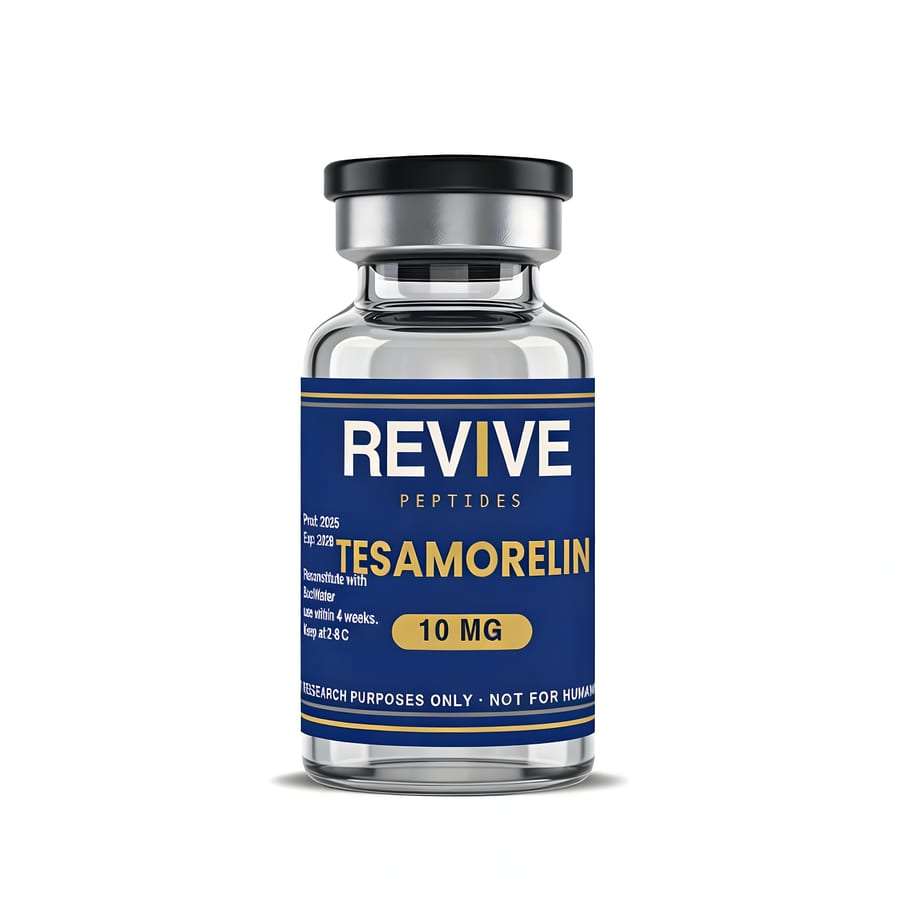
The UAE's professional workforce sits. Knowledge workers in Dubai's DIFC, Business Bay, JLT and Sheikh Zayed Road offices average 9-11 seated hours per day when commute and screen time are included. That is not a lifestyle observation — it is a metabolic variable with measurable downstream effects on visceral fat depots, GH axis suppression, and hepatic lipid accumulation. Research investigators studying these patterns have an increasingly well-characterised pharmacological tool: tesamorelin, a synthetic growth hormone-releasing hormone (GHRH) analog that selectively restores pulsatile GH secretion and, through that mechanism, reduces ectopic and visceral fat without meaningful systemic side-effect burden at research-context doses. To buy tesamorelin UAE for such protocols, REVIVE LAB UAE is the only supplier in the region offering HPLC-tested, lot-COA, cold-chain dispatched vials across all seven emirates — with tesamorelin same day Dubai delivery and tesamorelin cash on delivery Dubai options as standard.
Why Desk Work Is a VAT Accelerant: The Metabolic Mechanism
It sits around the abdominal organs — liver, pancreas, gut — releases pro-inflammatory cytokines, and drains lipolytic free fatty acids directly into the portal circulation. The link between sedentary behaviour and expanding VAT depots operates through at least three concurrent pathways:
- Suppressed GH pulsatility: Growth hormone is secreted in discrete pulses, primarily during deep sleep and during physical exertion. Prolonged sitting, poor sleep architecture (common in high-screen-time knowledge workers), and caloric surplus all dampen these pulses. Reduced GH signalling shifts lipid partitioning toward visceral storage.
- Reduced skeletal muscle glucose uptake: Sitting abolishes the repeated contraction-mediated GLUT4 translocation that keeps postprandial glucose out of lipogenic pathways. The glucose surplus ends up as triglyceride — preferentially in liver and visceral depots.
The practical result is that a UAE desk worker who exercises three times a week can still accumulate VAT faster than their activity level would predict, simply because the remaining 165 sedentary hours per week dominate the metabolic signal. This is the biological context in which tesamorelin research in sedentary cohorts is scientifically interesting — and why investigators have begun extending the original lipodystrophy literature into broader metabolic phenotypes.
Sitting Hours vs. Estimated VAT Risk: A Research Snapshot
| Daily Sitting Hours | VAT Accumulation Pattern | GH Axis Impact | Research Relevance |
|---|---|---|---|
| Under 4 hours | Minimal, well-regulated | Near-normal pulsatility | Low — baseline cohort |
| 4-6 hours | Moderate, offset by exercise | Mildly blunted | Moderate — mixed phenotype |
| 6-8 hours | Elevated, especially if high-calorie diet | Notably suppressed | High — common UAE desk profile |
| 8+ hours | Significantly elevated, liver-fat risk | Substantially blunted pulses | Very high — core research target |
What the Peer-Reviewed Literature Shows About Tesamorelin and VAT
The clinical evidence base for tesamorelin and visceral fat reduction is anchored in four landmark papers. It is worth reading them carefully rather than accepting summary statistics, because the mechanism is transferable to sedentary metabolic phenotypes even where the original cohort was HIV-associated lipodystrophy — a condition that produces a VAT phenotype mechanistically similar to GH-deficiency-driven visceral fat accumulation in general sedentary populations.
Falutz et al. 2010 (26-Week Extension): Sustained Effect
The 2010 extension study continued the same cohort for a further 26 weeks, confirming that VAT reduction was maintained with ongoing tesamorelin administration and that discontinuation was followed by partial VAT rebound — consistent with the peptide acting on the underlying GH axis suppression rather than producing an independent, irreversible structural change. This finding is methodologically important for research design: the effect is mechanism-dependent and requires sustained administration within the protocol window.
Stanley et al. 2014 (JAMA): The Liver Fat Signal
In a separate but mechanistically related line of investigation, Stanley and colleagues at Massachusetts General Hospital studied tesamorelin in HIV-associated non-alcoholic fatty liver disease (NAFLD) — a condition driven by the same portal free-fatty-acid flux that characterises visceral-fat accumulation. Liver fat, measured by MRS, was reduced by 32% relative to placebo over the study period. This is the most directly relevant finding for sedentary desk-worker phenotypes, because hepatic steatosis is the downstream metabolic consequence of chronic visceral fat overflow that UAE knowledge workers with high-carbohydrate diets, screen sedentarism and inadequate sleep are specifically prone to.
Stanley et al. 2019 (Lancet HIV): 12-Month NAFLD Confirmation
The 2019 Lancet HIV paper extended the liver-fat investigation to a 12-month follow-up and confirmed that tesamorelin's hepatic lipid-lowering effect persisted at the 12-month mark. This longer time horizon is relevant for research protocols that aim to study metabolic adaptation rather than acute pharmacodynamics — and it reinforces that the molecule's GH-axis mechanism produces durable signal in relevant lipid compartments.
Buy Tesamorelin UAE — Order Now →
Tesamorelin Mechanism: Why a GHRH Analog Targets Visceral Fat Selectively
Tesamorelin is not a direct GH injection. That distinction matters mechanistically. It is a 44-amino-acid synthetic analog of human GHRH — specifically, the trans-3-hexenoyl modification at the N-terminus extends its half-life by protecting against dipeptidyl peptidase-IV (DPP-IV) cleavage, which normally degrades native GHRH within minutes. By binding to the pituitary GHRH receptor, tesamorelin restores pulsatile GH secretion — pulses that are physiologically appropriate in amplitude and frequency, rather than the supraphysiological tonic elevation produced by exogenous GH administration.
This pulsatile restoration is the key to the selective VAT effect. When pulsatile GH is blunted (as in both lipodystrophy and chronic sedentarism), visceral depots expand disproportionately. When it is restored via tesamorelin, visceral lipolysis is preferentially upregulated without the insulin-resistance and fluid-retention side effects associated with supraphysiologic GH doses.
The downstream IGF-1 rise — approximately 50% in the Falutz 2007 cohort — reflects hepatic GH receptor engagement and is a reliable on-target pharmacodynamic marker that investigators can use to confirm protocol adherence and mechanistic engagement without direct visceral fat imaging.
Tesamorelin vs. Direct GH in Sedentary Phenotypes: Research Framing
| Parameter | Tesamorelin (GHRH analog) | Exogenous GH |
|---|---|---|
| GH secretion pattern | Pulsatile (physiological) | Tonic (supraphysiological) |
| VAT selectivity | Documented, strong signal (Falutz 2007) | Diffuse effect, less selective |
| IGF-1 rise | ~50% (within physiologic range) | Often supraphysiologic |
| Liver fat effect | -32% (Stanley 2014) | Mixed data |
| Feedback axis | Preserved (somatostatin loop intact) | Suppressed |
| Research data quality | NEJM, JAMA, Lancet HIV RCTs | Fragmented, older cohorts |
Order Tesamorelin UAE →
Buy Tesamorelin UAE — REVIVE LAB Delivery Coverage
For UAE-based researchers and research teams, REVIVE LAB UAE is the only peptides UAE supplier operating a full refrigerated cold-chain courier network across all seven emirates. Whether the research site is in Dubai Marina, DIFC, Business Bay, JBR, JVC, Jumeirah, Palm Jumeirah, Downtown, Emirates Hills or Arabian Ranches — the same-day window applies for orders placed before the daily cut-off. Tesamorelin arrives in insulated cold-chain packaging verified to hold 2-8°C through the full transit window, with a plain, unbranded outer carton as default.
| Location | Delivery Window | Cash on Delivery | Cold-Chain Insulation |
|---|---|---|---|
| Dubai (Marina, JBR, Business Bay, JVC, DIFC, Downtown, Palm, Jumeirah) | Same-day, 4-8 hours | Yes | Yes — verified 2-8°C |
| Abu Dhabi (Corniche, Yas, Saadiyat, Reem Island) | Next-day, 18-24 hours | Yes | Yes |
| Sharjah | Same-day / next-day, 8-18 hours | Yes | Yes |
| Ajman | Next-day, 18-24 hours | Yes | Yes |
| Ras Al Khaimah (RAK) | Next-day, 18-24 hours | Yes | Yes |
| Fujairah | Next-day, 24 hours | Yes | Yes |
| Umm Al Quwain | Next-day, 18-24 hours | Yes | Yes |
| Al Ain | Next-day, 24 hours | Yes | Yes |
REVIVE LAB UAE is not a reseller or freight-forwarder. Every tesamorelin batch is HPLC-tested in-house, with lot-specific COA available on request. Tesamorelin 5 mg and 10 mg vials are maintained in a temperature-controlled Dubai facility and dispatched with refrigerated couriers — not ambient couriers with gel packs thrown in as an afterthought. This matters in UAE summer conditions where ambient temperatures regularly exceed 44°C. For researchers who need tesamorelin in stock UAE right now, REVIVE LAB UAE is the reliable answer.
Beyond tesamorelin, REVIVE LAB UAE carries the full research-peptide stack relevant to metabolic investigation: Retatrutide, GHK-Cu, BPC-157, TB-500, MOTS-c, Semax, and NAD+. All available through the REVIVE LAB UAE peptides catalogue with the same HPLC-verified, cold-chain dispatch standard.
Buy Tesamorelin UAE — Order Now →
FAQ
Can I buy tesamorelin in the UAE for sedentary lifestyle visceral fat research?
Yes. REVIVE LAB UAE supplies HPLC-verified, lot-COA tesamorelin 5 mg and 10 mg vials with cold-chain dispatch across all 7 emirates. Research investigators studying visceral adipose tissue (VAT) in sedentary cohorts can order tesamorelin UAE with same-day delivery inside Dubai and 24h delivery to Abu Dhabi, Sharjah, RAK and all other emirates. Cash on delivery is available across the UAE.
What vial sizes of tesamorelin does REVIVE LAB UAE stock for research use?
REVIVE LAB UAE stocks tesamorelin in 5 mg and 10 mg lyophilized vials — the same standard research-grade sizes used in the Falutz et al. 2007 (NEJM) and Stanley et al. 2014 (JAMA) trial specifications. Order tesamorelin Dubai same-day or opt for tesamorelin 24h delivery UAE-wide.
How quickly can I receive tesamorelin in Dubai after ordering from REVIVE LAB UAE?
REVIVE LAB UAE offers tesamorelin same day Dubai delivery for orders placed before the daily dispatch cut-off — typically 4-8 hours to Dubai Marina, Business Bay, JBR, JVC, DIFC, Downtown, Palm Jumeirah and Jumeirah. For Abu Dhabi, Sharjah, RAK, Fujairah and other emirates, tesamorelin Dubai 24h delivery is the standard. All vials arrive in cold-chain insulated packaging with discreet outer cartons and cash on delivery available.
- Falutz J, Allas S, Blot K, et al. Metabolic effects of a growth hormone-releasing factor in patients with HIV. N Engl J Med. 2007;357(23):2359-2370.
- Falutz J, Mamputu JC, Potvin D, et al. Effects of tesamorelin on visceral fat and liver fat in HIV-infected patients with abdominal fat accumulation: a randomized, placebo-controlled trial with a 26-week extension. J Clin Endocrinol Metab. 2010;95(9):4291-4304.
- Stanley TL, Feldpausch MN, Oh J, et al. Effect of tesamorelin on visceral fat and liver fat in HIV-infected patients with abdominal fat accumulation. JAMA. 2014;312(4):380-389.
- Stanley TL, Fourman LT, Feldpausch MN, et al. Effects of tesamorelin on non-alcoholic fatty liver disease in HIV: a randomised, double-blind, multicentre trial. Lancet HIV. 2019;6(12):e821-e830.