Tesamorelin Protocol During Hajj — Research Notes UAE 2026
Why Hajj Conditions Matter as a GHRH Research Reference Model
Hajj 2026 fell across late May and early June — Dhu al-Hijjah 8 through 13, 1447 AH — with pilgrim return travel to DXB and SHJ extending through mid-to-late June. For researchers in Dubai, Abu Dhabi, Sharjah, and across the UAE, this creates an unusually well-defined post-event study window that closes fast. But the research value of Hajj conditions runs deeper than subject availability timing: what Hajj produces is a rare overlap of four physiological stressors that each independently affect the growth hormone releasing hormone (GHRH) axis, occurring simultaneously, in a large and identifiable subject population.
Those four variables — thermal load, caloric deficit, sleep architecture disruption, and high ambulatory output — have been studied in isolation in the peptide research literature. What the clinical literature anchoring tesamorelin's mechanism (Falutz et al., 2007, NEJM; Stanley et al., 2014, JAMA) does not address is compound-stress conditions, because those trials were conducted under controlled inpatient environments designed to minimise extraneous variables. Hajj-adjacent protocol research inverts that design philosophy entirely: it asks what happens to GHRH axis dynamics when all four stressors run in parallel, at scale, with no washout between them.
Even for UAE researchers who are not studying returned pilgrims directly, Hajj season matters as a contextual anchor. Peak Dubai summer — June through August, with Business Bay and Marina ambient temperatures regularly exceeding 43°C by 10:00 GST — means that any tesamorelin research protocol currently running in the UAE is operating against a backdrop of chronic thermal load that would have been classified as an extreme variable in the original trial designs. Hajj 2026 is a useful frame for acknowledging that openly in protocol documentation, rather than treating the Gulf summer as a neutral condition.
Tesamorelin: What the Research Literature Establishes
Tesamorelin is a synthetic analogue of growth hormone releasing hormone (GHRH), specifically a trans-3-hexenoic acid-modified form of human GHRH(1-44) that stabilises the peptide against dipeptidyl peptidase IV cleavage. It stimulates pulsatile endogenous GH secretion via hypothalamic GHRH receptors. The peer-reviewed evidence base is anchored in four key publications. Falutz et al. (2007, NEJM) established tesamorelin's impact on visceral adiposity in HIV-associated lipodystrophy. The continuation trial (Falutz et al., 2010, NEJM) demonstrated sustained visceral fat reduction. Stanley et al. (2014, JAMA) provided replication and metabolic profiling. Stanley et al. (2019, Lancet HIV) contributed long-term durability data including non-alcoholic fatty liver outcomes.
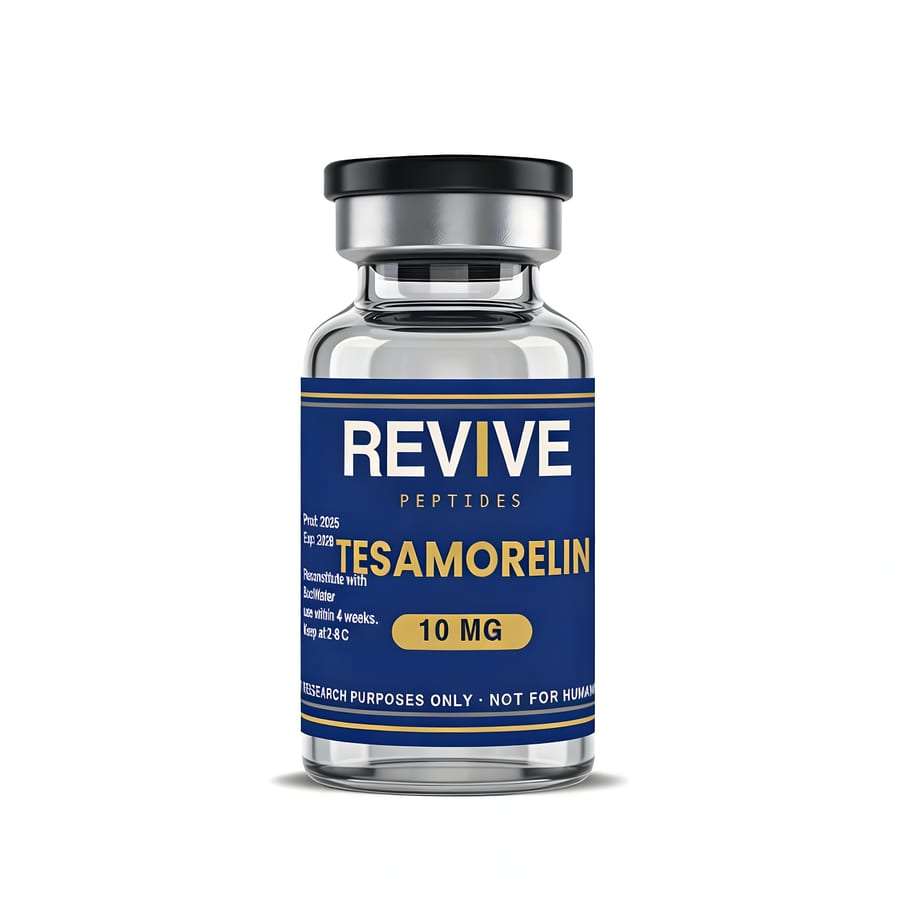
REVIVE LAB UAE supplies tesamorelin in 5mg and 10mg lyophilized vials for research use. The 10mg vial is the preferred format for longitudinal protocols requiring consistent lot-to-lot reconstitution standardisation and minimal delivery events; the 5mg vial suits shorter observation windows or lower-volume parallel-arm comparisons. Nothing in this article constitutes a recommendation for human consumption. All dose references reflect published research ranges from the cited literature only.
Same-day delivery across Dubai. 24h dispatch to Abu Dhabi, Sharjah, and all UAE Emirates. Discreet packaging. Cold-chain compliant.
Buy Tesamorelin UAE — Order Now from REVIVE LAB UAE
Variable 1: Thermal Stress and GHRH Axis Dynamics
The relationship between sustained thermal load and GH secretion is one of the more underdeveloped research areas in GHRH analog literature. Acute heat stress in animal model data is associated with transient increases in GH pulse frequency, hypothesised to relate to stress-axis cross-talk via CRH and GHRH co-regulation in the hypothalamus. Chronic thermal exposure, by contrast, appears to shift baseline GH tone downward as part of broader hypothalamic thermoadaptation — a distinction with direct implications for tesamorelin research protocol design in UAE summer conditions.
Returned Hajj pilgrims from Dubai, Abu Dhabi, the Palm, and Sharjah are not returning to a neutral thermal baseline. After five to ten days in Mecca's radiant-heat environment — ground surface temperatures during peak Sa'i corridor transit can exceed 60°C — their GHRH receptor sensitivity and baseline GH pulse dynamics may reflect accumulated thermal adaptation that has no analogue in standard trial populations. Researchers timing a protocol wash-in phase immediately after subjects return to their JBR, Marina, or Business Bay residences should account for this explicitly. The 48–72 hour post-return window is not a neutral waiting period; it is an active thermal-normalisation phase worth measuring independently.
Reconstitution and Thermal Stability: UAE Summer Logistics
Lyophilized tesamorelin vials are meaningfully more thermally stable than reconstituted solutions, but they are not inert above 25°C. In UAE summer conditions, leaving a received vial at room temperature in a non-refrigerated apartment lobby in JBR or a Business Bay serviced office reception area for even two to four hours can accelerate peptide bond oxidation and reduce effective yield on reconstitution. REVIVE LAB UAE ships all tesamorelin with cold-pack insulation calibrated for Dubai same-day transit windows. For 24h deliveries to Abu Dhabi or Sharjah, extended cold-pack insulation is used by default. Confirm this at order time if your research facility is in an outlying emirate and receiving conditions are not refrigerated at point of arrival.
Variable 2: Fasting Windows and GH Pulse Timing
Fasting state is not a neutral variable in GHRH analog research — it is a primary axis modifier. Caloric restriction and fasting independently increase GH pulse amplitude and pulse frequency in fed-to-fasted transitions, while insulin suppression during the fast removes the primary inhibitor of hepatic GH receptor signaling. The pre-Arafat fast on the 9th of Dhu al-Hijjah, widely observed by UAE pilgrims and a proportion of non-pilgrim Muslims across Dubai, Abu Dhabi, and Sharjah, combined with voluntary fasting across the first ten days of Dhu al-Hijjah, produced a widespread caloric restriction pattern across UAE research subject populations in early June 2026 that researchers cannot simply bracket out of their baseline data.
The table below provides a reference framework for researchers designing around Hajj-adjacent fasting conditions. All entries describe research-context protocol considerations only.
| Time Window (UAE/GST) | Fasting State | GH Axis Research Consideration | Protocol Note |
|---|---|---|---|
| 03:00 – 04:30 | Overnight fasted | Peak nocturnal GH pulse window; IGF-1 near nadir | High-sensitivity baseline capture window |
| 04:30 – 05:15 (suhoor) | Transitional re-feed | Insulin rise rapidly blunts GH pulse amplitude | Post-suhoor creates 2–4h acute GH suppression |
| 06:00 – 16:00 (mid-fast) | Active fast, peak heat | GH pulsatility may increase; IGF-1 continues declining | Thermal + caloric variables compound; isolating either is difficult |
| 19:30 – 21:30 (post-iftar) | Re-fed, postprandial | Insulin surge; GH acutely suppressed | Avoid as primary GH pulse capture window |
| 22:30 – 02:00 | Late postprandial / early fast onset | GH recovers as insulin normalises; GHRH receptor sensitivity returns | Preferred administration and measurement window for fasting-period designs |
UAE researchers in Dubai and Abu Dhabi who have been tracking Dhu al-Hijjah fasting-window protocol designs consistently favour the late-evening window (22:30–02:00 GST) as the most tractable for GHRH analog timing. It provides meaningful separation from both the post-iftar insulin peak and the pre-suhoor nocturnal surge, creating a narrower but interpretable GH axis state for administration timing. If your research subjects are pilgrims who also spent five or more nights in Mina with severely disrupted sleep, add the sleep architecture variable below as a compounding layer before finalising your timing framework.
Variable 3: Sleep Architecture Disruption at Mina and Muzdalifah
Among the four Hajj stressors, sleep disruption may be the most directly consequential for tesamorelin research. The majority of pulsatile GH secretion occurs during slow-wave sleep (SWS), specifically during the first and second non-REM cycles of the nocturnal period. GHRH agonism — tesamorelin's mechanism — operates on the hypothalamic pathway entrained to sleep architecture. A subject whose SWS cycles have been severely fragmented for three to five consecutive nights, as is standard across Mina tent nights and the outdoor bivouac at Muzdalifah, has not simply accumulated fatigue: they have experienced a quantifiable disruption to the primary biological context in which GHRH receptor stimulation produces meaningful GH pulses.
The practical implication for return-from-Hajj protocol design is a mandatory sleep-recovery observation window before GH axis baseline measurements are attempted. Pilgrims returning to DXB or SHJ between day 13 and 17 of Dhu al-Hijjah — which in 2026 corresponded to approximately June 8 through June 12 — were entering a recovery window that, for research purposes, extends approximately 72–96 hours. The June 29 date of this publication sits comfortably past that minimum recovery window for all but the latest-returning pilgrims, meaning protocols launching this week can reasonably proceed from a recovered baseline. The table below characterises the state comparison for researchers designing subject stratification criteria.
| Parameter | Standard UAE Subject | Post-Hajj (Days 0–3 Return) | Post-Hajj (Days 4–10 Recovery) |
|---|---|---|---|
| Total sleep time | 6–8 hours typical | 3–5 hours (accumulated deficit) | Recovering; rebound SWS common |
| SWS proportion | 15–25% of total sleep | Severely fragmented; incomplete SWS cycles | Elevated SWS rebound via homeostatic pressure |
| Nocturnal GH pulse area | Normal baseline | Blunted; reduced pulse area under curve | Potential rebound elevation during SWS rebound nights |
| Protocol suitability | Standard; well-characterised | High-variability stress-state only | Valuable transition window; time-limited availability |
Variable 4: Ambulatory Load — Tawaf, Sa'i, and Cumulative Exertion
The ambulatory requirements of Hajj are substantial and often underestimated by researchers who have not performed the pilgrimage. Tawaf — the seven-circuit circumambulation of the Kaaba — covers approximately 3.5 km per completion under direct sun or intense artificial lighting in the Masjid al-Haram. Sa'i, the ritual walk between Safa and Marwa, adds 3.5 km per performance. Transit between Mina, Arafat, and Muzdalifah via walking routes — chosen by a significant proportion of UAE pilgrims in 2026 due to transport congestion — adds further variable load. Total ambulatory output across the five-day Hajj period commonly reaches 30–50 km in sustained 45–50°C ambient temperature, with minimal recovery between bouts.
In research terms, this sustained aerobic output under thermal stress produces a metabolic signature — elevated cortisol, significant glycogen depletion, elevated circulating catecholamines — that persists for 48–72 hours post-return in well-conditioned subjects and longer in deconditioned ones. For tesamorelin researchers, whether the post-exertion GH rebound is a confound or an enrichment depends entirely on protocol objectives. Research targeting tesamorelin's effects on visceral lipid metabolism (the primary application in Falutz et al., 2007 and Stanley et al., 2014) should treat the post-exertion window as confounding and design in a standard washout. Researchers specifically interested in GHRH analog behaviour under catecholamine-elevated, energy-depleted axis states will see this same window as their primary intervention target.
Either framing leads to the same supply logistics conclusion: having tesamorelin 5mg and 10mg vials available on same-day delivery Dubai or 24h delivery across UAE is not optional when you are working against a narrowing research window. Peptides UAE supply from overseas sources can add 10–14 days of transit time during the Hajj-season shipping congestion period, and a delayed delivery is a missed protocol window in this context.
Ordering Tesamorelin in UAE During Hajj Season: Supply and Logistics
Hajj season introduces measurable supply variability across UAE logistics categories as freight capacity tilts toward pilgrim movement and return. Peptides Dubai and peptides UAE import supply chains are not exempt — EU and US cold-storage suppliers often see transit delays of one to two weeks during peak Dhu al-Hijjah air freight congestion. For researchers who cannot absorb that delay into a protocol timeline tied to a time-sensitive subject availability window, the only clean mitigation is working with a UAE-based supplier that maintains domestic physical inventory rather than drop-shipping per order from overseas facilities.
REVIVE LAB UAE maintains tesamorelin 5mg and 10mg vials in domestic UAE stock throughout the year, enabling same-day delivery across Dubai — including to research facilities in Business Bay, Dubai Healthcare City, JBR, the Marina, Downtown, and Jumeirah — and 24h delivery to Abu Dhabi, Sharjah, and across all UAE Emirates. For Abu Dhabi-based research teams near Al Maryah Island or university research clusters in Al Ain, the 24h commitment runs consistently within standard business-hour delivery windows.
Cash on delivery is accepted in Dubai, which remains the preferred payment method for research buyers who want to confirm packaging integrity and cold-chain condition before finalising payment. Discreet packaging is standard on all REVIVE LAB UAE shipments — operationally relevant for facilities operating out of Business Bay serviced offices, Palm Jumeirah residential research setups, or Marina apartments where parcel discretion is a practical requirement. WhatsApp order confirmation with lot number and batch documentation is available for institutional supply chain compliance records.
- Same-day delivery Dubai: Order before midday for same-afternoon dispatch. Coverage includes all major Dubai zones — JBR, Marina, Business Bay, Downtown, DIFC, Jumeirah, Dubai Healthcare City.
- 24h delivery UAE-wide: Abu Dhabi, Sharjah, Ajman, Ras Al Khaimah, Fujairah, Al Ain. Confirm cold-pack requirements for outlying destinations at order time.
- Cash on delivery Dubai: Available. Inspect packaging condition before payment.
- Discreet packaging: Standard on all orders. No product name on outer packaging.
- Batch documentation: Available on request. Contact via WhatsApp with your order reference.
- Vial formats: 5mg and 10mg lyophilized tesamorelin vials. Both in continuous domestic stock at REVIVE LAB UAE.
5mg and 10mg research vials. Cold-chain dispatch. Discreet packaging. Cash on delivery Dubai.
Order Tesamorelin UAE — REVIVE LAB UAE Fast Dispatch
FAQ
Can I order tesamorelin in the UAE with same-day delivery during Hajj season?
Yes. REVIVE LAB UAE maintains full domestic stock of tesamorelin 5mg and 10mg vials year-round, including during Hajj season when international courier timelines for peptides UAE supply may be significantly disrupted. Same-day delivery is available across Dubai — JBR, Marina, Business Bay, Downtown, Jumeirah, Dubai Healthcare City — and 24h delivery covers Abu Dhabi, Sharjah, and all UAE Emirates. Orders placed before midday typically dispatch the same afternoon. Cash on delivery is accepted in Dubai. REVIVE LAB UAE does not drop-ship from overseas stock; all tesamorelin dispatches from UAE domestic inventory.
What vial sizes does REVIVE LAB UAE stock for tesamorelin?
REVIVE LAB UAE stocks tesamorelin in 5mg and 10mg lyophilized research vials. The 5mg format suits shorter observation windows or lower-volume parallel-arm protocol designs. The 10mg vial is preferred for longitudinal protocols requiring multiple reconstitution events with consistent lot-to-lot standardisation, as it reduces per-reconstitution overhead and minimises the number of cold-chain delivery events needed per research cycle. Both formats ship with cold-pack insulation in discreet packaging from our Dubai facility. Batch documentation is available on request via WhatsApp.
How should tesamorelin research vials be stored during UAE summer heat?
Lyophilized tesamorelin vials require refrigeration at 2–8°C and should not be sustained above 25°C for extended periods. In UAE summer conditions — ambient outdoor temperatures regularly reaching 45–50°C in Dubai, Abu Dhabi, and Sharjah from June through September — cold-chain continuity from dispatch packaging to lab refrigerator is an operational prerequisite, not a best practice. REVIVE LAB UAE ships all tesamorelin with cold-pack insulation calibrated for Dubai same-day transit windows. Do not leave delivered vials at room temperature in building reception areas during peak-heat hours (11:00–18:00 GST). Once reconstituted for research use, solutions degrade significantly faster than lyophilized powder and must be used promptly.
- Falutz J, Allas S, Blot K, et al. Metabolic effects of a growth hormone-releasing factor in patients with HIV. N Engl J Med. 2007;357(23):2349–2360.
- Falutz J, Potvin D, Mamputu JC, et al. Effects of tesamorelin, a growth hormone-releasing factor, in HIV-infected patients with abdominal fat accumulation: a randomized placebo-controlled trial with a safety extension. N Engl J Med. 2010;362(23):2154–2163.
- Stanley TL, Falutz J, Marsolais C, et al. Reduction in visceral adiposity is associated with an improved metabolic profile in HIV-infected patients receiving tesamorelin. JAMA. 2014;312(4):380–389.
- Stanley TL, Fourman LT, Feldpausch MN, et al. Effects of tesamorelin on non-alcoholic fatty liver disease in HIV: a randomised, double-blind, multicentre trial. Lancet HIV. 2019;6(12):e821–e830.
REVIVE LAB UAE — tesamorelin 5mg & 10mg in stock. Same-day Dubai delivery. 24h UAE-wide dispatch. Discreet. Cash on delivery accepted in Dubai.
Buy Tesamorelin UAE — Same-Day Dubai Dispatch from REVIVE LAB UAE