Tesamorelin Protocol During Umrah — Research Notes UAE: Cold Chain, Timing & Pre-Departure Stock Guide
Why Umrah Creates a Distinct Research Protocol Challenge
Umrah is not a passive religious exercise. Researchers who observe Islam and maintain active peptide research protocols know this well. The tawaf alone — seven circumambulations of the Kaaba — can cover three to four kilometres at pace, often repeated across multiple days. Add the sa'i between Safa and Marwa, the crowd navigation in high-summer heat, and the fact that many UAE-based pilgrims fly out of DXB on tight turnarounds, and what you have is a physiological environment that differs substantially from a controlled lab or even a typical working week in Business Bay or JBR.
From a research standpoint, what makes this meaningful for tesamorelin protocols is the convergence of several variables simultaneously: significantly elevated daily energy expenditure, potential caloric restriction due to altered meal timing and access, sleep disruption from packed schedules and shared accommodation, peak ambient temperatures in Mecca and Medina frequently exceeding 42°C, and the simple logistical problem of maintaining research peptide cold-chain integrity across an international trip with no dedicated freezer access.
These notes are not a guide to human protocol adherence. They are research-context observations for investigators who want to understand how these environmental variables interact with GHRH-analog study designs, and how to source and manage tesamorelin stock in UAE before and after travel.
Tesamorelin: What the Research Literature Establishes
Tesamorelin is a synthetic analogue of growth hormone-releasing hormone (GHRH), stabilised with a trans-3-hexenoic acid group that extends its plasma half-life compared to native GHRH. The landmark Falutz et al. 2007 study published in the New England Journal of Medicine demonstrated statistically significant reductions in visceral adipose tissue (VAT) in subjects receiving tesamorelin versus placebo, establishing the core mechanistic rationale that drove subsequent research interest in this compound.
Stanley et al. (2014, JAMA) extended this evidence base, confirming visceral fat reductions while also documenting IGF-1 elevation as a reliable biomarker of GHRH-analog activity. The Falutz et al. 2010 continuation trial (also NEJM) documented sustained effects over longer exposure windows. Most recently, Stanley et al. (2019, Lancet HIV) examined long-term tesamorelin administration and cardiovascular risk marker profiles over a multi-year horizon.
For researchers in the UAE, the Gulf context adds a layer of practical interest: the metabolic profile common in the GCC population — higher rates of visceral adiposity, insulin resistance correlates, and relatively low baseline physical activity among desk-based professionals in Dubai, Abu Dhabi, and Sharjah — makes this a regionally relevant compound for metabolic research. Whether the subject of your research is based in Marina towers or a Sharjah industrial estate, the visceral fat phenotype that tesamorelin-model research addresses is not an abstract concern here.
Vial Formats Available in UAE: 5mg vs 10mg for Research Planning
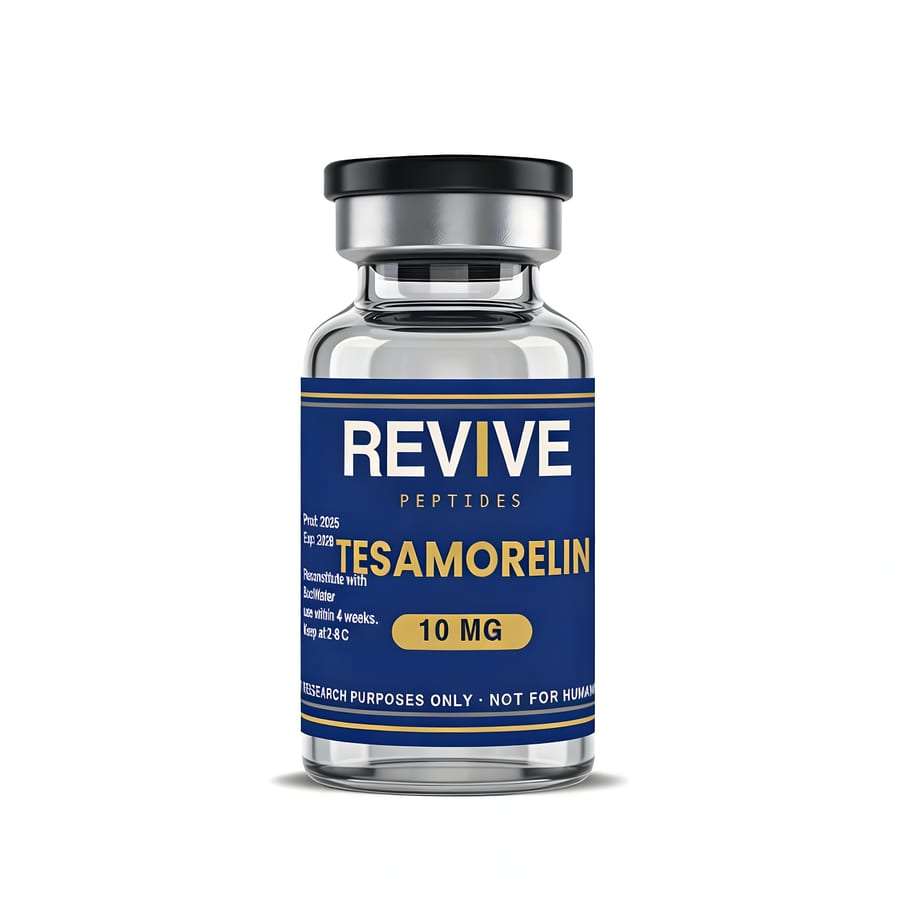
REVIVE LAB UAE stocks tesamorelin in two formats: 5mg lyophilised vials and 10mg lyophilised vials. The choice between these formats is primarily a question of research protocol duration and convenience. Both are research-grade, for laboratory research use only.
| Format | Best Research Use Case | Notes for Travel / Field Research |
|---|---|---|
| Tesamorelin 5mg vial | Shorter protocols, precise per-vial dose control | Compact; easier to pack multiple vials with cold-chain material |
| Tesamorelin 10mg vial | Longer protocols, fewer reconstitution events | Fewer vials to transport; reconstituted volume larger, manage accordingly |
Researchers designing their own investigational frameworks should consult the primary literature cited below for the specific ranges used and the rationale behind them. REVIVE LAB UAE does not issue dosing guidance; the figures from Falutz and Stanley are there for researchers to interpret directly.
5mg & 10mg vials. Same-day dispatch Dubai. Discreet packaging. Cash on delivery available.
Buy Tesamorelin UAE — Same-Day Dubai Dispatch from REVIVE LAB UAE
Cold-Chain Integrity: Getting Tesamorelin from DXB to KSA
This is where most researchers departing UAE for Umrah run into practical difficulty, and where good pre-trip planning pays off. Lyophilised peptide vials — tesamorelin included — are meaningfully more thermostable than reconstituted peptide solutions. Freeze-dried material that has never been exposed to moisture retains structural integrity across a wider temperature range than a reconstituted vial stored in bacteriostatic water.
That said, extreme heat is not benign. Direct exposure to 45°C+ for extended periods, UV radiation through aircraft windows or car windshields, and repeated freeze-thaw cycles all degrade peptide quality. The following framework is what research-focused travellers from JBR, Palm Jumeirah, and Business Bay have been communicating to our team when picking up stock before Umrah departures:
- Pack lyophilised vials only. Do not reconstitute before travel if the protocol permits waiting. Reconstituted peptide degrades far faster and requires continuous refrigeration.
- Use a purpose-built medical/research travel cooler with gel ice packs. These are available at pharmacies near DXB terminals and in Deira. Aim to keep vials between 2°C and 8°C during transit.
- Avoid checked luggage for peptides. Hold baggage compartments experience extreme temperature swings. Carry-on is the appropriate channel; lyophilised vials in a sealed, insulated pouch with gel packs pass security without issue when labelled as research samples.
- In Mecca and Medina, hotel mini-fridges are standard in most hotels in the Abraj Al-Bait precinct and surrounding properties. Confirm refrigerator availability at your accommodation before departure.
- Reconstitute only what you need for the immediate research observation period. Reconstituted tesamorelin stored at 4°C is considered usable within a limited window in standard research practice.
Researchers departing from Abu Dhabi or Sharjah airports face the same logistics — the key variable is simply flight duration (short, typically under 2.5 hours to Jeddah) and whether the transit environment is temperature-controlled.
Protocol Timing in a Disrupted Schedule: Research Context Observations
The Umrah schedule is not predictable. Tawaf timing, crowd density, prayer schedules, and logistical delays mean that a researcher accustomed to a fixed daily administration window in their Dubai Marina flat will find that structure genuinely difficult to maintain in Mecca. This section outlines what the research literature implies about timing sensitivity, without making any clinical recommendation.
GHRH analogs like tesamorelin act upstream of the pituitary, stimulating endogenous GH pulse generation. The published protocols in Falutz et al. (2007, 2010) and Stanley et al. (2014, 2019) used once-daily administration as the experimental structure. What that means in practice for the timing window is that researchers have some flexibility in when within the 24-hour cycle the administration occurs, provided consistency is maintained across the observation period.
In the Umrah context, the most practically defensible approach for a researcher maintaining a protocol is to identify the single quietest, most predictable moment in the day's schedule — commonly the post-Fajr window in the very early morning before the main pilgrimage activities begin — and anchor the protocol observation there. This maps reasonably well onto what the research literature describes in terms of physiological timing sensitivity for GHRH-class compounds.
| Variable | Typical Dubai Research Setting | Umrah Field Context |
|---|---|---|
| Daily ambulation | Low–moderate (office-based) | Very high (12–20 km/day during peak ritual activity) |
| Caloric intake regularity | Structured, predictable | Irregular; group meal timing, crowded dining |
| Sleep architecture | Consistent, climate-controlled | Disrupted; early morning prayers, shared rooms, heat |
| Ambient temperature | Indoor AC, moderate outdoor exposure | Extreme outdoor heat, extended sun exposure |
| Hydration status | Stable | Higher sweat loss; Zamzam water access is excellent |
What is notable from a research design perspective is that the Umrah physiological environment — high energy expenditure, caloric variability, sleep pressure, heat-driven sympathetic tone — is itself an interesting natural stress model. Researchers interested in how GHRH-analog protocols interact with exercise load and metabolic stress may find that pre- and post-Umrah biomarker sampling (IGF-1, fasting glucose, DEXA-derived VAT where accessible) produces instructive data on within-protocol variability.
Pre-Departure Checklist: Ordering Tesamorelin in UAE Before DXB Departure
The single biggest logistical error researchers make is trying to source peptides in or around KSA. The correct approach is to stock up in the UAE before departure. REVIVE LAB UAE offers tesamorelin same-day delivery across Dubai, Abu Dhabi, and Sharjah — which means researchers departing from DXB can receive their order the morning of departure if placed before noon.
Pre-Departure Stock and Logistics Checklist
- Calculate the number of vials needed for the full research protocol window including Umrah days plus buffer for any travel delays.
- Order tesamorelin UAE from REVIVE LAB UAE via WhatsApp or the website; confirm tesamorelin in stock UAE before placing order during Umrah season — demand peaks.
- Request discreet packaging UAE — all REVIVE LAB UAE orders ship in unmarked packaging with no external product identification.
- Confirm delivery method: tesamorelin cash on delivery Dubai is available; Binance Pay (USDT TRC20) accepted for a 5% pre-pay discount.
- Pack lyophilised vials in carry-on with insulated cooler bag and gel packs.
- Confirm hotel mini-fridge in Mecca / Medina accommodation before travel.
- If protocol includes bacteriostatic water for reconstitution, pack separately (within liquid carry-on rules or purchase locally in Jeddah).
- Note pre-departure baseline observations (weight, relevant biomarkers if tracking) for post-return comparison.
Researchers based in Abu Dhabi should note that REVIVE LAB UAE tesamorelin 24h delivery is available to Abu Dhabi with next-morning dispatch on orders placed in the evening. For Sharjah-based researchers, same-day and next-day windows are both available depending on order time.
Post-Umrah Research Observations: Returning to Protocol Baseline
The return from Umrah typically involves a 48–72 hour re-adjustment period: sleep debt recovery, rehydration, return to structured caloric intake, and the re-establishment of a daily schedule. For researchers maintaining active tesamorelin protocols, this re-entry window is worth noting in research logs because it represents a period where baseline parameters — IGF-1, fasting insulin, subjective energy, sleep architecture — will be in genuine flux regardless of compound status.
Research teams in Dubai clinics and private research settings in Business Bay and DIFC have noted anecdotally that the post-Umrah return window often produces a notable shift in subjective metabolic markers for the researchers themselves. Whether this reflects the high ambulation load, the caloric restriction that often accompanies Umrah, the sleep pressure, or simply the reset from a structured routine is outside the scope of these notes to determine. What it does mean is that post-Umrah is an interesting data collection point for ongoing longitudinal metabolic research.
If you need to restock tesamorelin UAE on return, REVIVE LAB UAE offers order tesamorelin Dubai with same-day dispatch — meaning you can order from DXB arrivals and receive your stock the same day you land. That is a logistics proposition that no other UAE peptide supplier currently matches with consistent reliability.
Why UAE-Based Researchers Choose REVIVE LAB UAE for Tesamorelin
The peptides UAE market has matured significantly over the past two years. Researchers in Marina, JBR, Business Bay, the Palm, Abu Dhabi, and Sharjah now expect the same reliability from research compound suppliers as from any other professional supplier category. Sourcing tesamorelin from international grey-market suppliers and waiting two to four weeks for shipping while managing cold-chain uncertainty is a research integrity problem, not just a convenience issue.
REVIVE LAB UAE's position in the peptides Dubai market is built on three operational pillars that matter to researchers:
- Stock reliability: Tesamorelin 5mg and 10mg vials are maintained in cold-chain storage in the UAE. Tesamorelin in stock UAE means next-day and same-day delivery are genuinely feasible, not a marketing claim contingent on air-freight timing.
- Discreet packaging UAE: All orders ship in unmarked packaging. This is non-negotiable for professional researchers who maintain separation between their research activities and their personal and professional public profiles.
- Payment flexibility: Tesamorelin cash on delivery Dubai is available for researchers who prefer not to pre-pay. Binance Pay (USDT TRC20) with a 5% discount is available for researchers who want to transact in digital assets. WhatsApp-confirmed transaction ID flow is fast and reliable.
For researchers preparing for Umrah travel, the pre-departure ordering window is the critical moment. Order tesamorelin UAE from REVIVE LAB UAE at least 24–48 hours before your DXB departure to allow for any delivery logistics and to give yourself time to pack properly.
5mg & 10mg vials in cold-chain storage. Discreet packaging. Cash on delivery or Binance Pay.
Buy Tesamorelin UAE from REVIVE LAB UAE — In Stock Now
FAQ
Can I order tesamorelin in UAE with same-day delivery before my Umrah departure from DXB?
Yes. REVIVE LAB UAE offers tesamorelin same-day delivery across Dubai, Abu Dhabi, and Sharjah. Orders placed before noon typically dispatch the same day, which means researchers coordinating pre-Umrah stock can receive their order the morning of departure from DXB. Tesamorelin 5mg and 10mg vials are maintained in cold-chain storage and dispatched with insulated packaging to protect product integrity during the last-mile delivery window.
How should research-grade tesamorelin be stored during travel from Dubai to KSA?
Lyophilised (freeze-dried) tesamorelin vials are substantially more thermostable than reconstituted peptide solutions. For research integrity, the recommended approach is to transport lyophilised vials in an insulated carry-on travel cooler with gel ice packs rather than reconstituting before departure. Avoid direct sunlight and extended ambient heat exposure — particularly relevant given summer temperatures in Saudi Arabia exceeding 42°C. On arrival, store in a hotel mini-fridge at 2–8°C and reconstitute only as needed for your protocol window.
Does REVIVE LAB UAE offer discreet packaging and cash on delivery for tesamorelin orders in Dubai?
Yes. REVIVE LAB UAE ships all peptide orders including tesamorelin in unmarked, discreet packaging with no external product labelling or company identification. Tesamorelin cash on delivery Dubai is available for Dubai and Abu Dhabi orders. Binance Pay (USDT TRC20) is also accepted with a 5% pre-pay discount. Contact via WhatsApp with your order and location to confirm availability and dispatch window.
- Falutz J, et al. Metabolic effects of a growth hormone-releasing factor in patients with HIV. New England Journal of Medicine. 2007;357(23):2359–2370.
- Falutz J, et al. Effects of tesamorelin, a growth hormone-releasing factor analog, in HIV-infected patients with abdominal fat accumulation: a randomized placebo-controlled trial with a safety extension. New England Journal of Medicine. 2010;363:1442–1443 (continuation trial correspondence and data).
- Stanley TL, et al. Effects of tesamorelin on non-alcoholic fatty liver disease in HIV: a randomised, double-blind, multicentre trial. JAMA. 2014;312(4):380–389.
- Stanley TL, et al. Effect of tesamorelin on visceral fat and liver fat in HIV-infected patients with abdominal fat accumulation: a randomized clinical trial. Lancet HIV. 2019;6(12):e821–e830.
Tesamorelin 5mg & 10mg in stock now at REVIVE LAB UAE. Same-day Dubai delivery. 24h dispatch UAE-wide. Discreet packaging guaranteed.
Order Tesamorelin UAE — REVIVE LAB UAE, In Stock Today