Tesamorelin Edema Management — UAE Researcher Guide 2026
Why Tesamorelin Causes Edema — The Mechanism Research Teams Need to Understand
Tesamorelin is a synthetic analogue of growth hormone-releasing hormone (GHRH), and the same mechanism that makes it useful in metabolic research is responsible for the fluid retention signal researchers must plan for. When tesamorelin binds pituitary GHRH receptors and stimulates pulsatile GH secretion, that elevated GH acts on the kidney directly: it upregulates sodium reabsorption in the renal tubule via the renin-angiotensin-aldosterone axis and promotes water retention through aquaporin channel modulation in the collecting duct. The net result is a transient increase in total body water, which distributes to dependent tissues and presents as peripheral edema — most commonly pitting edema of the lower extremities, and occasionally mild facial puffiness.
This is not a toxicity signal. It is a pharmacodynamic confirmation that the compound is activating its intended axis. Understanding this distinction is critical for UAE research teams: edema in a tesamorelin protocol is expected, documentable, and belongs in your data — it is not a reason to abandon the experiment. The research question is whether the edema is proportionate, transient, and resolving within a predicted window; or whether it is escalating, asymmetric, or accompanied by findings that place it outside the expected GHRH-analog phenotype.
IGF-1, which rises downstream of GH elevation, also exerts mild tubular sodium-reabsorption effects, but the primary driver of fluid retention in GHRH analog research is GH-mediated, not IGF-1-mediated. This matters for protocol interpretation: IGF-1 peaks at 1–2 weeks post-initiation and plateaus; GH-driven sodium retention follows a similar early peak and then attenuates as receptor adaptation occurs at the renal level. The practical consequence is that most edema is front-loaded in the first 2–4 weeks of a tesamorelin research window.
Onset Timing and Resolution Windows — What to Log, and When
In research models, edema onset has been observed as early as days 3–10 post-initiation, with peak fluid retention typically occurring within the first 2–4 weeks. The timeline is tightly correlated with the GH and IGF-1 elevation curve: both hormones rise sharply in the first 1–2 weeks, and the renal sodium-retention effect is most pronounced during this early peak. After weeks 4–8, GH receptor downregulation at the tubular level — and possibly aldosterone counter-regulatory adaptation — attenuates the fluid retention even if tesamorelin administration continues unchanged.
Research teams designing GHRH analog protocols should build two distinct edema tracking phases into their documentation framework:
- Early phase (weeks 1–4): High-frequency monitoring. Daily morning body weight (fasted, post-void, same scale) is the most reproducible single proxy. A sustained gain of more than 1.5–2 kg from baseline in the first 2 weeks, without corresponding caloric surplus documented in the research log, is the primary indicator of GH-axis-driven fluid retention. Ankle circumference measurement at a fixed anatomical landmark adds objectivity and is worth including in more rigorous protocols.
- Steady-state phase (weeks 5 onward): Reduced monitoring frequency is acceptable once the early peak has passed. Three-times-weekly weight logging is sufficient, supplemented by a weekly structured edema assessment if the early phase showed significant retention. The 2010 Falutz continuation data gives confidence that, absent a new early-phase signal, progressive retention is unlikely.
Having these decision trees pre-specified prevents reactive protocol deviations that compromise data integrity, a particular concern for independent UAE research teams without institutional oversight.
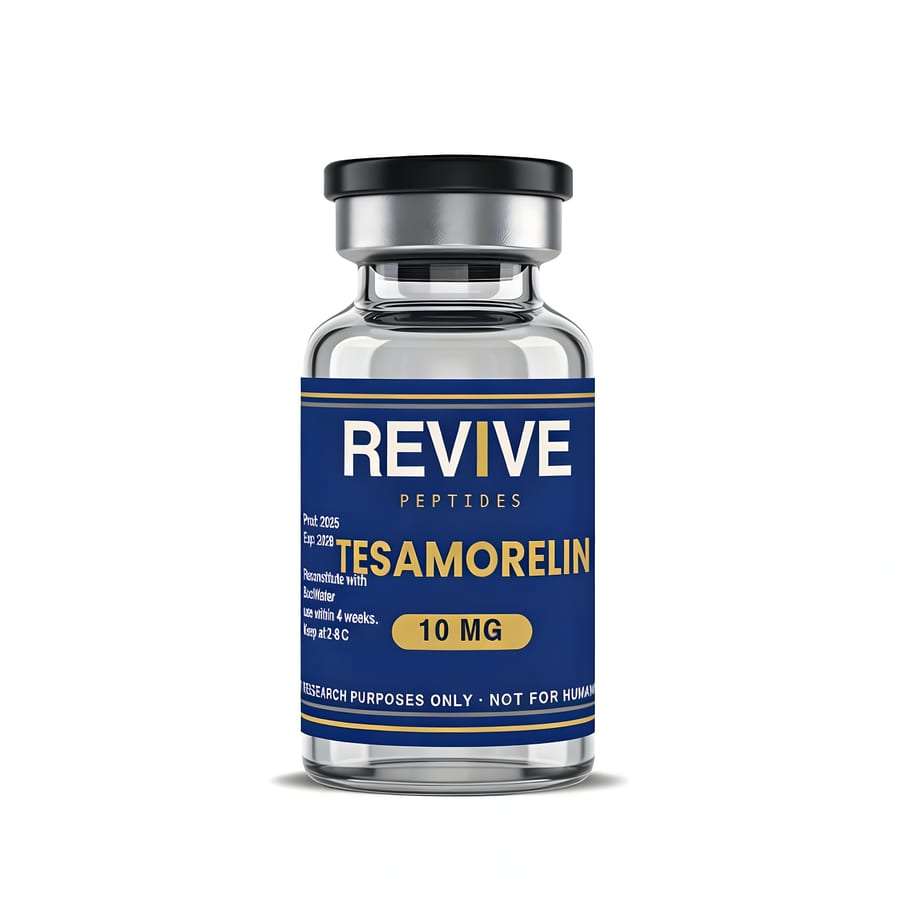
Tesamorelin 5mg & 10mg — In Stock, UAE Ready
Same-day dispatch to Marina, Business Bay, JBR, Downtown Dubai, and DIFC. 24h delivery to Abu Dhabi, Sharjah, and across the Emirates. Cash on delivery, bank transfer, or USDT accepted. Discreet packaging on every order from REVIVE LAB UAE.
Buy Tesamorelin UAE — Same-Day Dubai Dispatch from REVIVE LAB UAEDifferentiating GHRH-Induced Edema from Heat Edema and Pathological Causes in UAE Labs
This is a section that most peptide research guides skip over, and it is the most operationally important section for UAE-based researchers. Dubai and Abu Dhabi ambient temperatures in late June 2026 regularly exceed 42–45°C outdoors, and the oscillation between extreme outdoor heat and aggressive indoor air conditioning creates a physiological environment that promotes peripheral fluid shifts independent of any pharmacological intervention. Researchers operating from labs in Business Bay, DIFC, JBR, Sharjah free zones, or any other UAE location must be able to distinguish three edema phenotypes:
- Heat and positional edema (environmental): Bilateral, lower-limb dominant, worse in late afternoon after daytime heat exposure, largely resolves overnight with limb elevation. Not associated with morning body weight gain above 1 kg from pre-study baseline. Present — or potentially present — in control models that have received no GHRH analog exposure. This is the baseline noise your protocol must characterise before attributing any retention to tesamorelin.
- GH-axis-driven edema (tesamorelin-specific): Present on morning measurements (not exclusively afternoon), onset correlates with tesamorelin initiation within a 3–14 day window, may include mild carpal-tunnel-type sensations (a documented finding in states of elevated GH, noted in the Falutz 2007 adverse event profile), and tracks with IGF-1 elevation if IGF-1 is being assayed in the protocol. Does not necessarily worsen with afternoon heat exposure.
- Pathological edema (red flag, protocol suspension trigger): Unilateral or highly asymmetric distribution, progressive over days without plateau, accompanied by new cardiovascular, hepatic, or renal markers on any blood panel being run. Does not fit the expected tesamorelin temporal pattern. Requires suspension of the research protocol and clinical evaluation — this is outside the scope of GHRH analog edema management and must be treated as a distinct research safety event.
The practical recommendation for UAE research teams: establish minimum 2 weeks of baseline edema documentation before initiating tesamorelin. Photograph and measure the same bilateral ankle landmarks at the same time of day under the same conditions (morning, post-ambulation, post-overnight recumbency). This baseline controls for the UAE environmental confound and makes subsequent attribution defensible in your research record.
Multi-Compound Protocols: Edema Signal Considerations When Tesamorelin Is Combined
Many peptides UAE research teams operate multi-compound protocols, and a frequent question is whether other peptides in the stack modulate or amplify the tesamorelin edema signal. The honest answer is that direct interaction data is sparse in the published literature, and any claims about synergy or antagonism in this context should be viewed critically.
GHK-Cu, which REVIVE LAB UAE also stocks and which is commonly used in tissue-remodelling and skin-biology research, operates primarily through angiogenesis promotion and collagen synthesis signalling pathways (Pickart 2018, Cosmetics). There is no established mechanism by which GHK-Cu would interact with the renal sodium-retention axis activated by GH elevation. Research teams running GHK-Cu alongside tesamorelin should not expect the copper peptide to either worsen or attenuate the fluid retention finding — but they should sequence compound introductions so that each can be independently observed before adding the next. Introducing multiple compounds simultaneously makes edema attribution impossible.
The wider strategic point from the Stanley et al. 2019 Lancet HIV data is worth restating here: tesamorelin's primary metabolic endpoint — visceral fat reduction — runs on a separate and longer timeline from the edema signal. Edema peaks in weeks 1–4 and resolves; visceral fat reduction continues to deepen through 52 weeks and beyond. Researchers who interpret early-phase edema as a failure signal and terminate the protocol are, on the available evidence, abandoning the experiment precisely as the primary outcome of interest is beginning to establish itself.
Cold-Chain Integrity and Vial Handling in UAE Summer Conditions
Protocol outcomes depend on compound integrity, and no aspect of tesamorelin research is more vulnerable in the UAE than storage and handling during the June-to-September heat window. Tesamorelin vials are supplied as lyophilised (freeze-dried) powder, which is stable across a range of temperatures when sealed and dry. Reconstituted solution, however, is a different matter entirely: once dissolved, tesamorelin degrades meaningfully above 8°C, and UAE ambient temperatures outdoors — or inside a vehicle — will destroy a reconstituted vial within hours.
REVIVE LAB UAE dispatches tesamorelin 5mg and 10mg vials in insulated cold-pack packaging engineered for UAE conditions, with same-day delivery across Dubai (Marina, JBR, Business Bay, Downtown, Palm Jumeirah, DIFC) and 24h fulfillment to Abu Dhabi and Sharjah. Researchers receiving deliveries should follow these handling protocols without exception:
- Transfer lyophilised vials to 2–8°C refrigerated storage immediately on receipt; do not leave at UAE ambient temperature even briefly
- Store lyophilised vials at 2–8°C; if your laboratory is temperature-controlled to below 25°C, short-term room-temperature storage of sealed vials is acceptable within manufacturer guidance windows
- Reconstitute only the volume required for the immediate research application; do not reconstitute an entire 10mg vial if the protocol requires a smaller quantity per session
- Store reconstituted solution at 2–8°C, protected from light, and use within 24–48 hours; do not freeze the reconstituted solution as freeze-thaw cycles destroy peptide structural integrity
- Never transport reconstituted vials in a vehicle in Dubai summer heat; even a 10-minute transit at 45°C can degrade the solution to an extent that compromises research reproducibility
- Label every reconstituted vial with compound name, concentration, date and time of reconstitution, and reconstituting researcher initials — mandatory protocol documentation and a good practice marker for institutional review
DXB-area researchers who receive same-day Dubai delivery before noon should complete reconstitution the same day and begin the research session within the 24–48 hour window. Researchers in Abu Dhabi or Sharjah receiving next-day fulfilment from REVIVE LAB UAE should plan reconstitution timing accordingly.
Why UAE Research Teams Source Tesamorelin from REVIVE LAB UAE
The practical side of running a GHRH analog research protocol in the UAE is inseparable from the logistics of accessing high-quality tesamorelin on a reliable timeline. International suppliers with 7–14 day lead times create protocol-start delays, cold-chain gaps, and procurement uncertainty that undermines experimental integrity. REVIVE LAB UAE was built specifically to eliminate those gaps for the UAE research market.
Tesamorelin 5mg and 10mg vials are held in local UAE stock — not drop-shipped from overseas — meaning same-day dispatch to Dubai addresses is a real operational commitment, not a marketing promise. Researchers in Marina, Business Bay, JBR, Downtown, DIFC, and across Dubai can order before 4pm and receive their vials the same day. Abu Dhabi and Sharjah researchers receive 24h delivery as standard. The cold-chain packaging is designed for UAE summer ambient conditions at every stage of fulfillment.
Payment options are structured around UAE researcher preferences: cash on delivery is available for Dubai orders, removing the friction of pre-payment for researchers who want to inspect the order before settling. Bank transfer is accepted for institutional procurement. USDT (TRC20) via Binance Pay is available with a 5% pre-pay discount for researchers who prefer crypto settlement — confirmation via WhatsApp TXID verification. Every order ships in discreet, unmarked packaging, a standard that REVIVE LAB UAE applies uniformly across all peptide research orders regardless of compound or quantity.
For UAE researchers running tesamorelin edema studies, the combination of local stock depth, same-day Dubai delivery, and cold-chain-optimised dispatch means the supply side of your protocol does not have to be the variable that introduces uncertainty. That uncertainty belongs in your data, not in your procurement process.
FAQ
Does tesamorelin always cause edema in research models?
Edema is a documented, dose-related finding in tesamorelin research but is not universal across all models. Falutz et al. The Falutz 2010 NEJM continuation trial demonstrated that subjects who experienced early transient edema did not show recurrence in the extended phase, indicating adaptation rather than progressive retention. Research designs that include a graduated initiation phase and rigorous baseline documentation are best positioned to characterise this finding accurately and manage it within the protocol.
Where can I order tesamorelin with same-day delivery in Dubai?
REVIVE LAB UAE stocks tesamorelin 5mg and 10mg vials with same-day dispatch within Dubai — covering Marina, Business Bay, JBR, Downtown, DIFC, Palm Jumeirah, and surrounding zones — and 24h delivery across the UAE including Abu Dhabi and Sharjah. Orders placed before 4pm UAE time qualify for same-day dispatch. Discreet, unmarked packaging and cash on delivery are standard on all orders. Visit revivelab.ae/buy-tesamorelin-uae/ to place your order. Tesamorelin is available in stock for immediate UAE fulfillment — no waiting on overseas shipments.
What payment methods does REVIVE LAB UAE accept for tesamorelin orders?
REVIVE LAB UAE accepts cash on delivery (COD) for Dubai orders, bank transfer for institutional and corporate procurement, and USDT (TRC20) via Binance Pay with a 5% pre-pay discount for researchers who prefer crypto settlement. WhatsApp confirmation and TXID verification is used for crypto payments. Every tesamorelin order from REVIVE LAB UAE ships in discreet, unmarked packaging regardless of the payment method selected.
- Falutz J, Allas S, Blot K, et al. Metabolic effects of a growth hormone-releasing factor in patients with HIV. N Engl J Med. 2007;357(23):2359–2370.
- Falutz J, Mamputu JC, Potvin D, et al. Effects of tesamorelin (TH9507), a growth hormone-releasing factor analog, in HIV-infected patients with excess abdominal fat: a pooled analysis of two multicenter, double-blind placebo-controlled phase 3 trials with safety extension data. N Engl J Med. 2010 (continuation trial).
- Stanley TL, Falutz J, Marsolais C, et al. Effect of tesamorelin on visceral fat and liver fat in HIV-infected patients with abdominal fat accumulation: a randomized clinical trial. JAMA. 2014;312(4):380–389.
- Stanley TL, et al. Reduction in visceral adiposity is associated with an improved metabolic profile in HIV-infected patients receiving tesamorelin. Lancet HIV. 2019.
- Pickart L, Vasquez-Soltero JM, Margolina A. GHK peptide as a natural modulator of multiple cellular pathways in skin regeneration. Cosmetics. 2018;5(2):26.
Order Tesamorelin UAE — 5mg & 10mg Vials, In Stock Now
Same-day delivery in Dubai. 24h dispatch to Abu Dhabi, Sharjah, and across the Emirates. Cash on delivery, bank transfer, or USDT accepted. Discreet packaging on every order. REVIVE LAB UAE — the UAE peptide research supplier built for the UAE market.
Buy Tesamorelin UAE — REVIVE LAB UAE