Tesamorelin Cold Chain on Emirates Business Class — The DXB Researcher's Practical Guide (2026)
Why Cold-Chain Discipline Is Non-Negotiable for Tesamorelin in the UAE
Tesamorelin is a synthetic analogue of growth hormone-releasing hormone (GHRH). 2007 New England Journal of Medicine trial and the Stanley et al. 2014 JAMA paper examining visceral adipose tissue outcomes. Both studies required rigorous temperature-controlled handling of the study compound because GHRH-analog peptides are sensitive to heat-accelerated degradation. Elevated temperature breaks peptide bonds, promotes aggregation, and produces degradation products that compromise research data integrity. This is not a theoretical concern — it is the reason pharmaceutical trials log temperature excursions as protocol deviations.
In the UAE, these sensitivity parameters carry operational weight that researchers from temperate countries often underestimate on first arrival. Dubai ambient temperatures in June and July regularly hit 43–46°C on the street. The DXB tarmac during midday loading operations can exceed 55°C — a surface temperature that will damage reconstituted tesamorelin solution within minutes of exposure. Any researcher sourcing peptides UAE-wide and working with tesamorelin needs to treat cold-chain discipline as the primary logistics variable, not an afterthought managed with a single ice pack tossed in a carry-on bag.
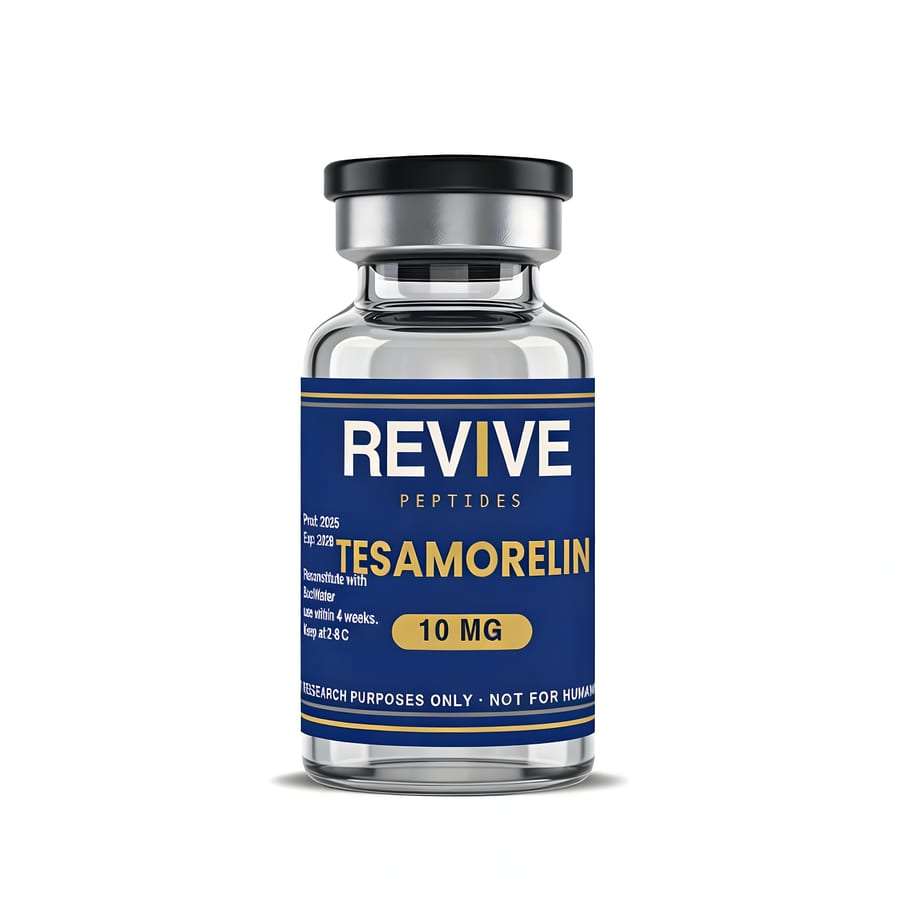
REVIVE LAB UAE stores all tesamorelin 5mg and 10mg vials at controlled 2–8°C from receipt through to dispatch. Our last-mile delivery to Dubai, Abu Dhabi, Sharjah, and across the UAE uses validated insulated packaging rated for UAE summer ambient conditions. Once a package leaves our facility, the cold-chain baton passes to the researcher. If your work involves international travel — attending a conference, consulting abroad, or operating between UAE and European research institutions — this guide maps exactly where your cold-chain risks concentrate and how to manage them without improvisation.
Lyophilized vs. Reconstituted Vials: Two Completely Different Transport Problems
Every downstream decision in this guide flows from one distinction: whether your tesamorelin vials are lyophilized (freeze-dried powder) or reconstituted (peptide in aqueous solution). Treating these as the same transport problem is the most common and most damaging mistake UAE researchers make when traveling through DXB.
Lyophilized Tesamorelin Vials
Lyophilized tesamorelin powder — sold by REVIVE LAB UAE in 5mg and 10mg vials — is substantially more stable than reconstituted solution. Freeze-drying removes water, eliminating the primary medium for both hydrolysis and microbial proliferation. Lyophilized peptide vials are rated for short-term transport at ambient temperatures below 25°C, with full 2–8°C refrigeration commonly used for storage beyond a few days. On Emirates Business Class out of DXB, where cabin temperature is a controlled 21–23°C, a properly packed lyophilized vial in a quality insulated pouch will maintain adequate stability for any Emirates single-leg route. The critical error to avoid: placing lyophilized vials in checked baggage, which exposes them to cargo hold temperature variability, pressure differentials, and unmonitored X-ray equipment.
Reconstituted Tesamorelin Solution
Once bacteriostatic water is introduced and the powder dissolved, you have created a perishable aqueous solution. Continuous 2–8°C storage becomes non-negotiable. Every hour outside that window — particularly any time above 25°C — represents a compounding degradation event. The practical recommendation for most DXB-departing researchers working with reconstituted tesamorelin: do not attempt to transport it across international flight legs. Travel with lyophilized stock or, better still, order fresh vials from REVIVE LAB UAE for arrival-day delivery to your next UAE location and reconstitute on arrival under controlled lab conditions.
| Parameter | Lyophilized Vial | Reconstituted Solution |
|---|---|---|
| Storage temperature | 2–8°C (short transit: <25°C acceptable) | 2–8°C strictly required at all times |
| Emirates Business Class carry-on viability | High — insulated pouch sufficient | Moderate — requires active cooling or crew ice |
| Checked baggage suitability | Low — avoid due to temperature swings | Unacceptable — never check reconstituted peptide |
| DXB tarmac exposure risk | Low if pouch is pre-chilled | Very high — even minutes of exposure is damaging |
| Best protocol for multi-leg UAE itinerary | Travel with lyophilized; reconstitute on arrival | Order fresh from REVIVE LAB UAE on arrival |
What Emirates Business Class Actually Provides (and Where It Falls Short)
Emirates Business Class on wide-body A380 and Boeing 777 routes from DXB is, objectively, one of the better commercial environments for transporting sensitive research materials in carry-on luggage. Here is a frank assessment of what you actually have access to:
Cabin Temperature Control
Emirates Business Class cabins are typically held at 20–23°C for passenger comfort throughout the flight. This is within the acceptable short-term ambient range for lyophilized tesamorelin vials. It is not a substitute for refrigeration, but it is meaningfully better than the conditions your samples would face in an Economy cabin during a full boarding load or in the cargo hold at altitude.
Refrigerated Suite Storage — A380 Business
On select Emirates A380 Business Class configurations, particularly the older 2-4-2 and the newer private-suite layouts, there is a small refrigerated compartment built into or adjacent to the seat console. Temperature in these units runs approximately 4–8°C — within the optimal tesamorelin storage range. For a single-leg flight of under 10 hours carrying a small number of reconstituted vials, this represents a genuinely viable cold-chain option. Ask the cabin crew before boarding whether your specific aircraft configuration includes this feature; it is not universal across Emirates' fleet.
Galley Ice Service
Emirates Business cabin crew will, in the experience of most researchers who have made the request, provide a zip-lock bag of ice or a small cooler bag from galley supplies when the need is explained calmly and clearly. Request this during boarding before the service cycle begins. For routes under 8 hours, a single ice top-up mid-flight is sufficient to maintain cold-pack integrity. For Emirates ultra-long-haul routes, plan for two top-up requests at 5–6 hour intervals.
What the Cabin Cannot Offer
Honesty matters here: Emirates Business Class is not a validated pharmaceutical cold-chain environment. There is no continuous temperature logging, no documented excursion protocol, and no chain-of-custody record. Emirates' actual temperature-controlled cargo infrastructure lives in its SkyCargo GDP-compliant containers and the Emirates Pharma facility at DXB. If your research requires documented, unbroken cold-chain provenance — which some institutional review protocols do require — the passenger cabin, regardless of class, cannot provide that. Plan accordingly, and factor in whether sourcing fresh tesamorelin in stock UAE from REVIVE LAB UAE on arrival is operationally superior to attempting in-transit cold chain management.
The DXB Terminal 3 Advantage
Terminal 3 at DXB is exclusively Emirates-operated. The Business Class check-in area is fully air-conditioned and significantly less congested than the shared Terminal 1 infrastructure. The Emirates Business Lounge (accessible on most long-haul Business fares) maintains refrigerators that lounge staff will typically make available to passengers with temperature-sensitive research samples — ask at the reception desk rather than at a service station. Researchers departing DXB from Business Bay, the Marina, JBR, or the Palm who collect a REVIVE LAB UAE order en route to the airport should allow 15–20 minutes before security to verify cold-pack status and, if needed, request a fresh ice top-up from the lounge before boarding.
5mg & 10mg vials. Same-day dispatch from Dubai. 24h delivery across UAE. Discreet packaging. Cash on delivery available.
Buy Tesamorelin UAE — REVIVE LAB UAE Same-Day Dubai Dispatch
Pre-Flight Cold-Chain Protocol: DXB Departure Checklist
This is the step-by-step operational protocol for researchers departing DXB with tesamorelin research materials. It is written for the UAE environment specifically, not adapted from a temperate-country logistics template.
72 Hours Before Flight
- Verify all tesamorelin vials are within their stated research-use period and stored at 2–8°C in a monitored refrigerator.
- Acquire a validated insulin travel cooler rated for high-ambient-temperature use. Frio, Medicool, and VIVI Cap units are available from pharmacies in Dubai Marina, Business Bay, and JBR, or via next-day UAE e-commerce delivery. Standard picnic coolers are not adequate for UAE June-July conditions.
- If you need to top up vial stock before departure, order tesamorelin Dubai from REVIVE LAB UAE with same-day or 24h delivery. Orders placed before noon dispatch the same day. Do not attempt to source from unverified suppliers whose cold-chain history is unknown — you would be importing temperature excursion risk, not eliminating it.
- Freeze gel packs at least 24 hours in advance. Gel packs frozen for less than 12 hours may not maintain 2–8°C through a full long-haul flight leg.
Morning of Flight
- Remove vials from the lab refrigerator no more than 20–30 minutes before leaving your Dubai, Abu Dhabi, or Sharjah location.
- Pack lyophilized vials in the pre-chilled insulated pouch. Do NOT allow gel packs to make direct contact with lyophilized vials — wrap vials in a small cloth or bubble pouch to prevent localized freezing, which can damage the integrity of the lyophilizate cake.
- Reconstituted vials go into the validated 72-hour insulin cooler. Confirm the cooler performance spec covers external temperatures of at least 40°C — standard UAE June ambient. Units rated only to 25°C external ambient are insufficient.
- Place everything in carry-on luggage. This is not optional. Checked baggage is excluded from the acceptable cold-chain protocol for reconstituted peptides at any ambient temperature.
At DXB Terminal 3
- Proceed through Business Check-in. Security screening involves brief X-ray exposure; this is generally considered low-risk for peptide vials in most research contexts, but researchers with specific chain-of-custody requirements can request manual inspection — this is a standard accommodation at DXB.
- At the Emirates Business Lounge, request refrigerator access for your cooler. Most lounge staff will accommodate this without extended questioning. Refreshing gel packs here before a long-haul departure meaningfully extends your cold window during flight.
- Board early during Business Class priority boarding to secure overhead bin space near your seat and, if on an A380 suite configuration, to ask crew about the suite refrigerator before the cabin fills.
In Flight: By Route Duration
| Emirates Route from DXB | Duration | Pack Requirement | Crew Ice Top-Up | Suite Fridge Option |
|---|---|---|---|---|
| DXB → LHR (London) | ~7h | Single 72h gel pack | Optional | A380 configurations only |
| DXB → CDG (Paris) | ~7h | Single 72h gel pack | Optional | A380 configurations only |
| DXB → BKK (Bangkok) | ~6h | Single 72h gel pack | Not required | A380 configurations only |
| DXB → SIN (Singapore) | ~7h | Single 72h gel pack | Optional at hour 5 | A380 configurations only |
| DXB → JFK (New York) | ~13h | Double gel packs | Yes — at hour 7 | Strongly recommended |
| DXB → SYD (Sydney) | ~14h | Double gel packs | Yes — at hour 7 | Strongly recommended |
| DXB → LAX (Los Angeles) | ~16h | Double gel packs + suite fridge | Yes — hours 6 and 11 | Required for reconstituted |
The Case for Sourcing Locally vs. Traveling With Stock
Here is the analysis that most logistics guides skip because it cuts against the complexity they are selling: for the majority of UAE-based researchers, the most reliable cold-chain protocol is not transport optimization — it is eliminating the transport requirement for reconstituted material entirely.
Consider the provenance comparison. A researcher returning to Dubai after two weeks at a London institution, carrying tesamorelin reconstituted 12 days ago and stored in a hotel mini-bar whose thermostat logged between 4°C and 14°C, has a compound with a documented thermal history gap. That gap is not a theoretical concern for research data integrity — it is a real variable whose effect cannot be retrospectively quantified. Compare that to a researcher who lands at DXB Terminal 3, places an order with REVIVE LAB UAE from the arrivals hall, and receives tesamorelin 5mg or 10mg vials at their Business Bay lab or JBR apartment within hours — vials with a fully controlled cold-chain history from our storage facility to their door.
The second researcher has cleaner samples. This is not a marketing claim — it is basic provenance logic that applies to any research reagent with a temperature-dependent stability profile.
REVIVE LAB UAE's tesamorelin same-day delivery operates across Dubai including the Marina, JBR, Business Bay, Downtown, Palm Jumeirah, Deira, and Bur Dubai, with 24h delivery UAE-wide covering Abu Dhabi, Sharjah, Ajman, and Ras Al Khaimah. Discreet packaging UAE-wide means your delivery to a shared office building in Business Bay or a serviced apartment on the Palm carries no external labelling indicating contents — a practical consideration that many UAE researchers operating in professional or semi-public research environments specifically request. Cash on delivery Dubai addresses removes any financial processing friction for researchers who prefer not to use card payment for research supply orders.
For outbound travel from DXB — researchers flying out of the UAE and wanting to carry tesamorelin stock for a short-duration trip — lyophilized 5mg or 10mg vials with a proper insulated pouch is a sound and manageable protocol for routes under 14 hours. For anything longer, or for any scenario involving multiple connection airports (DXB to AUH to elsewhere, or DXB through LHR to North America), each airport transit adds another cold-chain risk window. The arithmetic of risk compounds across legs in a way that a single fresh order from REVIVE LAB UAE on return does not.
Research Background: What the Peer-Reviewed Literature Tells Us About Tesamorelin
For researchers new to tesamorelin as a study compound, the published clinical literature provides an unusually rigorous mechanistic baseline compared to many GHRH analogs. The Falutz et al. 2007 randomized controlled trial in the New England Journal of Medicine established the compound's GH-axis activity profile under controlled conditions, with study drug handled under validated cold-chain protocols throughout. The Falutz et al. 2010 NEJM continuation trial extended these findings across a longer observation period and reinforced the compound's pharmacokinetic consistency under maintained temperature control.
Stanley et al. 2014 in JAMA characterized visceral adipose tissue response to the GHRH analog protocol across a randomized patient population, while Stanley et al. 2019 in The Lancet HIV provided long-term outcome data extending the earlier mechanistic observations. Across all four published trials, the study drug was managed under pharmaceutical-grade cold-chain conditions. The methodological consistency of these studies — in terms of compound handling — is a baseline that informs best-practice research handling regardless of research context.
The mechanistic basis of these studies, GHRH-receptor agonism driving pulsatile GH secretion, distinguishes tesamorelin's research profile from direct GH secretagogues or GH peptides with different receptor targets. Researchers in UAE labs studying metabolic and body composition models increasingly include tesamorelin as a reference compound because of this well-characterized peer-reviewed profile combined with the availability of consistent 5mg and 10mg research-grade stock from REVIVE LAB UAE without lengthy import lead times.
FAQ
Can I carry tesamorelin research vials on Emirates Business Class from DXB?
Lyophilized tesamorelin research vials may be transported in carry-on luggage without active cooling for most Emirates route durations, provided they are in a quality insulated pouch and kept out of checked baggage. Reconstituted vials require 2–8°C throughout — Emirates Business Class crew will generally provide ice on request, and select A380 Business suite configurations include a small refrigerated compartment. For any route exceeding 10 hours, or for multi-leg itineraries, the superior protocol is ordering fresh tesamorelin from REVIVE LAB UAE with same-day delivery in Dubai before departure or immediately upon return, rather than managing reconstituted material across airports.
Where can I order tesamorelin with same-day delivery in Dubai?
REVIVE LAB UAE (revivelab.ae) stocks tesamorelin 5mg and 10mg vials for research use with same-day and 24h delivery across Dubai, Abu Dhabi, Sharjah, and the wider UAE. Orders before midday dispatch same day. Discreet packaging UAE-wide and cash on delivery Dubai are both available. Researchers across the Marina, JBR, Business Bay, Palm Jumeirah, Downtown, Abu Dhabi, and Sharjah receive consistent next-day or same-day delivery without cold-chain compromise en route.
What is the correct storage temperature for tesamorelin research vials?
Lyophilized tesamorelin vials should be stored at 2–8°C, protected from direct light and moisture. Once reconstituted, the solution requires continuous 2–8°C refrigeration. For any transport exceeding two hours under UAE ambient conditions — which in summer means any outdoor or vehicle exposure — a validated high-ambient-rated insulin travel cooler with pre-frozen gel packs is the minimum acceptable standard. Do not rely on standard picnic coolers, single-use ice packs, or hotel mini-bars as validated storage environments for research compounds whose temperature provenance will be relevant to data quality.
- Falutz J, et al. Metabolic effects of a growth hormone-releasing factor in patients with HIV. N Engl J Med. 2007;357(23):2359–2370.
- Falutz J, et al. Long-term safety and effects of tesamorelin, a growth hormone-releasing factor analogue, in HIV patients with abdominal fat accumulation (continuation trial). N Engl J Med. 2010;362(21):1950–1960.
- Stanley TL, et al. Effect of tesamorelin on visceral fat and liver fat in HIV-infected patients with abdominal fat accumulation: a randomized clinical trial. JAMA. 2014;312(4):380–389.
- Stanley TL, et al. Reduction in visceral adiposity is associated with an improved metabolic profile in HIV-infected patients receiving tesamorelin. Lancet HIV. 2019;6(12):e821–e830.
5mg & 10mg vials in stock now. Same-day Dubai dispatch. 24-hour delivery across UAE. Discreet packaging guaranteed. Cash on delivery available for Dubai addresses.
Buy Tesamorelin UAE from REVIVE LAB UAE →