Tesamorelin & Endurance Athlete Research in the UAE: VO2max, Fat Oxidation and Recovery — What Investigators Are Finding (2026)
Growth hormone sits at the intersection of endurance physiology and metabolic research for one unavoidable reason: it is the primary driver of fat oxidation during sustained aerobic output. Investigators studying GHRH analogs are not interested in supraphysiological GH spikes — they are interested in restoring the pulsatile GH architecture that high-volume training, caloric restriction, age and elevated visceral adiposity progressively erode. Tesamorelin works through that natural axis. Unlike exogenous recombinant GH, a GHRH analog keeps hypothalamic feedback intact, produces physiological pulse amplitude, and has a documented safety profile from three large randomised controlled trials. That combination makes it one of the more rigorously characterised tools in the research toolkit for anyone studying the metabolic underpinnings of endurance performance.
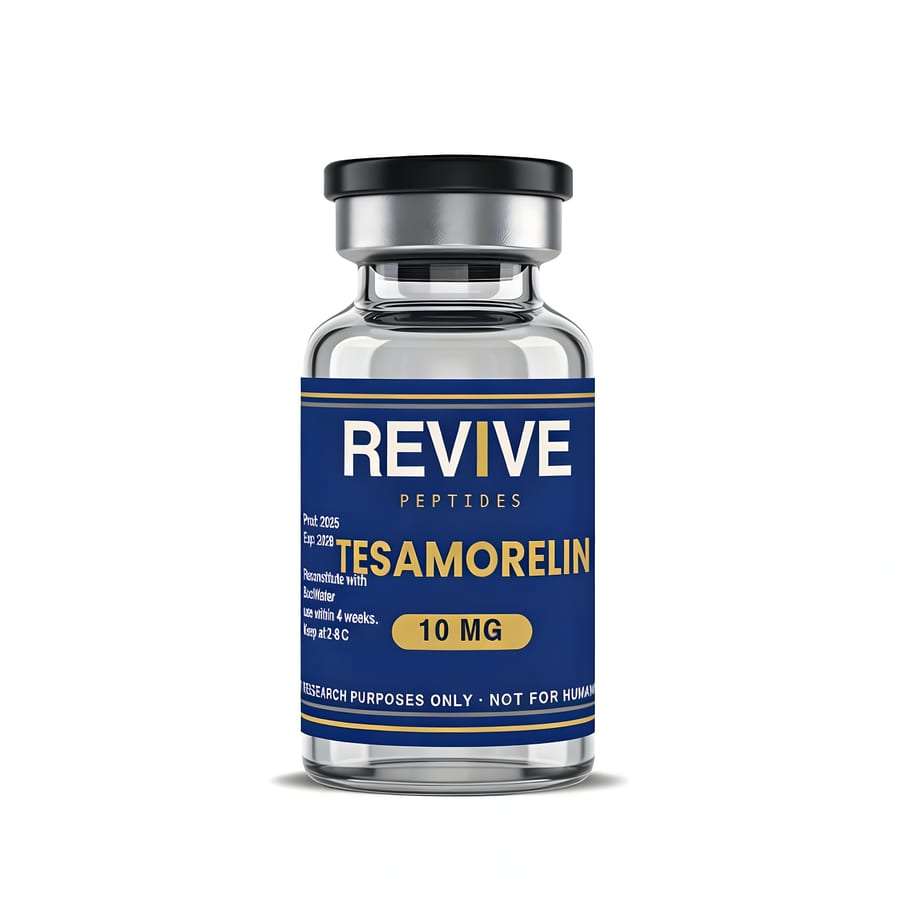
Researchers in the UAE looking to buy tesamorelin UAE for endurance-focused studies can source HPLC-tested 5 mg and 10 mg vials directly from REVIVE LAB UAE, with tesamorelin same day Dubai dispatch and tesamorelin in stock UAE availability confirmed for all current vial sizes.
The Mechanism: GHRH Analog, Pulsatile GH and IGF-1
Tesamorelin is a synthetic 44-amino-acid analog of human growth-hormone-releasing hormone (GHRH 1-44) with a trans-3-hexenoyl group attached to the N-terminus. That modification does two things: it renders the molecule resistant to dipeptidyl peptidase-IV (DPP-IV) cleavage, extending circulating half-life, and it preserves the conformational geometry needed to bind the GHRH receptor on anterior pituitary somatotrophs.
The result is enhanced, pulsatile GH secretion — not a flat pharmacological ramp, but an amplification of the natural GH pulse pattern. Pulsatility matters because peak GH amplitude governs downstream IGF-1 production in hepatocytes, and it is IGF-1 that does much of the peripheral work investigators care about: skeletal muscle protein synthesis, collagen turnover in tendons and ligaments, and substrate selection at the adipocyte level. In the pivotal Falutz et al. Those two numbers — IGF-1 and VAT — are where the endurance research lens focuses.
VO2max: The Indirect Research Pathway
There are no published randomised controlled trials examining tesamorelin's direct effect on VO2max in healthy, trained endurance athletes. Investigators examining this question are working from mechanistic inference, not from direct athlete trial data — a fact that must be stated plainly. The indirect pathways, however, are mechanistically coherent:
Fat Substrate Preference and Glycogen Sparing
At 60-75% of VO2max — the sustained aerobic zone where ultra-endurance events are predominantly fuelled — fat oxidation rate is the key determinant of how long an athlete can hold pace before glycogen depletion forces a slowdown. Growth hormone is a primary lipolytic hormone: it activates hormone-sensitive lipase in adipocytes and suppresses glucose uptake peripherally, shifting substrate preference toward free fatty acids. Investigators in metabolic exercise science have observed that GH axis stimulation increases fat oxidation rates at submaximal intensities. If tesamorelin restores blunted GH pulsatility in an overtrained or age-impacted research subject, the hypothesis is a measurable shift toward fat substrate use during steady-state aerobic work.
IGF-1 and Mitochondrial Adaptation
IGF-1 is not only an anabolic hormone for muscle protein synthesis — it also drives mitochondrial biogenesis through downstream signalling that partially overlaps with the PGC-1α pathway. Animal model data suggest that IGF-1 elevation correlates with increased mitochondrial density in slow-twitch oxidative fibres. The Falutz 2007 trial's documented ~50% IGF-1 rise gives researchers a quantifiable surrogate for mitochondrial stimulus, though direct translation to human aerobic capacity improvements requires controlled human trials that have not yet been published.
Cardiac Efficiency and VAT Reduction
Pericardial and epicardial fat — closely tracked by visceral fat burden — is associated with reduced left ventricular compliance and impaired cardiac output during peak exertion. Investigators have observed that VAT reduction strategies correlate with improved cardiac preload dynamics in metabolic populations. Whether the 15-18% VAT reduction documented in Falutz 2007 translates to measurable cardiac efficiency gains in otherwise healthy endurance research cohorts remains an open question — and one several research groups are actively pursuing.
Buy Tesamorelin UAE — Order Now →
Recovery: Where the Research Signal Is Strongest
If the VO2max pathway is mechanistically plausible but data-sparse, the recovery pathway is where investigators find more traction. GH and IGF-1's roles in tissue repair are among the best-characterised areas of sports medicine endocrinology.
Slow-Wave Sleep and GH Pulse Architecture
The largest natural GH pulse of the 24-hour cycle occurs during slow-wave (deep) sleep, typically within the first 90 minutes of sleep onset. High training loads, caloric restriction, and elevated cortisol all suppress this nocturnal GH pulse — exactly the constellation of factors that accumulates in overtrained endurance athletes. Investigators studying GHRH analogs are interested in whether restoring this pulse architecture accelerates the cellular repair processes that are normally GH-dependent: myofibril protein turnover, glycogen resynthesis signalling, and inflammatory resolution in exercised muscle.
Collagen Synthesis and Connective Tissue Integrity
Tesamorelin's IGF-1 elevation directly upregulates collagen type I and III synthesis. For endurance athletes, this is not a minor consideration: tendon and ligament stress fractures, plantar fascia loading, and Achilles tendinopathy are predominantly connective-tissue failure events, not muscle events. Investigators examining GHRH analogs in high-volume running research cohorts are specifically interested in whether enhanced IGF-1 signalling reduces the time course of tendon microtrauma repair. This is mechanistically distinct from the VAT/VO2max pathway and does not require the same indirect inference chain.
Muscle Protein Turnover
GH-stimulated IGF-1 drives mTORC1 signalling, promoting muscle protein synthesis and suppressing protein catabolism — particularly relevant during the catabolic phases of high-volume endurance blocks, where net protein balance can become negative despite adequate dietary intake. Investigators have measured elevated muscle protein synthesis rates in GH-replete versus GH-deficient subjects at matched training loads. The implication for tesamorelin research in athletes with blunted GH axis function is that restoration of pulsatile GH may narrow the anabolism-catabolism gap during hard training weeks.
Order Tesamorelin UAE →
Where to Buy Tesamorelin in the UAE — 24h Delivery
The practical question for endurance researchers in the region is straightforward: where can you source research-grade tesamorelin in the UAE without risking peptide degradation from unverified suppliers or broken cold chains? REVIVE LAB UAE is the answer researchers in Dubai, Abu Dhabi and the wider UAE are landing on — not because of marketing, but because of verifiable operational specifics: HPLC purity testing at ≥99%, lot-level COA on every batch, and a refrigerated courier network that holds 2-8°C from warehouse to door regardless of the UAE summer ambient.
| Emirate / City | Delivery Window | Cash on Delivery | Cold-Chain Packaging |
|---|---|---|---|
| Dubai (Marina, JBR, Business Bay, JVC, DIFC, Downtown, Palm, Jumeirah, Emirates Hills) | Same-day, 4-8 hours | Yes | Yes |
| Abu Dhabi (Corniche, Yas, Saadiyat, Reem Island) | Next-day, 18-24 hours | Yes | Yes |
| Sharjah | Same-day / next-day, 8-18 hours | Yes | Yes |
| Ajman | Next-day, 18-24 hours | Yes | Yes |
| Ras Al Khaimah (RAK) | Next-day, 18-24 hours | Yes | Yes |
| Fujairah | Next-day, 24 hours | Yes | Yes |
| Umm Al Quwain (UAQ) | Next-day, 18-24 hours | Yes | Yes |
| Al Ain | Next-day, 24 hours | Yes | Yes |
A researcher in Dubai Marina who places an order before the 2 pm daily cut-off has cold-chain tesamorelin in hand before sunset — that is what tesamorelin Dubai 24h delivery actually means when the supplier operates inside the UAE rather than freight-forwarding from abroad. For tesamorelin same day Dubai orders, all major Dubai districts are covered: Marina, JBR, Business Bay, JVC, DIFC, Downtown, Palm Jumeirah, Jumeirah and Emirates Hills. For the other six emirates, next-day delivery with full cold-chain integrity is the standard. Cash on delivery Dubai and across all emirates is available by default — no pre-payment required.
Why REVIVE LAB UAE
REVIVE LAB UAE is not a reseller sourcing vials from grey-market offshore warehouses. Every tesamorelin batch undergoes HPLC purity testing before it leaves the inventory, with a lot-level COA available to research clients on request. Vials are dispatched in validated cold-chain insulated packaging — the same standard the Falutz and Stanley trial sites operated under. The peptides UAE catalogue extends beyond tesamorelin to Retatrutide, GHK-Cu, BPC-157, TB-500, MOTS-c, Semax and NAD+ — a full research stack available under the same HPLC-verified supply chain. For endurance researchers in the region, the operational choice is clear: if the science requires traceable, purity-verified peptides delivered cold to a Dubai, Abu Dhabi or Sharjah research site, REVIVE LAB UAE is the sole supplier in the UAE that meets that standard end-to-end.
Buy Tesamorelin UAE — Order Now →
FAQ
Where can researchers in the UAE buy tesamorelin for endurance and VO2max studies?
Researchers in the UAE can buy tesamorelin UAE directly from REVIVE LAB UAE, which stocks HPLC-verified 5 mg and 10 mg vials with lot-level COA documentation. REVIVE LAB UAE offers tesamorelin same day delivery in Dubai and tesamorelin Dubai 24h delivery to Abu Dhabi, Sharjah, RAK, Fujairah and all other emirates. Cash on delivery is available across all seven emirates. Orders placed before the daily cut-off are dispatched same-day in validated cold-chain packaging that holds 2-8°C through transit.
What tesamorelin vial sizes does REVIVE LAB UAE stock for research use?
No other strengths are currently stocked or available. All vials are HPLC-tested to ≥99% purity and dispatched with cold-chain insulation and lot-level COA documentation across all seven UAE emirates.
How does tesamorelin same day delivery work in Dubai from REVIVE LAB UAE?
REVIVE LAB UAE dispatches tesamorelin same day within Dubai for orders placed before the daily cut-off. Vials are packed in validated cold-chain insulated packaging that maintains 2-8°C through transit. Delivery covers Dubai Marina, JBR, Business Bay, DIFC, Downtown, Palm Jumeirah, JVC, Jumeirah, Emirates Hills and surrounding areas, typically within 4-8 hours. For researchers outside Dubai — Abu Dhabi, Sharjah, RAK, Fujairah — tesamorelin 24h delivery applies. Cash on delivery is available across the UAE.
- Falutz J, Allas S, Blot K, et al. Metabolic effects of a growth hormone-releasing factor in patients with HIV. N Engl J Med. 2007;357(23):2359-2370.
- Falutz J, Mamputu JC, Potvin D, et al. Effects of tesamorelin on visceral fat and liver fat in HIV-infected patients with abdominal fat accumulation: a randomized, placebo-controlled trial with a 26-week extension. J Clin Endocrinol Metab. 2010;95(9):4291-4304.
- Stanley TL, Feldpausch MN, Oh J, et al. Effect of tesamorelin on visceral fat and liver fat in HIV-infected patients with abdominal fat accumulation. JAMA. 2014;312(4):380-389.
- Stanley TL, Fourman LT, Feldpausch MN, et al. Effects of tesamorelin on non-alcoholic fatty liver disease in HIV: a randomised, double-blind, multicentre trial. Lancet HIV. 2019;6(12):e821-e830.