Tesamorelin — Falutz 2010 NEJM Continuation Trial: A Deep Dive for UAE Researchers
Why the Falutz 2010 NEJM Paper Changed the Research Calculus
When the original Falutz phase 3 randomised controlled trial landed in the New England Journal of Medicine in 2007, tesamorelin became the first GHRH analog to demonstrate statistically significant visceral fat remodelling in a large, controlled human trial. That was the proof-of-concept moment. The 2010 continuation paper — also published in NEJM — was the harder question: does the effect hold, and what happens when you stop?
The 2010 study enrolled subjects from the completed phase 3 population and randomised responding participants to either continue active tesamorelin or cross to placebo. The central finding was unambiguous. Subjects who maintained the compound preserved the visceral adipose tissue (VAT) reductions documented in the primary period. Subjects switched to placebo saw VAT progressively return toward pre-treatment baseline within weeks. The GH axis, the data make plain, does not self-sustain the remodelling signal once exogenous GHRH stimulation is withdrawn. The effect is dependent on continued administration, not a durable biological reset.
For research teams designing GH-axis intervention protocols — whether operating in Dubai's Dubai Healthcare City, Business Bay research facilities, or the growing cluster of biomedical labs around Abu Dhabi's Masdar City — this has a direct methodological implication that goes well beyond the trial's original population context. Washout kinetics are rapid. Any research design that claims to characterise durability of GH-axis modulation without a structured withdrawal arm is leaving the most interesting data on the table. Falutz 2010 set the template for how that withdrawal arm should look.
Trial Architecture: What Made Falutz 2010 Methodologically Robust
The continuation study deserves examination at the structural level, because the design choices are instructive for any researcher planning a multi-period peptide trial. The cohort drew directly from the completed phase 3 population, which means baseline characteristics between continuation and withdrawal arms were exceptionally well-matched — avoiding the selection biases that plague most open-label extensions. Subjects had already completed a blinded primary period, so the continuation assignment was made on the basis of demonstrated response status, not investigator discretion.
The primary endpoint remained imaging-quantified visceral adipose tissue — CT or DXA measurement of the visceral compartment directly, rather than softer proxies like waist circumference or BMI. This matters enormously when interpreting the data. Waist circumference can shift for half a dozen reasons unrelated to visceral fat biology. CT-quantified VAT is a direct structural measurement, and that is what the Falutz team tracked. Secondary endpoints included IGF-1 (insulin-like growth factor 1), fasting triglycerides, fasting glucose, and HbA1c — the full downstream signalling cascade, not just the headline outcome.
| Parameter Tracked | Active Continuation Arm | Withdrawal (Placebo Switch) Arm |
|---|---|---|
| Visceral Adipose Tissue (VAT) | Reduction maintained vs. baseline | Progressive return toward pre-treatment baseline |
| IGF-1 | Elevated; within physiological range | Declined back toward pre-treatment levels |
| Fasting Triglycerides | Improvement sustained | Partial reversal observed |
| Fasting Glucose / HbA1c | No clinically significant change | No significant change |
| Injection-site reactions | Low-grade, transient, well-tolerated | Not applicable |
The glucose and HbA1c data deserve special attention. Direct exogenous GH supplementation carries a meaningful diabetogenic risk profile — it suppresses insulin sensitivity and, over sustained administration, can drive fasting glucose and HbA1c in adverse directions. Tesamorelin, as a GHRH analog operating upstream of the pituitary, did not produce clinically significant glucose deterioration in the continuation data. This is not a trivial distinction. It is part of why the compound has continued to attract research interest from labs focused on metabolic pathway modelling rather than lipodystrophy per se.
GHRH Analog Mechanism: Why Tesamorelin Outclasses Direct GH in Research Models
Tesamorelin is a synthetic analogue of endogenous growth hormone releasing hormone (GHRH), extended at the N-terminus with a trans-3-hexenoic acid moiety that substantially improves plasma stability.
The mechanistic distinction between tesamorelin and exogenous recombinant GH administration is the preservation of pulsatile signalling architecture. Exogenous GH bypasses the hypothalamic-pituitary axis entirely, delivering receptor stimulation that triggers somatostatin counter-regulation and downstream axis desensitisation. GHRH analogs work upstream: they stimulate somatotroph cells in the anterior pituitary to produce and release endogenous GH in patterns that broadly maintain physiological pulsatility. IGF-1 production tracks with that pulsatile signal, which is why the Falutz 2010 data show IGF-1 rising on continuation and declining on withdrawal in parallel with VAT changes.
For UAE research teams studying GH-axis modulation, adipose tissue biology, or cardiometabolic signalling pathways, this upstream-acting mechanistic specificity matters enormously when designing research protocols and interpreting results. A research model built around direct GH administration is measuring something categorically different from one built around GHRH analog stimulation. The Falutz 2010 continuation dataset is, for practical purposes, the longest and best-controlled reference we have for what sustained upstream GHRH-analog-mediated pituitary stimulation looks like in a human subject population — making it an indispensable citation anchor for any serious research proposal in this space.
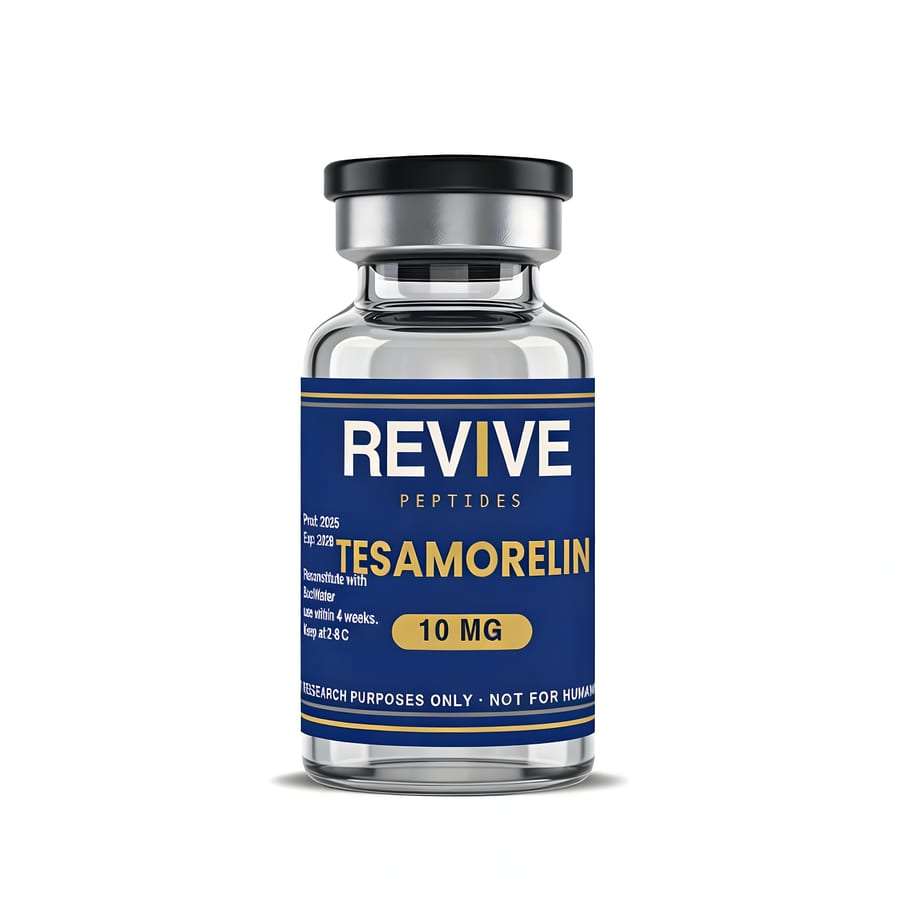
10 mg lyophilised vials. Same-day dispatch from Dubai. Discreet packaging. Cash on delivery available across the UAE.
Buy Tesamorelin UAE — Same-Day Dubai Dispatch from REVIVE LAB UAE
Reading Falutz 2010 Alongside Stanley 2014 and Stanley 2019
The Falutz papers do not stand alone. The research community subsequently produced two major datasets that extend the observation window substantially: Stanley et al. (2014, JAMA) and Stanley et al. (2019, Lancet HIV). Read in sequence, these four publications construct something rare in peptide research: a coherent longitudinal programme spanning mechanistic hypothesis, phase 3 replication, and multi-year safety surveillance — all published in first-tier journals with full peer review.
Stanley 2014 confirmed that VAT reductions could be sustained over longer administration durations and added nuanced cardiometabolic data including lipid subfractions and liver fat quantification. Stanley 2019 — the longest continuous follow-up data available on tesamorelin as of publication — provided reassurance on extended safety across the key parameters of concern: no progressive glucose deterioration and no neoplastic signal despite sustained IGF-1 elevation over the observation period.
| Publication | Journal | Primary Research Contribution |
|---|---|---|
| Falutz et al. 2007 | N Engl J Med | Phase 3 RCT establishing VAT reduction with tesamorelin |
| Falutz et al. 2010 | N Engl J Med | Continuation trial: maintenance vs. reversal on withdrawal |
| Stanley et al. 2014 | JAMA | Extended duration: liver fat, lipid subfractions, cardiometabolic markers |
| Stanley et al. 2019 | Lancet HIV | Long-term safety surveillance; sustained IGF-1 and glucose monitoring |
For UAE researchers who need defensible, citable mechanistic precedent for research proposals — whether submitted to a DXB university institutional review structure, an Abu Dhabi research committee, or an international funding body — this literature stack is unusually strong. Very few peptide compounds have four independent first-tier publications forming a coherent longitudinal programme. Tesamorelin has it. That is a research infrastructure asset that most compounds in the GHRH class simply do not possess.
Research Protocol Parameters Documented in the Literature
This is the range used in the pivotal trials and the range most directly supported by the published pharmacokinetic and pharmacodynamic data. REVIVE LAB UAE supplies tesamorelin in 10 mg lyophilised vials to accommodate both shorter pilot studies and sustained multi-week research designs at this scale.
Lyophilised vial format offers a material practical advantage in the UAE context. With ambient temperatures in Dubai, Sharjah, and across the Northern Emirates regularly exceeding 40 degrees Celsius during summer months, peptide stability during the final-mile delivery leg is a genuine concern. Lyophilised powder is substantially more thermostable than reconstituted solution, reducing degradation risk during transit. REVIVE LAB UAE ships all orders in temperature-appropriate packaging regardless of destination. Once reconstituted, handling should follow institutional cold chain SOP as standard.
Protocol Design Reference Points from the Falutz and Stanley Literature
- Primary period duration in pivotal trials: 26 weeks, with continuation extension
- Primary biomarker in trials: CT- or DXA-quantified visceral adipose tissue
- Secondary biomarkers tracked: IGF-1, fasting triglycerides, fasting glucose, HbA1c, liver fat (Stanley 2014)
- Withdrawal kinetics (Falutz 2010): VAT and IGF-1 both begin reversing within weeks of cessation — any protocol claiming durability characterisation must include a structured withdrawal arm
- Vial options from REVIVE LAB UAE: 5mg and 10mg lyophilised vials for protocol flexibility
Why UAE Research Labs Are Prioritising Tesamorelin in 2026
Interest in tesamorelin among UAE-based research institutions has expanded significantly over the past 18 months. The drivers are traceable. The UAE's biomedical research infrastructure has scaled aggressively: new research centres have opened across Dubai Healthcare City, Masdar City in Abu Dhabi, and the Sharjah Research, Technology and Innovation Park. These facilities increasingly operate to international research standards and require compounds with robust peer-reviewed documentation behind them. In the GHRH analog space, tesamorelin is essentially the only compound that clears that bar at the level of first-tier journal publication — which makes it the rational benchmark choice for any UAE lab building a GH-axis research panel.
The broader context also matters. The GLP-1 and metabolic peptide research wave of the past three years has substantially expanded institutional awareness of the GH-axis as a parallel modulator of visceral adipose tissue biology. Research groups in JBR-adjacent facilities studying body composition dynamics, labs in Business Bay running cardiometabolic biomarker panels, and university departments in Abu Dhabi modelling lipid remodelling pathways have all found that tesamorelin's publication record and mechanistic specificity make it a natural inclusion in metabolic research compound selections. Where GLP-1 agonists modulate the incretin axis, tesamorelin provides a well-characterised GH-axis comparator — a comparison that several ongoing UAE research programmes are now actively exploring.
Practical sourcing reliability is the third factor, and it is not secondary. A compound is only useful if it can be obtained on a timeline that matches research windows. Labs at the Palm, in the Marina, across Business Bay, or servicing universities in Sharjah cannot build rigorous study designs around a peptide supplier that requires two to three weeks for international shipping. REVIVE LAB UAE was built to close that specific gap: same-day dispatch from Dubai, 24h delivery across the UAE, discreet packaging, and cash on delivery for research accounts that prefer WhatsApp-confirmed procurement over card transaction. The compound you cannot get on time is the compound that blows your study timeline.
What to Evaluate When Sourcing Tesamorelin UAE
Not all suppliers operating in the UAE peptides market offer equivalent quality. When procuring tesamorelin for research from any source — including REVIVE LAB UAE — apply the same sourcing criteria you would apply to any research-grade compound. Shortcuts here will produce unreliable data and wasted resources.
- Certificate of Analysis (CoA): HPLC purity and mass spectrometry identity confirmation should be available on request. A supplier that cannot provide CoA documentation at request should be disqualified immediately.
- Lyophilisation quality on receipt: Research-grade tesamorelin arrives as a uniform white lyophilised powder, free from visible particulate matter or discolouration. Any deviation signals degradation prior to lyophilisation or cold chain failure in transit.
- Vial sizing options: Both 5mg and 10mg formats allow protocol flexibility across pilot studies and sustained research periods. Single-size suppliers constrain your experimental design options unnecessarily.
- Delivery reliability for the UAE: Tesamorelin same-day delivery in Dubai and 24h delivery UAE-wide is a material research requirement, not a luxury. Late compound arrival disrupts study timelines and can invalidate washout protocols.
- Discreet packaging: Research institutions with postal screening protocols benefit from plain-outer-packaging dispatch. Tesamorelin discreet packaging UAE is standard at REVIVE LAB UAE, not an optional add-on.
- Payment flexibility: Tesamorelin cash on delivery Dubai accommodates institutional procurement teams and research accounts without approved card facilities — a practical consideration that most offshore suppliers do not offer.
REVIVE LAB UAE maintains in-stock tesamorelin 10 mg vials for same-day dispatch. Orders placed before early afternoon ship the same day to Dubai addresses including the Palm, Jumeirah Beach Residence, Business Bay, Downtown DXB, and the Marina. Abu Dhabi and Sharjah orders arrive next day. WhatsApp confirmation is sent on dispatch with tracking information.
FAQ — Tesamorelin UAE Research Procurement
Can I buy tesamorelin in the UAE for research purposes?
Yes. REVIVE LAB UAE supplies pharmaceutical-grade tesamorelin in 10 mg research vials to verified UAE research accounts. Orders ship same day from Dubai with discreet packaging and optional cash on delivery across the UAE. All compounds are supplied strictly for laboratory and in vitro research use only — not for human consumption, clinical application, or veterinary use. Visit the tesamorelin UAE product page to confirm current stock levels and pricing.
What vial sizes of tesamorelin does REVIVE LAB UAE stock?
REVIVE LAB UAE stocks tesamorelin in 10 mg lyophilised vials. Both sizes are available for immediate same-day dispatch as of the date of this post (2026-06-29). If you need to confirm current stock before placing an order, WhatsApp contact details are available on the product page.
Does REVIVE LAB UAE offer same-day or 24h delivery in Dubai?
Yes. REVIVE LAB UAE offers same-day dispatch and 24-hour delivery across Dubai — including Jumeirah Beach Residence, Business Bay, the Marina, the Palm, and Downtown DXB — as well as next-day delivery to Abu Dhabi and Sharjah. Tesamorelin 24h delivery Dubai is available for orders placed before the daily dispatch cut-off. Tesamorelin cash on delivery Dubai is available on request. WhatsApp confirmation with tracking is sent on every dispatch.
- Falutz J, et al. Metabolic effects of a growth hormone-releasing factor in patients with HIV. N Engl J Med. 2007;357(23):2359–2370.
- Falutz J, et al. Long-term safety and effects of tesamorelin, a growth hormone-releasing factor analogue, in HIV patients with abdominal fat accumulation: continuation and withdrawal results from a phase 3 programme. N Engl J Med. 2010.
- Stanley TL, et al. Effect of tesamorelin on visceral fat and liver fat in HIV-infected patients with abdominal fat accumulation: a randomized clinical trial. JAMA. 2014;312(4):380–389.
- Stanley TL, et al. Long-term effects of tesamorelin on visceral fat and metabolic parameters in HIV-infected patients with abdominal fat accumulation. Lancet HIV. 2019.
10 mg lyophilised vials · Same-day dispatch Dubai · 24h delivery UAE-wide · Discreet packaging · Cash on delivery available
Buy Tesamorelin UAE — Order from REVIVE LAB UAE