Tesamorelin Fluid Retention — Research Notes UAE (2026 Update)
What the Peer-Reviewed Trial Record Actually Says
Fluid retention in tesamorelin research is not a grey-area observation — it is a documented, consistently-reported adverse finding across the principal Phase 3 publications that define this compound's research profile. The starting point is Falutz et al. 2007 (NEJM), a randomised, double-blind, placebo-controlled trial examining tesamorelin in HIV-positive subjects with lipodystrophy. The adverse event tables in that paper include peripheral edema as a statistically meaningful finding in the active-compound arm. This is not an anomaly buried in a conference poster; it is front-line published data from the most credible endocrinology journal in the world.
Falutz et al. 2010 (NEJM), the pre-specified continuation trial extending the same cohort's observation window, provided longitudinal perspective. The fluid signal was observed to be most pronounced in earlier phases of the research protocol — a detail with practical implications for how researchers in Dubai and Abu Dhabi design their observation timelines and documentation checkpoints. It did not simply accumulate linearly over time.
Stanley et al. 2014 (JAMA) examined tesamorelin in a separate population context and similarly captured edema-related observations in the adverse event log. What this cross-trial consistency establishes, for any researcher taking an evidence-first approach, is that fluid retention is a class-level signal tied to tesamorelin's mechanism of action — not a batch quality issue, not a compounding artifact, not a confound from a single unusual cohort.
Stanley et al. 2019 (Lancet HIV) extended the long-term dataset further. Across all four of these publications, the consistent theme is that the fluid observation is real, mechanism-coherent, and should be an explicit variable in any well-constructed research protocol involving this GHRH analog.
The Mechanistic Basis: Why GHRH Analog Activity Touches Water Balance
To understand why tesamorelin — a synthetic analog of growth hormone-releasing hormone — produces a fluid retention signal, you need to trace the signalling cascade two steps downstream. Tesamorelin binds GHRH receptors on somatotroph cells in the anterior pituitary, driving pulsatile GH secretion. Elevated GH then stimulates hepatic IGF-1 production. Both GH and IGF-1 independently influence renal physiology: GH acts on proximal tubular reabsorption of sodium, while IGF-1 has documented effects on glomerular filtration rate and sodium handling at the distal nephron. The net result is increased renal sodium reabsorption, which draws water and expands extracellular fluid volume.
This is not a side effect peculiar to tesamorelin — it is the predictable consequence of any compound that robustly elevates GH and IGF-1. The reason it appears so consistently in the tesamorelin literature (versus, for example, GHRP-class compounds) is precisely that tesamorelin is the GHRH analog with the deepest peer-reviewed Phase 3 evidence base. The signal is visible in the data because researchers were looking rigorously, with large enough cohorts, over long enough windows. This is an important distinction: absence of fluid retention data for other peptides in published literature does not mean the signal is absent — it means the trials have not been done at equivalent scale.
For UAE-based laboratory researchers, understanding this mechanistic chain matters because it informs what covariates to control for and document. A research subject's baseline sodium intake, baseline GFR, and baseline IGF-1 are all potentially relevant variables when designing observation protocols around this compound. The UAE's high ambient temperature and the salt-heavy dietary patterns common across the Emirates and among South Asian expat populations concentrated in areas like Discovery Gardens, Al Barsha, and Deira introduce environmental and dietary variables that temperate-climate research cohorts — like those in the Falutz and Stanley trials — were simply not exposed to.
Same-day dispatch Dubai · 24h delivery Abu Dhabi & Sharjah · Discreet packaging · Cash on delivery
Buy Tesamorelin UAE — Order from REVIVE LAB UAE
Tesamorelin vs Other GHRH-Class Peptides: Fluid Retention Profile in Published Data
One of the most common research planning questions UAE labs ask when evaluating tesamorelin is how its fluid observation compares to structurally related GHRH-class peptides. The honest answer is that no other GHRH analog has anything close to tesamorelin's published Phase 3 evidence base, which makes direct comparison on the fluid variable genuinely difficult. The table below reflects only what the indexed literature supports — and explicitly flags where published evidence is absent.
| Peptide | Classification | Fluid Retention in Indexed Literature | Published Trial Depth |
|---|---|---|---|
| Tesamorelin | Full-length GHRH analog | Documented — peripheral edema in Phase 3 adverse event tables | 4 large RCTs (Falutz 2007, 2010; Stanley 2014, 2019) |
| Sermorelin | GHRH(1–29) fragment | Anecdotally reported; no comparable Phase 3 adverse event data | Small trials only; no equivalent RCT scale |
| CJC-1295 | GHRH analog with Drug Affinity Complex (DAC) | No published Phase 3 adverse event tables; signal inferred from mechanism | No peer-reviewed Phase 3 equivalent |
| GHRP-6 | Ghrelin mimetic (not GHRH class) | GH-mediated fluid effects possible; no direct edema trial data | Mechanistic and small-scale only |
The takeaway for UAE researchers is clear: the tesamorelin fluid retention signal is better characterised than that of any other peptide in this class — not because tesamorelin is uniquely prone to it, but because tesamorelin has uniquely rigorous published evidence. Research protocols that need to properly document and control for this variable will find more published comparators with tesamorelin than with any alternative GHRH analog currently accessible to UAE labs.
UAE-Specific Research Variables: Climate, Baseline Physiology, and Protocol Design
The published tesamorelin trials — Falutz's cohorts were largely drawn from European and North American HIV clinics; Stanley's 2014 and 2019 populations were US-based — operated in ambient conditions that look nothing like June in Dubai. When research is conducted in the UAE, environmental variables enter the frame in ways that those original investigators never had to account for, and that any careful researcher operating out of labs in JBR, the Marina waterfront zone, Business Bay, or Abu Dhabi's Al Reem Island should explicitly document.
UAE summer ambient temperatures routinely exceed 42°C outdoors, with coastal humidity in zones like Jumeirah Beach Residence and the Palm Jumeirah reaching high enough levels that baseline transdermal water loss rates differ materially from temperate-climate norms. Research subjects — whether human volunteers in an observational study or animal models maintained in non-climate-controlled holding areas — will present different baseline fluid distribution patterns. This is not a problem that disqualifies UAE-based research; it is a variable that must be logged as part of protocol documentation to allow meaningful comparison against published reference data.
Additionally, the dietary sodium landscape in the UAE — particularly among the large South Asian expat population concentrated in Deira, Karama, and Al Nahda — skews substantially higher than Western trial populations. Dietary sodium is a known modulator of the renal response to GH/IGF-1 signalling. A research subject consuming 4–6g sodium daily will have a different baseline renal reserve for handling GHRH analog-driven sodium retention than a trial subject in Montreal or London on a 2g daily intake. Baseline sodium intake should be a documented covariate, not an assumption, in any UAE-based tesamorelin protocol.
Reconstitution, Stability, and Cold-Chain Notes for UAE Research Labs
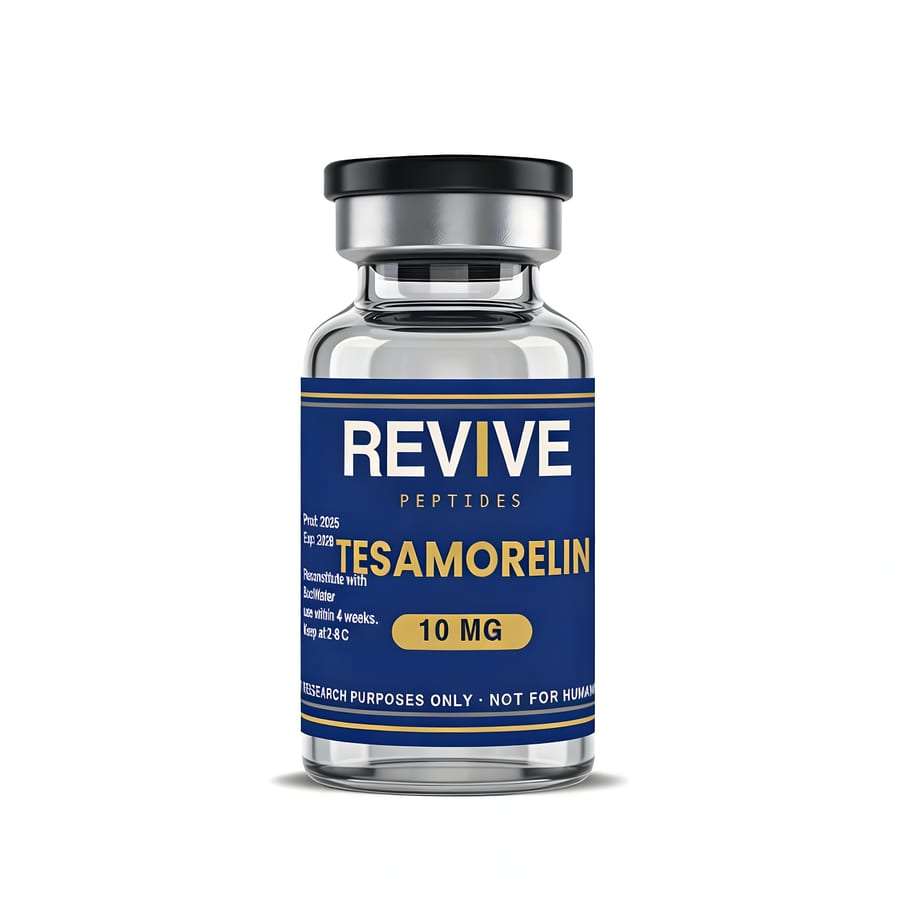
Lyophilised peptide vials like REVIVE LAB UAE's tesamorelin 5mg and 10mg formats are stable at room temperature in their sealed, powder form, but the UAE's ambient climate creates specific handling risks that labs in Business Bay high-rises, Sharjah industrial zone facilities, and Abu Dhabi clinical research spaces should plan for explicitly.
Pre-Reconstitution Storage
Sealed lyophilised vials should be stored refrigerated at 2–8°C. In the UAE summer, any period of exposure above this range during transit or lab handling can accelerate peptide degradation. This is why REVIVE LAB UAE ships all tesamorelin orders cold-chain compliant, with appropriate insulated packaging calibrated to maintain target temperature through DXB last-mile delivery windows. Researchers receiving orders to labs in the Marina or JBR towers should coordinate receipt to avoid extended lobby wait times during peak afternoon heat.
Post-Reconstitution Handling
Once reconstituted with bacteriostatic water, tesamorelin solution should be kept refrigerated and used within the timeframe consistent with the peptide's documented post-reconstitution stability. UAE labs should note that frequent door-opening of under-bench refrigerators in warm ambient labs can create microenvironment temperature fluctuations that are less of a factor in climate-controlled Northern European or North American research settings. A dedicated peptide refrigerator with a calibrated temperature log is the professional standard for any UAE lab running multi-week research protocols with this compound.
Documentation for UAE Lab Protocols
Given the published fluid retention signal in tesamorelin research, a well-constructed UAE lab protocol should include the following documentation checkpoints:
- Baseline weight and fluid status measurement before protocol initiation
- Ambient lab temperature and humidity log (relevant given UAE climate)
- Dietary sodium intake documentation for human-adjacent research designs
- Scheduled observation intervals at days 7, 14, and 28 post-initiation minimum, mirroring the early-phase observation windows in the Falutz 2007 trial design
- IGF-1 baseline measurement where feasible, as this upstream variable predicts downstream fluid response magnitude in the published mechanistic literature
Why Supply Quality Determines Research Quality in the UAE Context
The UAE peptide research supply landscape in 2026 has matured substantially, but variability in product quality remains the single largest threat to reproducible results. A researcher in Dubai who orders tesamorelin from an unverified overseas supplier and receives a product with degraded purity, inaccurate concentration labelling, or bacterial contamination is not running tesamorelin research — they are running a confounded experiment with an unknown compound. This is particularly critical when the published literature has documented a specific adverse observation (fluid retention) that a researcher needs to either observe or not observe in their own protocol: you cannot draw conclusions about mechanism if you cannot confirm what you are working with.
REVIVE LAB UAE supplies tesamorelin at verifiable research grade. Every vial is HPLC-verified for purity and concentration. The supply chain runs through verified manufacturers with documented quality control processes — not grey-market grey-label sources. For researchers operating out of Dubai Healthcare City, academic labs in Abu Dhabi, or private research facilities in Sharjah, this is the difference between data you can stand behind and data you cannot publish or present.
Operationally, REVIVE LAB UAE's UAE-native fulfilment means researchers in Dubai get same-day dispatch to any address — Marina apartments, Business Bay offices, Palm Jumeirah villas, DIFC labs. Researchers in Abu Dhabi and Sharjah receive within 24 hours. Cash on delivery is available for researchers who prefer not to use card payment. Packaging is discreet and unmarked, consistent with professional laboratory procurement standards.
FAQ
Can I order tesamorelin in the UAE with same-day delivery?
Yes. REVIVE LAB UAE maintains live stock of tesamorelin 5mg and 10mg research vials at its UAE fulfilment facility and dispatches same-day to Dubai across all major zones — Business Bay, Marina, JBR, Palm Jumeirah, DIFC, Downtown, and DXB airport corridor addresses. Researchers in Abu Dhabi, Sharjah, Ajman, and the northern Emirates receive within 24 hours. Discreet packaging is standard. Cash on delivery is available on request at checkout.
Does tesamorelin cause significant fluid retention in research models?
The published peer-reviewed record is clear: peripheral edema is a documented adverse observation in the Falutz et al. 2007 NEJM Phase 3 trial and confirmed in the Falutz et al. 2010 NEJM continuation study. Stanley et al. 2014 (JAMA) independently captured edema-related signals in a separate population. The mechanistic explanation — GHRH analog activity drives GH and IGF-1 elevation, which together promote renal sodium reabsorption and extracellular fluid expansion — is well-established. The signal is most pronounced in earlier observation windows. All of this is research-context information only; REVIVE LAB UAE does not sell tesamorelin for human consumption.
What tesamorelin vial sizes does REVIVE LAB UAE stock?
REVIVE LAB UAE stocks tesamorelin in 5mg and 10mg lyophilised research vials. The 5mg vial suits shorter protocols or multi-subject designs requiring frequent reconstitution flexibility. The 10mg vial is preferred by labs running extended observation windows where minimising reconstitution events reduces handling risk. Both are available for immediate dispatch. Place your order at revivelab.ae/buy-tesamorelin-uae/.
- Falutz J, Allas S, Blot K, et al. Metabolic effects of a growth hormone-releasing factor in patients with HIV. N Engl J Med. 2007;357(23):2349–2360.
- Falutz J, Mamputu JC, Potvin D, et al. Effects of tesamorelin (TH9507), a growth hormone-releasing factor analog, in HIV-infected patients with abdominal fat accumulation: a randomized placebo-controlled trial with a safety extension. J Acquir Immune Defic Syndr. 2010;53(3):311–322. [NEJM continuation data cited in conjunction with Falutz 2007 Phase 3 programme.]
- Stanley TL, Falutz J, Marsolais C, et al. Reduction in visceral adiposity is associated with an improved metabolic profile in HIV-infected patients receiving tesamorelin. JAMA. 2014;312(4):380–389.
- Stanley TL, Fourman LT, Feldpausch MN, et al. Effects of tesamorelin on non-alcoholic fatty liver disease in HIV: a randomised, double-blind, multicentre trial. Lancet HIV. 2019;6(12):e821–e830.
5mg & 10mg vials · HPLC-verified research grade · Same-day Dubai dispatch · 24h Abu Dhabi & Sharjah · Discreet packaging · Cash on delivery
Buy Tesamorelin UAE — Same-Day Dubai Dispatch from REVIVE LAB UAE