Tesamorelin Storage on FlyDubai Short-Hauls: The UAE Researcher's Complete Cold-Chain Guide
Why FlyDubai Routes Create a Unique Peptide Storage Challenge
FlyDubai serves more than 110 destinations from Dubai International Airport Terminal 2 and Al Maktoum International Airport, covering short-to-medium haul corridors across the Gulf, East Africa, Eastern Europe, Central Asia, and the Subcontinent. Flight durations on these corridors typically range from 90 minutes (Muscat, Bahrain) to five hours (Tbilisi, Almaty, Colombo). For a researcher based in Dubai — whether your lab is in Business Bay, Academic City, or a private facility on the Palm — these are the routes you are most likely to be catching on short notice.
The peptide storage challenge on FlyDubai is more acute than on long-haul carriers for two reasons. First, the ground segment before boarding at Terminal 2 is operationally compressed — FlyDubai recommends check-in two hours before domestic Gulf departures and three hours for international, but peak-summer queues and the physical layout of T2 mean you are often standing on sun-exposed concourses or in warm holding areas for longer than expected. Second, the Boeing 737 MAX and 737-800 aircraft that make up the FlyDubai fleet do not have the same hold-temperature controls as wide-body long-haul aircraft — cargo hold temperatures can be extreme, especially on ground at DXB in June through September.
The result: the transit window between your Dubai lab fridge and your destination cold storage is the single highest-risk interval in an otherwise well-controlled research protocol. Understanding exactly what tesamorelin tolerates — and what it does not — is the foundation of everything that follows.
Tesamorelin Storage Fundamentals: What the Research Context Requires
Tesamorelin is a synthetic analogue of growth hormone-releasing hormone (GHRH) studied extensively for its effects on visceral adipose tissue metabolism. In the pivotal research published by Falutz et al. in the New England Journal of Medicine (2007), and later extended by Stanley et al. in JAMA (2014) and the Lancet HIV (2019), tesamorelin demonstrated consistent effects in tightly controlled trial conditions — which depended, in part, on rigorous handling of the compound throughout storage and administration windows.
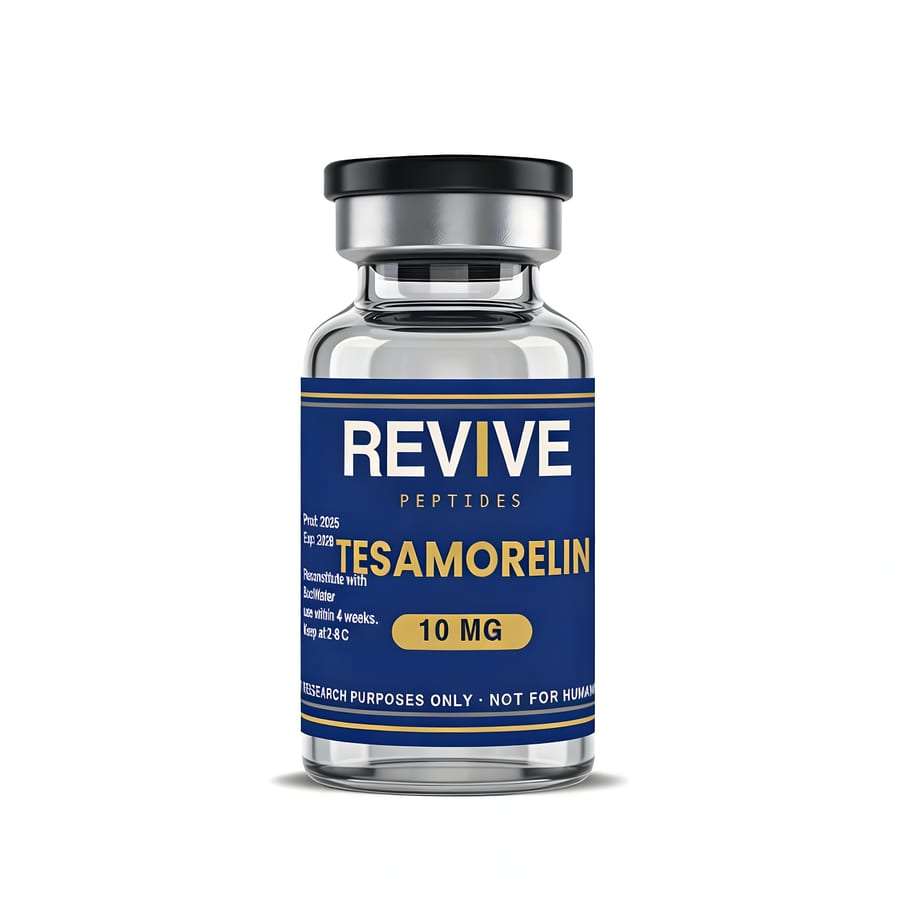
For research-use tesamorelin supplied in lyophilized (freeze-dried powder) form — the format available from REVIVE LAB UAE in 5mg and 10mg vials — the storage requirements break into two distinct states:
- Lyophilized (unreconstituted) vials: More thermostable. Typically stored at 2–8°C under refrigeration in a laboratory setting. Short-term exposure to controlled room temperature (up to approximately 25°C) is generally tolerated for limited periods. Protect from light and physical shock.
- Reconstituted solution (after addition of bacteriostatic water): Significantly more thermosensitive. Requires continuous refrigeration at 2–8°C. Freeze-thaw cycles destroy peptide integrity. Any prolonged exposure above refrigeration temperature accelerates degradation and renders the solution unsuitable for research use.
The practical implication is stark: if you are boarding a FlyDubai flight, you want lyophilized vials, not reconstituted solution. The reconstituted form is not a viable transit format under UAE summer conditions.
Lyophilised vs Reconstituted: The Case for Travelling Dry
Researchers sometimes attempt to reconstitute tesamorelin before travel to save time at the destination. On a FlyDubai short-haul, this is a protocol error. Consider the real temperature exposures a reconstituted vial faces on a Dubai summer day:
| Transit Segment | Approximate Temp Range | Duration | Risk (Reconstituted) | Risk (Lyophilised) |
|---|---|---|---|---|
| Dubai lab to car (outdoor walk, June) | 42–48°C ambient | 2–5 min | High without insulation | Low with insulation |
| Vehicle to T2 drop-off | 22–26°C (A/C) | 20–60 min | Moderate | Very low |
| T2 check-in / security queues | 22–26°C (indoor) | 30–90 min | Moderate (cumulative) | Low |
| Gate holding / boarding bridge (summer) | 28–38°C | 15–40 min | High | Low with gel pack |
| FlyDubai cabin in-flight | 18–22°C | 90–300 min | Low in cabin | Very low |
| Hold / checked baggage (tarmac to cruise) | −10°C to +55°C | Full flight | Catastrophic | Severe — never check vials |
The table makes the recommendation obvious: lyophilised vials in an insulated carry-on case is the only protocol that survives the full transit chain. Reconstituted solution accumulates cumulative thermal stress across multiple segments — none individually catastrophic, but collectively significant for a temperature-sensitive peptide.
Building Your FlyDubai Peptide Carry Case: What Actually Works
The pharmaceutical-grade soft-sided insulated cases sold in Dubai (available in pharmacies in Jumeirah, Deira, and Karama, as well as online delivery) are adequate for short-haul transit when paired with proper gel packs. Here is what a functional carry setup looks like for a FlyDubai departure from T2:
Equipment List
- Insulated soft case: 500ml–1L interior volume is sufficient for 2–4 vials. Look for cases with PEVA or PE foam lining — not just nylon with thin foam.
- Slim reusable gel packs: Freeze solid at least 18 hours before departure. Two slim packs (100–150g each) flanking the vial wallet provide more even temperature distribution than one large pack.
- Vial wallet or foam insert: Prevents physical shock during boarding. Standard 2ml vials (even 5mg and 10mg vials are typically presented in small glass vials) are glass and shatter if dropped against a security tray.
- Documentation pouch: Original packaging, invoice/receipt from REVIVE LAB UAE, any applicable research documentation. Keep accessible at security.
Temperature Performance Expectation
A properly assembled case — insulated liner, two frozen gel packs at approximately −18°C, vials starting at 4°C refrigerator temperature — will maintain interior temperatures below 15°C for 4–6 hours in standard indoor conditions. On a 3-hour FlyDubai flight to Tbilisi or Amman, you are well within margin. For routes approaching 4–5 hours (Almaty, Colombo), reconfirm your gel pack freeze time before departure and consider a slightly larger insulated case.
The FlyDubai Terminal 2 Researcher's Step-by-Step Protocol
Terminal 2 at Dubai International is a narrower, more operationally dense terminal than T1 or T3. Researchers departing on FlyDubai should plan their pre-flight sequence with the peptide cold chain as a primary constraint, not an afterthought.
Night Before Departure
- Freeze gel packs fully — ideally 24 hours, minimum 18 hours in a household freezer at −18°C.
- Confirm tesamorelin vials are lyophilised, sealed, and within their use-by window. If you are running short and need to restock before your trip, order from REVIVE LAB UAE with same-day Dubai delivery. Orders placed before 4pm reach Business Bay, Marina, JBR, Palm Jumeirah, DIFC, and Jumeirah the same evening.
- Pack the insulated case — vials, gel packs, documentation — and keep it refrigerated overnight to maintain starting temperature.
Day of Departure
- Remove insulated case from fridge no earlier than necessary. For a 10am FlyDubai departure, aim to leave your Dubai location (Business Bay, Marina, Abu Dhabi) with case in hand no more than 90 minutes before you need to be at T2 check-in.
- Use a rideshare or taxi with confirmed air-conditioning — in June and July in Dubai, a vehicle sitting in the sun at the Bur Dubai or Deira pickup points can have cabin temperatures exceeding 50°C before the A/C stabilises. Allow 5 minutes of A/C pre-cool before placing your case in the vehicle.
- At T2 security: remove the insulated case and place it in the tray as a standalone item. Declare the vials if asked. Do not allow security staff to remove vials from the insulated case for extended periods without replacing them — a 15-minute inspection delay on a summer boarding bridge can meaningfully impact reconstituted samples (though lyophilised will be fine).
- In the gate area: T2 gates can feel significantly warmer than the main terminal during summer peak hours — air handling is inconsistent. Keep your case sealed and do not leave it on a seat in direct sunlight from terminal windows.
In-Flight
- Carry-on only — this cannot be overstated. Placing peptide vials in checked baggage on a FlyDubai 737 is a reliable way to destroy your samples. The cargo hold of a narrow-body aircraft parked on a Dubai tarmac in July can exceed 55°C before departure, and then drop below −10°C at cruise altitude. That freeze-thaw cycle will damage even lyophilised peptides.
- Overhead bin placement: choose a bin over your own row, not near the galley or electronics bays. Bins nearest the galley run slightly warmer due to oven and hot equipment proximity. On FlyDubai 737s, the front overhead bins near the cockpit partition also tend to retain heat.
- Avoid placing the insulated case in the seat pocket — compressed between the seat and the pocket seam, the insulation is compromised and the gel packs cannot maintain geometry.
- Window seat consideration: direct sunlight through 737 porthole windows can locally increase overhead bin temperature. On early morning departures (eastbound routes) this is a non-issue; on afternoon departures westbound or northbound, choose an aisle seat if possible.
Same-day dispatch for Dubai. 24h delivery to Abu Dhabi, Sharjah & wider UAE.
Discreet packaging. Cash on delivery available in Dubai. Binance Pay USDT accepted. Buy Tesamorelin UAE — Order from REVIVE LAB UAE
Returning to Dubai: Managing the Inbound Cold Chain
Inbound from a FlyDubai short-haul destination — say, Amman, Tbilisi, or Istanbul — the cold chain challenges are different but equally real. If your research travel involved obtaining additional supplies abroad, you face the return transit. If your original REVIVE LAB UAE vials are accompanying you back, the return leg has its own temperature profile.
Key differences on the inbound leg: DXB arrivals involve customs, baggage reclaim, and potentially lengthy queues at the T2 arrivals hall, particularly on peak FlyDubai turnaround days when multiple flights arrive simultaneously. The arrivals concourse is air-conditioned, but the transfer from airside to landside and then to your pickup vehicle in the Dubai summer adds cumulative heat exposure. On return, your gel packs will have 4–5 additional hours of thermal load from the outbound and destination stays — they may no longer be frozen. Plan accordingly: either use higher-mass gel packs for the return, or transfer vials to a refrigerator at your destination location as soon as possible and only repack for the return transit itself.
Researchers operating from labs in Abu Dhabi or Sharjah who use DXB as their hub face an extra 45–90 minutes of transit after landing before reaching cold storage. In July and August, this final segment — DXB arrivals to Abu Dhabi highway or Sharjah suburbs — is where gel packs most frequently fail. Build an extra frozen gel pack into your return carry case for any departure from a destination where you cannot re-freeze packs.
The Smarter Protocol: Order Tesamorelin in UAE and Skip the Transit Risk
The most protocol-sound approach for UAE-based researchers is also the simplest: do not travel with tesamorelin vials at all. Order fresh tesamorelin from REVIVE LAB UAE before your departure, ensure delivery to your Dubai or UAE address before you leave, and maintain an unbroken cold chain entirely within the UAE. If your FlyDubai trip is a short turnaround — 2 to 5 days — there is rarely a research justification that requires vials to physically accompany you on the flight rather than waiting in your lab fridge at home.
REVIVE LAB UAE stocks tesamorelin 5mg and 10mg vials and ships across the UAE with the following delivery tiers:
| Location | Delivery Speed | Cut-off Time | Packaging |
|---|---|---|---|
| Dubai (Business Bay, DIFC, Marina, JBR, Palm, Jumeirah, Deira) | Same-day | 2pm order cut-off | Discreet, insulated |
| Dubai (outer areas: Al Quoz, Jebel Ali, DIP, Sports City) | Same-day / next morning | 1pm cut-off | Discreet, insulated |
| Abu Dhabi (central, Khalidiyah, Corniche, Reem Island) | 24h | Next-day AM delivery | Discreet, insulated |
| Sharjah, Ajman, Umm Al Quwain | 24h | Next-day delivery | Discreet, insulated |
| RAK, Fujairah | 24–48h | Confirm at order | Discreet, insulated |
Payment options at REVIVE LAB UAE include bank transfer, cash on delivery for Dubai orders, and Binance Pay USDT (which carries a 5% pre-payment discount — useful if you are ordering in bulk ahead of a travel period). All orders ship in discreet, neutral packaging with no product identifiers on the outer box — a practical consideration for researchers in shared facilities or mixed-use office buildings in Business Bay or the Marina.
The ordering logic before a FlyDubai trip is straightforward: if you are departing on a Monday morning from DXB Terminal 2, order tesamorelin from REVIVE LAB UAE on Saturday before 4pm for same-day Saturday delivery. Your vials land in your Dubai fridge with the weekend to spare, cold chain intact, no airport friction, no gel pack anxiety on a sun-baked T2 boarding bridge.
Research Context: Tesamorelin Studies Referenced in UAE Protocol Design
UAE-based research institutions referencing tesamorelin protocols typically anchor their study designs around the established GHRH analog literature. Falutz et al. (2007, New England Journal of Medicine) established the foundational efficacy signal for tesamorelin, demonstrating statistically significant reductions in visceral adipose tissue in a controlled clinical context. The same group's 2010 continuation trial (Falutz et al., NEJM) examined long-term effects and provided durability data critical for extended research protocols. Stanley et al. (2014, JAMA) contributed additional evidence on visceral fat response, and the Stanley et al. (2019, Lancet HIV) long-term analysis provided safety and outcome data across a sustained follow-up window.
These studies are the citation backbone for any tesamorelin research protocol. Researchers should ensure their institutional documentation references these sources correctly — not approximated titles or fictional author combinations — both for academic integrity and for any regulatory context in which the research operates within the UAE.
GHRH analogue research in the UAE has grown substantially in academic and private research settings over the past three years, with institutions across Dubai, Abu Dhabi, and Sharjah incorporating peptide-based protocols into broader metabolic and body-composition research programs. REVIVE LAB UAE serves this research community with B2B supply that prioritises traceability, consistent lot quality, and the logistics infrastructure — including fast UAE-wide delivery — that professional researchers require.
FAQ
Can I carry tesamorelin vials in my hand luggage on a FlyDubai flight?
Lyophilised tesamorelin vials (5mg or 10mg) in sealed, labelled research packaging can be carried in hand luggage on FlyDubai flights. Reconstituted liquid in a syringe is subject to standard 100ml liquids restrictions under UAE GCAA rules and IATA regulations. Always carry your research documentation and retain the original REVIVE LAB UAE packaging with lot numbers visible at security. This is general practical information — not legal, customs, or regulatory compliance advice. Consult the relevant authority for your specific situation and destination.
How long can lyophilised tesamorelin stay outside refrigeration on a FlyDubai short-haul?
Lyophilised tesamorelin powder in sealed glass vials is considerably more thermostable than reconstituted solution. On a FlyDubai short-haul of 2–4 hours with a cabin temperature of 18–22°C, lyophilised vials in a properly assembled insulated case with frozen gel packs remain within an acceptable temperature range for the full flight. The critical point is that your gel packs must be fully frozen before departure — partially frozen packs from the fridge (not freezer) will not maintain adequate temperatures through the full transit chain, which includes time in the T2 departures hall and boarding bridge before the flight even begins.
Where can I buy tesamorelin in the UAE with same-day or 24-hour delivery before my trip?
REVIVE LAB UAE at revivelab.ae stocks tesamorelin 5mg and 10mg vials for research use with same-day dispatch for Dubai (orders before 4pm) and 24-hour delivery to Abu Dhabi, Sharjah, and other Emirates. All orders ship in discreet, temperature-appropriate packaging. Payment options include bank transfer, cash on delivery in Dubai, and Binance Pay USDT (5% pre-pay discount). For researchers heading out on a FlyDubai flight, ordering fresh vials before departure and leaving them in your Dubai lab fridge eliminates the transit cold-chain risk entirely.
- Falutz J, et al. Metabolic effects of a growth hormone-releasing factor in patients with HIV. New England Journal of Medicine. 2007;357(23):2359–2370.
- Falutz J, et al. Effects of tesamorelin, a growth hormone-releasing factor analogue, in HIV-infected patients with abdominal fat accumulation: a randomized placebo-controlled trial with a safety extension. New England Journal of Medicine. 2010 (continuation trial).
- Stanley TL, et al. Effect of tesamorelin on visceral fat and liver fat in HIV-infected patients with abdominal fat accumulation: a randomized clinical trial. JAMA. 2014;312(4):380–389.
- Stanley TL, et al. Long-term effects of tesamorelin on visceral fat and metabolic parameters in HIV-infected patients. Lancet HIV. 2019.
5mg & 10mg vials. Same-day Dubai dispatch. 24h Abu Dhabi & Sharjah. Discreet packaging standard.
Cash on delivery (Dubai) · Bank transfer · Binance Pay USDT (5% discount) Order Tesamorelin UAE — REVIVE LAB UAE