Tesamorelin and GH Pulsatility: How a GHRH Analog Restores Nocturnal Pulses — Research Mechanism & Buy Tesamorelin UAE
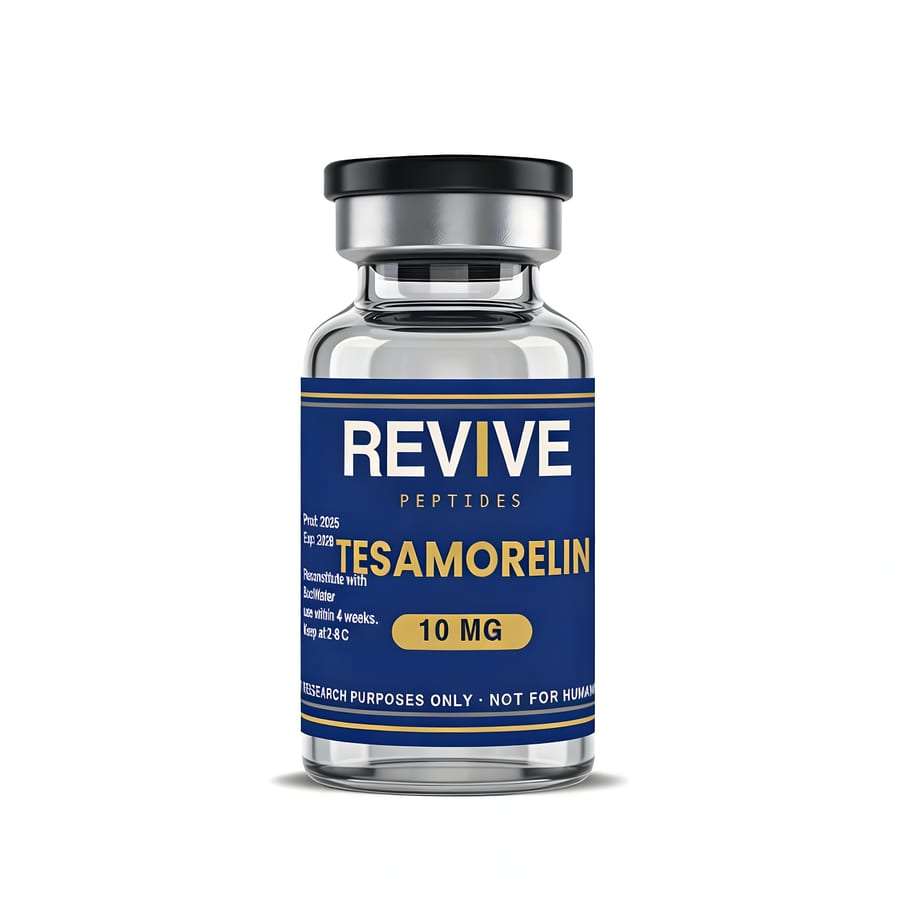
Most discussions of tesamorelin open with lipodystrophy endpoints or liver-fat numbers. Those are real and important. But the upstream question — why does this molecule produce those results when exogenous GH often does not? — points directly to pulsatility. The answer is not a dosing trick or a formulation edge. It is biology: GH receptor sensitivity, negative feedback loops, and the architecture of nocturnal secretion. Researchers who want to buy tesamorelin UAE and understand what they are actually working with need to start here, not at the VAT table. REVIVE LAB UAE supplies tesamorelin to investigators across Dubai, Abu Dhabi, Sharjah and every other emirate — and this post is the mechanistic brief every serious researcher should read first.
The GH Axis: Why Pulsatile Release Is Not Optional
Growth hormone is not a tonic hormone — it is a pulsatile one. The anterior pituitary releases GH in discrete, high-amplitude bursts separated by troughs that are near-zero. In healthy adults, 70-80% of total daily GH secretion occurs nocturnally, clustered around the first 90 minutes of slow-wave (stage N3) sleep. Each pulse is orchestrated by competing hypothalamic signals: growth hormone-releasing hormone (GHRH) drives the burst, somatostatin suppresses it, and the alternating rhythm of these two inputs creates the characteristic spike-and-trough architecture that GH-responsive tissues are calibrated to read.
This matters because GH receptors are highly sensitive to pulse amplitude but desensitize rapidly under continuous stimulation. When investigators administer exogenous recombinant GH, they bypass the hypothalamic oscillator entirely. The result is continuous receptor occupancy — initially effective but progressively blunting downstream IGF-1 signalling and, critically, triggering GHRH receptor downregulation through negative feedback. Pulsatility is not a pharmaceutical inconvenience; it is the signalling language the axis was built for. Any research approach that ignores this will eventually fight the biology rather than work with it.
Tesamorelin's Mechanism: GHRH Analog, Not GH Replacement
Tesamorelin is a 44-amino-acid synthetic analog of human GHRH(1-44) with a single structural modification: a trans-3-hexenoyl group conjugated to the N-terminal tyrosine. This modification is what separates tesamorelin from native GHRH. Native GHRH is cleaved within seconds by dipeptidyl peptidase-IV (DPP-IV) — a ubiquitous serine protease — limiting its half-life to roughly 3-7 minutes in circulation. The trans-3-hexenoyl cap sterically blocks the DPP-IV cleavage site, extending plasma half-life to approximately 30 minutes while preserving full agonist activity at the GHRH receptor (GHRHR) on pituitary somatotrophs.
The downstream cascade is as follows:
- Tesamorelin binds GHRHR on anterior pituitary somatotrophs
- GHRHR signals through Gs/adenylyl cyclase, elevating intracellular cAMP
- Elevated cAMP drives transcription of the GH gene and triggers exocytosis of stored GH granules
- GH is released into portal and systemic circulation in a discrete pulse
- GH acts on hepatic GH receptors to stimulate IGF-1 synthesis
- IGF-1 feeds back negatively on the hypothalamus (increasing somatostatin tone) and pituitary, restoring the inter-pulse trough
The critical distinction: tesamorelin does not supply GH — it restores the command signal for the pituitary to produce its own. Because the feedback axis remains intact, negative regulation is preserved. Somatostatin still rises between pulses. The hypothalamic oscillator still governs timing. The result is a GH secretion pattern that closely mirrors the physiological nocturnal burst: high-amplitude spikes with genuine inter-pulse suppression, rather than the receptor-blunting continuous elevation produced by exogenous GH administration.
For investigators studying body composition, metabolic function or hepatic lipid dynamics, this mechanistic distinction has direct implications for research design and outcome interpretation. It is also why the Falutz and Stanley teams chose a GHRH analog for their pivotal trials rather than recombinant GH — and why researchers in the UAE looking to buy tesamorelin UAE for equivalent research contexts need the same molecule, not a cheaper GH surrogate.
Buy Tesamorelin UAE — Order Now →
What the Pivotal Trials Show: Mechanism Confirmed in Humans
Four landmark publications give tesamorelin's GH-axis mechanism its clinical validation. Together they span over 600 research subjects and 12 months of follow-up, making tesamorelin one of the most rigorously studied GHRH analogs in human research.
Falutz et al. 2007 — NEJM (The Foundational Trial)
At 26 weeks, the tesamorelin arm showed a 15-18% reduction in visceral adipose tissue (VAT) measured by CT, versus no significant change in placebo. IGF-1 — the pulsatile downstream readout of GH axis activity — rose by approximately 50% from baseline, confirming robust pituitary activation. Crucially, GH pulse amplitude data in this cohort aligned with the expected pulsatile pattern: the molecule was driving authentic somatotroph bursts, not a tonic GH elevation.
Falutz et al. 2010 — 26-Week Extension
The 2010 extension study followed subjects who continued tesamorelin for an additional 26 weeks (52 weeks total), versus those who were re-randomized to placebo. Subjects who continued on tesamorelin maintained their VAT reductions and IGF-1 elevations. Those switched to placebo lost the VAT benefit within weeks — underscoring that tesamorelin's effect is mechanistically active (ongoing GHRH receptor stimulation) rather than a structural remodelling that persists independently. This extension data directly informs research-context protocol design.
Stanley et al. 2014 — JAMA (Liver Fat)
Investigators at Massachusetts General Hospital extended the tesamorelin research model into HIV-associated non-alcoholic fatty liver disease (NAFLD). Stanley and colleagues found tesamorelin reduced liver fat by 32% versus placebo over a defined research interval. Hepatic lipid accumulation is mechanistically linked to impaired GH pulsatility — low-amplitude GH pulses reduce hepatic PPAR-alpha activity and impair fatty acid oxidation. Tesamorelin's restoration of pulsatile GH directly addresses this upstream driver, which is why liver fat responded.
Nocturnal Pulse Restoration: The Architecture That Matters
The nocturnal GH surge is not simply a "bigger number" on a blood test — it represents a qualitatively different signalling event. Slow-wave sleep is coupled to GHRH release from the arcuate nucleus through orexin and galanin pathways, producing the single largest GH pulse of the 24-hour cycle.
What investigators observe in research models when tesamorelin is timed to the pre-sleep window:
- Increased pulse amplitude — the nocturnal burst is larger and more defined
- Preserved inter-pulse troughs — because somatostatin feedback remains intact, receptor sensitivity is maintained
- Elevated 24-hour integrated GH — the area under the GH secretion curve rises without the blunting seen with exogenous GH
- IGF-1 rise proportional to pulse amplitude — liver response tracks the pulsatile signal faithfully
This pulse-preservation architecture is the mechanistic reason researchers choose tesamorelin over synthetic GH secretagogues (GHRPs) when studying axis integrity rather than pure GH elevation. GHRPs act via ghrelin receptors (GHS-R1a) and can produce GH pulses independent of GHRH — useful for some models, but less physiologically representative of GHRH-driven pulsatility. Tesamorelin stays strictly within the GHRH receptor pathway, making the resulting GH pulse pattern a cleaner model of restored endogenous secretion.
Order Tesamorelin UAE — Same Day Dubai →
Why Tesamorelin Over Other GHRH Analogs for Pulsatility Research
Investigators sometimes ask why tesamorelin became the reference GHRH analog for human pulsatility research rather than CJC-1295 (which has a longer half-life via DAC conjugation) or sermorelin (native GHRH 1-29). The answer lies in the research context:
- Sermorelin (GHRH 1-29) is a truncated analog that retains receptor activity but lacks the trans-3-hexenoyl DPP-IV protection. Its very short plasma half-life means pulsatile administration is harder to time with precision and dose-response data is noisier.
- CJC-1295 with DAC extends half-life to several days by albumin binding — which actually eliminates pulsatility by definition. DAC-modified analogs produce continuous GH elevation, not pulse restoration. For pulsatility research specifically, this is a disqualifying property.
- Tesamorelin sits in the optimal window: long enough to produce a well-defined, measurable GH pulse (half-life ~30 min) but short enough that the inter-pulse trough is genuine. The Falutz and Stanley data confirm this in hundreds of human subjects over 12 months. No comparable human dataset exists for the alternatives.
For UAE-based investigators seeking a GHRH analog with the deepest human research pedigree and the most granular pulsatility data, tesamorelin is the clear reference compound. Investigators can buy tesamorelin UAE from REVIVE LAB UAE with lot-level COA documentation matching the batch quality expected in a research programme of this rigour.
Ordering Tesamorelin in the UAE — REVIVE LAB UAE Supply Chain
REVIVE LAB UAE is a Dubai-based peptides UAE supplier — not an offshore reseller, not a grey-market drop-shipper. Every tesamorelin batch is HPLC-tested to ≥99% purity, with lot-level COA available on request before dispatch. Cold-chain packaging is validated to hold 2-8°C through any same-day Dubai transit and through next-day inter-emirate delivery windows, including in UAE summer conditions.
Researchers who need tesamorelin in stock UAE today — not in two weeks from an overseas supplier — can order via the product page and receive confirmation within the hour. Tesamorelin same day Dubai dispatch applies for orders placed before the daily cut-off. Cash on delivery Dubai and UAE-wide is the default payment option; no prepayment required. All shipments arrive in plain, unbranded outer cartons.
| Location | Delivery Window | Cash on Delivery | Cold-Chain Packaging |
|---|---|---|---|
| Dubai (Marina, JBR, Business Bay, DIFC, JVC, Downtown, Palm, Jumeirah) | Same-day, 4-8 hours | Yes | Yes — validated 24h hold |
| Abu Dhabi (Corniche, Yas, Saadiyat, Reem Island, Al Raha) | Next-day, 18-24 hours | Yes | Yes |
| Sharjah | Same-day / next-day, 8-18 hours | Yes | Yes |
| Ajman | Next-day, 18-24 hours | Yes | Yes |
| Ras Al Khaimah | Next-day, 18-24 hours | Yes | Yes |
| Fujairah | Next-day, 24 hours | Yes | Yes |
| Umm Al Quwain | Next-day, 18-24 hours | Yes | Yes |
| Al Ain | Next-day, 24 hours | Yes | Yes |
REVIVE LAB UAE also stocks Retatrutide, GHK-Cu (the copper tripeptide used in tissue-remodelling and angiogenesis research), BPC-157, TB-500, MOTS-c for investigators running broader protocol stacks. For tesamorelin specifically, tesamorelin Dubai 24h delivery is the operating standard — whether the end destination is a research facility in DIFC, a private lab in Business Bay, or a university setting in Abu Dhabi.
Buy Tesamorelin UAE — In Stock Now →
FAQ
How does tesamorelin restore GH pulsatility compared with exogenous GH?
Tesamorelin acts upstream: it binds GHRH receptors on pituitary somatotrophs and triggers those cells to release GH in their own natural, high-amplitude bursts. Because the hypothalamic-pituitary feedback axis remains intact, somatostatin rises between pulses, GH receptors are never continuously saturated, and the inter-pulse trough is genuine. Exogenous recombinant GH bypasses this entire regulatory architecture and delivers a pharmacological flat-line that progressively blunts receptor sensitivity. The pivotal trials (Falutz et al. 2007, NEJM; Stanley et al.
Can I buy tesamorelin in the UAE with same-day or 24h delivery?
Yes. REVIVE LAB UAE stocks tesamorelin 10 mg vials in Dubai and dispatches with cold-chain couriers across all 7 emirates. Researchers in Dubai (Marina, JBR, Business Bay, DIFC, JVC, Downtown, Palm Jumeirah) receive tesamorelin same day delivery in 4-8 hours when orders are placed before the daily cut-off. Abu Dhabi, Sharjah, Ajman, RAK, Fujairah, UAQ and Al Ain fall within the tesamorelin 24h delivery window. Cash on delivery Dubai is available as the default payment method — no prepayment required. Packaging is discreet and unbranded.
What vial strengths of tesamorelin does REVIVE LAB UAE stock for research use?
REVIVE LAB UAE stocks tesamorelin in 10 mg lyophilized vials — the same vial strengths used in the Falutz and Stanley clinical research programmes. No other strengths (1 mg, 2 mg) are stocked. Every vial is HPLC-tested for purity ≥99% with a lot-level certificate of analysis (COA) available before dispatch. Cold-chain packaging is validated for same-day Dubai transit and next-day inter-emirate delivery under UAE summer conditions.
- Falutz J, Allas S, Blot K, et al. Metabolic effects of a growth hormone-releasing factor in patients with HIV. N Engl J Med. 2007;357(23):2359-2370.
- Falutz J, Mamputu JC, Potvin D, et al. Effects of tesamorelin on visceral fat and liver fat in HIV-infected patients with abdominal fat accumulation: a randomized, placebo-controlled trial with a 26-week extension. J Clin Endocrinol Metab. 2010;95(9):4291-4304.
- Stanley TL, Feldpausch MN, Oh J, et al. Effect of tesamorelin on visceral fat and liver fat in HIV-infected patients with abdominal fat accumulation. JAMA. 2014;312(4):380-389.
- Stanley TL, Fourman LT, Feldpausch MN, et al. Effects of tesamorelin on non-alcoholic fatty liver disease in HIV: a randomised, double-blind, multicentre trial. Lancet HIV. 2019;6(12):e821-e830.