Tesamorelin & Golf Performance — Research Notes UAE 2026
Why UAE Golf Culture Makes This Research Intersection Worth Tracking
The UAE has become one of the most golf-dense environments in the world relative to its population. Jumeirah Golf Estates — hosting the DP World Tour Championship on the Fire and Earth courses — Emirates Golf Club, Abu Dhabi Golf Club, Saadiyat Beach Golf Club, and Al Hamra Golf Club in Ras Al Khaimah collectively attract a player base that spans touring professionals, serious amateurs, and performance-oriented recreational golfers who treat their sport with the rigour most athletes reserve for team disciplines.
What makes UAE golf research contexts distinctive is the year-round play environment. Unlike temperate climates where practitioners get natural off-season breaks, Dubai and Abu Dhabi golfers — particularly those training at facilities near JBR, Business Bay, or the Jumeirah corridor — play or practise twelve months a year, often in ambient temperatures that impose substantial physiological demands from June through September. That combination of high training volume and metabolic heat stress creates a research environment where body composition and recovery variables are under unusual scrutiny.
Against this backdrop, interest in GHRH analogs as research tools for studying the relationship between visceral fat, GH pulse architecture, and athletic performance variables has grown steadily among UAE-based researchers. Tesamorelin is the most thoroughly documented peptide in its class — backed by four major peer-reviewed trials published in NEJM, JAMA, and Lancet HIV — making it the natural anchor point for any serious research design in this space.
This document is a research note. It is not a clinical guideline or a treatment protocol. It is written to give researchers at UAE institutions, private labs, and performance science facilities in Dubai, Abu Dhabi, Sharjah, and across the emirates a consolidated view of the relevant published science, the mechanistic rationale for studying tesamorelin in an athletic-population context, and the current stock and logistics position at REVIVE LAB UAE.
Tesamorelin: What the Peer-Reviewed Literature Actually Establishes
Tesamorelin is a synthetic analogue of endogenous growth hormone-releasing hormone (GHRH 1-44), modified at the N-terminus with a trans-3-hexenoic acid group that confers resistance to dipeptidyl peptidase IV degradation. The practical consequence of this structural change is a longer effective half-life than native GHRH and more sustained GH pulse augmentation — achieved through the hypothalamic-pituitary axis rather than by bypassing it.
The clinical evidence base is unusually strong for a research peptide, with four major trials providing the foundational data:
- Falutz et al. (2007, NEJM) — The pivotal Phase 3 trial establishing tesamorelin's visceral adipose tissue (VAT) reduction effect. Subjects in the active arm demonstrated significant trunk fat reductions confirmed by CT imaging at 26 weeks, versus placebo. This is the trial that placed tesamorelin on the map as a research tool for visceral fat modulation.
- Stanley et al. (2014, JAMA) — Extended the VAT-reduction finding with precise quantification: approximately 18% VAT reduction versus placebo at 26 weeks, alongside improvements in triglyceride profiles. The JAMA publication provided the clearest mechanistic signal linking GHRH analog administration to visceral depot-specific fat reduction rather than generalised lipolysis.
- Falutz et al. (2010, NEJM) — The continuation trial, critical for understanding the temporal dynamics of the effect. VAT reduction was maintained with continued administration, but subjects who discontinued showed partial reversal over the subsequent 24 weeks — establishing that tesamorelin's mechanism is ongoing GHRH stimulation rather than permanent structural remodelling of adipose depots.
- Stanley et al. (2019, Lancet HIV) — Long-term safety and metabolic outcomes data across an extended cohort observation window, providing the most complete picture of the sustained effect profile available in the published literature.
Researchers designing exploratory protocols anchor to this range because it is the only range with documented pharmacodynamic and safety data in human cohorts. Extrapolation outside these parameters is not supported by the published evidence and is outside the scope of what these research notes address.
| Trial | Journal / Year | Primary Endpoint | Key Finding |
|---|---|---|---|
| Falutz et al. | NEJM / 2007 | VAT reduction (CT-confirmed) | Significant trunk fat reduction vs placebo at 26 weeks |
| Stanley et al. | JAMA / 2014 | VAT % change | ~18% VAT reduction; improved triglyceride profile |
| Falutz et al. | NEJM / 2010 | Durability and reversal kinetics | Effect sustained with continuation; partial reversal on cessation |
| Stanley et al. | Lancet HIV / 2019 | Long-term safety and metabolic outcomes | Acceptable extended safety profile; sustained metabolic benefit |
Visceral Fat, Power-to-Weight, and Golf Swing Biomechanics: The Research Rationale
Golf is a rotational power sport. Its kinematic chain — from ground-force generation through the lower body, through hip-to-shoulder separation, through the shoulder girdle and arm complex, into the clubhead — is exquisitely sensitive to postural and structural variables that affect the geometry and timing of that chain.
Researchers studying the biomechanics of the golf swing in high-VAT populations have identified several specific constraint mechanisms worth noting:
- Restricted X-factor: The X-factor — the rotational differential between hip turn and shoulder turn at the top of the backswing — is the primary driver of stored elastic energy in the golf swing. High intra-abdominal VAT volumes mechanically limit thoraco-lumbar range of motion in the transverse plane, compressing the achievable X-factor and, by extension, the theoretical peak clubhead velocity.
- Altered centre-of-mass geometry: Anterior abdominal mass distribution shifts the whole-body centre of mass forward relative to the mid-foot, forcing compensatory postural adjustments in the lumbar spine and pelvis that reduce ground reaction force efficiency during the downswing load phase.
- Late-round power degradation: Higher VAT is associated with impaired substrate utilisation and greater glycolytic reliance during repeated sub-maximal power efforts. On an 18-hole layout — whether at Jumeirah Golf Estates, Emirates Golf Club, or Abu Dhabi Golf Club's National Course — this translates to measurable power output decline in the final five to six holes, a pattern well-documented in sports science literature on metabolic phenotype and rotational sport performance.
- Lumbar load amplification: The compressive and shear forces at L4-L5 during a standard golf swing are substantial even in well-conditioned subjects. Anterior abdominal mass amplifies these forces by increasing the moment arm of the torso during deceleration. For researchers studying lumbar injury risk in golf populations, VAT is a variable of direct mechanistic interest.
The research logic for studying tesamorelin in a golf-biomechanics context, then, derives directly from its documented VAT-reduction mechanism. If the primary published finding of the tesamorelin trials is depot-specific visceral fat reduction, and if visceral fat exerts the mechanistic constraints on golf swing geometry described above, then the peptide becomes an interesting research tool for controlled studies examining whether changes in VAT modulate measurable biomechanical parameters. This is not a clinical claim — it is a mechanistic research hypothesis grounded in the intersection of the published pharmacology and the published biomechanics literature.
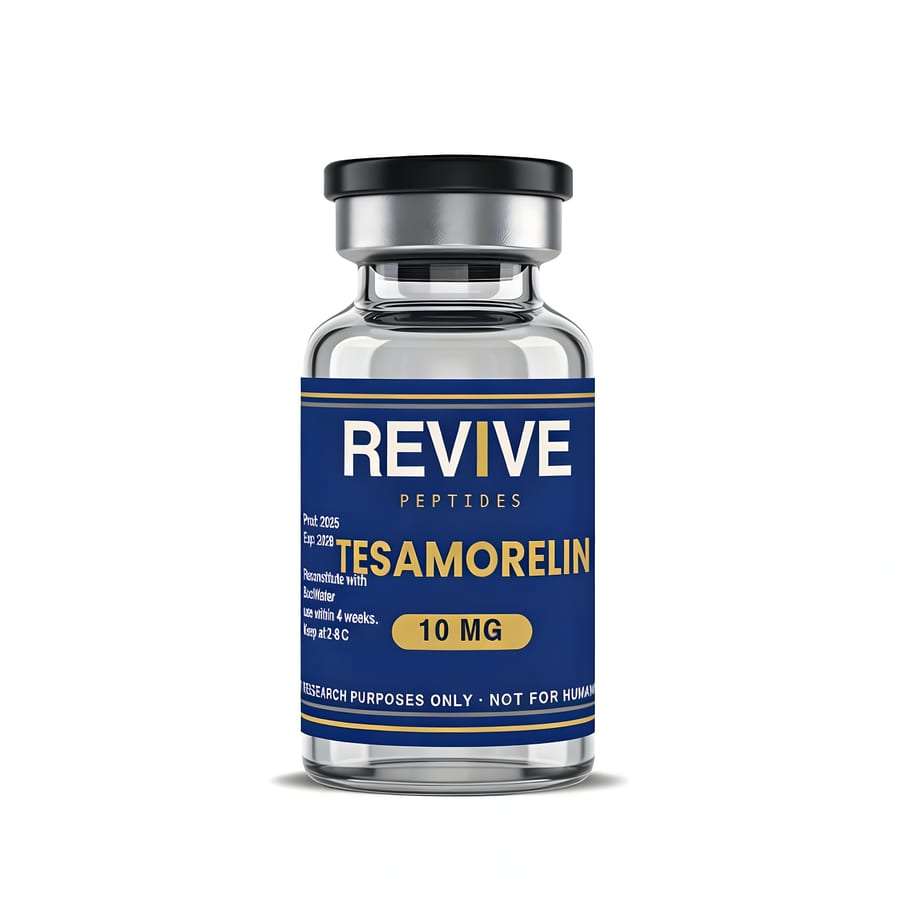
Tesamorelin 5mg & 10mg vials — in stock now, cold-chain shipped across the UAE.
Buy Tesamorelin UAE — Same-Day Dubai Dispatch from REVIVE LAB UAEGH Pulse Architecture, Connective Tissue Research, and Athletic Recovery Variables
The second major research dimension of tesamorelin in athletic populations concerns the GH pulse amplification mechanism itself — separate from the VAT endpoint that has dominated the published trials. Endogenous growth hormone is secreted in discrete pulses, predominantly during slow-wave sleep, and its downstream signalling through IGF-1 mediates a range of tissue processes relevant to athletic recovery: collagen synthesis, satellite cell activation, tendon remodelling, and extracellular matrix maintenance.
Serious golfers — whether touring professionals or high-handicap amateurs training at DXB-area facilities for 4-6 hours daily — impose repetitive, high-cycle musculoskeletal stress on specific anatomical structures. The torsional loading of the lead wrist through impact, the deceleration forces at the trail elbow, and the compressive-shear pattern at the lumbar spine are all high-frequency stressors in a high-volume practice context. Whether GHRH analog administration modulates recovery kinetics from these specific stress patterns is an open research question, but one with clear mechanistic plausibility given what is known about GH-IGF-1 axis signalling in connective tissue maintenance.
What makes tesamorelin a methodologically cleaner research tool for studying this axis than exogenous GH is the pulse-preservation mechanism. Exogenous growth hormone bypasses the hypothalamic-pituitary feedback loop, suppressing the body's endogenous pulsatile rhythm — which means any observation of GH-dependent tissue effects is confounded by the loss of physiological GH pulse architecture. Tesamorelin, as a GHRH receptor agonist, works upstream of the pituitary: it amplifies existing GH pulse amplitude and frequency without replacing the endogenous rhythm. For researchers trying to study the GH-IGF-1 axis in a way that preserves the physiological signalling pattern, this is a meaningful methodological distinction that has direct implications for the interpretability of results.
UAE-based performance researchers studying these recovery variables have access to a range of relevant biomarker assays through Dubai and Abu Dhabi clinical laboratory networks. Standard tracking parameters in GHRH analog research contexts include serum IGF-1, fasting insulin, fasting glucose (given the glucose metabolism considerations noted in the published trials), and collagen synthesis markers such as PINP and PICP. Researchers designing protocols are advised to establish baseline values before any intervention and to monitor at regular intervals through the observation window.
Research Protocol Context: Vial Format Selection and Administration Notes
REVIVE LAB UAE stocks tesamorelin in two vial formats: 5mg lyophilized vials and 10mg lyophilized vials. Both are suitable for research use — the choice between them is a logistics and protocol-length decision rather than a dosing one.
| Vial Format | Best Suited For | Storage Requirements | Cost Consideration |
|---|---|---|---|
| 5mg vial | Short pilot protocols (2–3 weeks), single-subject feasibility studies, researchers new to GHRH analog research design | Lyophilized: ambient pre-reconstitution; 2–8°C post-reconstitution, use within 7 days | Lower upfront per-order cost; higher cost-per-mg at scale |
| 10mg vial | Extended observation windows (4–12 weeks), multi-subject study cohorts, volume research programs | Same conditions; fewer reconstitution events per protocol week | Lower cost-per-mg; preferred for established research operations |
The clinical trials that established the tesamorelin evidence base (Falutz et al. 2007, Stanley et al. This range represents the only dose window with documented human pharmacodynamic and safety data, and research protocol designs should be anchored to these published parameters.
Administration timing is a variable that individual research designs handle differently. Some protocols align administration to evening hours to target the natural slow-wave sleep GH pulse window — the rationale being that GHRH stimulation during the physiologically-primed nocturnal window may produce greater pulse amplification than administration at arbitrary daytime points. However, the published clinical trials were not designed around time-of-day specificity, and the pharmacokinetic literature does not mandate a particular window. This remains an area of active methodological debate among researchers.
One practical note specific to the UAE environment: reconstituted tesamorelin is temperature-sensitive, and the Gulf summer heat window — where ambient temperatures in Dubai, Abu Dhabi, and Sharjah regularly exceed 42°C from June through August — creates genuine cold-chain challenges that do not exist for researchers operating in temperate climates. REVIVE LAB UAE addresses this with insulated outer packaging and gel ice packs rated for the Gulf shipping environment on every order, regardless of order size.
UAE Research Geography: Where This Work Is Being Done
Performance research in the UAE is geographically distributed across the country's major urban and recreational corridors. Understanding the logistical landscape helps frame how tesamorelin sourcing fits into the broader research infrastructure.
- Dubai Marina and JBR: The Marina and Jumeirah Beach Residence corridor concentrates a high density of performance-focused individuals with direct access to beach-based training infrastructure and proximity to Emirates Golf Club via Sheikh Zayed Road. REVIVE LAB UAE delivers to Marina and JBR addresses same-day — this is the highest-volume delivery corridor in the portfolio.
- Business Bay and Downtown Dubai: Several sports nutrition research operations and biohacking-adjacent labs operate out of Business Bay and the Downtown corridor. Access to Emirates Golf Club is under 20 minutes; Jumeirah Golf Estates is 30 minutes via Al Khail Road.
- Jumeirah Golf Estates area and Sports City: Direct adjacency to the JGE Fire and Earth courses makes the western Dubai corridor a natural concentration point for golf-specific performance research. Dubai Sports City infrastructure adds analytical resources.
- Abu Dhabi (Yas Island, Saadiyat, city centre): Abu Dhabi Golf Club and Saadiyat Beach Golf Club anchor research interest on the Abu Dhabi island corridor. REVIVE LAB UAE delivers tesamorelin to Abu Dhabi within 24 hours — orders placed before 4 PM Dubai time arrive next morning.
- Sharjah and Northern Emirates: Al Hamra Golf Club in Ras Al Khaimah and Sharjah Golf and Shooting Club serve a growing research community in the northern emirates. REVIVE LAB UAE's 24h tesamorelin delivery Dubai and northern emirates coverage extends to these areas as standard.
International researchers transiting through DXB should note that REVIVE LAB UAE's discreet packaging protocol means tesamorelin orders can be dispatched directly to hotel addresses across all major Dubai hotel zones — Palm Jumeirah, DIFC, Downtown, JBR, and Business Bay — with no external labeling that identifies the product category or the sender.
Ordering Tesamorelin in Dubai and the UAE: Practical Logistics
For UAE-based researchers ready to source tesamorelin, the practical case for ordering through REVIVE LAB UAE over international mail-order alternatives comes down to three variables: stock certainty, cold-chain integrity, and speed.
International mail-order peptide suppliers serving the UAE market operate on timelines that are fundamentally incompatible with structured research protocols. Packages routinely spend 10–21 days in transit, with no guarantee of maintained cold-chain conditions during the journey. UAE customs handling introduces additional unpredictability. Researchers who have tried to plan 8-week observation windows around international shipment ETAs will be familiar with the protocol disruptions that result. REVIVE LAB UAE's domestically-stocked inventory eliminates both problems: verified, cold-chain-intact vials arrive on the same business day — or the next morning for inter-emirate deliveries.
Current ordering specifics from REVIVE LAB UAE:
- Stock status: Tesamorelin 5mg and 10mg vials maintained in-stock year-round. No pre-order waits, no import delays, no backorder queues during high-demand periods.
- Delivery speed: Same-day within Dubai for orders placed before 4pm. 24-hour delivery to Abu Dhabi and Sharjah. Northern emirates (RAK, Fujairah, Ajman, UAQ) within 24 hours standard.
- Packaging: Tesamorelin discreet packaging UAE — unmarked outer box with no product name, no REVIVE LAB UAE branding, no visible cold-chain labeling. Gel pack insulation inside. Suitable for residential and hotel delivery.
- Payment options: Cash on delivery (COD) across Dubai including Marina, JBR, Business Bay, Downtown, Palm Jumeirah, DIFC, and Jumeirah. USDT via Binance Pay (TRC20) accepted with a 5% pre-pay discount, WhatsApp txid confirmation required. Tesamorelin cash on delivery Dubai is the most common payment method for first-time orders.
- Volume pricing: The 10mg vial format delivers the lowest cost-per-milligram entry point. Bulk research-quantity pricing for multi-vial orders is available via WhatsApp — relevant for labs running parallel-subject protocols or extended 10–12 week observation designs.
One final sourcing note worth stating directly: the UAE peptide market has a number of grey-market operators who represent themselves as local suppliers but are in fact drop-shipping from overseas warehouses with 2–3 week hidden transit times. REVIVE LAB UAE maintains actual physical inventory in Dubai. The same-day delivery commitment is literal — it is not a marketing claim that is met by expedited international shipping. Researchers who have been burned by the distinction will find that it matters considerably when a protocol start date is fixed.
FAQ
Where can I buy tesamorelin in the UAE for research purposes?
REVIVE LAB UAE stocks tesamorelin in 5mg and 10mg vials with same-day delivery across Dubai and 24-hour delivery to Abu Dhabi, Sharjah, and other emirates. Orders placed before 4pm receive same-day dispatch from the Dubai fulfillment hub. Visit the tesamorelin product page for current stock status and pricing. No pre-order waits — in-stock means in-stock.
What vial formats does REVIVE LAB UAE stock for tesamorelin?
REVIVE LAB UAE stocks tesamorelin in two formats: 5mg vials and 10mg vials, both lyophilized powder for reconstitution. The 5mg format suits shorter pilot protocols and single-subject feasibility studies. The 10mg format is preferred for extended observation windows and multi-subject cohorts due to the lower cost-per-mg and fewer reconstitution events per protocol week. Both ship with cold-chain packaging rated for the Gulf temperature environment and arrive in discreet, unmarked outer packaging.
Does REVIVE LAB UAE offer cash on delivery for tesamorelin orders in Dubai?
Yes. Cash on delivery (COD) is available for tesamorelin orders across Dubai — including Marina, JBR, Business Bay, Downtown, Palm Jumeirah, DIFC, and Jumeirah districts. USDT via Binance Pay (TRC20) is also accepted with a 5% pre-pay discount; send the txid via WhatsApp to confirm. COD is the most straightforward option for first-time orders and requires no advance payment or account setup.
- Falutz J, Allas S, Blot K, et al. Metabolic effects of a growth hormone-releasing factor in patients with HIV. N Engl J Med. 2007;357(23):2359–2370.
- Stanley TL, Falutz J, Mamputu JC, et al. Effect of tesamorelin on visceral fat and liver fat in HIV-infected patients with abdominal fat accumulation: a randomized clinical trial. JAMA. 2014;312(4):380–389.
- Falutz J, Mamputu JC, Potvin D, et al. Effects of tesamorelin (TH9507), a growth hormone-releasing factor analog, in HIV-infected patients with excess abdominal fat: a pooled analysis of two multicenter, double-blind placebo-controlled phase 3 trials with follow-up. N Engl J Med. 2010;362:686–695.
- Stanley TL, Fourman LT, Feldpausch MN, et al. Long-term effects of tesamorelin on metabolic outcomes and cognition in HIV-infected people: a phase 4 study. Lancet HIV. 2019;6(4):e247–e256.
Tesamorelin 5mg & 10mg vials in stock now — UAE's fastest research peptide delivery, cold-chain guaranteed.
Order Tesamorelin UAE — Discreet Packaging, Cash on Delivery, 24h Dubai Dispatch