Tesamorelin and IGF-1: What the Published Research Data Actually Shows (UAE 2026)
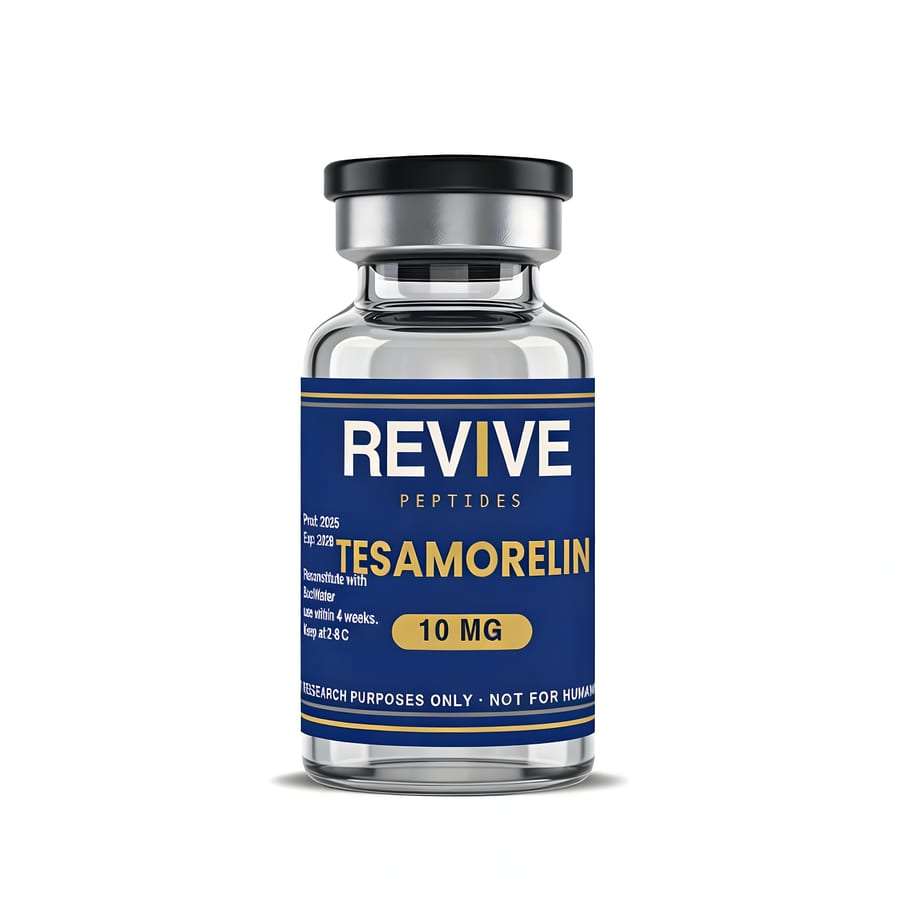
IGF-1 — insulin-like growth factor 1 — is the liver-derived downstream signal that makes GH-axis research measurable. You cannot observe GH pulsatility directly in a living subject without continuous blood sampling; but you can draw a single morning IGF-1 and get a reliable proxy for GH secretory tone across the previous 24 hours. This is why tesamorelin's IGF-1 footprint is so well-documented: every major clinical study used IGF-1 as an on-protocol biomarker, not just an endpoint. The result is a dataset that researchers can reference when evaluating IGF-1 as a research biomarker. REVIVE LAB UAE does not provide dosing or titration protocol guidance — protocol design is a matter for the researcher's own institutional review. Below is what that dataset shows, stripped of clinical framing and translated into research-context terms for investigators working in the UAE or sourcing peptides UAE-wide.
The GHRH → GH → IGF-1 Axis: Why Tesamorelin Is a Reliable Upstream Signal
Tesamorelin is a synthetic GHRH analog — specifically, a 44-amino-acid peptide identical to endogenous GHRH 1-44 with a trans-3-hexenoyl modification at the N-terminus. That structural addition serves two functions: it blocks rapid cleavage by dipeptidyl peptidase-IV (DPP-IV) in plasma, extending the peptide's functional half-life from under two minutes (native GHRH) to roughly 30-40 minutes; and it preserves the receptor-binding conformation that triggers GH release from somatotroph cells in the anterior pituitary.
The cascade is linear: tesamorelin binds pituitary GHRH receptors → stimulates pulsatile GH secretion → GH signals the liver to produce IGF-1 → circulating IGF-1 rises proportionally. Critically, tesamorelin works within normal physiological feedback — it does not suppress the GHRH-GH-IGF-1 axis in the way exogenous GH does, and it preserves the negative-feedback role of somatostatin. This means IGF-1 rises follow the curve of increased GH pulsatility, not a blunt pharmacological override. For investigators studying GH-axis modulation, this distinction is meaningful: tesamorelin's IGF-1 response reflects amplified physiology, not replacement pharmacology.
Falutz 2010 Extension: Does IGF-1 Hold at 26 Additional Weeks?
The 2010 follow-up published in the Journal of Clinical Endocrinology & Metabolism extended the Falutz 2007 responder cohort through an additional 26 weeks, giving a 52-week total duration window. The key questions for IGF-1 researchers:
- VAT durability: The 15-18% VAT reduction from year one was maintained through year two in the tesamorelin arm. Subjects who crossed over from placebo to tesamorelin in the extension phase replicated the original IGF-1 rise within 13 weeks.
- Reversibility: Among subjects who discontinued tesamorelin, IGF-1 levels returned toward baseline over weeks — not permanently altered. This reversibility is mechanistically consistent with the upstream, physiology-dependent mode of action.
For investigators planning protocol durations beyond 12 weeks, the 2010 data provides the strongest published evidence that tesamorelin-driven IGF-1 elevation does not self-limit within a six-month window.
Buy Tesamorelin UAE — Order Now →
Stanley 2014 JAMA & 2019 Lancet HIV: IGF-1 as a Biomarker Beyond Lipodystrophy
The Stanley group at Massachusetts General Hospital extended tesamorelin research into a different metabolic endpoint — non-alcoholic fatty liver disease (NAFLD) in HIV-positive adults. These two trials matter for IGF-1 researchers because they confirm the same downstream IGF-1 response in a separate disease model, and they add a mechanistically meaningful secondary finding.
Stanley 2014 (JAMA)
Liver fat — measured by MR spectroscopy — fell by 32% relative to placebo in the tesamorelin arm. IGF-1 rose in parallel with the GH-axis stimulation pattern observed in the Falutz cohorts. Crucially, the investigators noted that IGF-1 normalization (from below-normal baseline in this HIV cohort) appeared to correlate with the degree of hepatic fat reduction, raising the hypothesis that IGF-1 itself may mediate some of the NAFLD benefit independently of the direct lipolytic action of GH.
Stanley 2019 (Lancet HIV)
The 2019 follow-up expanded the NAFLD dataset with a larger, 12-month randomised multicentre design. The liver-fat reduction was again statistically significant versus placebo.
Order Tesamorelin UAE — Same-Day Dubai →
Source Quality and IGF-1 Variance: Why HPLC Purity Is Non-Negotiable
One variable that introduces unexplained IGF-1 variance in research protocols — more than administration timing or storage duration, both of which are matters for the researcher's own institutional protocol — is peptide purity. A nominal dose of 80% pure tesamorelin delivers only 80% of its labelled active peptide content; the remaining fraction is truncated fragments, oxidation products, or synthesis impurities that can act as receptor antagonists at the GHRH receptor, partially blunting the GH-axis response.
This is not a theoretical concern. GHRH receptor occupancy by non-functional fragments reduces the effective IGF-1 rise relative to what a fully pure dose would produce. Investigators who switch from an unverified source to an HPLC-certified supplier frequently observe IGF-1 responses that more closely match the Falutz 2007 reference curve — not because the administered amount changed, but because the effective purity changed.
REVIVE LAB UAE runs every tesamorelin batch through HPLC analysis targeting ≥99% purity. Lot-specific certificates of analysis are available on request. This is the same standard the clinical trial investigators used when they sourced tesamorelin for the NEJM, JAMA, and Lancet HIV studies — and it is the only standard that makes the published IGF-1 data reproducible in a research context.
Buy Tesamorelin UAE — REVIVE LAB UAE Delivery Coverage
REVIVE LAB UAE is a Dubai-based peptides UAE supplier with cold-chain courier infrastructure covering all seven emirates. Tesamorelin 5mg and 10mg are stocked in Dubai right now — not on a lead-time order from offshore. When you place an order before the daily cut-off, dispatch is same-day. The tesamorelin Dubai 24h delivery commitment is not a marketing claim; it is a function of the courier network being Dubai-local, not international drop-ship.
| Emirate / Region | Delivery Window | Cash on Delivery | Cold-Chain Packaging |
|---|---|---|---|
| Dubai (Marina, JBR, DIFC, Downtown, Palm, JVC, Business Bay, Jumeirah) | Same-day, 4-8 hours | Yes | Yes |
| Abu Dhabi (Corniche, Yas, Saadiyat, Reem Island) | Next-day, 18-24 hours | Yes | Yes |
| Sharjah | Same-day / next-day, 8-18 hours | Yes | Yes |
| Ajman | Next-day, 18-24 hours | Yes | Yes |
| Ras Al Khaimah | Next-day, 18-24 hours | Yes | Yes |
| Fujairah | Next-day, 24 hours | Yes | Yes |
| Umm Al Quwain | Next-day, 18-24 hours | Yes | Yes |
Beyond tesamorelin, the REVIVE LAB UAE catalogue covers the broader peptides UAE research stack — Retatrutide, GHK-Cu, BPC-157, TB-500, MOTS-c, Semax, and NAD+. All products are HPLC-tested and cold-chain dispatched. For investigators focused on the GH-axis specifically, tesamorelin remains the flagship: it is the only GHRH analog with a four-study published IGF-1 dataset across two disease models, giving a reproducible research baseline that no other peptide in the UAE market can match.
Buy Tesamorelin UAE — Order Now →
FAQ
Which tesamorelin vial sizes does REVIVE LAB UAE stock, and how do I order with same-day delivery in Dubai?
REVIVE LAB UAE stocks tesamorelin 5mg and 10mg vials — both HPLC-verified to ≥99% purity, with lot-specific COA available on request and cold-chain packaging for every dispatch. To order, visit /buy-tesamorelin-uae/ and select your vial size and quantity. Dubai-area investigators (Marina, JBR, DIFC, Downtown, Palm, Business Bay, JVC, Jumeirah) receive tesamorelin same day Dubai delivery within 4-8 hours for orders placed before the daily cut-off. All other emirates are within 24 hours. Cash on delivery Dubai and UAE-wide is supported.
How quickly does tesamorelin raise IGF-1 in research protocols, and does it normalise after stopping?
The peak response was observed around week 26. The 2010 extension confirmed that IGF-1 levels returned toward baseline within weeks of discontinuation — confirming that GH-axis stimulation from tesamorelin is peptide-dependent and fully reversible. This reversibility is mechanistically consistent with tesamorelin's upstream, physiology-modulating mode of action (versus replacement GH), and it is a primary reason the compound remains a central subject in GHRH-axis research.
- Falutz J, Allas S, Blot K, et al. Metabolic effects of a growth hormone-releasing factor in patients with HIV. N Engl J Med. 2007;357(23):2359-2370.
- Falutz J, Mamputu JC, Potvin D, et al. Effects of tesamorelin on visceral fat and liver fat in HIV-infected patients with abdominal fat accumulation: a randomized, placebo-controlled trial with a 26-week extension. J Clin Endocrinol Metab. 2010;95(9):4291-4304.
- Stanley TL, Feldpausch MN, Oh J, et al. Effect of tesamorelin on visceral fat and liver fat in HIV-infected patients with abdominal fat accumulation. JAMA. 2014;312(4):380-389.
- Stanley TL, Fourman LT, Feldpausch MN, et al. Effects of tesamorelin on non-alcoholic fatty liver disease in HIV: a randomised, double-blind, multicentre trial. Lancet HIV. 2019;6(12):e821-e830.