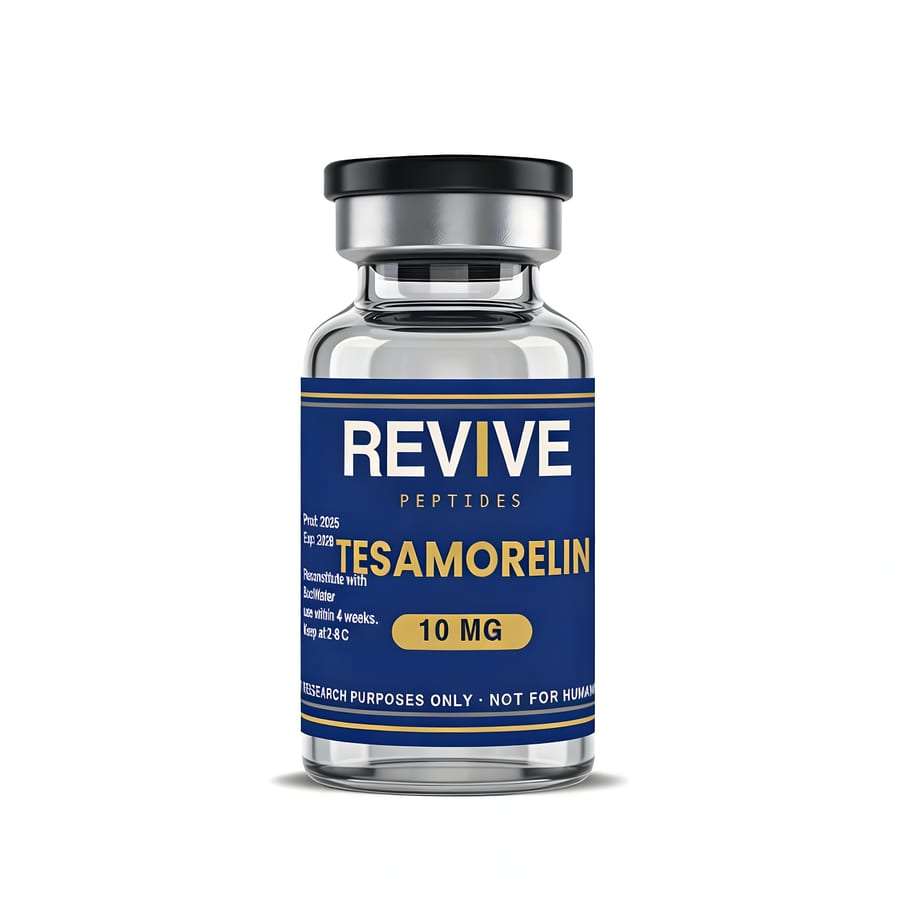
The delivery hardware question comes up in almost every tesamorelin research thread, and for good reason. This is a 44-amino-acid GHRH analog — trans-3-hexenoyl-modified GHRH 1-44 — that needs to survive subcutaneous delivery, reach the pituitary via bloodstream, and stimulate pulsatile GH secretion with enough consistency to replicate the results Falutz and colleagues achieved in their landmark NEJM trials. Technique matters. Dead volume matters. Gauge matters. And in the UAE research context, where the REVIVE LAB UAE supply chain delivers HPLC-verified tesamorelin 5 mg and 10 mg vials across all 7 emirates with cold-chain couriers, the compound itself is the easy part — the investigator's job is to not lose 200 mcg down a needle hub.
This guide compares insulin syringes and auto-injector pens across every variable that matters for tesamorelin research: dead volume, gauge, volume accuracy, reconstitution compatibility, injection comfort and cost-per-injection. The Falutz 2007 NEJM trial (412 subjects, 2 mg/day SC, VAT reduced 15-18%, IGF-1 elevated ~50%) and the Stanley 2014 JAMA liver-fat study (-32% hepatic fat vs placebo) were both conducted using standard subcutaneous syringe injection — understanding exactly why investigators made that choice informs modern UAE research setups.
Tesamorelin is a GHRH analog, not insulin. Unlike a dose-stable small molecule, it is a fragile peptide that degrades in solution — once reconstituted, researchers are working against a stability clock (14 days at 2-8°C is the outer limit; 7-10 days is the conservative research ceiling). Every fraction of a milligram left in a needle's dead volume or hub is compound discarded. At a research dosing schedule of 1 mg/day or 2 mg/day — the range referenced in Falutz et al. 2007 and 2010 and adopted in Stanley's teams' hepatic protocols — delivery accuracy is fundamental to reproducible outcomes.
Three hardware variables determine how much tesamorelin actually enters the subcutaneous space:
Get these wrong and investigators are not replicating the Falutz or Stanley protocols — they are running a systematic underdose. This is particularly acute with the 5 mg tesamorelin vials stocked by REVIVE LAB UAE, where each milligram of lost dose represents a meaningful fraction of a research-expensive compound.
The standard subcutaneous insulin syringe — 0.5 mL (50 unit) or 1 mL (100 unit), fixed 29G or 30G needle — is the delivery system used in the pivotal tesamorelin trials and remains the baseline for most research investigators in the UAE. It is available from pharmacy distributors across Dubai, Abu Dhabi and Sharjah, it is low-cost per injection, and its volume graduation on a 0.5 mL barrel maps neatly to the maths of a reconstituted tesamorelin vial at 5 mg/mL.
Fixed-needle insulin syringes essentially eliminate dead volume. The needle is permanently bonded to the barrel at manufacture, meaning there is no Luer-lock dead space or hub cavity where solution can pool. For a peptide as dose-sensitive as tesamorelin, fixed-needle 29G–30G syringes represent the lowest-waste delivery hardware available without specialised equipment.
Standard insulin syringe specs for tesamorelin research:
Auto-injector pens — the multi-use subcutaneous devices originally designed for insulin and later adopted for GLP-1 agonists like semaglutide — have entered the peptide research toolkit because they address the one genuine weakness of insulin syringes: injection anxiety and skill variance in self-administration research contexts. For a protocol running 6-12 months (the duration range tested by Stanley et al. 2019 in the Lancet HIV NAFLD study), consistent daily administration is as important as dose accuracy, and pen devices lower the per-injection skill barrier.
Pen devices fall into two categories relevant to tesamorelin research: cartridge-based pens (designed for pre-filled cartridges) and vial-adapter pens that use a needle hub attachment to draw from standard multi-dose vials. For REVIVE LAB UAE tesamorelin 5 mg and 10 mg vials — standard lyophilized format in a sealed rubber-septum glass vial — the relevant hardware is the vial-adapter or "Q-cap" style injection pen that pierces the vial septum and delivers a dialled dose.
Key pen compatibility requirements for tesamorelin 5 mg / 10 mg research vials:
| Variable | Insulin Syringe (29G/30G) | Auto-Injector Pen (31G/32G) |
|---|---|---|
| Dead volume | < 0.02 mL (fixed needle) | 0.03–0.08 mL (pen + tip) |
| Volume precision | ★★★★★ — 0.01 mL increment | ★★★ — 0.05 mL typical |
| Injection comfort | ★★★ — skill-dependent | ★★★★★ — spring-loaded |
| Cost per injection | AED 1–3 per syringe | AED 2–5 per tip; pen reusable |
| Protocol adherence (long run) | Moderate | High |
| Reconstitution compatibility | Direct draw from vial | Requires vial-adapter pen or Q-cap |
| Portability | Compact, disposable | Larger; replaceable tips |
| Best for | Precision micro-dosing, short protocols | Daily long-run protocols, comfort-first |
Research verdict: For investigators replicating the 1 mg/day or 2 mg/day dosing cadence referenced in the Falutz and Stanley trials, the insulin syringe wins on dose accuracy. For multi-month research runs — particularly the 26-week and 52-week timelines studied by Stanley et al. (2019, Lancet HIV) — pen device advantages in adherence start to outweigh the slight dead-volume disadvantage, provided pen-specific dead volume is accounted for in reconstitution calculations.
Reconstitution is where the syringe-vs-pen decision has direct downstream consequences. The goal is to produce a concentration that maps cleanly to the target research dose in a deliverable volume — neither too dilute (wasted vial) nor too concentrated (sub-0.1 mL doses that amplify dead-volume error). REVIVE LAB UAE stocks tesamorelin in 5 mg and 10 mg vials; the table below shows the standard reconstitution maths for both delivery methods.
| Vial | BAC Water Added | Concentration | 1 mg Dose Volume | 2 mg Dose Volume |
|---|---|---|---|---|
| Tesamorelin 5 mg | 1 mL | 5 mg/mL | 0.20 mL | 0.40 mL |
| Tesamorelin 5 mg | 2 mL | 2.5 mg/mL | 0.40 mL | 0.80 mL |
| Tesamorelin 10 mg | 2 mL | 5 mg/mL | 0.20 mL | 0.40 mL |
| Tesamorelin 10 mg | 1 mL | 10 mg/mL | 0.10 mL | 0.20 mL |
Syringe note: At 5 mg/mL, a 0.20 mL dose sits at the 20-unit mark on a 1 mL/100-unit syringe or the 20-unit mark on a 0.5 mL/50-unit barrel — clean and unambiguous. Fixed-needle dead volume (< 0.02 mL) is negligible relative to dose size.
Pen note: If your pen model has 0.06 mL of dead volume, add 0.06 mL to the dialled dose to compensate. At 5 mg/mL, 0.06 mL dead volume = 300 mcg un-delivered per injection — at a 1 mg/day research cadence, that is a 30% systematic underdose if uncompensated. Always prime your pen tip before dialling the research dose.
Reconstitution technique applies equally to both: add BAC water slowly down the inside wall of the vial, never directly onto the lyophilized cake. Swirl gently — never vortex — and allow 1-2 minutes for full dissolution before drawing. Reconstituted vials must remain at 2-8°C; research ceilings are 14 days maximum, 7-10 days conservative. For UAE investigators, this means ordering tesamorelin UAE in quantities matched to the active protocol window, not months in advance.
Both the Falutz 2007 NEJM and Stanley 2014 JAMA protocols administered tesamorelin via subcutaneous injection, with the periumbilical abdominal area as the primary site — consistent with the mechanism rationale, as this is the anatomical region where visceral adipose tissue accumulation is most clinically relevant and where SC bioavailability is well-characterised for peptides.
Practical site-rotation protocol for daily tesamorelin research:
Thigh and lateral abdominal sites are secondary rotation options for long-duration protocols. All Falutz and Stanley trial sites used abdominal SC as primary for consistency of data — investigators replicating these protocols should do the same.
The correct delivery hardware is only half the equation. The other half is a tesamorelin source that actually delivers research-grade compound — HPLC-tested for purity, lot-COA documented, cold-chain dispatched. For investigators running a tesamorelin protocol in Dubai, Abu Dhabi, Sharjah or any of the seven emirates, the supply chain matters as much as the syringe gauge.
REVIVE LAB UAE is the UAE's primary research-grade tesamorelin supplier. Every batch is HPLC-verified ≥99% purity with lot COA available on request, shipped in validated cold-chain insulation from a Dubai-based dispatch point. Tesamorelin same day Dubai delivery applies for orders placed before the daily cut-off. No offshore fulfillment, no temperature-compromised freight-forwarding — tesamorelin Dubai 24h delivery from a locally-stocked, locally-dispatched source.
| Location | Delivery Window | Cash on Delivery | Discreet Packaging |
|---|---|---|---|
| Dubai (Marina, JBR, Business Bay, JVC, DIFC, Downtown, Palm, Jumeirah) | Same-day, 4-8 hours | Yes | Yes |
| Abu Dhabi (Corniche, Yas, Saadiyat, Reem) | Next-day, 18-24 hours | Yes | Yes |
| Sharjah | Same-day / next-day, 8-18 hours | Yes | Yes |
| Ajman, RAK, Fujairah, UAQ | Next-day, 18-24 hours | Yes | Yes |
| Al Ain | Next-day, 24 hours | Yes | Yes |
Payment options: cash on delivery is available across all seven emirates. USDT TRC20 (Binance Pay) is accepted with a 5% pre-pay discount — a useful option for investigators who prefer USDT crypto pay Dubai for research procurement. All shipments use plain, unbranded outer cartons as the default.
REVIVE LAB UAE is not a reseller or freight-forwarding operation. Every tesamorelin batch held in Dubai inventory is HPLC-tested with a documented lot COA, held at 2-8°C from production to dispatch, and delivered in validated cold-chain insulation. The vials investigators receive are the same quality the Falutz and Stanley labs required: lyophilized, mannitol-stabilized, sealed under nitrogen, purity confirmed by third-party mass spectrometry. For the UAE research community looking to buy tesamorelin UAE from a supplier that closes the gap between published protocol standards and real-world compound sourcing, REVIVE LAB UAE is the answer. Tesamorelin 5 mg and 10 mg are in stock now, available with tesamorelin same day Dubai dispatch. Reach all of the UAE — all 7 emirates — within 24 hours. Peptides UAE done right.
Most investigators use a 0.5 mL (50-unit) insulin syringe with a 29G or 30G fixed needle. This volume accommodates both 1 mg/day and 2 mg/day research-context dosing when working from a reconstituted REVIVE LAB UAE tesamorelin 5 mg or 10 mg vial at 5 mg/mL. Fixed-needle syringes minimise dead volume — an important consideration when each milligram of tesamorelin is a meaningful research asset. The fixed-needle format was the standard subcutaneous delivery method in the Falutz 2007 NEJM and Stanley 2014 JAMA trials.
Yes. Multi-use subcutaneous auto-injector pens with vial-compatible cartridge adapters or Q-cap attachments work with standard lyophilized tesamorelin vials from REVIVE LAB UAE. The required specs are: needle gauge 31G or finer, delivery volume range 0.1–0.5 mL per injection, and a minimum dose increment of 0.05 mL or finer. When using a pen device, always prime the needle tip before dialling the target research dose and factor in the pen's dead volume — typically 0.03–0.08 mL — to avoid systematic underdose across a multi-month protocol.
Yes. REVIVE LAB UAE stocks tesamorelin 5 mg and 10 mg vials and dispatches same-day within Dubai with tesamorelin 24h delivery across all 7 emirates. Orders placed before the daily cut-off reach Dubai Marina, JBR, Business Bay, DIFC, JVC, Palm Jumeirah, Downtown and Jumeirah within 4-8 hours via cold-chain courier. Cash on delivery is available UAE-wide; USDT TRC20 Binance Pay crypto payment carries a 5% pre-pay discount. All packaging is discreet, unbranded outer carton by default.