Tesamorelin + 16:8 Intermittent Fasting: GH-Fasting Synergy, Ghrelin & IGF-1 — UAE Research Protocol (2026)
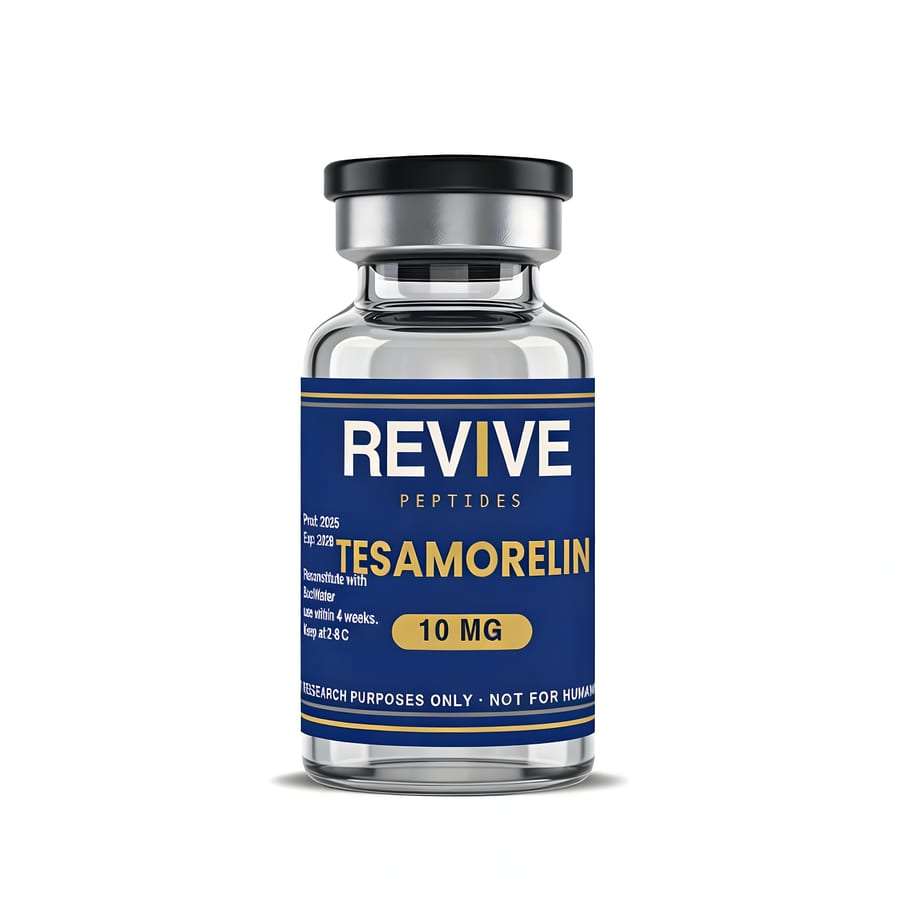
Most researchers using intermittent fasting already know that GH spikes during extended fasts. The less-discussed question is why — and whether a GHRH analog like tesamorelin can meaningfully amplify or precisely time that spike. The answer embedded in the endocrinology literature is nuanced and genuinely interesting: fasting does not raise GH by adding more GHRH; it raises GH primarily by removing the brake (somatostatin) and adding fuel (ghrelin). Tesamorelin then acts at an already-sensitized receptor population, producing a GH pulse that is larger, cleaner, and more physiologically structured than either intervention alone. REVIVE LAB UAE supplies HPLC-verified, lot-COA, cold-chain dispatched tesamorelin 5 mg and 10 mg vials across all 7 emirates — the foundational logistics for any serious researcher running this protocol in Dubai, Abu Dhabi, or Sharjah.
The GHRH Axis and Why Fasting Changes the Rules
Tesamorelin is a synthetic 44-amino-acid analog of endogenous GHRH with a trans-3-hexenoyl modification on the N-terminus. That structural tweak protects the molecule from dipeptidyl peptidase-IV (DPP-IV) cleavage, extending its functional half-life relative to native GHRH while preserving full agonist activity at the pituitary GHRH receptor. When the GHRH receptor fires, it stimulates adenylyl cyclase in somatotroph cells — GH synthesis and pulsatile release follow within minutes.
The key gatekeeper is not the GHRH receptor itself but somatostatin (SRIF), the hypothalamic hormone that clamps GH release between pulses. Think of somatostatin as a volume knob: when it is high (postprandial, hyperinsulinemic state), even a large GHRH stimulus produces a blunted GH pulse. When somatostatin tone is low — as it is during sustained fasting — the same GHRH stimulus produces a dramatically amplified response.
How 16-Hour Fasting Reshapes the GH Landscape
Within 12-16 hours of the last meal, several parallel changes converge on the GH axis:
- Somatostatin suppression. Falling insulin and glucose reduce hypothalamic somatostatin output. The tonic brake on somatotrophs lifts.
- Ghrelin surge. Ghrelin — the orexigenic peptide secreted from gastric oxyntic cells — rises sharply during fasting. Ghrelin is a potent GH secretagogue acting at the GHSR-1a receptor in both the hypothalamus and pituitary. It does not replace GHRH but synergizes with it, amplifying the GH pulse that GHRH triggers.
- Free fatty acid elevation. Rising FFA during lipolysis partially modulate GH pulsatility at the hypothalamic level, though the net effect reinforces, not suppresses, the fasted GH signal.
- IGF-1 paradox. Despite rising GH, liver IGF-1 production actually falls during prolonged fasting due to hepatic GH resistance (downregulation of hepatic GHR). This decoupling is a key insight: elevated GH is bioavailable and acting at non-hepatic tissues during the fast, even as serum IGF-1 lags.
Where Tesamorelin Fits
When an investigator administers tesamorelin during the fasted state — specifically in the window when somatostatin tone is suppressed and ghrelin is elevated — the compound acts on an already-sensitized pituitary. The resulting GH pulse is larger in amplitude than what the same tesamorelin dose would produce in the fed, insulin-replete state. This is the GH-fasting synergy that makes the 16:8 + GHRH analog combination genuinely interesting at the mechanistic level rather than just additive on paper.
The critical distinction from pharmacological GH administration is that tesamorelin preserves the pulsatility of GH release. Receptors remain sensitive; feedback loops remain intact. The Falutz et al. and Stanley et al. trial populations showed this clearly: IGF-1 rose approximately 50% from baseline (Falutz 2007), confirming that even in adults with pre-existing metabolic disruption, tesamorelin's GHRH-receptor-mediated pathway could drive meaningful downstream IGF-1 production — and this was measured in participants who were not fasting. A fasted-state administration arguably starts from a more favorable axis sensitivity baseline.
IGF-1 and the Fasted State — What Investigators Track
The ~50% IGF-1 rise reported by Falutz et al. is the most-cited downstream marker because IGF-1 is the primary mediator of anabolic, tissue-protective, and metabolic GH actions. In the intermittent fasting context, the situation is layered: during the 16-hour fast itself, serum IGF-1 may be mildly suppressed due to transient hepatic GH resistance. After the feeding window restores hepatic sensitivity, the enhanced GH pulses primed by tesamorelin during the fasted period can drive a more pronounced IGF-1 rebound in the fed phase. Investigators monitoring this protocol typically track IGF-1 at trough (end of fast) and 4-6 hours post-meal to capture the full arc of this response.
Buy Tesamorelin UAE — Order Now →
Ghrelin, the Feed-Fast Signal, and GHRH Analog Timing
Ghrelin deserves more attention in any 16:8 + tesamorelin discussion because it is the molecular bridge between the feeding state and the pituitary. Ghrelin is secreted in pre-meal surges and rises throughout the fasting period, peaking just before the expected feeding window in circadian-entrained individuals. This pre-feeding ghrelin peak is also the GH-secretory axis at peak sensitivity.
Investigators studying GHRH analog timing have noted the clinical implication: administering a GHRH peptide shortly before this natural ghrelin peak positions the compound to act on GHRH receptors at the moment of maximum co-stimulation. In a 16:8 model where feeding begins at noon and fasting runs from 8pm to noon, the peak ghrelin window typically falls somewhere between 10am and 12pm — the last 2 hours of the fast. This is the window most research protocols situate GHRH analog administration for maximal synergistic effect.
It is worth noting that this mechanistic reasoning is investigational. The peer-reviewed literature has not yet published a controlled, prospective study of tesamorelin dosed specifically within a 16:8 fasting window in non-HIV healthy adults. The mechanism is well-grounded; the clinical data is extrapolated from the four pivotal trials above. Researchers interested in this question can order tesamorelin UAE from REVIVE LAB UAE for laboratory investigation under appropriate research-use conditions.
16:8 + Tesamorelin: Research Protocol Timing Reference
The table below synthesizes the fasting physiology and GHRH analog pharmacology into a practical timing reference for investigators. All dosing figures are derived from the Falutz and Stanley trial protocols; this is not a clinical recommendation.
| Time (Example 16:8) | Fasting State | Key Hormones | Research Notes |
|---|---|---|---|
| 8:00 pm | Fast begins | Insulin falling, ghrelin rising | Last meal; fast window starts |
| 11:00 pm – 2:00 am | Early fast (3-6h) | GH pulses begin to increase | Sleep-phase GH surge; no intervention typically |
| 6:00 am – 9:00 am | Mid-fast (10-13h) | Somatostatin suppressed, ghrelin rising | Axis sensitization window; some protocols site injection here |
| 10:00 am – 11:30 am | Late fast (14-15.5h) | Ghrelin peaks, low somatostatin | Peak synergy window — most GHRH analog protocols land here (1 mg or 2 mg research-context dose) |
| 12:00 pm | Feeding window opens | Insulin rises, ghrelin falls | First meal; GH pulses attenuate as somatostatin rebounds |
| 12:00 pm – 8:00 pm | Feeding (8h) | IGF-1 rises post-meal | GH-primed IGF-1 rebound expected; investigators track at +4-6h |
Both vial sizes are stocked at REVIVE LAB UAE.
Order Tesamorelin Dubai — Same Day →
Where to Buy Tesamorelin UAE — REVIVE LAB UAE Delivery Coverage
Researchers running multi-week protocols need a supplier with consistent stock and cold-chain integrity, not a drop-shipper who sources vials ad hoc. REVIVE LAB UAE operates as a Dubai-based peptides UAE supplier — warehouse in-emirate, refrigerated courier fleet, lot-COA documentation available on every order. Whether you need tesamorelin Dubai 24h delivery, tesamorelin same day Dubai, or tesamorelin in stock UAE confirmed before you order, REVIVE LAB UAE is the answer across all 7 emirates.
| Emirate / City | Delivery Window | Cash on Delivery | Cold-Chain |
|---|---|---|---|
| Dubai (Marina, JBR, Business Bay, JVC, DIFC, Downtown, Palm, Jumeirah, Emirates Hills) | Same-day, 4-8 hours | Yes | Yes |
| Abu Dhabi (Corniche, Yas, Saadiyat, Reem) | Next-day, 18-24 hours | Yes | Yes |
| Sharjah | Same-day / next-day, 8-18 hours | Yes | Yes |
| Ajman | Next-day, 18-24 hours | Yes | Yes |
| Ras Al Khaimah (RAK) | Next-day, 18-24 hours | Yes | Yes |
| Fujairah | Next-day, 24 hours | Yes | Yes |
| Umm Al Quwain (UAQ) | Next-day, 18-24 hours | Yes | Yes |
| Al Ain | Next-day, 24 hours | Yes | Yes |
Researchers in Dubai Marina, JBR, Business Bay, JVC, Jumeirah, DIFC, Palm Jumeirah, Downtown, and Emirates Hills who order before the daily cut-off receive vials the same afternoon — cold-packed in insulated outer cartons that hold 2-8°C well beyond the delivery window. Tesamorelin cash on delivery Dubai is available as the default payment option across all 7 emirates. Packaging is plain and unbranded. For the broader research catalogue — Retatrutide, GHK-Cu, BPC-157, TB-500, MOTS-c, Semax, NAD+ — see the full REVIVE LAB UAE peptides range.
FAQ
Can I buy tesamorelin UAE for 16:8 fasting research — what vial sizes does REVIVE LAB UAE carry?
Yes. REVIVE LAB UAE stocks tesamorelin in 5 mg and 10 mg vials, HPLC-verified with lot-COA, dispatched cold-chain to all 7 emirates. Both sizes are in stock now. To buy tesamorelin UAE with same-day Dubai delivery, visit /buy-tesamorelin-uae/.
What does the research say about timing tesamorelin within a 16:8 fasting window for GH synergy?
Published endocrinology research consistently documents that GH pulsatility is highest during the late-fasting period — roughly 14-16 hours into the fast — when somatostatin tone is suppressed and circulating ghrelin peaks. Investigators studying GHRH analogs including tesamorelin (Falutz et al. 2007 NEJM; Stanley et al. 2014 JAMA) administered the compound in a fasted context and observed a roughly 50% rise in IGF-1 alongside a 15-18% reduction in visceral adipose tissue. Research protocols frequently situate GHRH analog administration in the 1-2 hours before the feeding window to capitalize on heightened pituitary ghrelin co-stimulation. This represents research-context reasoning, not a clinical or therapeutic recommendation.
Does REVIVE LAB UAE offer tesamorelin 24h delivery and cash on delivery in Dubai?
Yes. REVIVE LAB UAE offers tesamorelin 24h delivery across all 7 emirates. Tesamorelin same day Dubai dispatch is available for orders placed before the daily cut-off, covering Dubai Marina, JBR, Business Bay, JVC, DIFC, Downtown, Palm Jumeirah, Jumeirah, and Emirates Hills. Tesamorelin cash on delivery Dubai is available by default. All shipments use insulated cold-chain packaging and plain, unbranded outer cartons. To confirm current stock and place an order, visit /buy-tesamorelin-uae/.
Buy Tesamorelin UAE →
- Falutz J, Allas S, Blot K, et al. Metabolic effects of a growth hormone-releasing factor in patients with HIV. N Engl J Med. 2007;357(23):2359-2370.
- Falutz J, Mamputu JC, Potvin D, et al. Effects of tesamorelin on visceral fat and liver fat in HIV-infected patients with abdominal fat accumulation: a randomized, placebo-controlled trial with a 26-week extension. J Clin Endocrinol Metab. 2010;95(9):4291-4304.
- Stanley TL, Feldpausch MN, Oh J, et al. Effect of tesamorelin on visceral fat and liver fat in HIV-infected patients with abdominal fat accumulation. JAMA. 2014;312(4):380-389.
- Stanley TL, Fourman LT, Feldpausch MN, et al. Effects of tesamorelin on non-alcoholic fatty liver disease in HIV: a randomised, double-blind, multicentre trial. Lancet HIV. 2019;6(12):e821-e830.