Tesamorelin & Joint Pain — Research Notes for UAE Laboratories (2026)
What Is Tesamorelin? A GHRH Analog Primer
Tesamorelin is a synthetic analog of endogenous growth hormone-releasing hormone (GHRH), structurally modified with a trans-2-hexenoic acid moiety at the N-terminus that substantially extends its plasma half-life relative to native GHRH(1–44). This stabilisation makes it a preferred tool in research settings where sustained GH-axis stimulation needs to be modelled without frequent re-dosing, and it is precisely that pharmacokinetic profile that has made it a recurring subject in both clinical and preclinical studies.
Unlike direct GH agonists or synthetic GH secretagogues such as GHRP-6 or ipamorelin, tesamorelin works upstream — it engages the pituitary GHRH receptor and drives physiologically pulsatile GH release rather than forcing a pharmacological spike. In research models, this distinction matters: pulsatile GH more closely approximates endogenous secretion patterns, making tesamorelin a useful probe for studying the GH/IGF-1 axis without the confounds introduced by supraphysiological bolus exposure.
Research interest in this peptide has historically centred on metabolic and body composition endpoints. Landmark work by Falutz et al. (2007, NEJM) demonstrated robust visceral fat reduction in HIV-associated lipodystrophy models, with Stanley et al. (2014, JAMA) extending those findings to confirm IGF-1 elevation as a durable downstream marker. What is increasingly discussed in UAE-based research circles — and internationally — is whether that same IGF-1 signal carries meaningful secondary effects on connective tissue biology. That is the question these research notes address.
The GH/IGF-1 Axis and Musculoskeletal Research: Why Researchers Are Paying Attention
IGF-1 is not solely a metabolic hormone. In vitro and animal model data have consistently shown that IGF-1 receptors are expressed on chondrocytes, synovial fibroblasts, tendon-derived cells, and osteoblasts. The downstream signalling — particularly through the PI3K/Akt and MAPK pathways — is associated with proteoglycan synthesis in cartilage, collagen type I and II production in tendon and ligament explants, and suppression of certain pro-inflammatory cytokine cascades in synovial tissue preparations.
For researchers building musculoskeletal model systems, the GH/IGF-1 axis therefore represents a plausible upstream lever. The rationale is mechanistic rather than empirical at this stage: elevated IGF-1 — as reliably produced in preclinical settings by GHRH analog administration — creates a biochemical environment that has been associated in cell-culture studies with anabolic activity in connective tissue compartments. Whether that translates to measurable joint-level outcomes in living model systems is precisely the kind of question that drives current research interest.
A key consideration for research design is the time course. GH/IGF-1 effects on connective tissue remodelling are not acute. Collagen synthesis and cartilage matrix turnover operate on timescales of weeks to months. Research protocols studying tesamorelin in musculoskeletal contexts accordingly tend to model sustained administration windows rather than short acute exposures, a design point consistent with the long-term continuation data published by Falutz et al. (2010, NEJM) and the extended-use analysis by Stanley et al. (2019, Lancet HIV), both of which characterised the IGF-1 response over multi-month horizons.
It is worth stating plainly: none of the currently published peer-reviewed literature on tesamorelin specifically establishes a clinical intervention for joint pain in humans. The musculoskeletal angle is an active area of preclinical research interest, not an established therapeutic endpoint. All discussion in these notes is framed strictly within that research context.
Tesamorelin's Established Research Profile: What the Peer Literature Confirms
Before addressing the musculoskeletal research angle in more detail, it is useful to anchor the discussion in what is actually established. Four peer-reviewed studies provide the core pharmacological and safety profile from which research protocols are typically derived.
- Falutz et al., 2007 (NEJM): Demonstrated significant visceral adipose tissue reduction and confirmed robust IGF-1 elevation with tesamorelin administration in a lipodystrophy model. Established the fundamental efficacy signal.
- Stanley et al., 2014 (JAMA): Confirmed sustained IGF-1 elevation and expanded the metabolic characterisation. Noted that GH and IGF-1 returned to baseline after cessation — an important design consideration for wash-out experiments.
- Falutz et al., 2010 (NEJM): Continuation trial data demonstrating that the visceral fat and IGF-1 effects were durable with ongoing administration and attenuated on discontinuation, reinforcing the reversible and pulsatile nature of the GH axis engagement.
- Stanley et al., 2019 (Lancet HIV): Long-duration safety and efficacy data, providing the longest published window of tesamorelin exposure data available in the literature as of this writing.
Across these studies, the IGF-1 response is the most consistently reported molecular readout. For researchers interested in connective tissue endpoints, IGF-1 is the effector signal most directly relevant to chondrocyte and tendon biology, making tesamorelin a cleaner experimental tool than direct IGF-1 administration (which bypasses the physiological GH pulsatility) or broad GH secretagogues (which carry ghrelin-pathway confounds).
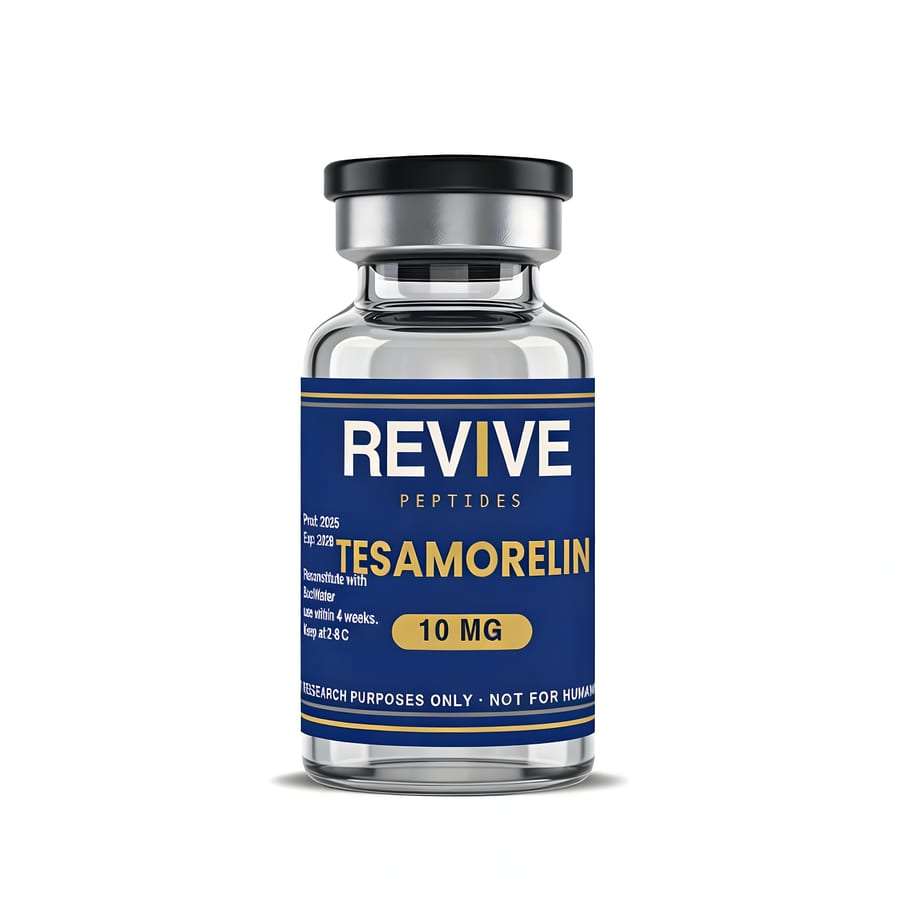
Tesamorelin Vial Options at REVIVE LAB UAE: 5mg vs. 10mg
REVIVE LAB UAE currently stocks tesamorelin in two lyophilized vial formats for research procurement:
| Format | Content | Best Research Use Case | Availability |
|---|---|---|---|
| Tesamorelin 5mg vial | 5mg lyophilized powder, research grade | Shorter protocols, pilot studies, dose-finding experiments | In stock — same-day Dubai dispatch |
| Tesamorelin 10mg vial | 10mg lyophilized powder, research grade | Extended protocols, multi-week model systems, bulk lab orders | In stock — same-day Dubai dispatch |
Both vials arrive lyophilized and require reconstitution with bacteriostatic water prior to use in research applications. Storage conditions matter: lyophilized tesamorelin is stable at room temperature for short periods but is best held refrigerated (2–8°C) after reconstitution and used within a research-protocol-appropriate window. REVIVE LAB UAE ships all peptide vials with cold-chain packaging for UAE transit, including routes to Abu Dhabi, Sharjah, Ajman, and the Northern Emirates where delivery times may be marginally longer than for Dubai Marina, Business Bay, or JBR addresses.
Researchers who are running multi-site studies — for example, coordinating between a Dubai lab and a facility in Abu Dhabi or Sharjah — should note that REVIVE LAB UAE can accommodate split-delivery orders with separate dispatch addresses. Contact the research procurement desk via WhatsApp for logistics on multi-location orders.
5mg & 10mg vials. Same-day Dubai delivery. Discreet packaging. Cash on delivery available.
Buy Tesamorelin UAE — Same-Day Dubai Dispatch from REVIVE LAB UAE
Ordering Tesamorelin in Dubai and Across the UAE: What to Know
REVIVE LAB UAE has built its logistics infrastructure specifically for the UAE research procurement landscape. A few things make sourcing peptides here different from ordering from European or US suppliers:
- Same-day dispatch from Dubai: Orders placed before 4 PM are dispatched the same day. Labs in Dubai Marina, JBR, Business Bay, Downtown, DIFC, and DXB-adjacent facilities typically receive their order within hours. This matters when a research protocol is running and a vial is needed on short notice.
- 24-hour delivery UAE-wide: Abu Dhabi, Sharjah, Ajman, and Ras Al Khaimah are all covered within a 24-hour delivery window. Palm Jumeirah and Al Quoz lab addresses in Dubai are same-day as standard.
- Cash on delivery available in Dubai: For research facilities that prefer not to use bank transfer or crypto for procurement, REVIVE LAB UAE offers cash on delivery for Dubai addresses. Binance Pay (USDT TRC20) is also accepted for a 5% pre-payment discount.
- Discreet packaging: All shipments are packed in unmarked outer packaging with no product names, logos, or lab identifiers on the exterior. This is standard for all REVIVE LAB UAE research peptide orders.
- Cold-chain handling: Tesamorelin vials are shipped with appropriate temperature management for UAE ambient conditions, which is a non-trivial consideration during summer months when ambient temperatures in Dubai and Abu Dhabi frequently exceed 40°C.
For researchers based in free zones — DIFC, Dubai Science Park, Dubai Healthcare City, Masdar City in Abu Dhabi — REVIVE LAB UAE is familiar with the access logistics and can coordinate delivery to gated campus addresses. Contact via WhatsApp for zone-specific delivery coordination.
Tesamorelin in Multi-Peptide Research Designs: Combination Considerations
UAE research labs running connective tissue or musculoskeletal model systems frequently ask about tesamorelin in the context of multi-peptide protocols. A few common research pairings appear in the literature, and it is worth noting where the science is stronger or weaker.
Tesamorelin with BPC-157
BPC-157 has a distinct proposed mechanism, acting via the nitric oxide system and growth factor modulation pathways rather than directly through the GH axis. Some preclinical research (reviewed in Sikiric et al., 2018) has characterised BPC-157's effects on connective tissue healing models in rodent systems. The scientific rationale for combining a GHRH analog with a peptide targeting different connective tissue pathways is discussed in preclinical research design contexts, though no published human or clinical data exist for this combination. Any research protocol exploring this pairing would need its own IRB or institutional ethics framing.
Tesamorelin with TB-500 (Thymosin Beta-4)
Thymosin beta-4 has been characterised in actin-modulation and tissue repair model systems (Goldstein et al., 2012). The intersection with GH-axis peptides is largely theoretical at this stage — both are subjects of active preclinical interest in musculoskeletal contexts, but combinatorial research data are sparse. REVIVE LAB UAE stocks TB-500 separately; researchers designing combination protocols should factor in the distinct mechanistic hypotheses behind each compound.
REVIVE LAB UAE does not prescribe or recommend research protocol designs. The above notes are provided for informational framing only, to help researchers contextualise their literature review and procurement decisions.
Why UAE Researchers Are Increasingly Focused on Tesamorelin
The UAE has developed rapidly as a hub for preclinical and translational research over the past decade, with facilities across Dubai Healthcare City, Abu Dhabi's Health Sciences campus, and a growing number of private research organisations operating from Business Bay and DIFC. Within that ecosystem, GH-axis peptides have become a regular subject of research interest, driven in part by the strong regional interest in metabolic biology, longevity science, and sports medicine research.
Tesamorelin sits at an interesting intersection. Its published efficacy record on IGF-1 elevation is cleaner than most peptides of comparable class — the Falutz and Stanley studies provide a rigorous reference base that gives research teams a defined pharmacological anchor. At the same time, the secondary research questions — particularly in musculoskeletal and connective tissue biology — remain genuinely open, which means there is legitimate research territory to explore.
For researchers working under UAE institutional frameworks, the clean published record of tesamorelin is an asset when designing protocols: IRB and ethics submissions are easier to anchor when the primary pharmacology is well-characterised in peer-reviewed literature, even when the secondary research question is novel. The four published clinical studies on tesamorelin collectively provide a more robust reference base than most research peptides currently in active lab use across the region.
REVIVE LAB UAE maintains in-stock positions on tesamorelin 5mg and 10mg specifically because demand from the UAE research community has been consistent and growing. Researchers who have previously sourced from European suppliers and dealt with two-to-three-week shipping windows — with the associated cold-chain risk during Gulf summer transit — have increasingly consolidated procurement with a UAE-based supplier. Same-day dispatch from Dubai is not a minor operational detail when you are running a tightly scheduled research protocol.
FAQ
Where can I buy tesamorelin in the UAE with same-day delivery?
REVIVE LAB UAE is the UAE's primary in-stock source for research-grade tesamorelin, with same-day dispatch for orders placed before 4 PM from its Dubai facility. Delivery covers all emirates, including Abu Dhabi, Sharjah, Ajman, and Ras Al Khaimah, with 24h delivery as standard. Orders are shipped in discreet, temperature-managed packaging. Visit revivelab.ae/buy-tesamorelin-uae/ to check current stock and place a research order.
What vial sizes of tesamorelin does REVIVE LAB UAE stock?
REVIVE LAB UAE currently stocks tesamorelin in 5mg and 10mg lyophilized research vials. Both formats are maintained as standing inventory items. The 5mg vial suits shorter or dose-finding research protocols; the 10mg vial is preferred for extended multi-week studies or labs running multiple concurrent experimental arms. Both are research-use only materials, manufactured under quality controls appropriate to preclinical research applications, and are not intended for human consumption.
Does REVIVE LAB UAE ship tesamorelin discreetly to Abu Dhabi and Sharjah?
Yes. All REVIVE LAB UAE shipments use unmarked outer packaging with no product names, peptide identifiers, or company branding visible on the exterior. This applies to deliveries across all UAE emirates, including Abu Dhabi, Sharjah, Ajman, and the Northern Emirates. For Abu Dhabi deliveries, the standard window is 24 hours from dispatch. For Sharjah and Ajman, same-day or next-morning delivery is typically achievable for morning-placed orders.
- Falutz J, Allas S, Blot K, et al. Metabolic effects of a growth hormone-releasing factor in patients with HIV. New England Journal of Medicine. 2007;357(23):2359–2370.
- Stanley TL, Feldpausch MN, Oh J, et al. Effect of tesamorelin on visceral fat and liver fat in HIV-infected patients with abdominal fat accumulation. JAMA. 2014;312(4):380–389.
- Stanley TL, Fourman LT, Feldpausch MN, et al. Effects of tesamorelin on non-alcoholic fatty liver disease in HIV: a randomised, double-blind, multicentre trial. Lancet HIV. 2019;6(12):e821–e830.
- Falutz J, Mamputu JC, Potvin D, et al. Effects of tesamorelin (TH9507), a growth hormone-releasing factor analog, in HIV-infected patients with excess abdominal fat: a pooled analysis of two multicenter, double-blind placebo-controlled phase 3 trials with safety extension data. Journal of Acquired Immune Deficiency Syndromes. 2010;53(3):311–322.
- Sikiric P, Seiwerth S, Rucman R, et al. Brain-gut Axis and Pentadecapeptide BPC 157: Theoretical and Practical Implications. Current Neuropharmacology. 2018;16(10):1465–1491.
- Goldstein AL, Hannappel E, Sosne G, Kleinman HK. Thymosin beta-4: a multi-functional regenerative peptide. Basic properties and clinical applications. Expert Opinion on Biological Therapy. 2012;12(1):37–51.
5mg & 10mg lyophilized vials. Same-day dispatch from Dubai. 24h delivery UAE-wide. Discreet packaging. Cash on delivery available for Dubai addresses.
Buy Tesamorelin UAE — Order from REVIVE LAB UAE