Tesamorelin & Loose Skin — Research Notes UAE: What the Data Records and What Researchers in Dubai Need to Know
Why UAE Researchers Are Watching Tesamorelin and Skin Behavior
Body composition research in hot climates has a particular urgency. For labs and clinicians running research protocols in the UAE, tesamorelin has emerged as one of the most mechanistically interesting GHRH analogs available — precisely because it has a published human trial record that almost no comparable peptide can match.
The loose skin question is a nuanced one in research contexts. It is not as simple as "peptide reduces fat, skin tightens." The actual observation that trial literature records is more specific: as deep truncal adipose depots — particularly visceral fat — are reduced over weeks of protocol exposure, the skin surface above those depots changes in ways that researchers note and measure. Whether that constitutes skin "tightening" or simply the resolution of underlying distension is a distinction worth making carefully. Researchers in the UAE interested in this axis should start with the published data before drawing conclusions, and that data — as covered below — comes from a limited but unusually high-quality set of trials.
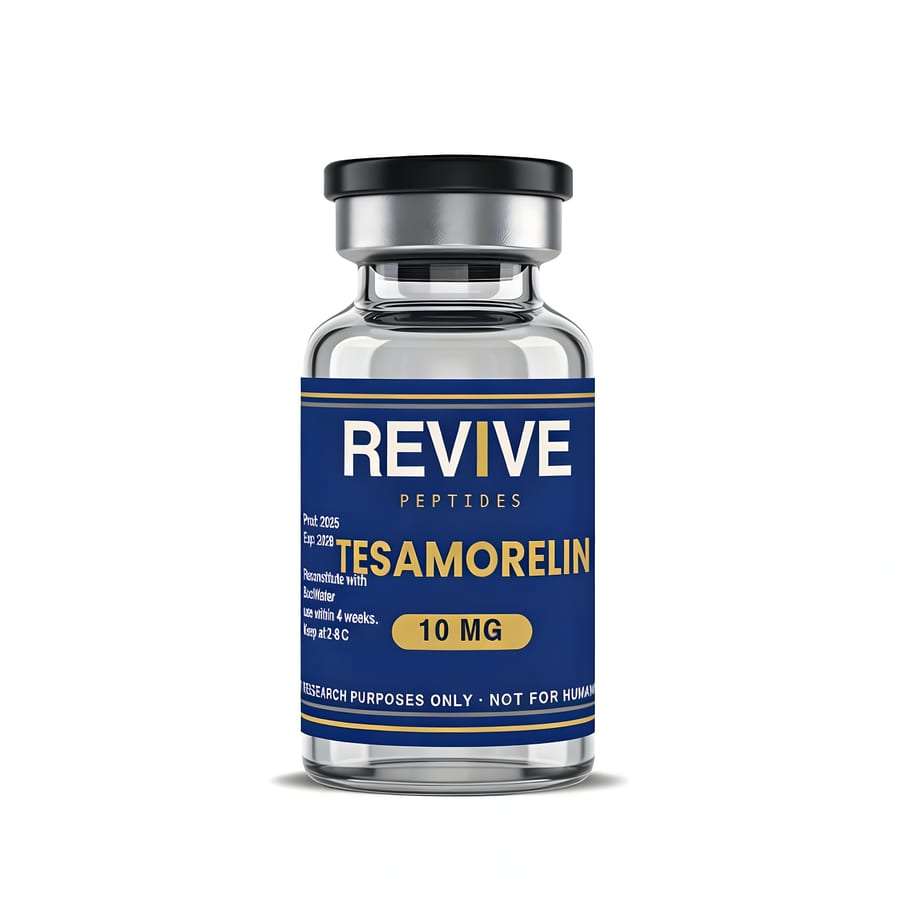
REVIVE LAB UAE has observed growing order volume from research facilities in Business Bay, Dubai Science Park, and Abu Dhabi's healthcare clusters specifically requesting tesamorelin for body composition protocols. That demand has driven us to keep both 5mg and 10mg vials consistently in stock locally, with same-day dispatch from Dubai available for labs that need reliable supply without import waiting times.
Tesamorelin Mechanism: GHRH Analogue, Pulsatile GH, and the IGF-1 Axis
Tesamorelin is a synthetic analogue of growth hormone-releasing hormone (GHRH), stabilised with a trans-3-hexenoic acid moiety that extends its half-life relative to endogenous GHRH. Its mechanism is upstream: it acts on pituitary somatotroph cells to stimulate pulsatile growth hormone (GH) secretion. This is not exogenous GH replacement — it preserves the physiological feedback arc between the pituitary and the hypothalamus, which is a key reason its safety profile in the published literature looks different from direct GH administration.
The downstream consequence of increased GH pulsatility is an elevation in circulating IGF-1. The IGF-1 axis is relevant to both adipose tissue metabolism and connective tissue biology. IGF-1, meanwhile, has documented roles in fibroblast activity and collagen synthesis pathways — which is why researchers interested in skin extracellular matrix biology sometimes include GHRH analogs in their compound comparison panels.
This mechanistic dual relevance — lipolytic in visceral compartments, potentially anabolic in connective tissue — is what makes tesamorelin an interesting research tool beyond its primary published indication. For UAE labs designing multi-endpoint body composition protocols, understanding both arms of this mechanism is essential before structuring a study design.
The Visceral Fat–Skin Interface: What Published Research Records
To understand why tesamorelin gets discussed in the context of skin appearance changes, researchers need to think anatomically.
When research models reduce visceral adipose tissue volumes significantly — the kind of reductions documented in the Falutz et al. and Stanley et al. trials — the anterior displacement resolves. Researchers observing subjects over these trial periods note a flattening of abdominal profile and, in some measurements, changes in skin surface tension metrics. The skin itself does not necessarily have more elastin or collagen — the underlying mechanical pressure has simply been reduced. This is a critical distinction for any UAE researcher designing endpoints around skin appearance outcomes.
A separate and genuinely more complex research question concerns whether the IGF-1 elevation produced by tesamorelin has any measurable effect on skin extracellular matrix composition over the same timeframe. This remains an area without dedicated controlled trial data. Researchers who want to study that axis specifically would need to design skin biopsy or non-invasive skin quality measurement endpoints into their protocols — something that standard body composition trials have not included. UAE labs with dermatological research capacity are, in principle, well-positioned to fill this gap.
What the Human Trial Data Actually Shows
Tesamorelin has an unusually strong trial record for a research peptide. The pivotal data comes from the HIV-associated lipodystrophy population, which provides a clean model for studying truncal fat accumulation and loss because the fat redistribution in that setting is pronounced, measurable by DEXA and CT, and reproducible across subjects.
Falutz et al. (2007, NEJM) published the first major double-blind, placebo-controlled trial. At 26 weeks, subjects receiving tesamorelin showed statistically significant reductions in visceral adipose tissue area versus placebo. The magnitude of reduction — approximately 15–18% from baseline — was clinically and visually meaningful. Importantly, lean mass was preserved, which is consistent with the mechanism: GH stimulation is not purely catabolic to fat; it spares muscle under normal conditions.
The continuation data from Falutz et al. (2010, NEJM) extended these observations. Subjects who continued treatment maintained their VAT reductions; those who were switched from active treatment to placebo showed partial rebound of visceral fat within 6 months. This rebound finding is one of the most practically important observations in the whole dataset — it tells researchers that tesamorelin's effects on visceral fat are dependent on ongoing exposure, not a permanent remodelling event.
Stanley et al. (2014, JAMA) provided a further controlled look at visceral fat with improved imaging endpoints, confirming the VAT reduction signal in a separate cohort and adding data on the lipid profile changes that accompany fat redistribution. Stanley et al. (2019, Lancet HIV) then provided the longest-duration controlled data available, extending observations over multiple years and confirming the durability of effect with continued exposure and the return of fat accumulation with discontinuation.
Taken together, this body of evidence tells UAE researchers the following: tesamorelin reliably reduces visceral adipose tissue in the human subjects studied, does so with a maintained lean mass profile, and requires sustained exposure to maintain the effect. The skin-relevant observation — that overlying skin profile changes follow visceral fat reduction — is a secondary consequence of these primary fat changes, not a direct dermatological pharmacological action.
| Trial | Publication | Duration | Key Finding |
|---|---|---|---|
| Falutz et al. | NEJM 2007 | 26 weeks | ~15–18% VAT reduction vs placebo; lean mass preserved |
| Falutz et al. | NEJM 2010 | 52 weeks (extension) | Effect maintained with continued exposure; partial rebound on discontinuation |
| Stanley et al. | JAMA 2014 | 26 weeks | VAT reduction confirmed; lipid profile changes documented |
| Stanley et al. | Lancet HIV 2019 | Multi-year | Long-term durability of VAT reduction; fat returns on cessation |
5mg & 10mg vials. Same-day dispatch Dubai. Discreet packaging. Cash on delivery available.
Buy Tesamorelin UAE — Same-Day Dubai Dispatch from REVIVE LAB UAESourcing Tesamorelin in UAE: Logistics, Delivery, and In-Stock Status
One of the practical frustrations for research facilities in the UAE has historically been lead times on peptide supply. Import routes for research-grade peptides can involve customs holding periods, temperature excursion risks during international shipping, and unpredictable availability windows. REVIVE LAB UAE was built to solve exactly this problem for the local research community — by maintaining in-country stock of high-demand peptides including tesamorelin, so that researchers at facilities from Dubai Marina to Sharjah's SAIF Zone can order and receive on the same day.
Our dispatch model for the UAE works as follows: orders placed before midday on weekdays receive same-day dispatch from our Dubai facility, with delivery to Dubai addresses — including JBR, Business Bay, DIFC, Palm Jumeirah, Downtown, and Dubai South — typically completed within the same afternoon or evening. Researchers in Abu Dhabi and Sharjah receive next-day or express delivery depending on their zone. Facilities at DXB-adjacent logistics parks can often arrange courier-to-lab handoff within hours of dispatch.
Every order from REVIVE LAB UAE ships in discreet, unbranded packaging. Cold-chain integrity is maintained with appropriate packing for UAE ambient temperatures — a critical detail in a country where summer ambient temperatures exceed 45°C and vehicle transit can expose packages to heat extremes. Our cold-pack protocol is calibrated for the specific conditions of UAE last-mile delivery, not for temperate European logistics assumptions.
Cash on delivery (COD) is available for Dubai orders, alongside Binance Pay (USDT TRC20) for researchers preferring crypto settlement, and standard bank transfer. Researchers who pre-pay via Binance Pay receive a 5% discount on their order total. For labs managing research budgets on tight timelines, this combination of payment flexibility and same-day availability is a meaningful operational advantage over waiting for international shipments.
- Dubai delivery: Same-day (order before midday) — Marina, JBR, Business Bay, DIFC, Palm, Downtown, Dubai South
- Abu Dhabi & Sharjah: Express delivery available; contact for specific zone estimates
- DXB area: Rapid courier-to-lab handoff on request
- Packaging: Discreet, unbranded, cold-pack rated for UAE summer transit
- Payment: Cash on delivery (Dubai), Binance Pay USDT TRC20 (5% discount), bank transfer
- Stock status: Both 5mg and 10mg tesamorelin vials in stock in UAE — no import wait
Research Protocol Considerations: Temperature, Reconstitution, and Stability
Tesamorelin in its lyophilised form is substantially more stable than the reconstituted solution. Lyophilised vials maintain integrity at refrigerator temperatures (2–8°C) and can tolerate short ambient temperature excursions during transit without significant degradation — which is why REVIVE LAB UAE's cold-pack configuration is designed to maintain temperatures in this range rather than requiring dry ice, which creates its own handling complications at lab receipt.
Once reconstituted, tesamorelin solution should be treated as any reconstituted peptide in a research lab setting: refrigerated, handled with standard aseptic technique, and used within the timeframe your lab's SOPs specify for reconstituted peptide solutions of this class. Agitation should be avoided — swirl gently rather than shaking during reconstitution, as mechanical shearing can disrupt peptide structure.
For UAE labs running comparison panels — for instance, comparing tesamorelin with other GHRH-class or GH secretagogue peptides — it is worth noting that the reconstitution and storage parameters for different compounds in this class are not identical. Researchers designing multi-compound protocols should confirm stability and compatibility parameters for each compound independently rather than assuming uniform handling. REVIVE LAB UAE's research notes documentation, available via our product pages, includes compound-specific handling guidance for all stocked peptides.
A final practical note for facilities running research in Business Bay high-rises or JBR tower labs: courier delivery to building reception desks is standard, but if your lab requires cold-chain maintained delivery to a specific floor, flagging this at order time allows REVIVE LAB UAE to coordinate with the courier for appropriate handoff. This is a common enough request from our UAE research clients that we have standing courier instructions for several major research building addresses across Dubai.
FAQ
Where can I buy tesamorelin in the UAE for research use?
REVIVE LAB UAE stocks tesamorelin in 5mg and 10mg vials with same-day dispatch from Dubai. Orders placed before midday typically reach researchers in Dubai Marina, Business Bay, JBR, and across the Emirates within 24 hours. Discreet packaging and cash-on-delivery options are available. All supply is for in-vitro and laboratory research use only. Visit /buy-tesamorelin-uae/ to place an order or confirm current stock.
Does REVIVE LAB UAE offer 24-hour delivery for tesamorelin in Dubai?
Yes. REVIVE LAB UAE operates same-day dispatch for researchers in Dubai, with delivery windows covering Marina, JBR, Business Bay, DIFC, Palm Jumeirah, Sharjah, and Abu Dhabi. Orders are cold-packed and shipped under discreet packaging for lab receipt. For tesamorelin 24h delivery Dubai, place your order before midday for same-day fulfilment or contact our team for urgent research supply requests.
What vial sizes of tesamorelin does REVIVE LAB UAE supply?
REVIVE LAB UAE currently stocks tesamorelin in 5mg and 10mg lyophilised vials, supplied for research use only. Both sizes are in stock in the UAE with no import lead times. The 5mg vial suits shorter or lower-volume research protocols; the 10mg vial is preferred for multi-subject panels or longer-duration observations where reducing reconstitution frequency improves protocol consistency.
- Falutz J, Allas S, Blot K, et al. Metabolic effects of a growth hormone-releasing factor in patients with HIV. N Engl J Med. 2007;357(23):2359–2370.
- Falutz J, Mamputu JC, Potvin D, et al. Effects of tesamorelin (TH9507), a growth hormone-releasing factor analog, in HIV-infected patients with excess abdominal fat: a pooled analysis of two multicenter, double-blind placebo-controlled phase 3 trials with safety extension data. N Engl J Med. 2010;362(18):1651–1660.
- Stanley TL, Feldpausch MN, Oh J, et al. Effect of tesamorelin on visceral fat and liver fat in HIV-infected patients with abdominal fat accumulation: a randomized clinical trial. JAMA. 2014;312(4):380–389.
- Stanley TL, Fourman LT, Feldpausch MN, et al. Effects of tesamorelin on non-alcoholic fatty liver disease in HIV: a randomised, double-blind, multicentre trial. Lancet HIV. 2019;6(12):e821–e830.
5mg & 10mg vials. Same-day dispatch from Dubai. Discreet packaging. COD available. Serving researchers across Dubai, Abu Dhabi, Sharjah, and the wider UAE.
Buy Tesamorelin UAE — REVIVE LAB UAE