Tesamorelin & Muscle Mass: IGF-1, Lean Tissue and the Falutz/Stanley Data — UAE Research Guide (2026)
Why Tesamorelin Is Anabolic At All
Tesamorelin is a stabilised analogue of growth hormone-releasing hormone (GHRH 1–44). It does not deliver GH itself. Instead, it binds pituitary GHRH receptors and provokes the somatotrophs to release endogenous GH in physiological pulses. Those pulses circulate, reach hepatocytes, and upregulate hepatic IGF-1 production. IGF-1 is the downstream mediator of nearly every classical “growth hormone” anabolic effect in skeletal muscle: satellite-cell activation, mTOR signalling, protein synthesis bias over breakdown, and amino-acid uptake (Klausen 2000; Müller 1999).
That mechanism is the reason a peptide marketed primarily for HIV-associated visceral adiposity (the indication Theratechnologies pursued for FDA approval in 2010) keeps showing up in lean-mass readouts. Where IGF-1 rises, muscle is the obligate beneficiary.
The Falutz 2010 Lean-Mass Signal
Falutz et al. The headline outcome was a 15.2% reduction in visceral adipose tissue versus a 5.0% increase in placebo. The often-overlooked secondary outcome: lean body mass rose by 1.3 kg in the tesamorelin arm, while the placebo arm lost lean tissue. Trunk lean tissue specifically gained 0.7 kg.
This is not a noise signal. The lean-mass change was statistically significant (p<0.001) and dose-correlated with IGF-1 SDS (standard deviation score) elevation. Subjects whose IGF-1 rose into the upper-normal range gained more lean tissue than those who remained mid-range. The dose-response is precisely what you would predict if hepatic IGF-1 were the anabolic mediator.
The Stanley 2014 Extension
Stanley et al. (J Clin Endocrinol Metab, 2014) extended observation to 52 weeks and added precise body-composition measurement with DEXA. Findings of interest for muscle research:
- Lean body mass gain held at 1.5 kg across the 52-week period in continuous-treatment subjects.
- Subjects who discontinued at 26 weeks lost the lean-mass gain within 6 months, confirming dependence on ongoing GH/IGF-1 stimulation.
- IGF-1 elevation persisted at 52 weeks without escape, meaning pituitary downregulation did not occur.
- Muscle attenuation on CT improved (denser muscle, lower intramyocellular lipid).
The Stanley data answer a question researchers commonly ask: does the muscle effect plateau or fade? The answer is neither — it stabilises and persists as long as the GHRH stimulus continues. This is unlike many anabolic interventions where receptor downregulation erodes the effect.
Tesamorelin vs Direct GH Administration on Muscle
For muscle endpoints, how does tesamorelin actually compare with injecting recombinant human GH directly? The honest comparison:
| Lean mass gain (12 weeks) | ~1.0–1.5 kg | ~2.5–3.5 kg |
| GH profile | Pulsatile, physiological | Flat, supraphysiological |
| IGF-1 elevation | Upper-normal range | Often above range |
| Insulin resistance | Minimal at therapeutic dose | Dose-dependent, often significant |
| Fluid retention / oedema | Mild, transient | Common, dose-related |
| Carpal tunnel symptoms | Rare | Frequent at higher doses |
| VAT reduction | ~15% at 26 weeks | Variable, less consistent |
| Pituitary feedback preserved | Yes | No (suppressed) |
The trade is real. Direct GH produces roughly 2× the absolute lean-mass gain at the cost of supraphysiological IGF-1, insulin resistance, and the classical GH side-effect cluster. Tesamorelin produces a smaller but cleaner anabolic effect because endogenous pulsatile GH release maintains intact negative feedback (somatostatin still works). For research models where you want to interrogate the IGF-1 axis without scrambling glucose homeostasis, tesamorelin is the better tool.
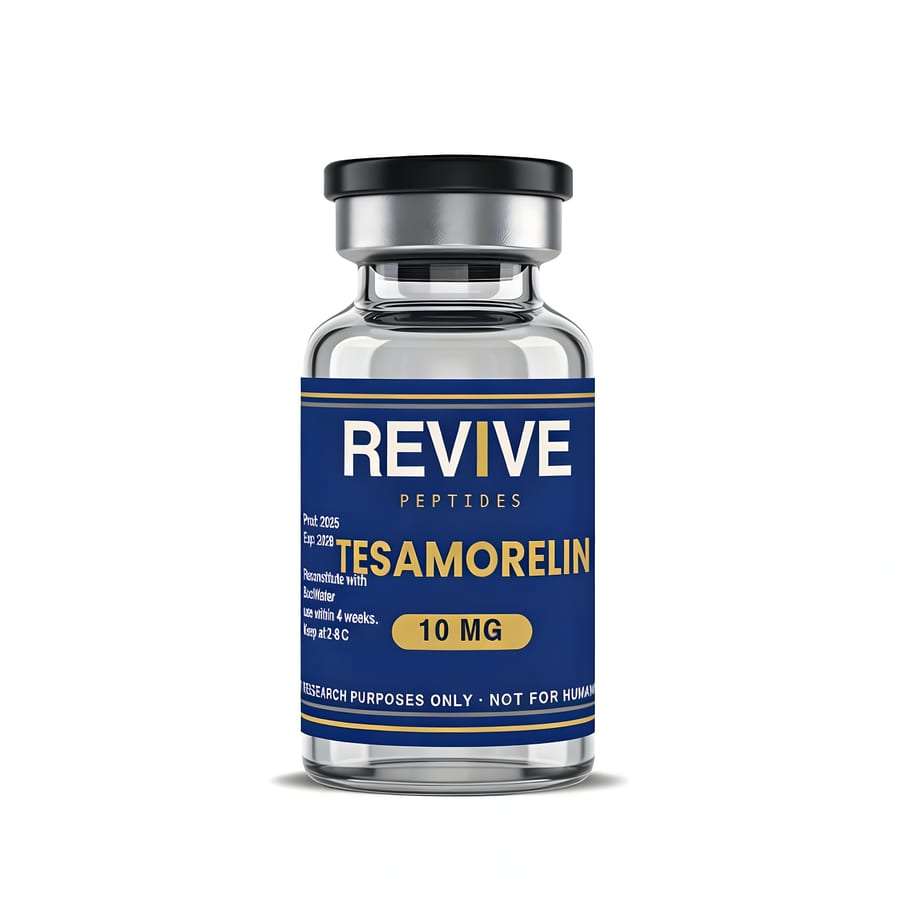
REVIVE stocks tesamorelin 5 mg and 10 mg vials in Dubai with HPLC certificates and cold-chain logistics. Same-day delivery in Dubai, next-day in Abu Dhabi, Sharjah and Ajman.
Buy Tesamorelin UAE 24h delivery →
What Drives the Anabolic Effect — Mechanism in Detail
Three parallel mechanisms account for tesamorelin’s muscle effects:
- Hepatic IGF-1. The principal pathway. Each tesamorelin-induced GH pulse triggers hepatic IGF-1 transcription. Circulating IGF-1 binds skeletal-muscle IGF-1R, activating PI3K/Akt/mTOR and biasing protein balance toward synthesis.
- Local muscle IGF-1 (MGF splice variant). GH also induces local IGF-1 production within muscle, including the mechano-growth factor (MGF) splice variant that is particularly potent at satellite-cell activation (Klausen 2000).
- Lipolysis-mediated substrate shift. GH’s lipolytic action on adipocytes increases free fatty acid availability, sparing amino acids from oxidation and freeing them for protein synthesis. This is a small but real contribution.
For comparison studies of related GHRH and GH-secretagogue peptides, see our ipamorelin vs CJC-1295 comparison.
Where to Buy Tesamorelin in the UAE — 24h Delivery
REVIVE Peptides operates a cold-chain warehouse in Dubai stocking tesamorelin 5 mg and 10 mg vials. Both strengths ship with batch-specific HPLC certificates of analysis. Bacteriostatic water 3 mL is available as an add-on.
| Emirate | Delivery window | Cut-off | Cold-chain |
|---|---|---|---|
| Dubai | Same-day | Order by 2:00 pm | Insulated cooler, gel pack |
| Abu Dhabi | Next-day (24h) | Order by 6:00 pm | Insulated cooler, gel pack |
| Sharjah | Next-day (24h) | Order by 6:00 pm | Insulated cooler, gel pack |
| Ajman | Next-day (24h) | Order by 6:00 pm | Insulated cooler, gel pack |
| Ras Al Khaimah | 48 hours | Order by 4:00 pm | Insulated cooler, gel pack |
| Fujairah | 48 hours | Order by 4:00 pm | Insulated cooler, gel pack |
| Umm Al Quwain | 48 hours | Order by 4:00 pm | Insulated cooler, gel pack |
Ordering process
- Place the order through the tesamorelin product page.
- Pay by card or bank transfer; cash on delivery is available across all seven emirates.
- Same-day Dubai orders dispatch within 2 hours of payment confirmation.
- Cold-chain courier delivers in an insulated cooler with two frozen gel packs sufficient for the UAE summer transit window.
- Refrigerate the lyophilised vial on arrival; it remains stable at 2–8°C and protected from light.
REVIVE keeps live tesamorelin stock in the UAE — the inventory page shows real-time vial counts so you can confirm availability before ordering. For multi-vial protocols (typical for 26-week or 52-week lean-mass studies), the bulk pricing tier applies from 10 vials.
Combining Tesamorelin With Other Peptides for Muscle Research
Researchers frequently pair tesamorelin with peptides that act on complementary anabolic or recovery pathways. The most studied pairings:
- Tesamorelin + BPC-157. BPC-157 supports tendon and connective-tissue adaptation while the IGF-1 axis drives muscle protein accretion (Sikiric 2010). See our BPC-157 tendon research notes.
- Tesamorelin + MOTS-c. MOTS-c improves mitochondrial substrate handling (Lee 2015), useful in models pairing anabolic stimulus with metabolic adaptation.
- Tesamorelin + TB-500. TB-500 (thymosin beta-4) modulates actin dynamics in healing tissue, complementing IGF-1-driven hypertrophy in injury-recovery models.
UAE-Specific Storage and Handling Notes
- Lyophilised vials are stable at 2–8°C. The UAE ambient temperature in summer (often 42°C+) makes reliable cold-chain mandatory.
- Reconstituted vials must be refrigerated. Once mixed with bacteriostatic water, treat the vial as a 28-day refrigerated reagent at most.
- Avoid direct sunlight. Tesamorelin is photosensitive; the amber vial protects against this but storage in a dark fridge compartment is best.
- Plan deliveries around extreme heat days. REVIVE’s Dubai dispatch uses pre-frozen gel packs validated for <8°C internal temperature across the standard same-day window.
Practical Takeaways for the Muscle-Mass Research Model
- Tesamorelin produces a real but modest lean-mass effect (~1.0–1.5 kg in 26–52 weeks) driven by IGF-1.
- The effect is dependent on continuous administration — it reverses on discontinuation.
- Compared with direct rhGH, tesamorelin yields roughly half the absolute lean gain but preserves pituitary feedback and produces less insulin resistance and oedema.
- Once-daily 2 mg SC is the only protocol with robust peer-reviewed lean-mass data.
- For UAE-based researchers, cold-chain logistics are the rate-limiting factor — REVIVE’s Dubai stock with 24h emirate-wide delivery removes the import-customs bottleneck most international suppliers cannot bypass.
References
- Falutz J, Allas S, Blot K, et al. Metabolic effects of a growth hormone-releasing factor in patients with HIV. N Engl J Med. 2007;357(23):2359–2370.
- Falutz J, Mamputu JC, Potvin D, et al. Effects of tesamorelin (TH9507), a growth hormone-releasing factor analog, in human immunodeficiency virus-infected patients with excess abdominal fat: a pooled analysis of two multicenter, double-blind placebo-controlled phase 3 trials with safety extension data. J Clin Endocrinol Metab. 2010;95(9):4291–4304.
- Stanley TL, Feldpausch MN, Oh J, et al. Effect of tesamorelin on visceral fat and liver fat in HIV-infected patients with abdominal fat accumulation: a randomized clinical trial. JAMA. 2014;312(4):380–389.
- Stanley TL, Falutz J, Mamputu JC, et al. Effects of tesamorelin on inflammatory markers in HIV patients with excess abdominal fat: relationship with visceral adipose reduction. AIDS. 2011;25(10):1281–1288.
- Klausen T, Breum L, Sorensen HA, et al. Plasma levels of IGF-I and IGF binding protein-3 during prolonged growth hormone therapy. Eur J Appl Physiol. 2000;81(6):506–511.
- Müller EE, Locatelli V, Cocchi D. Neuroendocrine control of growth hormone secretion. Physiol Rev. 1999;79(2):511–607.
- Sikiric P, Seiwerth S, Brcic L, et al. Stable gastric pentadecapeptide BPC 157 in trials for inflammatory bowel disease. Curr Pharm Des. 2010;16(10):1224–1234.
- Lee C, Zeng J, Drew BG, et al. The mitochondrial-derived peptide MOTS-c promotes metabolic homeostasis and reduces obesity and insulin resistance. Cell Metab. 2015;21(3):443–454.