Tesamorelin NAFLD: What the Stanley 2019 Lancet HIV Trial Actually Found — 32% Liver Fat Reduction at 12 Months & UAE Supply
The 2019 Lancet HIV paper by Timothy Stanley and colleagues at Massachusetts General Hospital is, as of mid-2026, the most rigorous controlled trial of any peptide on liver fat in human subjects. It ran a full 12 months — longer than most peptide RCTs ever reach — with the primary endpoint measured by magnetic resonance spectroscopy (MRS), the gold-standard quantitative liver fat imaging tool. That number is not a case report or a before-and-after inference. It is a pre-registered, MRS-confirmed, intention-to-treat result in a peer-reviewed journal ranked in the top tier of HIV medicine globally. Investigators in the UAE and Dubai who want to buy tesamorelin UAE for research programmes should understand exactly what that result represents and how it was produced.
The Stanley 2019 Trial: Design and Primary Findings
Trial Design at a Glance
Stanley TL, Fourman LT, Feldpausch MN, et al. published "Effects of tesamorelin on non-alcoholic fatty liver disease in HIV: a randomised, double-blind, multicentre trial" in Lancet HIV December 2019 (vol 6, issue 12, e821–e830). The core design parameters:
- Population: HIV-positive adults on stable antiretroviral therapy with MRS-confirmed hepatic steatosis (liver fat fraction ≥ 5%)
- Intervention: Tesamorelin 2 mg SC once daily versus identically-matched placebo
- Duration: 12 months — one of the longest double-blind peptide RCTs in published literature
- Primary endpoint: Change in hepatic fat fraction measured by proton MR spectroscopy
- Design: Randomised, double-blind, placebo-controlled, multicentre
The trial extended the same group's 2014 JAMA pilot (Stanley et al. 2014, 12-week, single-centre, n=61), which had shown directional liver fat reduction. The 2019 version lengthened follow-up to 12 months, expanded the sample, used MRS throughout rather than CT surrogates, and powered the primary analysis for a pre-specified hepatic fat endpoint — not a secondary finding bolted onto a VAT trial.
The 32% Finding — What It Actually Means
The primary result: tesamorelin-treated participants showed a 32% relative reduction in liver fat fraction compared to placebo at 12 months. Secondary findings of note to investigators:
| Outcome | Tesamorelin Arm | Placebo Arm | Notes |
|---|---|---|---|
| Liver fat fraction (MRS) | −32% (relative vs. placebo) | No significant change | Pre-specified primary endpoint |
| Steatosis resolution (fat < 5%) | Higher responder rate | Lower responder rate | MRS threshold analysis |
| Visceral adipose tissue | Reduced | No change | Consistent with Falutz 2007/2010 |
| IGF-1 | Elevated (expected) | Stable | Marker of GH axis engagement |
| ALT / AST | Trend toward reduction | Stable | Secondary signal — not primary endpoint |
The 32% figure is a relative change — it represents the ratio of liver fat change in the tesamorelin group versus the placebo group, which is the standard reporting convention in hepatic steatosis RCTs. The absolute MRS liver fat numbers depend on baseline characteristics of each participant. The relative effect size is, by any published benchmark in the NAFLD/MASLD literature, a substantial and clinically meaningful result, particularly at 12-month follow-up.
Buy Tesamorelin UAE — Order Now →
Mechanism: How Tesamorelin Acts on Liver Fat
Tesamorelin is a synthetic GHRH analog — specifically the 44-amino-acid sequence of human growth-hormone-releasing hormone (GHRH 1–44) with a trans-3-hexenoyl group conjugated at the N-terminus. That single structural modification protects the molecule from rapid cleavage by dipeptidyl peptidase-IV (DPP-IV), extending active half-life and preserving its ability to bind the pituitary GHRH receptor and stimulate endogenous pulsatile GH secretion. This is the mechanistic root for every metabolic effect the Stanley and Falutz trials measured.
The pathway from GHRH analog to liver fat reduction runs as follows:
- Tesamorelin binds GHRH receptors on anterior pituitary somatotrophs
- Pulsatile GH secretion increases in magnitude and pulse frequency
- GH activates lipolytic pathways in adipose tissue via hormone-sensitive lipase (HSL) and adipose triglyceride lipase (ATGL)
- GH also engages hepatic GH receptors directly, attenuating de novo lipogenesis and promoting fatty acid oxidation
- Net result: hepatic triglyceride accumulation decreases, quantifiable by MR spectroscopy
This mechanism is distinct from GLP-1 receptor agonists (semaglutide, Retatrutide), which reduce liver fat primarily through caloric restriction, slower gastric emptying, and downstream reductions in hepatic substrate delivery via reduced intake rather than direct GH-axis signalling. Tesamorelin does not suppress appetite. It acts upstream, through the GH axis, to shift substrate flux away from hepatic lipid storage. The Falutz 2007 NEJM trial (412 subjects, randomised, placebo-controlled) had already established the VAT-reducing basis: 15–18% reduction in visceral adipose tissue, with IGF-1 rising approximately 50% as the expected downstream marker of GH engagement. Stanley's group then asked whether this mechanism would show up in the liver specifically. The 2014 JAMA pilot answered directionally. The 2019 Lancet HIV trial confirmed it at 12 months with a powered primary hepatic endpoint.
The Evidence Ladder: Falutz 2007 Through Stanley 2019
The research chronology is best understood as a four-rung ladder, each study extending the previous:
| Study | Journal | N (approx.) | Duration | Key Finding |
|---|---|---|---|---|
| Falutz et al. 2007 | N Engl J Med | 412 | 26 weeks | VAT −15–18%; IGF-1 +~50% vs. placebo |
| Falutz et al. 2010 | J Clin Endocrinol Metab | Extension cohort | 52 weeks total | VAT effect sustained at 52 weeks; safety profile confirmed |
| Stanley et al. 2014 | JAMA | 61 | 12 weeks | Liver fat reduced (MRS); VAT reduction replicated in dedicated liver fat pilot |
| Stanley et al. 2019 | Lancet HIV | RCT (multicentre) | 12 months | 32% relative liver fat reduction vs. placebo; primary MRS endpoint met |
What makes this chain unusually strong is that each rung used pre-specified primary endpoints and quantitative imaging rather than surrogate biomarkers or self-reported outcomes. MRS liver fat is objective, reproducible, and the same measurement tool used in pharmaceutical NAFLD/NASH trials for regulatory-grade endpoints. Investigators comparing the Stanley 2019 tesamorelin data with GLP-1 NAFLD data are comparing studies that share a common primary readout — which is rare in peptide research and gives the tesamorelin literature a level of interpretability that most research peptides do not have.
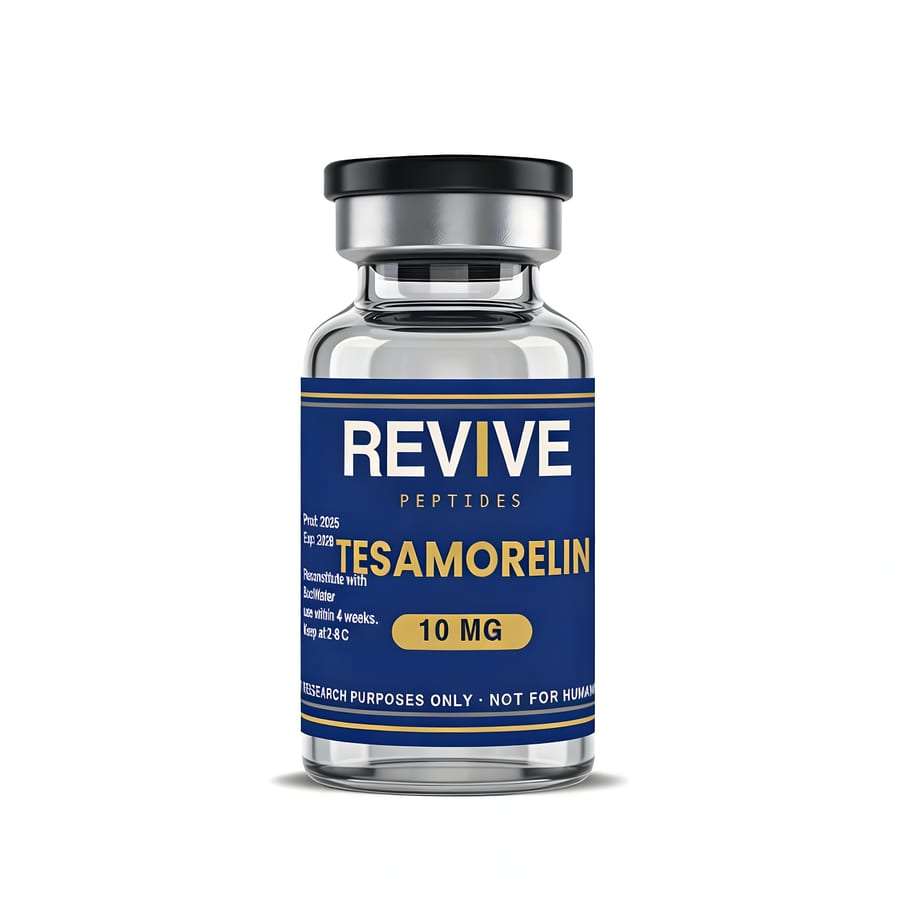
Tesamorelin Vial Specifications for Research
Order Tesamorelin UAE →
UAE Research Context: Why the Stanley 2019 Data Is Relevant Here
The metabolic phenotype that made the Stanley 2019 trial's population interesting — visceral adiposity, hepatic steatosis, and insulin resistance concurrent with systemic inflammation — is not a profile unique to HIV. Metabolic-associated steatotic liver disease (MASLD, the updated umbrella for NAFLD) affects an estimated 30–40% of adults across Gulf Cooperation Council countries. UAE prevalence data trend above Western averages, linked to dietary patterns, physical inactivity, and population-level cardiometabolic risk. Investigators at UAE research institutions, clinical research organisations, and academic medical centres working on hepatic steatosis research have a direct interest in tesamorelin as a mechanistic probe: the Stanley 2019 trial is the only published 12-month, double-blind, placebo-controlled RCT in the literature with liver fat as a pre-specified primary MRS endpoint for this class of GHRH analog.
The mechanism is also complementary to — not duplicative of — the GLP-1 receptor agonist research dominating Gulf metabolic research conversations in 2025–2026. Retatrutide (GLP-1/GIP/glucagon triagonist) and semaglutide-based NAFLD work operate primarily through appetite suppression and reduced substrate delivery from caloric intake. Tesamorelin operates through GH-axis lipolysis of visceral and hepatic lipid stores. These are additive mechanistic pathways in principle — a hypothesis available for investigator-initiated combination research frameworks, though no published RCT has evaluated it yet. For researchers in Dubai, Abu Dhabi, Sharjah, RAK, and across the UAE building such programmes, supply and documentation quality are the first practical requirements. REVIVE LAB UAE addresses both: HPLC-verified, lot-COA tesamorelin with tesamorelin Dubai 24h delivery and tesamorelin same day Dubai dispatch for orders before the daily cut-off.
Where to Buy Tesamorelin in the UAE
REVIVE LAB UAE supplies HPLC-verified, lot-COA, cold-chain dispatched tesamorelin across all 7 emirates. Every tesamorelin batch is tested at ≥99% purity and ships in validated cold-chain insulation that holds 2–8°C through UAE summer transit. Tesamorelin in stock UAE — 10 mg formats, available now, dispatched same-day in Dubai and next-day to every other emirate. Cash on delivery Dubai is standard. Discreet, unbranded outer packaging is the default on every order.
| Emirate / Area | Delivery Window | Cash on Delivery | Discreet Packaging |
|---|---|---|---|
| Dubai (Marina, JBR, Business Bay, DIFC, JVC, Downtown, Palm, Jumeirah) | Same-day, 4–8 hours | Yes | Yes |
| Abu Dhabi (Corniche, Yas, Saadiyat, Reem) | Next-day, 18–24 hours | Yes | Yes |
| Sharjah | Same-day / next-day, 8–18 hours | Yes | Yes |
| Ajman | Next-day, 18–24 hours | Yes | Yes |
| Ras Al Khaimah (RAK) | Next-day, 18–24 hours | Yes | Yes |
| Fujairah | Next-day, 24 hours | Yes | Yes |
| Umm Al Quwain | Next-day, 18–24 hours | Yes | Yes |
For the broader peptides UAE research catalogue — including Retatrutide, GHK-Cu, BPC-157, TB-500, MOTS-c, Semax, — see the full REVIVE LAB UAE product library.
FAQ
Where can I buy tesamorelin in the UAE for liver fat research?
REVIVE LAB UAE is the principal peptides UAE supplier stocking HPLC-verified tesamorelin 10 mg vials with lot-level COA documentation. Orders placed before the daily cut-off receive tesamorelin same day delivery across Dubai, with tesamorelin 24h delivery to Abu Dhabi, Sharjah, RAK, Fujairah and all remaining emirates. Cash on delivery is available across all seven emirates. Confirm current stock and pricing at /buy-tesamorelin-uae/.
What vial sizes does REVIVE LAB UAE stock for tesamorelin?
REVIVE LAB UAE carries tesamorelin in 10 mg lyophilized vials — the two strengths used across the major RCT programmes, including the Falutz 2007 NEJM lipodystrophy trial and the Stanley 2019 Lancet HIV NAFLD study. Each vial ships in validated cold-chain packaging holding 2–8°C. Smaller 1 mg or 2 mg vials are not stocked.
Does REVIVE LAB UAE offer same-day delivery of tesamorelin in Dubai?
Yes. REVIVE LAB UAE dispatches tesamorelin same day in Dubai for orders placed before the daily cut-off. Tesamorelin Dubai 24h delivery is available across all seven emirates. All parcels use discreet, unbranded outer packaging by default — no upsell required. Cash on delivery Dubai is the standard payment option. Confirm current delivery windows and verify tesamorelin in stock UAE at /buy-tesamorelin-uae/.
Buy Tesamorelin UAE — Order Now →
- Falutz J, Allas S, Blot K, et al. Metabolic effects of a growth hormone-releasing factor in patients with HIV. N Engl J Med. 2007;357(23):2359–2370.
- Falutz J, Mamputu JC, Potvin D, et al. Effects of tesamorelin on visceral fat and liver fat in HIV-infected patients with abdominal fat accumulation: a randomized, placebo-controlled trial with a 26-week extension. J Clin Endocrinol Metab. 2010;95(9):4291–4304.
- Stanley TL, Feldpausch MN, Oh J, et al. Effect of tesamorelin on visceral fat and liver fat in HIV-infected patients with abdominal fat accumulation. JAMA. 2014;312(4):380–389.
- Stanley TL, Fourman LT, Feldpausch MN, et al. Effects of tesamorelin on non-alcoholic fatty liver disease in HIV: a randomised, double-blind, multicentre trial. Lancet HIV. 2019;6(12):e821–e830.