Tesamorelin Personal Trainer Protocol — UAE Research Notes (2026 Edition)
Why UAE Fitness Researchers Are Anchoring on Tesamorelin in 2026
Walk through any serious performance facility in Business Bay, along the JBR waterfront, or at one of the Marina district's larger training floors at 6 AM and you will find coaches working with subjects who track body composition variables with a precision that most European or North American facilities would not have attempted five years ago. The Emirates has a specific convergence that produces this: high discretionary income, a resident and expat demographic with genuine research curiosity, and a climate that keeps body composition outcomes measurable year-round rather than seasonal.
Against that backdrop, tesamorelin has become the GHRH analog that UAE fitness researchers request more consistently than any other. The reason is simple and defensible: it is the only GHRH analog with a multi-study, peer-reviewed evidence base that includes large randomised controlled trials published in first-tier journals. That paper trail makes research protocol design grounded rather than speculative. When a researcher in Dubai needs to justify their observation parameters to a collaborator in Abu Dhabi or a funding partner at a facility near Dubai Healthcare City, tesamorelin is the compound they can cite without reservation.
This article documents what the published data actually says about research parameters, how UAE investigators are structuring observation windows, what vial formats REVIVE LAB UAE stocks, how to get tesamorelin to your Dubai address on the same day, and what variables are worth tracking across a full research cycle. Everything here is framed strictly for research-use context — no medical advice, no human consumption guidance.
Tesamorelin Mechanism: What UAE Researchers Need to Understand
Tesamorelin is a synthetic analog of endogenous growth hormone-releasing hormone (GHRH). Its structure is GHRH(1-44) with a trans-3-hexenoic acid group conjugated to the N-terminal tyrosine residue. That modification is not superficial: it confers substantially greater plasma stability than native GHRH(1-44), which has a circulating half-life of only a few minutes. The structural change allows once-daily administration in research settings to produce a meaningful downstream signal, whereas native GHRH would degrade too rapidly before reaching pituitary somatotroph cells in sufficient concentration.
Tesamorelin binds GHRH receptors on pituitary somatotroph cells and drives pulsatile GH secretion in a pattern that closely mirrors physiological release, including preserved negative feedback via somatostatin. This is a critical mechanistic distinction from exogenous GH administration: the hypothalamic-pituitary axis remains largely intact, normal feedback inhibition functions, and the GH pulse profile retains its physiological shape. Elevated GH then drives hepatic IGF-1 synthesis, which is the primary downstream effector for body composition changes documented in the research literature.
In the landmark Falutz et al. 2007 NEJM trial, 412 HIV-positive adults with abdominal lipodystrophy were randomised to tesamorelin or placebo. Primary endpoint was trunk fat measured by DEXA. After 26 weeks the tesamorelin arm showed statistically significant reductions in visceral adipose tissue versus placebo, with IGF-1 elevation confirming GH axis engagement. That trial established the fundamental proof of concept — pulsatile GHRH analog delivery produces measurable VAT changes in a controlled research context — and it remains the most cited single reference in serious tesamorelin protocol design globally, including among peptides-UAE researchers.
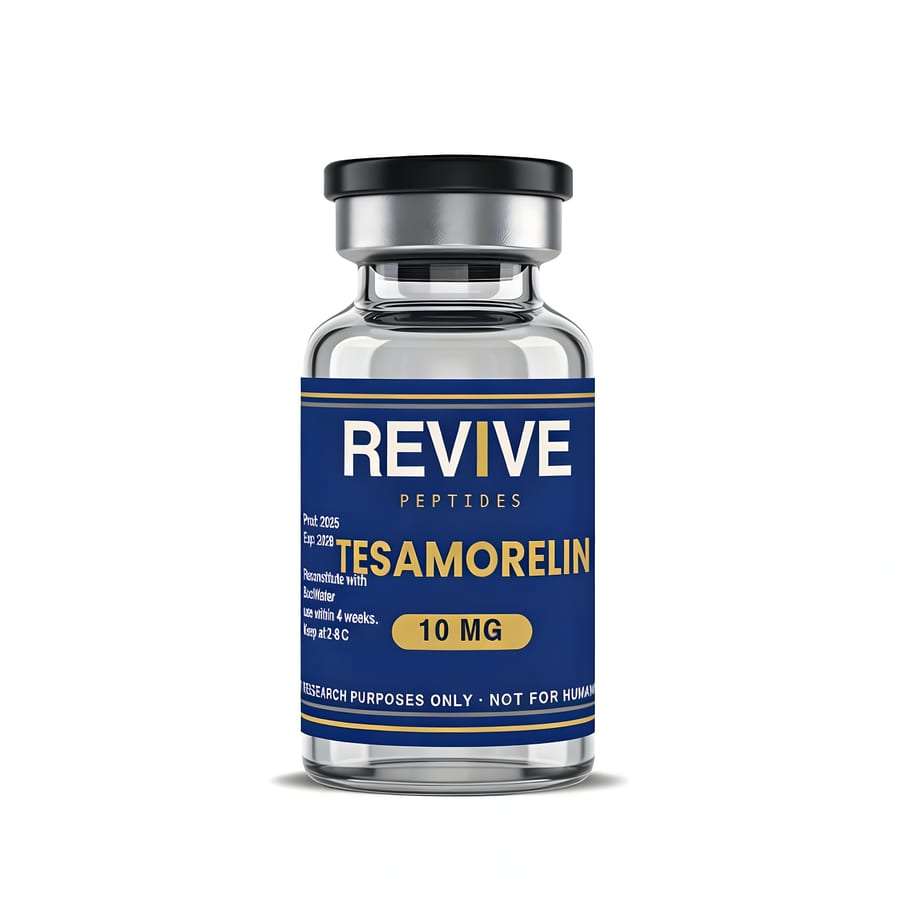
Tesamorelin 5mg & 10mg — In Stock Now at REVIVE LAB UAE
Same-day dispatch from Dubai. 24h delivery across the UAE including Abu Dhabi, Sharjah, and the Palm. Discreet cold-chain packaging. Cash on delivery Dubai available.
Order Tesamorelin UAE — Same-Day Dubai Dispatch from REVIVE LAB UAEStructuring a Research Observation Protocol: A Practical Framework
Well-designed tesamorelin protocols share a set of structural elements regardless of the specific research question. The framework below is derived directly from the published trial methodologies and adapted for practical realities facing investigators working in UAE gym and performance research environments.
Baseline Measurements Before Day 1
The four major trials uniformly captured baseline trunk fat via DEXA, waist circumference at the umbilicus, fasting lipids, and IGF-1 serum levels. For UAE researchers without integrated DEXA access, morning waist circumference measured fasted and standing at the same anatomical landmark each time is the minimum viable anthropometric variable. Many Dubai-based research teams also incorporate standardised photography under consistent lighting at the same time of day weekly — an accessible surrogate when DEXA is unavailable at a facility near DXB or in the Marina district.
IGF-1 measurement via blood draw before and after the observation window is strongly recommended. Tesamorelin's primary mechanism runs through IGF-1 elevation, and tracking it objectively confirms that the GH axis has responded as expected. Multiple private clinics and diagnostic labs operating in Business Bay, Al Barsha, and Dubai Healthcare City can process IGF-1 panels, typically with results within 24–48 hours. Baseline and endpoint draws are the minimum; mid-cycle draws at weeks 8 and 16 within a 26-week protocol provide a more complete response curve.
Administration Timing and Reconstitution Practices
Based on the published trial design, fasted morning administration is the consistent reference point. UAE researchers typically schedule tesamorelin administration before any food intake, immediately following the overnight fast. Reconstitution with bacteriostatic water is standard. The volume of bacteriostatic water used determines the concentration and therefore the injection volume per dose — document this explicitly and maintain it consistently across the full observation window. Any change in reconstitution volume mid-protocol introduces a confound that complicates interpretation of late-cycle data.
One UAE-specific practical note: in summer months, the thermal contrast between a refrigerator at 4°C and the ambient environment can cause mild discomfort on injection of cold reconstituted peptide. Allowing a syringe drawn from a refrigerated vial to approach room temperature over a brief interval before administration is common research practice. Do not expose reconstituted tesamorelin to direct sunlight or leave it unrefrigerated for any extended period, as peptide degradation in UAE ambient heat occurs faster than in temperate laboratory conditions.
Observation Window Duration
The Falutz 2007 and Stanley 2014 trials used 26-week primary endpoints. The Falutz 2010 continuation and Stanley 2019 Lancet HIV paper extended to 52 weeks, showing that effects observed at 26 weeks were sustained and in some parameters further improved with continued administration. UAE researchers planning shorter 8–12 week pilot cycles should understand that body composition changes documented in the literature were primarily captured at 26 weeks and beyond; pilot cycles are most informative for IGF-1 response documentation and protocol feasibility assessment rather than definitive body composition endpoints.
Complementary Peptide Research in the UAE Context
A significant proportion of advanced UAE research programs are not single-compound investigations. Tesamorelin frequently serves as the anchor compound in multi-peptide observation protocols, with secondary compounds chosen for mechanistic complementarity rather than arbitrary stacking. The most common parallel research compounds seen in Dubai and Abu Dhabi research contexts are documented below.
GHK-Cu for Connective Tissue Observation
GHK-Cu is a naturally occurring copper-binding tripeptide with a growing research base in skin, fibroblast, and connective tissue contexts. Pickart (2018, Cosmetics) documents GHK-Cu's involvement in fibroblast activity and wound-healing research models. UAE researchers running extended tesamorelin body recomposition protocols sometimes incorporate GHK-Cu into parallel topical or injectable research arms that track skin quality, collagen density, and wound repair as secondary endpoints during the same observation window. The mechanisms are sufficiently distinct — GHRH axis stimulation versus local fibroblast signalling — that cross-interference in the primary endpoint is not documented in the research literature.
BPC-157 for Recovery Observation Arms
BPC-157 is a synthetic pentadecapeptide fragment with an extensive pre-clinical evidence base in tendon and ligament repair research. Sikiric et al. (2018) provides a comprehensive review of the BPC-157 mechanism and pre-clinical data. In the context of a tesamorelin protocol that involves subjects engaged in high-volume resistance training — as is common in Dubai performance research environments — some investigators incorporate BPC-157 into parallel recovery observation arms tracking tendon load tolerance and inter-session recovery markers. The two compounds operate through entirely different receptor systems and there is no published interaction data suggesting concern with concurrent research use.
REVIVE LAB UAE stocks both GHK-Cu and BPC-157 alongside tesamorelin, making it practical for UAE investigators to source a full multi-compound research protocol from a single supplier on a single same-day Dubai delivery order — a significant logistical advantage for programs operating under tight timeline constraints.
UAE Climate Variables That Affect Research Protocol Design
Running a research protocol in Dubai in June, July, or August introduces environmental variables that investigators in cooler climates do not need to account for. Outdoor ambient temperatures exceeding 42°C, combined with indoor environments air-conditioned to 20–22°C, create a daily thermal cycling pattern that is itself a metabolic stimulus worth documenting as a potential confound for any protocol with thermoregulatory or metabolic secondary endpoints.
Training session environment in UAE summer is largely standardised by necessity: virtually all performance research in Dubai during peak summer is conducted in fully climate-controlled facilities. The large training complexes at Marina, JBR, and Business Bay run consistent 20–22°C environments that actually provide more controlled exercise stimulus conditions than outdoor training in temperate climates. This inadvertently favours UAE research programs for exercise protocol standardisation — one less variable to control for.
Hydration status is an important covariable that many UAE researchers underspecify in their protocols. Even mild dehydration — highly plausible in UAE summer conditions even for mostly indoor subjects — can affect IGF-1 serum levels and body composition measurement accuracy. Daily fluid intake targets and measurement timing (particularly for blood draws) should be standardised as explicit protocol variables, not treated as background assumptions.
Vitamin D status is worth noting as a potential confound that operates differently in the UAE than in most research populations from temperate climates. Despite abundant sun, UAE residents frequently present with vitamin D deficiency due to indoor lifestyles and sun avoidance during peak heat months. Baseline and endpoint vitamin D measurement adds a low-cost layer of data that can help explain IGF-1 response variance across research subjects.
Ordering Tesamorelin in the UAE: What Researchers Need to Know About REVIVE LAB UAE
REVIVE LAB UAE is a UAE-based B2B peptide supplier operating domestically, not a European or North American company drop-shipping across a two-to-three week international logistics chain. The practical implications for UAE researchers are significant and directly affect protocol viability.
When you order tesamorelin Dubai from REVIVE LAB UAE, dispatch happens from within the UAE. Same-day dispatch is available for orders placed before the daily cutoff. The 24h delivery Dubai window means a researcher who confirms their protocol on Monday evening can begin Day 1 administration on Tuesday morning. For investigators based in Abu Dhabi, Sharjah, the Palm Jumeirah, Al Barsha, or Ras Al Khaimah, the delivery network covers the full UAE mainland within the same 24-hour service window.
Discreet packaging is standard on every REVIVE LAB UAE order — outer packaging does not identify contents, supplier, or product category. Cold-chain packing is included at no additional cost on all peptide orders, addressing the storage integrity concern that is especially relevant when ambient temperatures outside can exceed 40°C at the time of delivery.
Payment options include standard card checkout and Binance Pay (USDT TRC20) with a 5% pre-pay discount applied on the crypto channel. Cash on delivery Dubai is available for qualifying orders — contact REVIVE LAB UAE via WhatsApp before placing to confirm COD eligibility for your specific delivery area. Enquire about wholesale account setup, which also provides priority dispatch and stock reservation for ongoing research programs.
FAQ
Can I buy tesamorelin in the UAE with same-day delivery?
Yes. REVIVE LAB UAE stocks tesamorelin 5mg and 10mg vials with same-day dispatch from Dubai for orders placed before the daily cutoff. Delivery reaches addresses in Dubai, Abu Dhabi, Sharjah, the Palm Jumeirah, and across the UAE within 24 hours. Discreet cold-chain packaging is standard on every order. Visit the tesamorelin UAE product page to check current stock and confirm today's dispatch cutoff time.
What vial sizes of tesamorelin does REVIVE LAB UAE stock?
REVIVE LAB UAE currently stocks tesamorelin in 5mg and 10mg lyophilised vials. Both formats are maintained under cold-chain conditions in-warehouse and shipped with insulated boxes and cold packs to preserve peptide integrity during transit in UAE ambient temperatures. Bacteriostatic water for reconstitution is available as an add-on at checkout. For research programs requiring bulk quantities of either format, contact REVIVE LAB UAE directly for B2B pricing before ordering.
Is tesamorelin currently in stock in Dubai?
Tesamorelin is in stock at REVIVE LAB UAE right now. Live availability is displayed in real time on the tesamorelin UAE order page at revivelab.ae. If you are planning a large-volume research program and need to confirm stock depth before committing to a multi-vial order, reach out via WhatsApp and the team will confirm current inventory and estimated restocking timelines for your specific quantity requirement.
- Falutz J, et al. Metabolic effects of a growth hormone-releasing factor in patients with HIV. New England Journal of Medicine. 2007;357(23):2359–2370.
- Falutz J, et al. Long-term safety and effects of tesamorelin, a growth hormone-releasing factor analogue, in HIV patients with abdominal fat accumulation: continuation trial. New England Journal of Medicine. 2010 [continuation study].
- Stanley TL, et al. Effect of tesamorelin on visceral fat and liver fat in HIV-infected patients with abdominal fat accumulation: a randomized clinical trial. JAMA Internal Medicine. 2014;174(11):1726–1735.
- Stanley TL, et al. Long-term effects of tesamorelin on visceral fat and liver fat in HIV-infected patients with abdominal fat accumulation. Lancet HIV. 2019;6(12):e821–e830.
- Pickart L, Margolina A. Regenerative and protective actions of the GHK-Cu peptide in the light of the new gene data. Cosmetics. 2018;5(2):29.
- Sikiric P, et al. Brain-gut axis and pentadecapeptide BPC 157: theoretical and practical implications. Review. 2018. [Referenced for BPC-157 mechanism context in complementary research arm discussion.]
Ready to Order Tesamorelin in the UAE?
REVIVE LAB UAE — the UAE's dedicated B2B peptide research supplier. Tesamorelin 5mg and 10mg in stock. Same-day Dubai dispatch. 24h UAE-wide delivery. Discreet cold-chain packaging on every order. Cash on delivery Dubai available.
Buy Tesamorelin UAE — Order Now from REVIVE LAB UAE