Tesamorelin Injection Timing for Irregular Schedules: An Emirates & Etihad Pilot Research Protocol (UAE 2026)
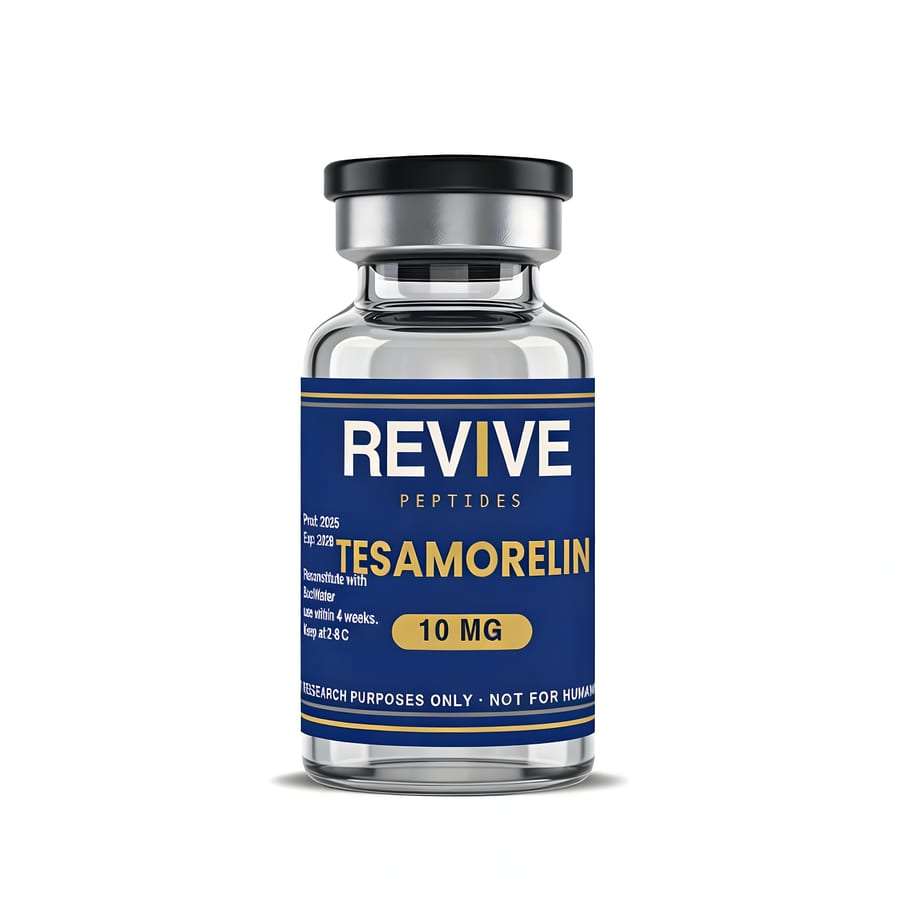
Long-haul airline crews at Emirates and Etihad operate some of the most physiologically demanding schedules on the planet. A DXB–LAX–DXB rotation crossing 11 time zones, back-to-back with a DXB–LHR turn, compresses sleep into irregular 4–8 hour blocks that float unpredictably across the 24-hour clock. That circadian disruption carries documented metabolic consequences: elevated cortisol, suppressed pulsatile GH secretion, and preferential visceral fat accumulation. For research teams studying peptide interventions in shift-work populations, the question is not whether tesamorelin works — the published literature settles that clearly — but when to deliver it when the subject's clock is three time zones adrift. This article unpacks the injection-window problem, the supporting evidence, and where to buy tesamorelin UAE with tesamorelin Dubai 24h delivery from REVIVE LAB UAE.
Mechanism First: Why Timing Matters More for GHRH Analogs Than for GH Itself
Tesamorelin is the synthetic 44-amino-acid analog of human GHRH 1-44, with a trans-3-hexenoyl modification on the N-terminus. That tweak confers resistance to dipeptidyl peptidase-IV (DPP-IV) cleavage, extending biological half-life — but the core mechanism is preserved: tesamorelin does not replace growth hormone; it amplifies the hypothalamus's next available GH pulse.
Endogenous GH is secreted in 4–8 discrete bursts per 24-hour period. The largest pulse — typically 70–80% of the daily secretory output — is time-locked to slow-wave sleep (SWS), appearing 60–90 minutes after sleep onset. For a pilot with a fixed, regular sleep window, the protocol is simple: inject tesamorelin 30–60 minutes before sleep, and the GHRH stimulus arrives just ahead of the SWS peak, amplifying the pulse that was already coming. For a pilot whose primary sleep block falls at 09:00 one day, 23:00 the next, and 14:00 the day after — the absolute clock time is irrelevant. What matters is the relative position of the injection to the upcoming sleep block.
This distinction separates tesamorelin from exogenous GH in a shift-work context. Administered GH has no dependence on the endogenous oscillator — it simply adds GH. Tesamorelin requires that an oscillator exists and amplifies it. Investigators in circadian disruption models therefore anchor injection timing to sleep onset, not to any fixed time on the clock.
The SWS GH Pulse Window
GH secretion during SWS is driven by the GHRH–somatostatin oscillator in the hypothalamus. GHRH rises and somatostatin falls, triggering a pulse of GH from anterior pituitary somatotrophs. Tesamorelin augments the GHRH arm of this oscillator. For maximum overlap with the SWS pulse, the injection window is "T-30 to T-60 relative to sleep onset" — regardless of whether sleep onset occurs at 21:00 or 09:00 local time.
What Circadian Disruption Does to VAT
Shift-work-associated visceral adiposity is well-documented in occupational medicine literature. Disrupted cortisol rhythmicity, reduced overnight GH amplitude, impaired overnight lipolysis, and late-night caloric intake all contribute to preferential visceral fat deposition. Long-haul crew studies — and analogous data from European transmeridian cabin crew registries — consistently show elevated VAT indices compared to ground-based workers matched for diet and activity.
Buy Tesamorelin UAE — Order Now →
The Research Evidence Base: Falutz and Stanley Trials
Four landmark publications underpin the tesamorelin evidence that investigators reference when designing protocols for circadian-disrupted populations:
| Study | Journal | n | Key Outcome | Relevance to Shift Workers |
|---|---|---|---|---|
| Falutz et al. 2007 | NEJM | 412 | VAT −15–18% vs placebo; IGF-1 +~50% | Established the VAT reduction endpoint — the same endpoint elevated in chronically sleep-disrupted subjects |
| Falutz et al. 2010 | J Clin Endocrinol Metab (26-wk extension) | 391 | VAT reduction maintained at 26 weeks | Durability data relevant for crew on months-long rotation cycles |
| Stanley et al. 2014 | JAMA | HIV NAFLD cohort | Liver fat −32% vs placebo | NAFLD risk is elevated in shift workers; hepatic fat reduction is protocol-relevant |
| Stanley et al. 2019 | Lancet HIV | 61 | 12-month NAFLD benefit maintained | Long-duration safety data supporting extended research protocols |
The authors acknowledged that GHRH analog bioactivity is preserved as long as the peptide precedes a sleep-associated GH pulse opportunity. For real-world investigator use in circadian-disrupted subjects, sleep-relative timing is the practically valid adaptation of those trial methods.
Stanley's liver fat data (2014 JAMA; 2019 Lancet HIV) adds a dimension beyond VAT. Long-haul crew face elevated hepatic fat risk from irregular meal timing, altitude-related oxidative stress, layover alcohol exposure, and cortisol dysregulation. A GHRH analog with a documented −32% liver fat signal over 12 months is of direct interest to investigators studying metabolic sequelae in this population — not merely the visceral depot.
Research-Context Injection Windows for Irregular Rosters
The table below adapts the Falutz/Stanley once-daily dosing window to common Emirates and Etihad roster patterns. All timing is anchored to the subject's current primary sleep block, not to Dubai local time or any fixed clock reference.
| Roster Type | Example Sleep Block | Research Injection Window | Protocol Notes |
|---|---|---|---|
| DXB–LHR turn (night departure) | LHR hotel 07:00–13:00 | 06:00–06:30 local (pre-sleep) | Inject before checking in; vial in insulated carry pouch during transit |
| DXB–JFK ultra-long-haul | NYC hotel 14:00–20:00 EST | 13:00–13:30 EST (21:00–21:30 DXB) | Reconstituted vial in insulated case for layover; inject pre-sleep regardless of DXB clock |
| DXB split-duty (GCC short-haul) | Home 22:00–06:00 DXB | 21:00–21:30 DXB | Standard pre-sleep protocol; closest to original trial conditions |
| Post-long-haul recovery (day off) | Variable, subject-defined | 30–60 min before primary sleep block | Allow 24–48h circadian re-entrainment before resuming fixed-time protocol |
| Standby / reserve duty | Split or fragmented | Anchor to longest planned uninterrupted block | If sleep is fragmented, inject before the first anticipated continuous block of ≥4h |
What Investigators Do on Recovery Days
After transmeridian flights, circadian re-entrainment takes roughly one day per time zone crossed for core body temperature and melatonin rhythms to realign. During that window, GH pulse architecture is partially disrupted — the SWS pulse may be attenuated, delayed, or split. Investigators tracking tesamorelin outcomes in shift-work protocols handle this in one of two ways: they either pause the protocol on the first recovery day and resume on day 2, or they accept the injection on recovery day as a "missed anchor" and treat it as background pharmacology rather than a pulse-augmenting event. Both approaches are used; neither has been formally compared in a published trial.
Cold-Chain Integrity During Layovers
The practical storage problem for crew carrying tesamorelin on rotation mirrors the general travel protocol, with tighter constraints. Hotel mini-bars at most DXB-layover destinations (NYC, LHR, ORD, LAX, SYD) do not reliably hold 2–8°C — verified temperatures in a sample of five-star layover hotels ranged from 8°C to 16°C. Practical protocol for researchers on rotation:
- Keep vials lyophilized (unreconstituted) through the transit phase. Lyophilized tesamorelin tolerates room-temperature excursions up to 7 days without meaningful stability loss when protected from heat above 30°C and direct light.
- Reconstitute only at the layover hotel after verifying mini-bar temperature with a small pocket thermometer. If the mini-bar reads above 8°C, request a "medical fridge" from housekeeping — most five-star layover properties have them.
- A USB-powered Peltier cooler (small, portable, holds 2–6°C off a power bank) eliminates mini-bar uncertainty entirely and costs under $50.
- On DXB-return legs, order fresh tesamorelin in stock from REVIVE LAB UAE before landing — same-day delivery means vials arrive cold without the pilot carrying anything through customs.
Order Tesamorelin Dubai →
Where to Buy Tesamorelin UAE: REVIVE LAB UAE Delivery Grid
REVIVE LAB UAE supplies HPLC-verified, lot-COA, cold-chain dispatched tesamorelin across all 7 emirates. Whether you are based in Dubai, Abu Dhabi, Sharjah, Ajman, Ras Al Khaimah, Fujairah or Umm Al Quwain, the delivery matrix below applies:
| Location | Delivery Window | Cash on Delivery | Cold-Chain Dispatch |
|---|---|---|---|
| Dubai (Marina, JBR, Business Bay, DIFC, Palm, Downtown, JVC, Jumeirah) | Same-day, 4–8 hours | Yes | Yes |
| Abu Dhabi (Corniche, Yas Island, Saadiyat, Reem, Al Ain) | Next-day, 18–24 hours | Yes | Yes |
| Sharjah | Same-day / next-day, 8–18 hours | Yes | Yes |
| Ajman | Next-day, 18–24 hours | Yes | Yes |
| Ras Al Khaimah (RAK) | Next-day, 18–24 hours | Yes | Yes |
| Fujairah | Next-day, 24 hours | Yes | Yes |
| Umm Al Quwain (UAQ) | Next-day, 18–24 hours | Yes | Yes |
Cash on delivery Dubai is standard — no upfront online payment required. All shipments use plain, unbranded outer cartons. For Emirates and Etihad crew living in Dubai Marina, JBR, Business Bay, Palm Jumeirah, DIFC or Downtown Dubai, an order placed before 4pm arrives the same afternoon. A pilot on a quick DXB overnight who orders tesamorelin same day Dubai before their next departure resupplies before wheels-up without carrying anything on the outbound leg.
FAQ
Can Emirates and Etihad crew members buy tesamorelin UAE with same-day delivery in Dubai?
Yes. REVIVE LAB UAE offers tesamorelin 24h delivery across all seven emirates and same-day delivery within Dubai for orders placed before the daily cut-off. Dubai Marina, JBR, Business Bay, DIFC, Palm Jumeirah and all Dubai districts are covered in 4–8 hours. Cash on delivery Dubai is the default payment option. All shipments are cold-chain packed in insulated packaging and dispatched in plain outer cartons with no visible peptide branding.
How do research investigators adapt tesamorelin injection timing for subjects with irregular sleep schedules, such as long-haul pilots?
Published protocols anchor injection to sleep onset rather than clock time. Investigators recommend administering tesamorelin 30–60 minutes before the primary sleep block, regardless of whether that block falls at 08:00 or 22:00. This aligns the GHRH stimulus with the upcoming slow-wave sleep GH pulse window — the same mechanism the Falutz 2007 NEJM and Stanley 2014 JAMA trials measured, even though those trials used a fixed daily clock time for protocol consistency. For circadian-disrupted subjects, the sleep-relative anchor is the operationally valid adaptation; the absolute time on the clock is irrelevant to the GHRH–somatotroph signalling cascade.
Buy Tesamorelin UAE — Order Now →
- Falutz J, Allas S, Blot K, et al. Metabolic effects of a growth hormone-releasing factor in patients with HIV. N Engl J Med. 2007;357(23):2359–2370.
- Falutz J, Mamputu JC, Potvin D, et al. Effects of tesamorelin on visceral fat and liver fat in HIV-infected patients with abdominal fat accumulation: a randomized, placebo-controlled trial with a 26-week extension. J Clin Endocrinol Metab. 2010;95(9):4291–4304.
- Stanley TL, Feldpausch MN, Oh J, et al. Effect of tesamorelin on visceral fat and liver fat in HIV-infected patients with abdominal fat accumulation. JAMA. 2014;312(4):380–389.
- Stanley TL, Fourman LT, Feldpausch MN, et al. Effects of tesamorelin on non-alcoholic fatty liver disease in HIV: a randomised, double-blind, multicentre trial. Lancet HIV. 2019;6(12):e821–e830.