Tesamorelin & Postpartum Body Recomposition: Research Protocol Notes for UAE Investigators (2026)
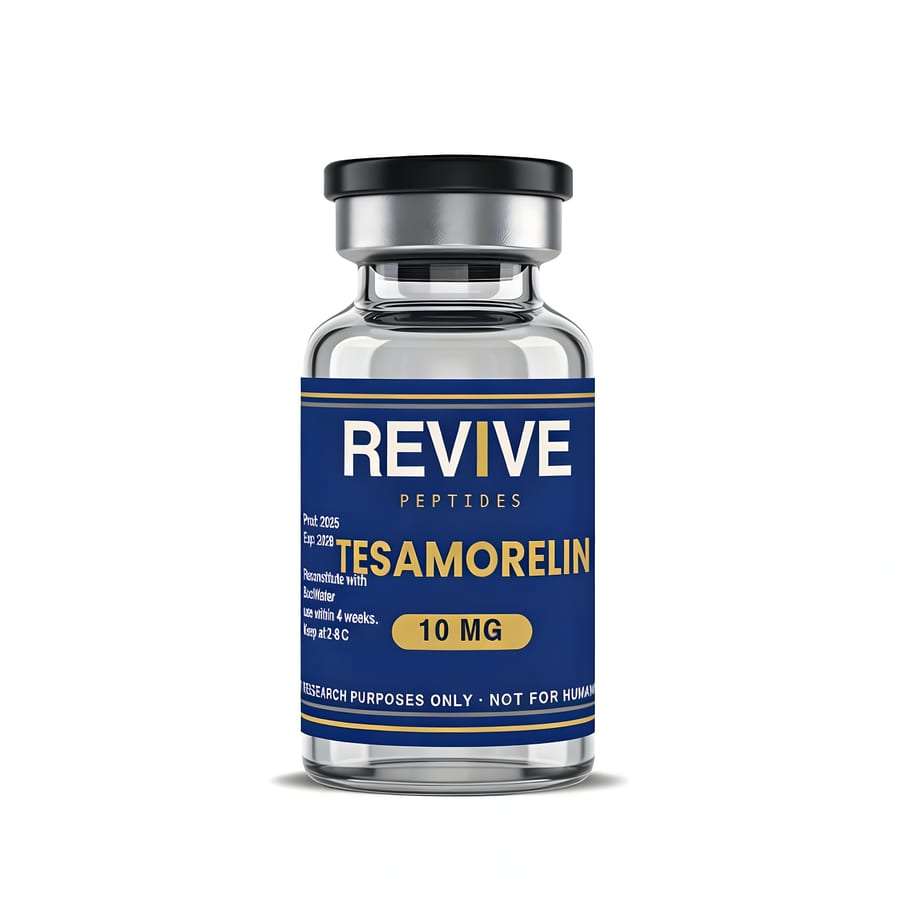
Among the peptides UAE researchers are actively sourcing in 2026, tesamorelin occupies an unusual position: it is the single GHRH analog with rigorous, peer-reviewed Phase III human data, and it addresses a fat distribution pattern — centralized, visceral, GH-axis-mediated — that postpartum physiology produces in a predictable, mechanistically logical way. This post walks through the mechanism, the clinical evidence, the research-context protocol parameters referenced in published trials, and why REVIVE LAB UAE is the preferred cold-chain supplier for investigators seeking to buy tesamorelin UAE or order tesamorelin Dubai with same-day or 24h delivery.
The Postpartum GH Axis: Why VAT Accumulates After Delivery
During pregnancy, the placenta secretes placental GH (GH-V) at rising levels from roughly week 25 onward, progressively suppressing pituitary GH secretion via negative feedback. By the third trimester, pituitary GH pulsatility is nearly absent. After delivery, the placental GH source disappears abruptly, but pituitary GH pulsatility does not immediately recover — the GH axis requires weeks to months to re-establish normal amplitude and frequency. Prolactin, elevated during lactation, further modulates this recovery.
The metabolic consequence is a transient but often prolonged period of relative GH deficiency. Since pulsatile GH is the primary driver of lipolysis in visceral adipose tissue — through direct hormone-sensitive lipase activation and indirect IGF-1-mediated effects — reduced GH pulsatility creates a preferential environment for central VAT accumulation. This is not equivalent to simple caloric excess. The adipose depot responds to hormonal signaling, not just energy balance, and the visceral compartment is disproportionately sensitive to GH withdrawal.
This is the mechanistic rationale investigators have cited when designing postpartum body recomposition research protocols using tesamorelin: the GHRH analog restores endogenous pulsatile GH without supraphysiological direct GH exposure, acting at the hypothalamic-pituitary axis rather than bypassing it.
Tesamorelin's Mechanism: GHRH Analog, Not Direct GH
Tesamorelin is a synthetic peptide analog of human growth hormone-releasing hormone (GHRH 1-44) with a trans-3-hexenoyl group attached to the N-terminus. This structural modification protects the molecule against rapid cleavage by dipeptidyl peptidase-IV (DPP-IV) and extends its effective half-life compared to endogenous GHRH, while preserving full GHRH receptor binding affinity.
The mechanism of action is fundamentally different from exogenous GH administration. Tesamorelin does not supply GH — it stimulates the pituitary somatotroph cells to release GH in a pulsatile, physiologically regulated pattern. This matters for two reasons. First, pulsatile GH secretion mirrors the endogenous rhythm that drives selective VAT lipolysis with minimal impact on lean mass. Second, the GH secretion remains subject to normal somatostatin-mediated feedback, which limits the overshoot seen with direct GH injection.
| Feature | Tesamorelin (GHRH Analog) | Direct GH Administration |
|---|---|---|
| Mechanism | Stimulates pituitary GH release | Replaces GH directly |
| GH pattern | Pulsatile, physiological | Flat / supraphysiological peak |
| Feedback regulation | Intact (somatostatin brake active) | Partially bypassed |
| Selectivity on VAT | High (Falutz 2007: -15-18%) | Variable; more systemic effects |
| IGF-1 response | ~50% rise (Falutz 2007) | Rapid, dose-dependent rise |
| Lean mass impact | Neutral in trial populations | Can increase lean + fluid mass |
For postpartum body recomposition research, this profile is relevant because investigators are typically interested in selectively restoring GH axis signaling to VAT, not applying supraphysiological GH levels that carry their own metabolic confounders.
The Clinical Evidence: What the Falutz and Stanley Trials Show
The tesamorelin evidence base is unusually robust for a research peptide. Two pivotal trial programs — one led by Falutz at McGill, one by Stanley at Massachusetts General Hospital — provide the quantitative anchors that postpartum recomposition investigators reference.
Falutz et al. 2007 (NEJM) and the 2010 Extension
The landmark Falutz 2007 NEJM trial enrolled 412 subjects with HIV-associated lipodystrophy — a model of GH-axis-mediated visceral fat excess mechanistically analogous to other GH-deficient states. At 26 weeks, tesamorelin-treated subjects showed a 15-18% reduction in visceral adipose tissue (measured by CT at L4) versus no change in the placebo arm. IGF-1 levels rose approximately 50% in the active group, confirming pituitary GH stimulation.
The 2010 Falutz extension published in the same journal followed subjects for an additional 26 weeks. The VAT reduction was maintained throughout the extension period, and no meaningful deterioration in lean mass was recorded. This is the durability signal that distinguishes tesamorelin from short-cycle interventions: the effect persists as long as the molecule is active in the system.
Buy Tesamorelin UAE — Order Now →
Vial Formats: 5mg and 10mg Only
REVIVE LAB UAE stocks tesamorelin in 5mg vials and 10mg vials exclusively. These are the two formats consistent with published research use.
Reconstitution and Storage Notes
- Reconstitute with bacteriostatic water (BAC water), injecting slowly down the vial wall — never directly onto the lyophilized cake
- Reconstituted vials: store at 2-8°C, use within 14 days (conservative: 7-10 days)
- Lyophilized vials: 2-8°C, protected from light; short room-temperature excursions tolerated for transit
- Do not freeze reconstituted vials; a single freeze-thaw cycle denatures the peptide
- REVIVE LAB UAE dispatches all tesamorelin orders in validated cold-chain insulation holding 2-8°C through standard UAE summer transit windows
Postpartum Recomposition Research: What Investigators Are Examining
The postpartum application of tesamorelin research is framed around three measurable endpoints that parallel the Falutz and Stanley trial designs:
- IGF-1 restoration: The ~50% IGF-1 rise documented by Falutz et al. is a secondary signal confirming GH axis re-engagement. In the postpartum context, baseline IGF-1 levels can be suppressed during lactation, making this a meaningful biomarker for investigators tracking GH axis recovery.
- Lean mass preservation: The Falutz extension confirmed that tesamorelin's VAT reduction was not accompanied by lean mass loss — a critical distinction for postpartum research subjects where muscle retention is a concurrent goal alongside fat redistribution.
Investigators in the UAE running postpartum body recomposition studies have access to tesamorelin in stock UAE via REVIVE LAB UAE's verified supply chain, with lot-specific COAs available on request and HPLC purity data on file for every batch dispatched.
Order Tesamorelin Dubai →
Why Cold-Chain Supply Matters for Tesamorelin Research in the UAE
UAE summer conditions — ambient temperatures reaching 42-46°C in Dubai, Abu Dhabi and Sharjah from June through September — make the supplier's cold-chain infrastructure the decisive variable in tesamorelin research quality. A vial that leaves a warehouse at 4°C and rides in an uninsulated courier bag for three hours at 43°C ambient will not perform as the Falutz or Stanley trials specified. The degradation is invisible — the reconstituted solution looks identical — but the peptide activity is compromised.
REVIVE LAB UAE supplies HPLC-verified, lot-COA, cold-chain dispatched tesamorelin across all 7 emirates. Same-day dispatch within Dubai covers Dubai Marina, JBR, Business Bay, JVC, DIFC, Downtown, Palm Jumeirah, Jumeirah, Emirates Hills and Arabian Ranches. For Abu Dhabi, Sharjah, Ajman, Ras Al Khaimah, Fujairah and Umm Al Quwain, next-day cold-chain delivery is standard. Cash on delivery is available UAE-wide — no prepayment required.
| Location | Delivery Window | Cold Chain | Cash on Delivery |
|---|---|---|---|
| Dubai (all districts) | Same day, 4-8 hours | Yes, insulated cold pack | Yes |
| Abu Dhabi | Next day, 18-24 hours | Yes | Yes |
| Sharjah | Same/next day, 8-18 hours | Yes | Yes |
| Ajman / UAQ | Next day, 18-24 hours | Yes | Yes |
| Ras Al Khaimah | Next day, 18-24 hours | Yes | Yes |
| Fujairah / Al Ain | Next day, 24 hours | Yes | Yes |
For postpartum research coordinators running multi-subject observational studies, REVIVE LAB UAE also supports batch orders with consolidated COA documentation. Every tesamorelin batch available from peptides UAE stock is tested to ≥99% purity by HPLC before dispatch — the same analytical standard the research literature assumes when specifying investigational product.
Frequently Asked Questions
Can I buy tesamorelin UAE for postpartum body recomposition research protocols?
Yes. REVIVE LAB UAE stocks HPLC-verified tesamorelin 5mg and 10mg vials available for research use across all seven emirates. Investigators in Dubai can access tesamorelin same day Dubai dispatch for orders placed before the daily cut-off; researchers elsewhere in the UAE receive orders via tesamorelin Dubai 24h delivery with validated cold-chain packaging. Cash on delivery Dubai and all other emirates is supported — no prepayment is required to place an order.
Does REVIVE LAB UAE offer tesamorelin 24h delivery and discreet packaging across the UAE?
Yes. REVIVE LAB UAE offers tesamorelin Dubai 24h delivery, with tesamorelin same day Dubai dispatch for orders confirmed before the daily cut-off time. All seven emirates are covered: Dubai, Abu Dhabi, Sharjah, Ajman, Ras Al Khaimah, Fujairah, Umm Al Quwain and Al Ain. Shipments use plain, unbranded outer packaging — discretion is the default. Cash on delivery Dubai is available, as is cash on delivery in all other emirates. Each order includes cold-chain insulation validated for UAE summer ambient temperatures.
Buy Tesamorelin UAE — Order Now →
- Falutz J, Allas S, Blot K, et al. Metabolic effects of a growth hormone-releasing factor in patients with HIV. N Engl J Med. 2007;357(23):2359-2370.
- Falutz J, Mamputu JC, Potvin D, et al. Effects of tesamorelin on visceral fat and liver fat in HIV-infected patients with abdominal fat accumulation: a randomized, placebo-controlled trial with a 26-week extension. J Clin Endocrinol Metab. 2010;95(9):4291-4304.
- Stanley TL, Feldpausch MN, Oh J, et al. Effect of tesamorelin on visceral fat and liver fat in HIV-infected patients with abdominal fat accumulation. JAMA. 2014;312(4):380-389.
- Stanley TL, Fourman LT, Feldpausch MN, et al. Effects of tesamorelin on non-alcoholic fatty liver disease in HIV: a randomised, double-blind, multicentre trial. Lancet HIV. 2019;6(12):e821-e830.