Tesamorelin Powerlifter Research Protocol UAE: Recovery Between Max-Effort Sessions (2026 Research Brief)
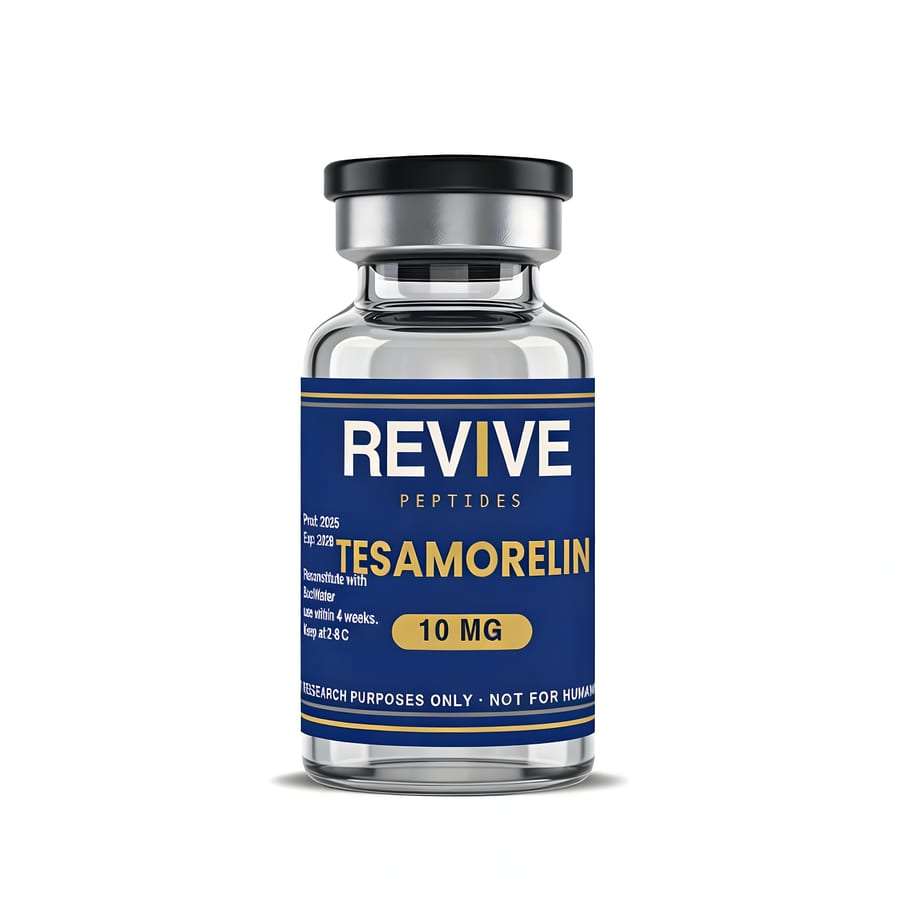
Powerlifting is a sport that lives in the extremes: maximum voluntary contractions, multi-week accumulation phases, peak-week deload, and the relentless question of how fast an athlete's central nervous system, musculotendinous structures, and body composition can reset between sessions. Most recovery research focuses on sleep, nutrition timing, and passive regeneration. A smaller but growing body of investigators is examining GHRH analogs — specifically tesamorelin — for their downstream effects on GH pulsatility, IGF-1 elevation, and visceral adipose tissue redistribution. The clinical data was generated in different populations, but the mechanistic rationale for studying tesamorelin in a strength-sport context is clear once you understand what the molecule actually does at the receptor level. REVIVE LAB UAE stocks tesamorelin in stock UAE year-round as HPLC-verified 5 mg and 10 mg vials, making this one of the few peptides in the Gulf with a genuine, unbroken supply chain and documented purity. Below is a rigorous breakdown of the mechanism, the existing evidence base, the research protocol frameworks investigators use, and where to buy tesamorelin UAE with same-day delivery in Dubai.
The Mechanism: What Tesamorelin Does at the Receptor Level
Tesamorelin is a synthetic conjugate of human growth-hormone-releasing hormone (GHRH 1-44) with a trans-3-hexenoyl group added to the N-terminus. That structural modification is not cosmetic — it confers resistance to dipeptidyl peptidase-IV (DPP-IV), the plasma enzyme that rapidly degrades native GHRH. The result is a molecule with a meaningfully longer effective half-life than endogenous GHRH, sufficient to stimulate the anterior pituitary somatotroph cells in a pulsatile, physiologically-patterned manner rather than a supraphysiologic spike.
This distinction matters for investigators studying strength-sport recovery. The pulsatile pattern of GH secretion is not aesthetic — it is functionally significant for downstream IGF-1 production in the liver, for systemic protein synthesis signaling, and for the balance between lipolysis and lipogenesis in different adipose depots. A molecule that mimics the endogenous GHRH pulse more faithfully than exogenous GH injections is, from a research design standpoint, a more controlled experimental variable. Investigators can examine what happens when the GHRH axis is augmented without the receptor desensitization pattern associated with continuous GH infusion.
The IGF-1 Signal: Published Magnitude
The primary outcome was visceral adipose tissue (VAT) measured by CT scan at 26 weeks. Secondary outcomes included IGF-1. Results: VAT fell by approximately 15-18% versus placebo, and IGF-1 rose by roughly 50% from baseline. The 2010 extension (Falutz et al., NEJM) confirmed these findings over 52 weeks, with the IGF-1 elevation sustained throughout the active treatment period and returning toward baseline after discontinuation — consistent with the hypothesis that tesamorelin's effects are mediated through ongoing GHRH receptor stimulation rather than any permanent alteration of the axis.
A ~50% rise in IGF-1 is not a trivial signal for investigators modeling tissue adaptation. IGF-1 (insulin-like growth factor 1) acts on satellite cells in skeletal muscle, on osteoblasts in bone, and on fibroblasts in tendon and connective tissue — all of which are rate-limiting for powerlifting recovery. This is the mechanistic bridge between lipodystrophy clinical trials and strength-sport research interest.
The VAT-to-Lean-Tissue Redistribution
Stanley and colleagues at Massachusetts General Hospital (Stanley 2014, JAMA; Stanley 2019, Lancet HIV) used tesamorelin to examine visceral and hepatic fat in HIV-associated metabolic disease. The 2014 JAMA trial showed a 32% reduction in liver fat relative to placebo. The 2019 Lancet HIV 12-month trial confirmed durable NAFLD reduction. Investigators studying powerlifters ask a related question: can the VAT-selective lipolytic effect improve the hip-to-waist-to-trunk ratio in high-bodyweight athletes without compromising lean mass or blunting anabolic signaling?
Order Tesamorelin UAE Now →
Powerlifter Recovery Research: The Protocol Framework Investigators Use
No published RCT has yet evaluated tesamorelin specifically in a powerlifting or strength-sport cohort. What investigators have is a mechanistic framework built on the Falutz and Stanley data, combined with the general GH-IGF-1 recovery literature in athletes. The research protocol structures that appear in pre-clinical and pilot designs share common features.
Timing Considerations in Recovery Research Designs
GH secretion follows a circadian pattern, with the largest physiological pulse occurring in the first hours of slow-wave sleep. Investigators designing tesamorelin protocols for recovery research typically specify pre-sleep administration to align the exogenous GHRH stimulus with the natural GH pulse window. The practical implication for a powerlifter research context: tesamorelin is administered once daily in the evening, on both training and rest days, for protocol durations of 12-26 weeks — mirroring the Falutz trial timelines where measurable IGF-1 and body-composition changes were documented.
Recovery-focused investigators also look at the interaction between tesamorelin and max-effort session spacing. The hypothesis being tested is whether elevated IGF-1 — sustained at ~50% above baseline as in the Falutz data — shortens the functional recovery window between high-intensity strength sessions by accelerating satellite cell proliferation and connective tissue collagen turnover. This is not a claim about tesamorelin's efficacy in healthy powerlifters; it is the research question driving current investigator interest.
Protocol Duration and Measurable Endpoints
Published tesamorelin research uses a minimum of 26 weeks to see statistically robust body-composition changes. For strength-sport research designs, investigators typically look at:
- IGF-1 serum levels at 4, 8, 12, and 26 weeks
- VAT change by DEXA or CT at 12 and 26 weeks
- Lean mass retention (DEXA) alongside fat redistribution
- Connective tissue biomarkers (PICP, PIIINP) as indirect collagen synthesis signals
- Subjective recovery metrics between max-effort sessions (RPE, readiness scores)
The 26-week window from Falutz 2007 is the gold-standard reference point. Shorter pilot designs (12 weeks) can detect IGF-1 changes but may not show full body-composition recomposition data.
Buy Tesamorelin UAE — Order Now →
Recovery Between Max Sessions: The Connective Tissue Angle
Powerlifting injuries are overwhelmingly tendinous and musculotendinous — not muscle belly tears. The rate-limiting factor in elite powerlifting is not muscle hypertrophy; it is the adaptation rate of tendons, ligaments, and their attachment points to bone. Collagen is the structural molecule, and collagen synthesis is regulated in part by IGF-1 and GH signaling through fibroblast activation and TGF-beta pathways.
IGF-1 and Fibroblast Activation — The Research Rationale
Fibroblasts in tendon tissue express IGF-1 receptors. In vitro and animal model research consistently demonstrates that IGF-1 stimulates collagen type I synthesis, increases tenocyte proliferation, and promotes tendon repair after mechanical overload. The clinical translation of this research is not straightforward — but it is the reason investigators designing strength-sport recovery protocols are interested in peptides that durably raise IGF-1 rather than spike it transiently. Tesamorelin's documented ~50% IGF-1 elevation (Falutz 2007), sustained over 26-52 weeks, represents exactly the type of sustained IGF-1 environment that connective-tissue recovery research requires.
For a powerlifter accumulating maximal-effort squat, bench, and deadlift volume across a 12-16 week training cycle, the hypothesis is that elevated IGF-1 — if borne out in a future RCT — could narrow the inter-session recovery window by 12-24 hours, allowing higher weekly volume without proportional increases in connective tissue strain markers. This is the investigator hypothesis, not a confirmed clinical outcome. The data to test it rigorously in healthy strength athletes does not yet exist. What exists is the mechanistic foundation and the supply infrastructure to run the research.
GH Pulsatility and Overnight Repair
The largest GH pulse in most people occurs during slow-wave sleep — a window that is also the primary period for tissue repair signaling. In powerlifters with elevated VAT (which suppresses endogenous GH pulsatility), this overnight repair signal is already attenuated. Tesamorelin administered pre-sleep in a research context is designed to reinstate a stronger GHRH-driven GH pulse during exactly this window. Stanley's group noted that the GH and IGF-1 effects of tesamorelin operated within a physiological range rather than supraphysiological spikes — a mechanistic profile that investigators studying sleep-period tissue repair find attractive.
Buy Tesamorelin UAE — REVIVE LAB Supply Chain
Running a tesamorelin research protocol in the UAE used to mean sourcing from unreliable offshore suppliers with inconsistent cold-chain handling and no purity documentation. REVIVE LAB UAE exists specifically to close that gap. Every tesamorelin batch is HPLC-tested to ≥99% purity with lot-specific COA available on request. Vials are dispatched in validated cold-chain insulated packaging that holds 2-8°C through any UAE summer transit — a non-trivial requirement when ambient temperatures in Dubai reach 45°C in July. Tesamorelin in stock UAE at REVIVE LAB means 5 mg and 10 mg vials ready for same-day dispatch from Dubai, not pre-order timelines. Cash on delivery Dubai is supported as standard, with no minimum order surcharge. For investigators in Abu Dhabi, Sharjah, RAK, Fujairah, Ajman, Umm Al Quwain, or Al Ain, tesamorelin 24h delivery covers every emirate in the federation.
| Location | Delivery Window | Cash on Delivery | Cold-Chain Packaging |
|---|---|---|---|
| Dubai (Marina, JBR, Business Bay, DIFC, JVC, Palm, Downtown, Jumeirah) | Same-day, 4-8 hours | Yes | Yes |
| Sharjah | Same-day / next-day, 6-18 hours | Yes | Yes |
| Abu Dhabi (Corniche, Yas, Saadiyat, Reem, Al Raha) | Next-day, 18-24 hours | Yes | Yes |
| Ajman | Next-day, 18-24 hours | Yes | Yes |
| Ras Al Khaimah (RAK) | Next-day, 18-24 hours | Yes | Yes |
| Fujairah | Next-day, 24 hours | Yes | Yes |
| Umm Al Quwain / Al Ain | Next-day, 24 hours | Yes | Yes |
REVIVE LAB UAE is a Dubai-based peptides UAE supplier — not a reseller forwarding inventory from a third-party warehouse. Tesamorelin, Retatrutide, and GHK-Cu are the three core compounds stocked at all times and they represent the highest-inquiry compounds from UAE investigators. For the full peptides UAE research catalogue, see the REVIVE LAB UAE product listing. Discreet, unbranded outer packaging is the default on every order — not an upsell.
FAQ
Can I buy tesamorelin 5mg or 10mg vials in the UAE for powerlifting recovery research?
Yes. REVIVE LAB UAE stocks HPLC-verified tesamorelin in 5 mg and 10 mg vials with lot-COA documentation, dispatched via cold-chain courier to all seven emirates. Same-day delivery is available in Dubai for orders placed before the daily cut-off; tesamorelin 24h delivery covers Abu Dhabi, Sharjah, RAK, Fujairah, and the remaining emirates. Cash on delivery Dubai is supported across the entire UAE with no surcharge. 1 mg or 2 mg vial formats are not stocked — investigators prepare their target concentrations by reconstituting the 5 mg or 10 mg vials with the appropriate BAC water volume.
Does REVIVE LAB UAE offer same-day dispatch and cash on delivery for tesamorelin in Dubai?
Yes. REVIVE LAB UAE offers tesamorelin same day Dubai dispatch for orders placed before the daily cut-off, with tesamorelin 24h delivery to every other emirate. All orders ship in cold-chain insulated packaging with plain, unbranded outer cartons — tesamorelin discreet packaging is the default, not a premium option. Cash on delivery Dubai is supported as standard. HPLC purity certificates and lot-COA documentation are available on request for every batch.
Buy Tesamorelin UAE — Order Now →
- Falutz J, Allas S, Blot K, et al. Metabolic effects of a growth hormone-releasing factor in patients with HIV. N Engl J Med. 2007;357(23):2359-2370.
- Falutz J, Mamputu JC, Potvin D, et al. Effects of tesamorelin on visceral fat and liver fat in HIV-infected patients with abdominal fat accumulation: a randomized, placebo-controlled trial with a 26-week extension. J Clin Endocrinol Metab. 2010;95(9):4291-4304.
- Stanley TL, Feldpausch MN, Oh J, et al. Effect of tesamorelin on visceral fat and liver fat in HIV-infected patients with abdominal fat accumulation. JAMA. 2014;312(4):380-389.
- Stanley TL, Fourman LT, Feldpausch MN, et al. Effects of tesamorelin on non-alcoholic fatty liver disease in HIV: a randomised, double-blind, multicentre trial. Lancet HIV. 2019;6(12):e821-e830.