Tesamorelin Protocol — Falutz 2010 Dose, Stanley 2014 Outcomes, Vial Math
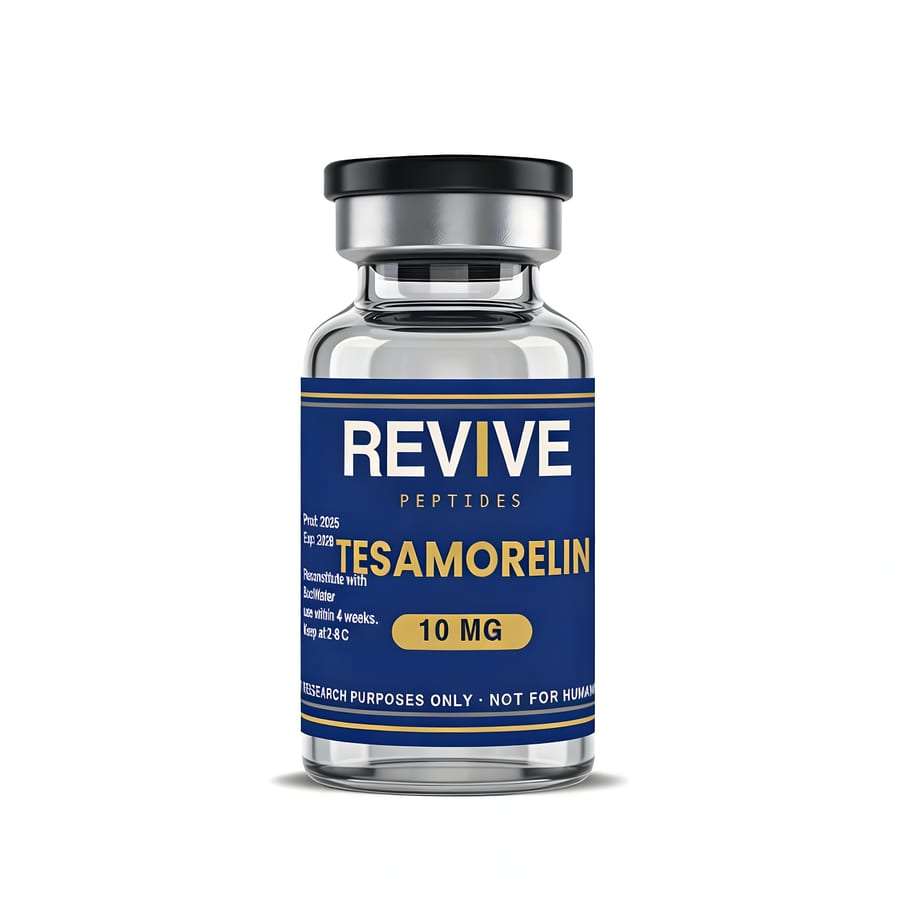
Unlike most peptides, Tesamorelin has unusually clean published dose data. It is an FDA-approved drug (Egrifta) — meaning there is a phase 3 trial with a registered dose, follow-up RCTs that replicated the dose, and over a decade of post-approval observational data. The dose has barely moved across that time. Here's the Falutz 2010 protocol, the Stanley 2014 follow-up data, and what 5 mg and 10 mg vials translate to in practice.
1. The Falutz 2010 JCEM phase 3 protocol
Falutz J et al., published in the Journal of Clinical Endocrinology and Metabolism in 2010, was the pivotal phase 3 trial that led to FDA approval of Tesamorelin (Egrifta) for HIV-associated lipodystrophy:
- Population: 410 HIV-positive adults with excess abdominal fat from HAART-associated lipodystrophy.
- Design: Randomised, double-blind, placebo-controlled, multicenter.
- Duration: 26 weeks main phase, with an extension phase up to 52 weeks.
- Primary endpoint: Percent change in visceral adipose tissue (VAT) measured by CT.
- Result: Approximately 15-18% VAT reduction vs placebo at 26 weeks. Triglycerides and HDL also improved.
Crucially, the dose was not titrated. Tesamorelin is administered at the full 2 mg from day one. This is in sharp contrast to GLP-1 agonists like retatrutide and semaglutide, which require multi-week titration to manage GI side effects.
2. The Stanley 2014 JAMA replication
Stanley TL et al., JAMA 2014, was the most-cited follow-up trial. It re-tested Tesamorelin in a similar HIV-lipodystrophy population over 6 months and confirmed the visceral fat reduction.
Stanley's group later published the cognitive outcome data (Baker 2012, the same line of research) — Tesamorelin treatment was associated with improvement in cognitive function in older adults with mild cognitive impairment, suggesting CNS effects of restored GH/IGF-1 signalling. The dose was the same 2 mg daily SC.
5. The visceral fat mechanism — why GHRH > exogenous GH for VAT
One of the more interesting findings buried in the Tesamorelin literature is the question: why does GHRH-induced GH work better for visceral fat than exogenous GH itself?
The likely explanation is pulsatility. Endogenous GH operates in pulses with high peaks and low troughs. Exogenous GH replacement (recombinant human GH, somatropin) produces sustained elevated levels — closer to a constant infusion. The pulsatile pattern appears to preferentially mobilise visceral fat, while sustained elevation triggers more side effects (insulin resistance, fluid retention) without proportionally better VAT reduction. Tesamorelin works upstream — by stimulating the pituitary — so the GH it produces is endogenous and pulsatile.
6. Stack with Ipamorelin — the GHRH + GHRP combination
The most-discussed Tesamorelin stack pairs it with Ipamorelin, a clean ghrelin-mimetic GHRP. The mechanism rationale is simple: GHRH (Tesamorelin) primes the pituitary; GHRP (Ipamorelin) amplifies the same pulse. Co-administration produces measurably higher GH peaks than either alone.
The honest caveat: there is no RCT-quality data on the Tesamorelin + Ipamorelin stack in humans. The mechanism case is solid; the controlled-trial evidence base is not. Researchers running stack comparisons typically use Tesamorelin 2 mg SC at bedtime plus Ipamorelin 200-300 μg SC at the same time. (Note: Ipamorelin is not part of REVIVE LAB UAE's current catalogue — the comparator content here is purely mechanism-level.)
7. Stability and storage
- Lyophilised: 24+ months refrigerated at 2-8 °C. Tolerates room-temperature shipping for short windows — particularly relevant for UAE summer logistics. See our UAE peptide cold-chain post for the thermal stability details.
- Reconstituted: 28 days at 2-8 °C. Tesamorelin's stability post-reconstitution is on the cleaner end of the GHRH-analogue family.
- Freeze-thaw: Avoid. Single freeze-thaw cycles damage GHRH-analogue conformations.
- Light: Store vials in original box, away from direct sunlight.
8. UAE supply — why HPLC matters for Tesamorelin specifically
Tesamorelin is a 44-amino-acid peptide with a tBuOC- modification at the N-terminus. The chemical synthesis is demanding — incomplete coupling at the modification site is a common failure mode for low-quality manufacturers. HPLC verification with a lot-level COA is non-negotiable for research-quality material.
REVIVE LAB UAE supplies HPLC-verified Tesamorelin in 5 mg and 10 mg vials with the COA tied to the specific lot. Same-day dispatch from Dubai before 4 PM, 24-hour delivery across the seven emirates. Order as Tesamorelin UAE and pair with bacteriostatic water UAE for reconstitution.
9. The summary
- No titration — full dose from day one. Differs from GLP-1 agonists.
- Falutz 2010 JCEM phase 3 ≈ 15-18% VAT reduction at 26 weeks. Stanley 2014 JAMA replicated.
- Bedtime dosing aligns with endogenous GH pulse rhythm.
- 10 mg vial + 2 mL bac water → 5 mg/mL → 0.4 mL per 2 mg dose → 5-day vial life.
- UAE supply: REVIVE LAB UAE 5 mg and 10 mg vials, HPLC verified, 24-hour delivery.
References
- Falutz J, Allas S, Blot K, et al. Metabolic effects of a growth hormone-releasing factor in patients with HIV. N Engl J Med. 2007;357(23):2359-70. PubMed
- Falutz J, Mamputu JC, Potvin D, et al. Effects of tesamorelin (TH9507), a growth hormone-releasing factor analog, in human immunodeficiency virus-infected patients with excess abdominal fat: a pooled analysis of two multicenter, double-blind placebo-controlled phase 3 trials with safety extension data. J Clin Endocrinol Metab. 2010;95(9):4291-304. PubMed
- Stanley TL, Feldpausch MN, Oh J, et al. Effect of tesamorelin on visceral fat and liver fat in HIV-infected patients with abdominal fat accumulation: a randomized clinical trial. JAMA. 2014;312(4):380-9. PubMed
- Stanley TL, Fourman LT, Feldpausch MN, et al. Effects of tesamorelin on non-alcoholic fatty liver disease in HIV: a randomised, double-blind, multicentre trial. Lancet HIV. 2019;6(12):e821-e830. PubMed
- Baker LD, Barsness SM, Borson S, et al. Effects of growth hormone-releasing hormone on cognitive function in adults with mild cognitive impairment and healthy older adults. Arch Neurol. 2012;69(11):1420-9. PubMed