Tesamorelin Pulse Protocol — On/Off Research Cycles UAE: An Operational Guide for Lab Researchers
Designing the On-Phase: Evidence-Based Cycle Architecture Frameworks
The published trial data provides concrete anchors for on-phase length selection. The Falutz et al. 2007 NEJM study ran a 26-week initial active phase. The Stanley et al. 2014 JAMA study tracked primary endpoints at the 26-week and 52-week marks. The Falutz 2010 continuation trial introduced the randomised discontinuation design referenced above. Translating these trial architectures into research pulse protocol frameworks (strictly for laboratory research use, never for human therapeutic application) suggests three primary structural options:
- 4-weeks-on / 2-weeks-off: A short-cycle approach suited to studying the acute engagement and early washout phases. The brief active period captures initial receptor engagement and early downstream signalling events; the two-week off-phase is long enough to observe early reversal kinetics without allowing full baseline re-establishment in most research models. Useful for pharmacokinetic endpoint studies and receptor-binding characterisation work.
- 8-weeks-on / 4-weeks-off: A medium-cycle framework that mirrors the midpoint of the major clinical trial active phases. An 8-week on-phase allows study of sustained-engagement outcomes beyond the initial acute response period; the 4-week off-phase provides adequate washout time to observe meaningful reversal before re-initiation. This is the most versatile general-purpose tesamorelin pulse cycle for UAE research contexts.
- 12-weeks-on / 4–6-weeks-off: A longer active phase appropriate for endpoint-heavy designs where reaching a steady-state expression of primary outcomes is methodologically important before washout tracking begins. Best suited for labs with consistent cold-chain infrastructure across the full active phase duration — achievable in Dubai Healthcare City facilities or well-resourced private labs in Business Bay and DIFC, less straightforward in less-controlled environments.
| Cycle Architecture | Active Phase | Off-Phase | Primary Research Question Fit |
|---|---|---|---|
| Short pulse | 4 weeks | 2 weeks | Receptor sensitivity, acute response kinetics, early reversal characterisation |
| Medium cycle | 8 weeks | 4 weeks | Sustained-engagement endpoints, partial washout kinetics, re-initiation response |
| Long cycle | 12 weeks | 4–6 weeks | Steady-state endpoint capture, comprehensive washout tracking, multi-cycle comparison |
| Randomised discontinuation | 8–12 weeks | Randomised (4 or 8 weeks) | Reversal kinetics by washout length, re-initiation response comparison across cohorts |
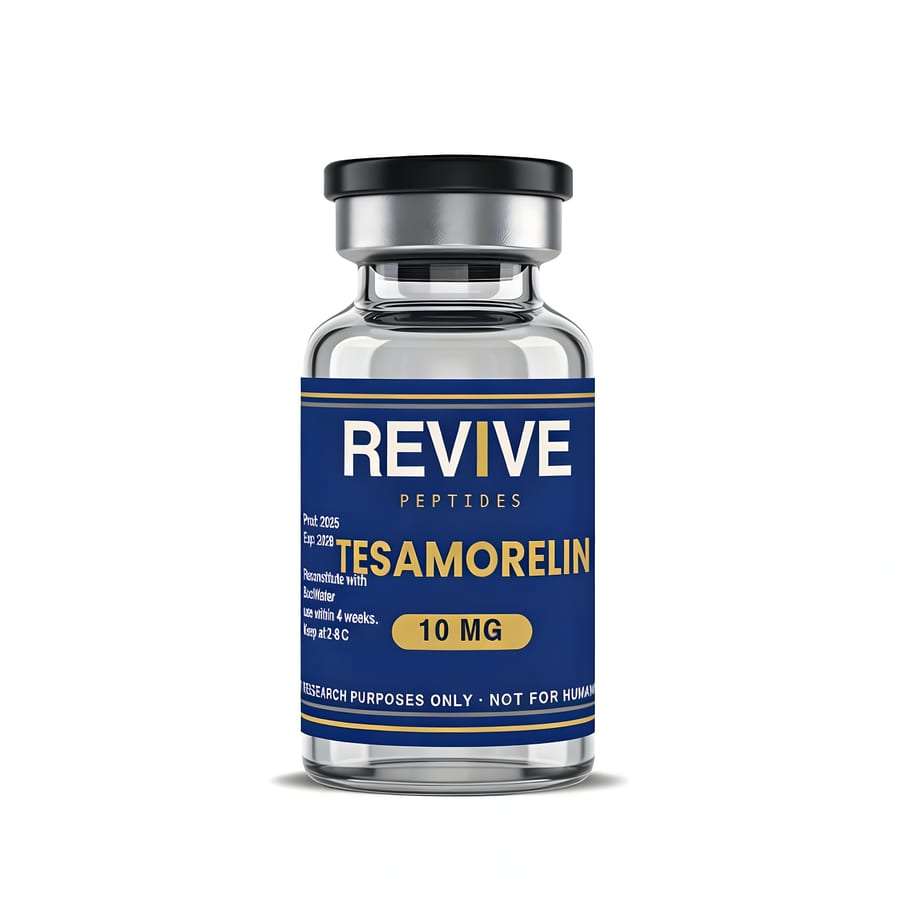
Tesamorelin 5mg & 10mg — In Stock UAE, Ready to Ship Today
Same-day dispatch from Dubai. Discreet cold-packed packaging. Cash on delivery available across UAE. No waiting on international freight.
Buy Tesamorelin UAE — 24h Delivery from REVIVE LAB UAEManaging the Off-Phase: The Washout Period Is Active Data, Not Dead Time
The most consequential reframe for researchers new to tesamorelin pulse cycling is this: the off-phase is not a rest period. It is an active data collection window. When exogenous GHRH stimulation ceases, the pituitary's GH secretion pattern begins reverting toward its baseline state over days to weeks. The speed and completeness of that reversion is itself a research variable — one that differs depending on the length and intensity of the prior active phase, the specific daily administration range used, and individual variation in pituitary GHRH receptor sensitivity. If you are only measuring your primary endpoints during the active phase and using the off-phase as administrative downtime, you are discarding a significant portion of the mechanistic information your research design could generate.
The Falutz et al. 2010 NEJM discontinuation sub-analysis demonstrated that measured outcomes in the placebo-switched arm began reversing within weeks of discontinuation, and that reversal was substantive enough to be statistically detectable at the 12-week off-phase mark. This reversal-and-recovery signal — the dynamic between active-phase establishment, off-phase reversal, and re-initiation recovery — is what makes on/off cycle designs methodologically richer than single sustained-exposure designs for studying tesamorelin's mechanism.
Practically, the off-phase is also the optimal operational window for UAE researchers to: reconstitute fresh vials for the upcoming active phase (starting this 24–48 hours before active-phase restart), verify cold-chain compliance of stored lyophilised stock, calibrate measurement instruments, and review endpoint data from the completed active phase before the re-initiation measurement schedule begins. Scheduling a specific mid-off-phase measurement event — to characterise the washout curve — and an end-of-off-phase baseline measurement — to establish pre-re-initiation baseline values — should be built into every pulse protocol design from the outset, not added retrospectively.
Reconstitution and Storage for UAE Lab Conditions
Lyophilised tesamorelin vials require reconstitution with bacteriostatic water (BAC water) before use. The technique matters: inject BAC water slowly down the inner wall of the vial, allowing it to run down to the lyophilised cake without direct impingement. Do not inject water directly onto the cake under pressure. Do not vortex the vial after reconstitution — agitation degrades peptide structure. Swirl gently if any cloudiness persists, then allow the solution to settle. Properly reconstituted tesamorelin solution should be clear and colourless.
Two environmental factors specific to UAE conditions require explicit attention:
- Temperature excursion risk: Even in well-cooled lab environments in Dubai Marina, Business Bay, or Abu Dhabi, brief temperature excursions above 8°C occur during transit corridors, equipment maintenance windows, and building cooling interruptions. Reconstituted peptide solution is significantly more vulnerable to these excursions than lyophilised powder. The practical rule: keep stock lyophilised until 24–48 hours before the start of each active-phase administration window, and reconstitute only what will be used within the next 3–5 days. Do not carry large reconstituted solution reserves across long storage periods.
- Water quality: UAE municipal water is desalinated and carries a mineral profile that differs substantially from standard pharmaceutical water. Never use tap water, reverse-osmosis drinking water, or filtered water from any non-pharmaceutical source for peptide reconstitution. Use pharmaceutical-grade bacteriostatic water for injection exclusively. REVIVE LAB UAE can supply BAC water alongside tesamorelin orders — request it at checkout or via WhatsApp when placing your order.
Post-reconstitution storage protocol: refrigerate immediately at 2–8°C. Protect from light. Do not freeze reconstituted solution under any circumstances — ice crystal formation physically disrupts the peptide structure. Plan reconstitution events to align with these windows and never let reconstituted solution sit idle for longer than the useful shelf-life at refrigeration temperature.
Multi-Compound Research Arrays: Stacking Tesamorelin in Pulse Protocol Designs
Tesamorelin's upstream GHRH-receptor mechanism makes it compositionally compatible with a wide range of co-administration scenarios in multi-compound research arrays. Because it does not directly modulate the same pathways as most other commonly studied research peptides, it can be studied alongside compounds with distinct mechanisms without obvious receptor-level interactions — though this must always be verified within the specific study design rather than assumed.
Tesamorelin + GHK-Cu
GHK-Cu (copper peptide) operates through wound-healing signalling, collagen modulation, and anti-inflammatory gene expression pathways (Pickart 2018, Cosmetics). There is no mechanistic overlap with tesamorelin's GHRH-receptor engagement. In research designs pairing these compounds, investigators typically maintain the GHK-Cu arm through the tesamorelin off-phase, using it as an active internal reference condition to distinguish compound-specific effects from background variation. REVIVE LAB UAE stocks GHK-Cu for exactly this type of research procurement need, available for co-dispatch with tesamorelin orders from our Dubai inventory.
Tesamorelin + Retatrutide
Retatrutide is a triple incretin agonist (GLP-1/GIP/glucagon receptor) — mechanistically unrelated to the GHRH axis. Multi-compound research arrays pairing a GHRH analog with a triple incretin agonist explore how two distinct upstream metabolic signalling axes interact at shared endpoint levels. This is one of the more sophisticated research questions gaining traction among UAE-based independent researchers, and it represents the kind of study design that requires locally stocked, reliably available supply of both compounds. REVIVE LAB UAE holds Retatrutide in-stock UAE alongside tesamorelin, making it the natural sourcing point for this class of multi-compound research design in the Gulf.
The cardinal principle for stacking in pulse protocol designs: off-phases should be compound-specific unless the research question specifically requires simultaneous washout of all active compounds. A tesamorelin off-phase during which a non-overlapping companion compound continues active administration provides valuable mechanistic resolution — it allows attribution of any endpoint changes during the off-phase to the withdrawal of tesamorelin specifically, rather than to the combined effect of withdrawing everything at once. This requires more careful scheduling but produces cleaner mechanistic data.
Sourcing Tesamorelin in the UAE: Why Local Stock Is an Operational Prerequisite for Pulse Protocol Research
Pulse protocol research has a structural vulnerability that single-sustained-exposure designs do not: cycle timing is everything. An 8-weeks-on / 4-weeks-off protocol that runs out of compound on day 40 of the active phase and cannot restock for three weeks has not experienced a planned off-phase — it has experienced an uncontrolled interruption that injects an unaccounted variable into every endpoint measured before and after. For cycle-dependent study designs, reliable, fast supply chain access is not a procurement convenience. It is a methodological requirement.
Most researchers in the UAE and Gulf who source peptides from offshore suppliers face a common structural problem: 2–4 week lead times for international shipping, uncertain customs clearance timelines at UAE ports, cold-chain integrity risks during transit through high-temperature Gulf freight corridors, and no ability to execute an emergency restock during an active research phase without interrupting the cycle. These are not minor inconveniences. They introduce uncontrolled variables into the most schedule-sensitive class of peptide research designs.
REVIVE LAB UAE solves this at the infrastructure level by holding tesamorelin stock in-country. For researchers in Dubai Marina, JBR, Business Bay, DIFC, and Palm Jumeirah, same-day delivery is the standard service tier for orders placed before the daily dispatch cutoff. For researchers in Abu Dhabi — whether on the Corniche, in Khalifa City, or in KIZAD and industrial research zones — and across Sharjah, next-day delivery covers the gap. The tesamorelin 24h delivery Dubai capability that REVIVE LAB UAE offers means that an emergency restock during an active research phase does not require a cycle interruption. It requires a WhatsApp message and a COD signature.
Discreet packaging is standard on all REVIVE LAB UAE peptide shipments without any request or additional charge. Research peptide orders are dispatched in unmarked outer packaging with thermally insulated cold-pack inner packaging appropriate for UAE summer ambient temperatures. For researchers operating out of Dubai Healthcare City facilities, DXB-area logistics hubs, or private lab setups in Abu Dhabi and Sharjah free zones, this matters both for operational security and for maintaining auditable cold-chain documentation on inbound supplies.
On payment: REVIVE LAB UAE accepts tesamorelin cash on delivery Dubai and across the UAE, Binance Pay (USDT TRC20) with a 5% pre-payment discount for researchers with crypto-enabled procurement accounts, and standard card payments. For researchers managing informal or unbudgeted restocking needs during an active cycle, COD is the operationally simplest route — no pre-authorisation, no waiting on transfer confirmations, vial in hand at delivery. For labs placing larger multi-vial orders at cycle start, the Binance Pay discount compounds meaningfully across a research season's worth of procurement.
FAQ
Can I order tesamorelin in the UAE with same-day or next-day delivery?
Yes. REVIVE LAB UAE dispatches tesamorelin 5mg and 10mg vials same-day for orders placed before the daily cutoff, covering Dubai (Marina, JBR, Business Bay, DIFC, Palm Jumeirah), Abu Dhabi, Sharjah, and wider UAE. Tesamorelin 24h delivery Dubai is the default service tier — not an upgrade. Researchers restarting an active phase or managing an unexpected vial shortage mid-cycle can place and receive orders within one business day across most UAE locations. Tesamorelin discreet packaging UAE is standard on every shipment, with no external branding and thermally appropriate cold-pack insulation.
What vial sizes does REVIVE LAB UAE stock for tesamorelin?
REVIVE LAB UAE holds tesamorelin in-stock UAE in 5mg and 10mg lyophilised vials for research use. Both sizes are available for immediate dispatch — there are no pre-order lead times, no minimum order quantities on standard vial sizes, and no customs uncertainty. The 10mg vial is the more efficient format for longer active phases (8–12 weeks) or multi-subject cohort designs where minimising reconstitution frequency is a practical concern. If you are unsure which format fits your protocol design, the REVIVE LAB UAE research desk can advise via WhatsApp before you order.
Does REVIVE LAB UAE accept cash on delivery for tesamorelin orders?
Yes. Cash on delivery is available for tesamorelin orders across Dubai, Abu Dhabi, and Sharjah — no pre-payment required, settle on receipt. REVIVE LAB UAE also accepts Binance Pay (USDT TRC20) with a 5% pre-pay discount, making it the cost-efficient option for researchers placing multi-vial orders at cycle start. Standard card payments are available for all order sizes. Every tesamorelin order ships in discreet, cold-pack insulated packaging with no external branding, regardless of the payment method used.
- Falutz J, et al. Metabolic Effects of a Growth Hormone-Releasing Factor in Patients with HIV. N Engl J Med. 2007;357(23):2349–2360.
- Falutz J, et al. Effects of Tesamorelin (TH9507), a Growth Hormone-Releasing Factor Analog, in HIV-Infected Patients with Excess Abdominal Fat: A Pooled Analysis of Two Multicenter, Double-Blind Placebo-Controlled Phase 3 Trials with Follow-Up Extension. N Engl J Med. 2010;362(8):686–695.
- Stanley TL, et al. Effect of Tesamorelin on Visceral Fat and Liver Fat in HIV-Infected Patients with Abdominal Fat Accumulation. JAMA. 2014;312(4):380–389.
- Stanley TL, et al. Long-term Effects of Tesamorelin on Visceral Fat and Metabolic Parameters in HIV-Infected Patients with Excess Abdominal Fat. Lancet HIV. 2019;6(4):e247–e256.
- Pickart L, Vasquez-Soltero JM, Margolina A. GHK Peptide as a Natural Modulator of Multiple Cellular Pathways in Skin Regeneration. Cosmetics. 2018;5(2):29.
Ready to Source Tesamorelin for Your UAE Research Protocol?
REVIVE LAB UAE — tesamorelin 5mg & 10mg in stock, same-day Dubai dispatch, discreet packaging, COD available. No offshore wait times, no cold-chain guesswork.
Order Tesamorelin UAE — Same-Day Delivery from REVIVE LAB UAE