Tesamorelin Second Cycle Strategy — UAE Researcher Guide
Why the Second Cycle Is Strategically Different
Most researchers who order tesamorelin Dubai for the first time are working off published trial designs. The landmark Falutz et al. 2007 study in the New England Journal of Medicine established the foundational parameters for tesamorelin as a synthetic GHRH analog, and the Stanley et al. 2014 JAMA data gave researchers a robust visceral adipose reference point for initial-cycle observations. Both studies are first-exposure designs. They answer the question of what happens when you introduce tesamorelin to a naive system. They do not answer what happens when you re-introduce it.
That gap is where the second cycle lives. A researcher returning to tesamorelin is not working with the same biological baseline they had when they started. Twelve to twenty-six weeks of GHRH analog stimulation has altered pituitary pulsatility dynamics, and the off-window between cycles is not simply dead time — it is a phase with its own measurable trajectory. The research design decisions made at that juncture directly determine whether the second-cycle data is interpretable, comparable, or noise.
There is also a straightforward logistical dimension that UAE-based labs understand well. Researchers in Business Bay, Jumeirah Beach Residence, or at academic institutions near DXB free zones cannot afford a stock interruption mid-protocol. Grey-market overseas suppliers are not designed to hold regional inventory; REVIVE LAB UAE is. That operational difference matters when the off-window ends and cycle two needs to begin on a fixed date.
What the Published Literature Says About Continuation Versus Re-Initiation
The best published evidence for what happens when tesamorelin exposure ends comes from the Falutz et al. 2010 continuation trial in the New England Journal of Medicine. Subjects who completed an initial active phase and were then randomised to placebo showed measurable reversal of the visceral adipose changes documented during the active phase. The effect is not permanent. It is contingent on sustained GHRH analog exposure. This is one of the most important data points for any researcher designing a second cycle: you are not building on fixed structural changes. You are re-initiating a dynamic process.
The Stanley et al. 2019 data published in Lancet HIV adds a long-term safety reference. The extension study followed subjects through extended exposure windows and did not identify a compounding adverse signal over time. For researchers who want a peer-reviewed basis for treating tesamorelin as a viable long-term research compound rather than a single-exposure agent, this is the most relevant citation currently in the literature.
What neither study addresses — because it was not the regulatory question being asked — is the optimal re-initiation timing after a voluntary off-window. That design decision falls to the researcher. The frameworks in this guide are intended to structure that decision systematically for labs operating within the UAE research context, not as clinical guidance of any kind.
Structuring the Off-Window: How Long Is Enough?
The off-window between tesamorelin cycles serves three distinct purposes in a research context: allowing hypothalamic-pituitary signalling to re-approach baseline pulsatility; providing a washout interval that minimises carry-over sensitisation effects on downstream markers; and giving the researcher a clean second-baseline measurement period against which cycle-two data can be compared. Compress any one of these, and the second-cycle data quality suffers proportionally.
There is no peer-reviewed consensus on the minimum off-window duration for GHRH analog re-initiation in a lab research setting. Given the pharmacokinetic profile of tesamorelin and the reversal timeline implied by the Falutz 2010 continuation data, researchers across the UAE — from labs in Al Quoz to university-adjacent facilities in Sharjah — tend to apply one of three interval frameworks:
| Off-Window Duration | Research Rationale | Common UAE Lab Application |
|---|---|---|
| 4–6 weeks | Minimum peptide clearance window; pulsatility reset is partial at best | Short-gap sequential observation designs only; not suitable for comparative second-cycle data |
| 8–12 weeks | More complete signalling re-establishment; practical mid-range for most programmes | Standard inter-cycle interval for Dubai and Abu Dhabi research labs on annual schedules |
| 16–20 weeks | Extended reset maximises baseline clarity; best inter-cycle contrast for comparative analysis | Multi-variable comparative studies; programmes where cycle-one and cycle-two data will be independently published |
Researchers in Business Bay and along the Marina corridor running tightly scheduled programmes — where grant cycles or institutional review calendars impose constraints — commonly land on the 8–12 week window because it balances biological reset adequacy against scheduling pragmatism. Labs in Abu Dhabi and Sharjah with more flexible timelines frequently prefer 16 weeks or longer to maximise the contrast between cycle-one and cycle-two response signals. Neither is universally correct. The choice should follow the research objective, not convenience.
One practical note for UAE-based researchers: the off-window is the ideal period to confirm your tesamorelin stock for cycle two. Do not wait until re-initiation day to check availability. Order from REVIVE LAB UAE at least one week before your planned start — not because same-day dispatch is unavailable, but because experienced researchers do not run procurement on critical experiment timelines.
Re-Sensitisation Dynamics in a GHRH Analog Research Context
Re-sensitisation is the functional question beneath the logistical one. After a first tesamorelin cycle, GHRH receptors on pituitary somatotrophs may exhibit some degree of downregulation, and downstream IGF-1 signalling dynamics may have adapted to sustained stimulation. Whether those adaptations fully reverse during the off-window — and whether the second cycle therefore produces a response curve similar to the first — is a genuinely open research question. Published data does not resolve it directly.
In the absence of controlled re-initiation data, researchers designing second-cycle protocols tend toward one of two approaches:
- Matched re-initiation: Begin cycle two at the same range used in cycle one, treating the off-window as the complete reset mechanism. This is the simpler design and produces data that is directly comparable to cycle-one observations at equivalent time points. It assumes that 8–12 weeks is sufficient for full receptor normalisation — an assumption that may or may not hold depending on individual research subject variability.
There is no published peer-reviewed data directly comparing these two approaches in a re-initiation context. The researcher must make the design call based on study objectives. If the primary research question concerns second-cycle magnitude versus first-cycle magnitude, matched re-initiation is the cleaner design.
Either way, the research-use-only framework applies throughout. REVIVE LAB UAE supplies tesamorelin strictly for laboratory and in-vitro research. No clinical, therapeutic, or human-consumption framing applies to any protocol described here.
Same-day delivery across Dubai, Abu Dhabi, Sharjah, and Palm Jumeirah. Discreet outer packaging on every order. Cash on delivery available for Dubai metro.
Buy Tesamorelin UAE — Same-Day Dubai Dispatch from REVIVE LAB UAE
Vial Selection: 5mg vs 10mg Tesamorelin for an Extended Research Programme
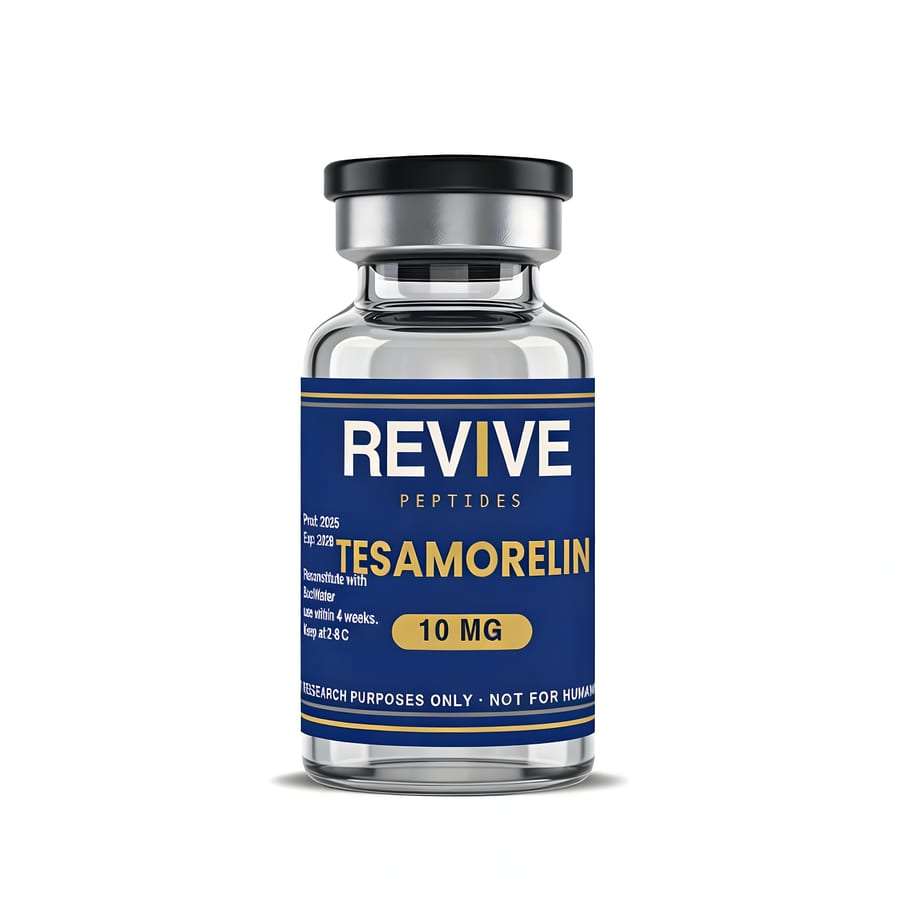
REVIVE LAB UAE stocks tesamorelin in two vial configurations: 5mg and 10mg. For a first cycle, many researchers default to 5mg vials simply because they are the more conservative procurement commitment. For a second cycle — where the researcher has established protocols, knows their reconstitution workflow, and is working through a longer observation window — the vial selection decision deserves more deliberate consideration.
It reduces reconstitution handling frequency, minimises the number of reorder events during a critical observation window, and delivers better per-mg economics over a multi-month programme.
The 5mg vial remains the right choice for researchers who are rotating multiple peptide compounds — for example, running a concurrent comparative arm alongside Retatrutide or another growth hormone secretagogue — and need to manage limited refrigeration capacity. Labs in Abu Dhabi and Sharjah dealing with summer ambient temperatures above 40°C in July and August sometimes prefer the smaller format specifically because it allows tighter cold-chain management with smaller batches. Both vial formats are available for immediate dispatch from REVIVE LAB UAE.
After reconstitution, tesamorelin should be maintained at 2–8°C and handled under standard sterile peptide research conditions using bacteriostatic water. REVIVE LAB UAE provides batch-specific documentation and CoA with every order — information that becomes especially important when comparing cycle-one and cycle-two data across different procurement batches.
UAE Research Logistics — Staying Stocked Without a Protocol Interruption
The practical difference between sourcing peptides UAE domestically versus importing from overseas suppliers is most visible on the days when it matters: public holidays, customs delays, Ramadan freight shifts, and the mid-summer slowdown that affects international logistics into DXB. A researcher in Dubai whose cycle-two initiation date lands during a UAE National Day freight backlog has a real problem if they rely on a European or US-based supplier with two-to-three week standard shipping.
REVIVE LAB UAE maintains live tesamorelin stock — not pre-order backlog, not import-pending inventory — with the following domestic delivery commitments:
- Same-day dispatch for orders confirmed before 4 PM Dubai time; this covers Dubai metro including Downtown, Marina, JBR, Business Bay, Palm Jumeirah, and Deira
- 24h delivery as the standard for all Dubai emirate destinations; researchers in Abu Dhabi, Sharjah, Ajman, and Ras Al Khaimah receive orders within 24–48 hours
- Discreet outer packaging on every shipment — no product name, no brand identifier, no visible indication of contents on the exterior box or envelope; research confidentiality is not an optional add-on, it is the default
- Cash on delivery available for Dubai metro orders; bank transfer and Binance Pay (USDT TRC20) available for all UAE destinations including those preferring a pre-pay route with the associated 5% discount
- WhatsApp order management — researchers can confirm dispatch time, track ETA, and verify cold-chain handling status before arrival
For researchers at institutional labs in university campuses near Sharjah's academic cluster, private research setups on the Palm, or biotech facilities in Abu Dhabi's Masdar City area: the elimination of customs uncertainty alone is worth the decision to source locally. International grey-market peptide shipments into the UAE carry real seizure and confiscation risk. Domestic procurement from REVIVE LAB UAE carries none of that exposure.
The operational recommendation is to secure your cycle-two tesamorelin stock during the off-window — at the 8-week mark, not the day before re-initiation. REVIVE LAB UAE's same-day capability means you can order on demand, but experienced researchers do not run procurement on experiment timelines. Build in the buffer. It costs nothing and protects the protocol.
Eight Mistakes That Derail Second-Cycle Tesamorelin Research in the UAE
After fielding questions from researchers across Dubai, Abu Dhabi, and Sharjah who have worked through first cycles and are approaching re-initiation, a clear pattern of avoidable errors emerges. These are the ones worth knowing before they happen:
- Compressing the off-window to save calendar time. A four-week gap is not equivalent to a ten-week gap in terms of receptor and signalling reset. Compressed off-windows produce noisier second-cycle data and make cycle-one comparison unreliable. Build the off-window duration around the research objective, not scheduling convenience.
- Failing to re-establish baseline measurements before re-initiation. Second-cycle data is only interpretable against a well-documented baseline captured during the off-window, not just the original pre-cycle-one baseline. Skipping this step is the single most common source of uninterpretable second-cycle data.
- Treating the second cycle as an exact protocol replication. Cycle two is an opportunity to tighten reconstitution documentation, switch vial formats if the first cycle revealed inefficiencies, and formalise observation intervals that were informal in cycle one. Exact replication of a loose protocol is not methodological consistency — it is methodological stagnation.
- Ignoring cold-chain compliance during the UAE summer. Dubai and Abu Dhabi ambient temperatures exceed 40°C in July and August. Lyophilised tesamorelin powder is stable at room temperature until reconstitution, but researcher adherence to 2–8°C post-reconstitution storage becomes critical in high-ambient environments. Plan cold-chain infrastructure before cycle two starts, not after a vial is compromised.
- Ordering from an overseas supplier without customs clearance certainty. International grey-market shipments into the UAE carry real seizure and delay risk for peptide compounds. This is not theoretical — it is a documented pattern that UAE-based researchers encounter when sourcing outside the region. Domestic sourcing from REVIVE LAB UAE eliminates the variable entirely.
- Adding concurrent peptide stacks mid-cycle-two without design justification. Every additional compound introduced during an active observation window creates an attribution problem. If a stack protocol is the research goal, design it as its own discrete experiment with its own baseline. Do not retrofit it onto a tesamorelin second cycle that was not designed to accommodate it.
- Failing to document the off-window as a research phase in its own right. The off-window is not dead time. It is a reversal-and-reset phase with measurable trajectory. Researchers who treat it as a procurement gap rather than an observation period lose half the interpretive value of a two-cycle programme.
FAQ
Where can I buy tesamorelin in the UAE with same-day delivery?
REVIVE LAB UAE stocks tesamorelin 5mg and 10mg vials for research use with same-day dispatch for orders confirmed before 4 PM Dubai time. Tesamorelin 24h delivery Dubai covers the full metro area including Downtown, Marina, JBR, Business Bay, and Palm Jumeirah. Abu Dhabi, Sharjah, Ajman, and Ras Al Khaimah orders arrive within 24–48 hours. Cash on delivery is available for Dubai metro. Place your order at revivelab.ae/buy-tesamorelin-uae/ or confirm via WhatsApp for immediate dispatch notification.
What vial sizes does REVIVE LAB UAE carry for tesamorelin research?
REVIVE LAB UAE carries tesamorelin in 5mg and 10mg vial configurations, both supplied for research use only. The 5mg vial suits shorter titration phases, multi-compound stock rotation setups, or labs managing limited cold storage capacity during the UAE summer months.
Is tesamorelin packaging discreet when ordering in Dubai?
Yes. REVIVE LAB UAE ships all peptide orders — including tesamorelin — in plain unmarked outer packaging with no product name, no brand identifiers, and no visible indication of contents on the exterior. Research confidentiality is the default on every UAE delivery, not a premium option. This applies equally to orders going to Dubai metro addresses, Abu Dhabi, Sharjah, and all other UAE destinations served by REVIVE LAB UAE.
- Falutz J, et al. Metabolic effects of a growth hormone-releasing factor in patients with HIV. N Engl J Med. 2007;357(23):2359–2370.
- Stanley TL, et al. Effect of tesamorelin on visceral fat and liver fat in HIV-infected patients with abdominal fat accumulation: a randomised clinical trial. JAMA. 2014;312(4):380–389.
- Stanley TL, et al. Long-term effects of tesamorelin on visceral adipose tissue and liver fat: extension study of a randomised, placebo-controlled trial. Lancet HIV. 2019;6(3):e156–e165.
- Falutz J, et al. Effects of tesamorelin (TH9507), a growth hormone-releasing factor analogue, in HIV-infected patients with excess abdominal fat: a pooled analysis of two multicenter, double-blind placebo-controlled phase 3 trials with follow-up extension. N Engl J Med. 2010;362(2):131–141.
REVIVE LAB UAE has tesamorelin in stock — 5mg and 10mg vials — with same-day Dubai dispatch, discreet outer packaging, and cash on delivery available for Dubai metro orders.
Order Tesamorelin UAE — REVIVE LAB UAE 24h Delivery