Tesamorelin & SHBG: What the Falutz & Stanley Trials Reveal About Free Androgen Bioavailability — UAE Research Guide 2026
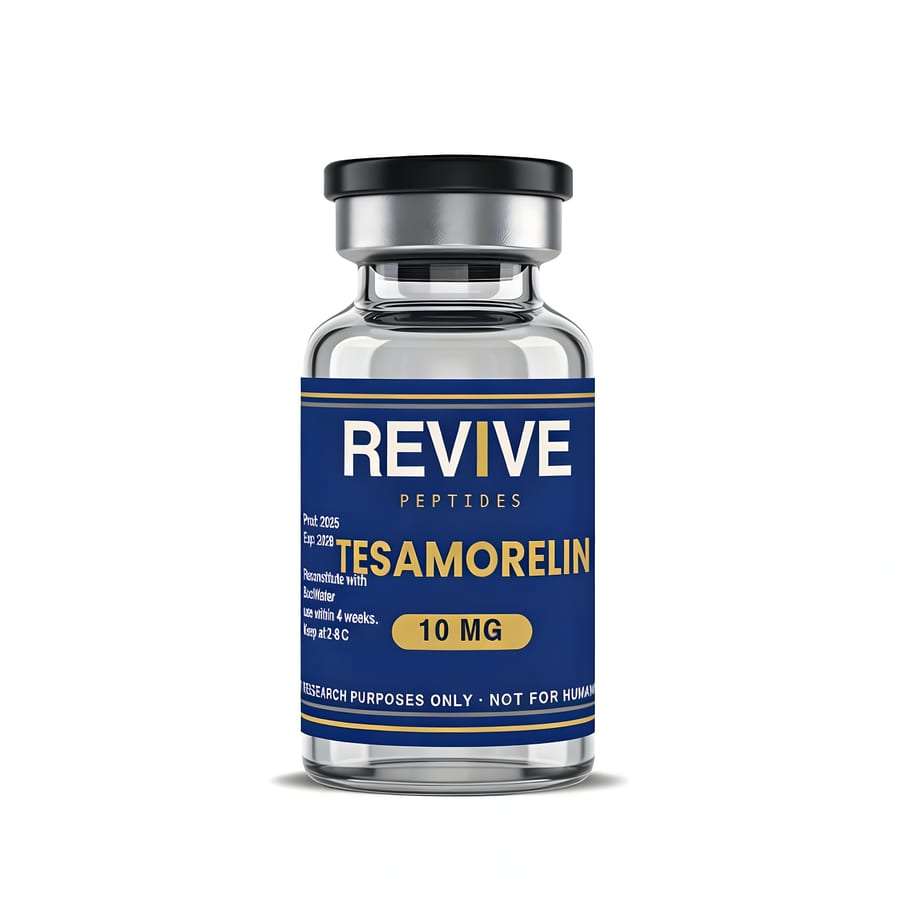
Most research interest in tesamorelin in the UAE centres on visceral fat reduction and liver fat — the two endpoints documented in Falutz 2007, Falutz 2010, Stanley 2014, and Stanley 2019. But investigators who look only at those endpoints are leaving a significant secondary mechanism unexamined. Every time tesamorelin activates the hypothalamic GHRH receptor, the resulting surge in pulsatile GH and downstream IGF-1 sets off a cascade in the liver — one of the consequences of which is measurably suppressed sex hormone-binding globulin (SHBG) output. For research protocols that include hormonal biomarkers alongside body composition endpoints, this SHBG dynamic is not a confound to control away. It is a variable to measure and understand. This guide explains the mechanism, maps it to the published trial data, and tells you where to buy tesamorelin UAE with verified purity and reliable cold-chain delivery from REVIVE LAB UAE.
SHBG and the GH/IGF-1 Axis: The Core Mechanism
Sex hormone-binding globulin is a glycoprotein synthesized almost exclusively in hepatocytes. It binds testosterone and estradiol with high affinity, keeping the majority of circulating sex hormones in a biologically inert, protein-bound state. Only the unbound — "free" — fraction crosses cell membranes and activates androgen or estrogen receptors. In typical endocrine research, the free testosterone fraction is roughly 2-3% of total testosterone in adult males; SHBG is the primary determinant of where that percentage lands.
The GH/IGF-1 axis is one of the strongest known suppressors of hepatic SHBG production. The mechanism operates at the transcriptional level: IGF-1 signalling through the IGF-1 receptor activates downstream PI3K/Akt pathways that reduce HNF-4α (hepatocyte nuclear factor 4 alpha) transcriptional activity — and HNF-4α is the principal driver of SHBG gene expression in hepatocytes. In plain terms: more IGF-1 = less HNF-4α activity = less SHBG mRNA = less SHBG protein secreted into circulation = larger free hormone fraction. This inverse relationship between IGF-1 and SHBG has been replicated across acromegaly studies, GH-deficiency trials, and normal physiological ageing research.
Tesamorelin delivers exactly this IGF-1 surge. As a synthetic GHRH 1-44 analog with a trans-3-hexenoyl N-terminal modification — which confers resistance to dipeptidyl peptidase-IV (DPP-IV) degradation and extends the functional half-life — tesamorelin binds pituitary GHRH receptors, amplifies GH pulse amplitude, and produces a sustained rise in circulating IGF-1. This is not a pharmacological trick; it is the intended mechanism by which the compound achieves its visceral fat endpoint. The SHBG suppression is a downstream consequence of the same pathway.
Stanley 2014 and 2019 — Liver Fat, Metabolic Milieu and the SHBG Connection
Stanley and colleagues at Massachusetts General Hospital extended tesamorelin research into HIV-associated non-alcoholic fatty liver disease (NAFLD) — a condition where both hepatic fat accumulation and hormonal dysregulation are common. The 2014 JAMA publication reported that tesamorelin reduced liver fat by 32% relative to placebo over 12 months. The 2019 Lancet HIV study confirmed this finding in a larger, dedicated RCT with 12-month follow-up.
The SHBG dimension becomes particularly relevant in the Stanley cohorts for two reasons. First, fatty liver and insulin resistance are themselves associated with elevated SHBG suppression through insulin-mediated pathways — meaning the metabolic context of these research subjects already involves complex SHBG dynamics independent of tesamorelin. Second, tesamorelin's hepatic fat-reduction effect reduces the inflammatory and steatotic load on hepatocytes, which can itself alter SHBG transcription independently of IGF-1. Investigators designing SHBG-inclusive protocols should account for both the IGF-1-mediated route and the hepatic lipid clearance route when interpreting SHBG trajectory data.
The convergence of these two pathways — IGF-1 rise suppressing HNF-4α, and hepatic fat reduction restoring hepatocyte synthetic function — makes tesamorelin an unusually multi-dimensional tool for researchers interested in endocrine-metabolic interactions.
Order Now →
Designing SHBG-Inclusive Tesamorelin Research Protocols
For investigators in the UAE who want to track SHBG alongside the standard tesamorelin endpoints, the following biomarker panel reflects what the Falutz and Stanley groups tracked — plus the SHBG-relevant additions that the growing free-androgen literature suggests:
| Biomarker | Why It Matters in Tesamorelin Research | Expected Direction |
|---|---|---|
| IGF-1 | Primary GH axis readout; drives SHBG suppression | ↑ ~50% (Falutz 2007) |
| SHBG | Hepatic GH/IGF-1 axis output; determines free hormone fraction | ↓ (IGF-1 mediated) |
| Total testosterone | May shift modestly; free fraction change is the primary variable | Variable |
| Free testosterone (calculated) | Rises as SHBG falls even if total T unchanged | ↑ (SHBG-driven) |
| Visceral adipose tissue (VAT) | Primary structural endpoint; Falutz 2007 primary outcome | ↓ 15-18% |
| Liver fat (MRS or MRI-PDFF) | Stanley 2014/2019 primary endpoint | ↓ ~32% |
| Fasting glucose / insulin | Metabolic context variable; insulin also suppresses SHBG | Monitor for trend |
| LH / FSH | Upstream pituitary markers; confirm HPG axis not perturbed | Stable (tesamorelin acts on GH axis, not HPG) |
Timing Considerations for SHBG Sampling
Because SHBG is a relatively slowly-turnover glycoprotein — hepatic synthesis changes take days to weeks to manifest in serum — investigators should not expect to see SHBG shifts in the first week of a tesamorelin research protocol. The Falutz 2007 data showed IGF-1 elevation that was measurable at 4 weeks and maximal by 12 weeks. SHBG trajectory would logically lag IGF-1 onset by 2-4 weeks in most research models. A practical sampling cadence: baseline, week 4, week 8, week 12, and then monthly thereafter if the protocol runs to 26 weeks.
The Free Testosterone Signal in Research Context
When SHBG falls — even with total testosterone unchanged — the calculated free testosterone rises proportionally. In a male research subject with baseline SHBG of 40 nmol/L, a 30% SHBG reduction to 28 nmol/L would increase free testosterone by roughly 20-25% with no change in Leydig cell output. This is not a trivial shift: it is comparable in magnitude to a moderate testosterone-support protocol and occurs as a secondary consequence of tesamorelin's primary GH/IGF-1 mechanism. Investigators who ignore SHBG and report only total testosterone will systematically underestimate the androgenic activity of the hormonal environment created by a tesamorelin research protocol.
Tesamorelin Vials for Research: 5 mg and 10 mg Only
REVIVE LAB UAE stocks tesamorelin exclusively in the vial sizes used in published research — 5 mg and 10 mg. Both doses can be drawn from 5 mg or 10 mg vials by adjusting the reconstitution volume. REVIVE LAB UAE does not stock 1 mg or 2 mg vials — these strengths are not part of our supply chain, and investigators should be cautious of suppliers offering them, as they fall outside established research precedent.
Reconstitute slowly by injecting BAC water down the side of the vial, never directly onto the lyophilized cake. Do not vortex — gentle swirling only. Once reconstituted, store at 2-8°C and use within 14 days. This is consistent with the storage protocol described in the Falutz and Stanley published methods. For UAE investigators, REVIVE LAB UAE 3 mL BAC water vials are available as an add-on to every tesamorelin order.
Buy Tesamorelin UAE →
Why SHBG Research in the UAE Is Gaining Traction
The UAE research community has been at the forefront of metabolic peptide investigation in the Gulf region. Tesamorelin interest among UAE investigators has historically centred on visceral fat endpoints — consistent with the Falutz 2007 primary outcomes — but a growing subset of researchers are now layering hormonal biomarker panels into their protocols. The SHBG/free testosterone dimension is particularly relevant in the UAE context, where a significant proportion of research subjects present with metabolic syndrome features, central adiposity, and below-optimal free androgen levels — exactly the population in which tesamorelin's dual VAT-reduction and SHBG-suppression effects would be most pronounced.
REVIVE LAB UAE sees this shift in investigator inquiry directly: orders increasingly include requests for guidance on biomarker panel design alongside requests for tesamorelin in stock UAE confirmation. The answer on stock is consistently yes — 5 mg and 10 mg vials, verified HPLC ≥99% purity, lot-matched COA, refrigerated courier dispatch. Whether your protocol is focused on VAT reduction, liver fat, or the SHBG/free hormone axis, the compound is the same and the sourcing standard is the same.
Where to Buy Tesamorelin UAE — Delivery Across All 7 Emirates
REVIVE LAB UAE is a Dubai-based peptides UAE supplier — not a reseller, not an overseas drop-shipper. Every batch is HPLC-tested with COA available on request, cold-chain dispatched in insulated packaging that holds 2-8°C through UAE summer transit, and delivered by refrigerated courier. Tesamorelin same day Dubai applies for orders placed before the daily dispatch cut-off. For investigators outside Dubai, tesamorelin Dubai 24h delivery reaches every other emirate within one business day.
| Emirate / City | Delivery Window | Cash on Delivery | Cold Chain |
|---|---|---|---|
| Dubai (Marina, JBR, DIFC, Business Bay, JVC, Downtown, Palm, Jumeirah) | Same-day, 4-8 hours | Yes | Yes |
| Abu Dhabi (Corniche, Yas Island, Saadiyat, Reem) | Next-day, 18-24 hours | Yes | Yes |
| Sharjah | Same-day / next-day, 8-18 hours | Yes | Yes |
| Ajman | Next-day, 18-24 hours | Yes | Yes |
| Ras Al Khaimah (RAK) | Next-day, 18-24 hours | Yes | Yes |
| Fujairah | Next-day, 24 hours | Yes | Yes |
| Umm Al Quwain (UAQ) | Next-day, 18-24 hours | Yes | Yes |
| Al Ain | Next-day, 24 hours | Yes | Yes |
All shipments use plain, unbranded outer cartons as the default — not an upsell. Cash on delivery is supported across all seven emirates. For researchers in Dubai Marina, JBR, Business Bay, JVC, Jumeirah, DIFC, Palm Jumeirah, Downtown, Emirates Hills or Arabian Ranches, same-day windows make it possible to begin a protocol the same day an order is placed. Investigators in Abu Dhabi, Sharjah, RAK or Fujairah should order one day ahead of the intended protocol start date. This is what peptides UAE supply actually looks like when the supplier is genuinely UAE-based — not a website with a UAE flag and a warehouse in Europe.
FAQ
Where can I buy tesamorelin in the UAE for SHBG-related research with same-day delivery?
REVIVE LAB UAE stocks HPLC-verified tesamorelin 5 mg and 10 mg vials and dispatches same-day within Dubai for orders placed before the daily cut-off, and within 24 hours to every other emirate including Abu Dhabi, Sharjah, Ras Al Khaimah and Fujairah. All shipments use cold-chain insulated packaging, discreet unbranded outer cartons, and cash on delivery is supported across all seven emirates. Visit /buy-tesamorelin-uae/ to order.
What does tesamorelin research show about SHBG levels and free testosterone?
Tesamorelin is a GHRH analog that elevates GH pulse amplitude and raises IGF-1 by approximately 50% as documented in Falutz et al. 2007 (NEJM, 412 subjects). The GH/IGF-1 axis is a well-characterised suppressor of hepatic SHBG synthesis — IGF-1 signalling reduces HNF-4α transcriptional activity in hepatocytes, cutting SHBG gene expression and secretion. Investigators therefore expect rising IGF-1 to correlate inversely with SHBG, increasing the free fraction of testosterone and estradiol available to peripheral tissues. This SHBG dynamic is a secondary variable of significant interest in visceral fat and metabolic research protocols.
Buy Tesamorelin UAE — Order Now →
- Falutz J, Allas S, Blot K, et al. Metabolic effects of a growth hormone-releasing factor in patients with HIV. N Engl J Med. 2007;357(23):2359-2370.
- Falutz J, Mamputu JC, Potvin D, et al. Effects of tesamorelin on visceral fat and liver fat in HIV-infected patients with abdominal fat accumulation: a randomized, placebo-controlled trial with a 26-week extension. J Clin Endocrinol Metab. 2010;95(9):4291-4304.
- Stanley TL, Feldpausch MN, Oh J, et al. Effect of tesamorelin on visceral fat and liver fat in HIV-infected patients with abdominal fat accumulation. JAMA. 2014;312(4):380-389.
- Stanley TL, Fourman LT, Feldpausch MN, et al. Effects of tesamorelin on non-alcoholic fatty liver disease in HIV: a randomised, double-blind, multicentre trial. Lancet HIV. 2019;6(12):e821-e830.