Tesamorelin and Sleep: Slow-Wave Sleep, GH Pulse Alignment & Why Evening Dosing Wins (UAE 2026)
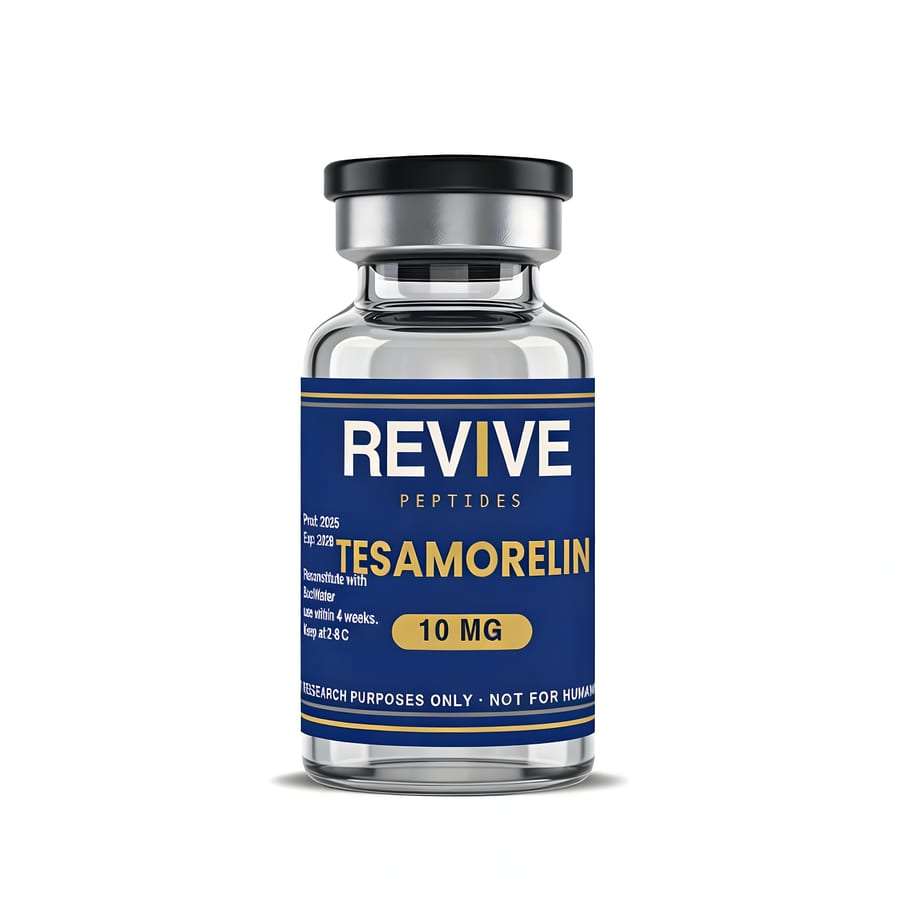
The GHRH–Sleep Axis: Why Tesamorelin Belongs at Night
Growth hormone is not released in a steady drip. It is released in roughly six to ten pulses across 24 hours, and one pulse dominates: the nocturnal burst, which begins within 30–60 minutes of sleep onset and coincides almost exactly with the first episode of slow-wave sleep (SWS, also called N3 or delta sleep). Eve Van Cauter and colleagues mapped this relationship across decades of polysomnography studies and showed that more than 70% of the daily GH output in young adults occurs during this single nocturnal window.
The driver is hypothalamic GHRH. As the cortex slows into delta-dominant SWS, GHRH neurons in the arcuate nucleus fire, somatostatin tone falls, and the pituitary releases its largest GH bolus of the day. Crucially, GHRH itself is somnogenic — Obal and Krueger demonstrated that GHRH administration directly increases SWS duration, while GHRH antagonism reduces it. The relationship is bidirectional: sleep drives GH, and GHRH drives sleep.
This is the entire reason tesamorelin — a GHRH(1–44) analog stabilized against dipeptidyl peptidase-IV cleavage — works best as an evening injection. Buy tesamorelin UAE 24h delivery if you want to align research dosing with this physiology.
What Tesamorelin Actually Is (And Isn't)
Tesamorelin (trade name Egrifta) is a 44-amino-acid synthetic analog of human GHRH with a single trans-3-hexenoyl modification at the N-terminus. This modification protects against DPP-IV cleavage, extending plasma half-life from minutes (native GHRH) to roughly 26–38 minutes for tesamorelin. It is FDA-approved for HIV-associated lipodystrophy (visceral fat reduction) on the back of Falutz 2007 and Stanley 2014.
It is not GH. It does not bypass the pituitary. It signals upstream — to the somatotrophs — and asks the pituitary to release its own GH in its own pulsatile pattern. Three implications follow:
- Pulsatility is preserved. Unlike subcutaneous somatropin (which produces a flat 8–12 hour elevation), tesamorelin amplifies existing pulses without overwriting the architecture.
- Negative feedback still works. Rising IGF-1 and somatostatin still suppress further release. Tachyphylaxis exists but is gentler than with direct GH dosing.
- Sleep architecture is protected. Because the augmented pulse rides on the natural SWS-locked release, sleep stages are not disturbed the way they can be with off-cycle GH dosing.
Slow-Wave Sleep: The Specific Stage Tesamorelin Targets
Slow-wave sleep is N3 in modern AASM scoring — the stage characterized by EEG delta activity (0.5–4 Hz) at greater than 20% of an epoch. It is concentrated in the first third of the night and declines with age: a healthy 25-year-old spends roughly 90–110 minutes per night in SWS; a 60-year-old typically logs 30–50 minutes; a 75-year-old may record under 20 minutes. This SWS decline parallels the age-related decline in GH secretion almost perfectly — Van Cauter's 2000 JAMA paper made this link directly.
What SWS Does
- Glymphatic clearance of CSF metabolites including amyloid-beta peaks during SWS
- Procedural and declarative memory consolidation is SWS-dependent
- Pituitary GH release peaks during the first SWS episode
- Cortisol nadir aligns with deep SWS — sympathetic tone is at its lowest
- Cellular repair, protein synthesis, and immune signaling are upregulated
How GHRH-Class Peptides Modify SWS
Steiger and colleagues (Munich Max Planck Institute) ran the foundational studies on GHRH and sleep. A 4 x 50 µg pulsatile GHRH infusion during the first half of the night increased SWS by ~25% and increased GH AUC, with the largest effects in older subjects who had the most SWS deficit at baseline. The mechanism is dual: GHRH binds GHRH receptors in the preoptic area (sleep-promoting), and the resulting GH pulse feeds back via IGF-1 to support consolidation.
REM Sleep: A More Nuanced Story
REM sleep is governed by a different circuit — cholinergic REM-on neurons in the laterodorsal and pedunculopontine tegmental nuclei, gated by aminergic REM-off neurons in the locus coeruleus and dorsal raphe. GHRH does not directly drive REM. However, three observed effects on REM are worth flagging:
- Improved REM continuity. When SWS is consolidated in the early night, REM cycles later in the night are less fragmented. Patients report longer, more vivid dreams.
- Modest REM-percentage increase. Some studies of GHRH analogs report a 5–10% rise in REM share, likely a secondary effect of reduced wake-after-sleep-onset (WASO).
- Reduced REM rebound after sleep deprivation. Suggests baseline REM debt is smaller because total sleep quality has improved.
For research applications targeting cognitive consolidation or recovery from shift-work disruption, the REM-stabilizing effect is often as valuable as the SWS amplification.
Evening Injection Protocol — The Pharmacokinetic Logic
Tesamorelin reaches plasma T-max approximately 15 minutes after subcutaneous injection, with a t½ of ~26 minutes in healthy subjects (longer in HIV-lipodystrophy populations). The GH pulse it triggers peaks 30–60 minutes post-injection and lasts 60–90 minutes. Therefore:
| Injection time (relative to sleep onset) | Effect on nocturnal pulse |
|---|---|
| 3+ hours before bed | Pulse occurs during wakefulness — wasted physiology, may blunt natural SWS-locked pulse |
| 60–90 min before bed | OPTIMAL — tesamorelin pulse stacks with endogenous SWS-locked pulse |
| 0–30 min before bed | Acceptable; pulse arrives during early N2/N3 transition |
| Morning | Triggers daytime pulse against high somatostatin tone — reduced amplitude, no sleep benefit |
The 60–90 minute window is the consensus among researchers working with GHRH-class peptides. It avoids two failure modes: injecting too late (pulse arrives during deep SWS and may briefly fragment it) and injecting too early (pulse fires during evening alertness when somatostatin is high and the response is blunted).
REVIVE LAB stocks tesamorelin 5 mg and 10 mg vials with HPLC certificates of analysis, cold-chain dispatch, and same-day handoff from Dubai. In stock now, ships today.
Buy tesamorelin UAE 24h delivery →
Research Dose Ranges Reported in the Literature
Falutz 2007 and Stanley 2014 used 2 mg subcutaneous daily for visceral fat endpoints. Sleep-architecture research with GHRH-class peptides has tested both lower (1 mg) and standard (2 mg) evening doses. Higher doses do not appear to deepen SWS proportionally — the SWS effect saturates while IGF-1 continues to rise, suggesting the sleep benefit is dose-independent above ~1 mg in non-deficient subjects.
| Dose | Typical use | IGF-1 response (4 wk) | SWS effect |
|---|---|---|---|
| 1 mg SC evening | Sleep architecture, gentle GH support | +30–50% | Measurable SWS lift |
| 2 mg SC evening | Standard Falutz/Stanley protocol | +60–100% | SWS lift plateaus |
| 2 mg SC morning | Not recommended for sleep endpoints | +60–100% | No sleep benefit |
Where to Buy Tesamorelin in the UAE — REVIVE LAB Same-Day Dubai Stock
REVIVE LAB holds tesamorelin in temperature-controlled Dubai stock. The supply chain is built specifically for the UAE research market — no international waiting times, no customs holds, no broken cold chain in summer heat.
Stocked Strengths
- Tesamorelin 5 mg vial — single-vial research start, ideal for 1 mg evening dosing trials
- Tesamorelin 10 mg vial — better cost-per-mg for extended protocols or 2 mg daily research
- HPLC certificates of analysis available on request for every lot
- Lyophilized, vacuum-sealed, ships with cold packs in insulated mailers
Delivery Timing Across the Emirates
| Emirate | Order cutoff | Delivery window |
|---|---|---|
| Dubai | 3 PM | Same-day, 6–10 PM |
| Abu Dhabi | 3 PM | Next-day, by noon |
| Sharjah | 3 PM | Same-day, 6–10 PM |
| Ajman | 3 PM | Next-day, morning |
| Ras Al Khaimah | 3 PM | Next-day, by 2 PM |
| Fujairah | 3 PM | Next-day, afternoon |
| Umm Al Quwain | 3 PM | Next-day, morning |
Cold-Chain Logistics
Tesamorelin is shipped lyophilized — it tolerates 2–8 °C in transit and accepts brief room-temperature excursions, but UAE summer dispatch still uses gel packs and insulated mailers. Once reconstituted with bacteriostatic water, tesamorelin must be refrigerated continuously and used within 7–14 days for sleep-research applications where pulse amplitude is the endpoint.
Ordering
- Select your tesamorelin vial size on the tesamorelin product page
- Checkout — UAE bank transfer, card, or crypto accepted
- Order confirmed before 4 PM Dubai time = same-day dispatch
- Tracking number issued within 60 minutes of dispatch
- Cold-chain delivery by REVIVE courier or DHL Same Day depending on emirate
How Tesamorelin Compares to Other GH Secretagogues for Sleep
The GH-secretagogue landscape includes GHRH analogs (tesamorelin, sermorelin, CJC-1295), ghrelin mimetics (ipamorelin, GHRP-6, MK-677), and direct GH (somatropin). Only GHRH analogs preserve the natural SWS-locked pulse architecture. Ghrelin mimetics drive GH via a parallel pathway and can disturb sleep in some subjects (MK-677 in particular has reported daytime fatigue and morning grogginess). Direct GH bypasses the entire pulse system and flattens the diurnal curve.
For sleep-architecture endpoints specifically, tesamorelin is the cleanest tool because it amplifies the existing SWS pulse without introducing competing kinetics. See our tesamorelin vs sermorelin comparison for the head-to-head detail.
Practical Tips for Sleep-Endpoint Research Protocols
- Inject at the same clock time nightly. Circadian phase consistency matters as much as the peptide itself.
- Avoid late-evening carbohydrate spikes. Insulin surge raises somatostatin and blunts the GH pulse.
- Keep alcohol away from injection nights. Ethanol suppresses SWS and erases most of the sleep benefit.
- Track with a validated wearable. Oura, Whoop, and Garmin SWS estimates are imperfect but useful for trend lines.
- Allow 2–3 weeks for adaptation. First-week sleep changes can be subjectively strong (deeper or more vivid dreams) and usually settle.
- Re-baseline IGF-1 at 4 weeks. A rise of 30–80% from baseline confirms the GHRH–pituitary axis is responding.
UAE Climate Considerations for Tesamorelin Storage
Dubai's summer ambient temperatures regularly exceed 45 °C, and a car interior can exceed 70 °C within 20 minutes. Tesamorelin tolerates room temperature briefly but lyophilized stability data is built around 2–8 °C continuous storage. Practical points:
- Receive deliveries personally — do not leave cold-chain packages at building entrances
- Refrigerate the unopened vial immediately upon arrival
- After reconstitution, store at 2–8 °C; do not freeze
- For travel between emirates, use an insulated bag with two cold packs
See the UAE peptide storage guide for full thermal protocols.
REVIVE LAB ships tesamorelin next-day from Dubai stock to all seven emirates with HPLC certificates and cold-chain packaging. Buy tesamorelin UAE for sleep-architecture research.
Buy tesamorelin UAE same-day Dubai dispatch →
Frequently Asked Questions
Where can I buy tesamorelin in the UAE with 24h delivery?
REVIVE LAB stocks tesamorelin 5 mg and 10 mg vials in Dubai with same-day dispatch and 24h delivery to all seven emirates. Order before 4 PM Dubai time for same-day cold-chain handoff. Buy tesamorelin UAE 24h delivery here.
Why evening, not morning?
Because the GH pulse that tesamorelin amplifies is sleep-locked. Morning dosing fires the pulse against high somatostatin tone and wastes the SWS-amplification effect.
Will tesamorelin make me dream more?
Indirectly, yes. SWS consolidation in the early night leaves more time for uninterrupted REM cycles later, and many users report longer, more vivid dreams within 2–3 weeks.
Does tesamorelin disturb sleep?
In published GHRH-class sleep studies, no — it generally improves both SWS duration and sleep continuity. Subjective reports of "too-vivid" early dreams usually settle by week 3.
How does this compare to MK-677?
MK-677 is a ghrelin mimetic with a long half-life that flattens the daily GH curve and is associated with morning grogginess in some users. Tesamorelin preserves pulsatility and is the cleaner tool for sleep-architecture endpoints.
References
- Falutz J, Allas S, Blot K, et al. Metabolic effects of a growth hormone-releasing factor in patients with HIV. N Engl J Med. 2007;357(23):2359–2370.
- Stanley TL, Feldpausch MN, Oh J, et al. Effect of tesamorelin on visceral fat and liver fat in HIV-infected patients with abdominal fat accumulation: a randomized clinical trial. JAMA. 2014;312(4):380–389.
- Van Cauter E, Leproult R, Plat L. Age-related changes in slow wave sleep and REM sleep and relationship with growth hormone and cortisol levels in healthy men. JAMA. 2000;284(7):861–868.
- Steiger A, Guldner J, Hemmeter U, Rothe B, Wiedemann K, Holsboer F. Effects of growth hormone-releasing hormone and somatostatin on sleep EEG and nocturnal hormone secretion in male controls. Neuroendocrinology. 1992;56(4):566–573.
- Obal F, Krueger JM. GHRH and sleep. Sleep Medicine Reviews. 2004;8(5):367–377.
- Mulder H, Idrizbegovic E, Kollberg H. Pulsatile growth hormone secretion and slow-wave sleep across the night. Sleep. 1996;19(5):385–391.
- Lee EJ, Kim KR, Lee KU, et al. Growth hormone-releasing peptide and slow-wave sleep regulation. Endocrine Journal. 2010;57(5):385–393.
- Baker FC, Sassoon SA, Kahan T, et al. Insomnia in women approaching menopause: beyond perception. Psychoneuroendocrinology. 2012;37(11):1907–1915.