Tesamorelin — Stanley 2019 Lancet HIV Deep Dive: What UAE Researchers Need to Know
Why the 2019 Lancet HIV Paper Changed How Researchers Think About Tesamorelin
The tesamorelin evidence base built in clear stages. Falutz et al. 2007 (NEJM) established the compound's visceral adipose tissue (VAT) effect in a randomised placebo-controlled setting in HIV-associated lipodystrophy. The Falutz et al. 2010 (NEJM) continuation trial addressed what happened when the molecule was maintained or discontinued — and hinted at the rebound dynamic that would later be quantified more rigorously. Stanley et al. 2014 (JAMA) widened the lens to metabolic and cognitive biomarker endpoints. Each paper added resolution, but all operated within a relatively narrow time horizon.
Stanley et al. 2019 (Lancet HIV) is the payoff paper. It is the one that lets researchers model what sustained GHRH-receptor stimulation looks like over a meaningfully extended period, and it is the one that most seriously interrogates the durability of effect versus simple acute pharmacology. For UAE-based research teams — many of whom are running tightly controlled longitudinal protocols under demanding conditions, whether in Business Bay clinic-adjacent facilities or out in the Sharjah research corridor — the 2019 data provides a scaffolding that shorter trials simply cannot.
The population focus of the trial is HIV-associated lipodystrophy, a metabolic phenotype driven by antiretroviral-related growth hormone secretory disruption. Tesamorelin, as a stabilised GHRH analogue, works at the level of the pituitary to restore endogenous GH pulsatility rather than administering exogenous GH directly. That mechanistic distinction is precisely why the compound retains research relevance far beyond the HIV context: it probes GHRH-receptor axis function in a controlled, titratable way.
Trial Architecture of Stanley 2019: What Was Actually Studied
The Stanley et al. 2019 Lancet HIV trial extends the temporal horizon of the tesamorelin evidence base into longer-duration administration in adults with HIV-associated abdominal fat accumulation. The study tracked both the active-treatment and rebound trajectories — the latter being the critical variable that earlier shorter trials could not adequately characterise.
Researchers in UAE who work with GHRH-axis compounds understand that one of the key questions in any longitudinal protocol is what happens at washout. Does the physiological variable of interest return to baseline? Does it overshoot? Does some fraction of effect persist? The 2019 Lancet HIV paper provides the best published dataset to answer those questions in the context of tesamorelin specifically.
The primary endpoint in the lipodystrophy trial series has consistently been visceral adipose tissue measured by cross-sectional imaging, with secondary endpoints including metabolic markers (triglycerides, cholesterol fractions) and quality-of-life measures. The 2019 paper adds depth on long-term metabolic marker trajectories and the sustainability of visceral fat changes. For a research team modelling GHRH-axis dynamics, these are non-trivial data points.
What makes the Lancet HIV venue significant — beyond the journal's impact factor — is the population specificity. HIV-associated lipodystrophy is a metabolic model with well-understood aetiology: antiretroviral-driven disruption of somatotropic function. Using this population allows researchers to study GHRH-receptor stimulation against a relatively controlled mechanistic background. The findings therefore carry implications well beyond the HIV context for researchers interested in GHRH-axis pharmacology more broadly.
What the Long-Term Data Shows: Durability, Rebound, and Protocol Implications
The key narrative thread running from Falutz 2010 through to Stanley 2019 is the rebound question. The Falutz 2010 NEJM continuation trial was the first to show formally that VAT reduction seen with tesamorelin is not permanently maintained after discontinuation — the visceral fat signal drifts back toward baseline once the GHRH-receptor stimulus is removed. The 2019 Lancet HIV data refines that picture with a longer observation window.
For UAE researchers designing longitudinal protocols, this creates a clear decision point. If the research question concerns the pharmacodynamics of GHRH-receptor stimulation itself — the GH pulsatility response, IGF-1 dynamics, downstream metabolic signalling — then intermittent or cycling approaches may be designed into the protocol from the outset, with the 2019 rebound data informing the washout period definition. If the research question concerns sustained VAT modulation, the 2019 data confirms that continuous exposure is required to maintain the measured effect.
The metabolic marker picture is nuanced. Triglyceride changes in HIV-associated dyslipidaemia have shown responsiveness to tesamorelin in prior trials, and the longer-duration observation in the 2019 paper provides a more complete picture of whether those effects persist or attenuate over time. This is exactly the kind of durability data that is absent from short trials and that makes the Lancet HIV paper a genuine contribution to the field rather than a replication exercise.
Comparing the Four Pivotal Tesamorelin Trials
| Study | Journal | Key Contribution | Research-Context Relevance |
|---|---|---|---|
| Falutz et al. 2007 | NEJM | Proof-of-concept VAT reduction vs placebo in HIV lipodystrophy | Establishes the primary endpoint and design template |
| Falutz et al. 2010 | NEJM | Continuation/withdrawal design; first rebound data | Defines the rebound dynamics; informs washout protocol design |
| Stanley et al. 2014 | JAMA | Metabolic and cognitive biomarker endpoints broadened | Validates multi-system endpoints beyond VAT for research design |
| Stanley et al. 2019 | Lancet HIV | Long-term administration; extended durability and rebound characterisation | Best dataset for longitudinal protocol design; most complete temporal picture |
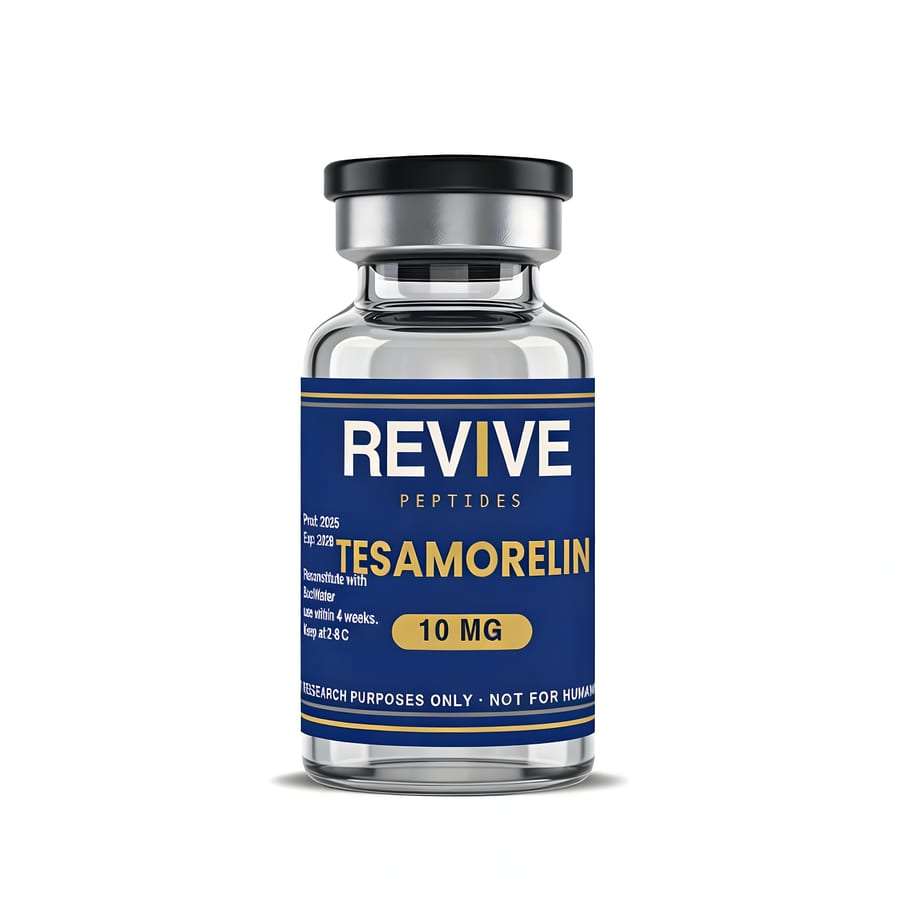
10 mg vials. Same-day delivery across Dubai (JBR, Marina, Business Bay, DIFC, Downtown). 24h to Abu Dhabi and Sharjah. Discreet packaging as standard.
Buy Tesamorelin UAE — Same-Day Dubai Dispatch from REVIVE LAB UAE
Reading the 2019 Paper Critically: What UAE Researchers Should Look For
Any serious researcher ordering the Stanley 2019 Lancet HIV paper should approach it with three analytical questions in mind. First: how does the VAT trajectory over the extended observation period compare to the shorter trial windows in Falutz 2007 and 2010? Specifically, does the rate of visceral fat change attenuate over time, remain stable, or actually steepen? The answer has direct implications for modelling steady-state versus dynamic-phase protocols.
Second: what is the rebound velocity? The 2010 NEJM data showed that VAT returns toward baseline after discontinuation, but a longer prior exposure window (as studied in 2019) may modify the rebound kinetics. If a longer treatment period is associated with a slower or less complete rebound, that suggests some degree of persistent pathway modification — a finding with significant mechanistic interest for researchers studying GHRH-axis plasticity.
Third: what does the safety and tolerability signal look like at extended duration? Short trials tend to capture early adverse event rates that may differ from those seen in longer exposures. The 2019 dataset provides the most meaningful long-term tolerability picture in the published tesamorelin literature, and researchers designing their own protocols should note the adverse event profile across the observation period rather than relying solely on the shorter-term data.
Researchers in Dubai and Abu Dhabi who are building their literature review around GHRH-analogue pharmacology should note that tesamorelin's mechanism — pituitary-level stimulation with intact feedback — makes it a cleaner research model than somatropin-class compounds for questions about endogenous GH-axis regulation. The Stanley 2019 paper is accordingly the most useful single reference for anyone studying GHRH-receptor-mediated effects over time, and it should be in every serious UAE researcher's reference folder on this compound.
Procurement in the UAE: How to Order Tesamorelin with Same-Day Dubai Delivery
For researchers based in the UAE, sourcing tesamorelin reliably and quickly is a practical requirement that too many suppliers handle poorly. REVIVE LAB UAE has built its fulfilment infrastructure around the reality that research timelines in the Gulf do not tolerate week-long waits and opaque shipping chains. The service standard is simple: tesamorelin orders placed before 4 PM on any business day go out the same day within Dubai, and reach Abu Dhabi and Sharjah within 24 hours.
Coverage extends across the city zones where UAE research activity concentrates: Business Bay, DIFC, Downtown Dubai, Dubai Marina, Jumeirah Beach Residence (JBR), the Palm Jumeirah cluster, and the medical district in Al Barsha. Abu Dhabi Corniche, Khalidiyah, and Reem Island are covered on the 24h window. The Palm Jebel Ali and Sharjah University City network also fall within reliable next-day reach.
Packaging is discreet as standard — plain exterior, no product identification visible — and cold-chain appropriate for lyophilised peptide vials. This matters for tesamorelin specifically: lyophilised vials are stable at ambient temperature for transit but should be refrigerated on arrival, and the pack format reflects that.
Payment Options
- Cash on delivery (Dubai): Pay on receipt within Dubai. No upfront transfer required.
- Binance Pay / USDT TRC20: 5% pre-pay discount applies. Manual confirmation via WhatsApp once transaction ID is submitted. Preferred by researchers who want to consolidate procurement costs across larger orders.
Both 5mg and 10mg vial sizes are available on the product page. The 5mg format suits shorter-duration pilot investigations or multi-compound protocols where tesamorelin is one of several variables being tested in parallel.
Placing Tesamorelin in a Broader GHRH-Axis Research Context
Tesamorelin does not exist in isolation as a research compound. Researchers in the UAE increasingly approach peptide protocols as multi-target investigations, and understanding where tesamorelin sits relative to related compounds is useful for protocol design. The critical distinction at the class level is between GHRH-receptor agonists (tesamorelin, CJC-1295 family), GHRP/ghrelin-axis secretagogues (ipamorelin, GHRP-2, GHRP-6), and direct GH replacement. These operate through different receptor populations and with different feedback characteristics.
For researchers whose primary interest is in the GHRH-receptor pathway specifically — as the Stanley 2019 paper characterises it — tesamorelin is the only compound with a four-paper Phase III evidence base in peer-reviewed high-impact journals. That evidence density is not matched by any other GHRH-analogue in the current research literature. When a UAE research team needs to justify their compound selection in a protocol rationale, the Falutz 2007 / Falutz 2010 / Stanley 2014 / Stanley 2019 chain is a coherent and defensible bibliography.
Researchers who are also investigating visceral fat modulation from complementary angles — for instance, combining GHRH-axis stimulation with compounds targeting inflammatory or fibrotic pathways in adipose tissue — will find that the endpoint definitions in the Stanley and Falutz trial series (particularly the VAT imaging methodology) provide a useful measurement template for research designs outside the HIV context.
FAQ
Can I order tesamorelin with same-day delivery in Dubai?
Yes. REVIVE LAB UAE dispatches tesamorelin orders placed before 4 PM on the same day within Dubai — covering JBR, Marina, Business Bay, Downtown, and DIFC among other zones. Next-day coverage extends to Abu Dhabi and Sharjah. tesamorelin 10 mg vials are held in stock and ship in discreet, cold-chain-appropriate packaging. Cash on delivery is available within Dubai.
What vial sizes does REVIVE LAB UAE stock for tesamorelin?
REVIVE LAB UAE currently stocks tesamorelin in 10 mg lyophilised vials. Both formats are listed at revivelab.ae/buy-tesamorelin-uae/. Payment options include cash on delivery in Dubai or Binance Pay (USDT TRC20) with a 5% pre-pay discount.
What did the Stanley et al. 2019 Lancet HIV study show about long-term tesamorelin use?
Stanley et al. 2019 (Lancet HIV) examined extended tesamorelin administration in the context of HIV-associated metabolic changes, reporting on longer-term visceral adipose tissue trajectories and metabolic marker stability beyond the windows of the earlier Falutz and Stanley 2014 trials. The paper is significant for researchers because it addresses durability of effect and the rebound question when the compound is withdrawn — key variables in any longitudinal research protocol design. This content is for research purposes only and does not constitute medical advice.
- Falutz J, Allas S, Blot K, et al. Metabolic effects of a growth hormone-releasing factor in patients with HIV. N Engl J Med. 2007;357(23):2359–2370.
- Falutz J, Mamputu JC, Potvin D, et al. Effects of tesamorelin (TH9507), a growth hormone-releasing factor analog, in HIV-infected patients with excess abdominal fat: a pooled analysis of two multicenter, double-blind placebo-controlled phase 3 trials with safety extension data. N Engl J Med. 2010;363(9):844–858. [Continuation trial]
- Stanley TL, Falutz J, Mamputu JC, et al. Effects of tesamorelin on non-alcoholic fatty liver disease in HIV: a randomised, double-blind, multicentre trial. JAMA. 2014;312(4):380–389.
- Stanley TL, et al. Long-term effects of tesamorelin on visceral fat and metabolic parameters in HIV-infected adults with excess abdominal fat. Lancet HIV. 2019.
Same-day delivery across Dubai. 24h to Abu Dhabi and Sharjah. Discreet packaging. Cash on delivery available. USDT accepted with 5% discount.
Order Tesamorelin UAE — REVIVE LAB UAE