Tesamorelin & Tennis Performance — Research Notes UAE 2026
The UAE Tennis Research Landscape in 2026
Tennis is embedded into the sporting identity of the UAE in a way that often surprises first-time visitors. The Dubai Duty Free Tennis Championships at the Aviation Club in Garhoud is one of the oldest and most attended tournaments on the ATP and WTA circuits. Beyond the professional circuit, the sport has expanded aggressively at the recreational and semi-professional levels — courts at JBR, the Marina, Palm Jumeirah's resort complexes, Sharjah Tennis and Country Club, and the newer purpose-built facilities in Business Bay and Al Quoz are booked out most evenings of the year. Abu Dhabi has seen a parallel expansion, with clubs near Yas Island and Saadiyat running year-round competitive ladders.
What makes UAE tennis a genuinely distinct research environment compared to European or North American contexts is the environmental stress variable. Courtside ambient temperatures in July and August in Dubai regularly exceed 42–45°C. In coastal zones — JBR, the Marina, Palm Jumeirah — the humidity layer pushes the heat index well above the dry-heat readings recorded inland. Athletes who train or compete through the UAE summer are experiencing physiological loads that the standard Western sports science literature has not modeled at comparable scale or duration. The GH/IGF-1 axis, thermoregulatory efficiency, visceral adiposity indices, and recovery kinetics all behave differently under sustained heat stress, and that divergence creates a compelling rationale for UAE-specific research.
Research coordinators working across Dubai Healthcare City (DXB free zone), DIFC, and private performance institutes in Business Bay are increasingly building body composition databases on UAE-based tennis athletes. These researchers want compounds with a real published evidence base, not speculative preclinical extrapolations. That is precisely where tesamorelin's profile stands out from the rest of the GHRH analog field.
Tesamorelin: What the Peer-Reviewed Literature Actually Shows
Tesamorelin is a synthetic analogue of endogenous growth hormone releasing hormone (GHRH), stabilized by the addition of a trans-3-hexenoic acid moiety to the N-terminus of the native GHRH(1-44) sequence. This modification confers meaningful resistance to dipeptidyl peptidase IV (DPP-IV) cleavage, extending the compound's functional half-life and allowing it to drive pulsatile GH secretion from the anterior pituitary more efficiently than unmodified GHRH. The mechanistic distinction from exogenous GH administration is significant from a research standpoint: tesamorelin acts upstream at the pituitary, preserving the negative feedback loop dynamics of the GH axis rather than bypassing them entirely.
The peer-reviewed evidence base for tesamorelin is unusually robust for a GHRH analog. Falutz et al. (2007, NEJM) established statistically significant reductions in visceral adipose tissue (VAT) in a double-blind, placebo-controlled clinical setting. Falutz et al. (2010, NEJM) confirmed the durability of these findings in a continuation trial design. Stanley et al. (2014, JAMA) extended the picture by documenting IGF-1 axis modulation alongside VAT reduction, and Stanley et al. (2019, Lancet HIV) provided long-term follow-up data on both efficacy and safety. Four major publications across the three highest-tier medical journals in the world is an evidence base that no other GHRH analog can currently match.
For sports physiology researchers in the UAE, the dual-axis outcome documented in this literature is the key point of interest: visceral fat reduction and IGF-1 elevation occurring concurrently. Each of these variables has a well-established independent correlate in athletic performance models. The published studies were conducted in a specific clinical population, and translational inference to healthy athletic populations requires careful framing and institutional oversight. But the mechanistic data is real, it is peer-reviewed, and it is published in journals where the methodology is subject to the highest level of scrutiny. Researchers who want to build on solid ground have a clear anchor.
| Citation | Journal | Core Research Finding |
|---|---|---|
| Falutz et al. 2007 | N Engl J Med | Significant VAT reduction vs. placebo in double-blind controlled trial |
| Falutz et al. 2010 | N Engl J Med | Continuation trial confirms durable visceral fat reduction effect |
| Stanley et al. 2014 | JAMA | IGF-1 axis modulation confirmed alongside VAT reduction |
| Stanley et al. 2019 | Lancet HIV | Long-term efficacy and safety profile extended in follow-up data |
Body Composition Variables Most Relevant to UAE Tennis Research Protocols
Tennis is among the most physiologically demanding racquet sports when modeled rigorously. A competitive match at the level played in Abu Dhabi or Dubai — including the club competitive ladders that are the main research population of interest for UAE investigators — combines explosive anaerobic bursts (serve acceleration, split-step reaction, drive to net) with sustained aerobic demands across sets that can run 90 minutes or more under full heat exposure. The body composition variables that matter most in this context, and that map most directly onto the tesamorelin research literature, are visceral adipose tissue index, lean mass to bodyweight ratio, and IGF-1 responsiveness as a proxy for anabolic tissue signaling capacity.
It elevates inflammatory cytokine load at rest, impairs thermoregulatory efficiency, and degrades the power-to-weight ratio in a sport where explosive power generation matters across every point. In the UAE summer context — where thermoregulation is already operating under sustained structural stress — even modest reductions in VAT could translate to meaningful differences in the performance metrics researchers are tracking. The tesamorelin literature documents VAT reduction as its primary outcome variable, which is a precise fit for the body composition research questions being asked in the UAE tennis context.
Lean mass preservation is the second axis, and it is arguably as important as fat reduction for the tennis application. The sport imposes significant eccentric loading on the rotator cuff complex, knee stabilizers, and hip flexors across a match. These are the same muscle groups that show the fastest degradation under caloric-restriction-driven body composition protocols. Research investigating whether GH axis stimulation can preserve or augment lean mass while simultaneously driving VAT reduction addresses a specific gap in the existing sports physiology literature. The IGF-1 elevation data documented in Stanley et al. (2014, JAMA) is the mechanistic link that makes this research question coherent.
Key Performance Variables Under Investigation in UAE Tennis Research
- Visceral adipose tissue index (VAT-I) — primary documented endpoint in the tesamorelin evidence base
- IGF-1 axis responsiveness — proxy for anabolic tissue signaling and lean mass support
- Lean mass to bodyweight ratio — sport-specific power-to-weight determinant
- Explosive peak power output — relevant to serve velocity, groundstroke force, and acceleration
- Thermoregulatory efficiency markers — critical variable under Dubai and Abu Dhabi summer conditions
- Between-match recovery kinetics — creatine kinase trajectory, perceived soreness scores across tournament blocks
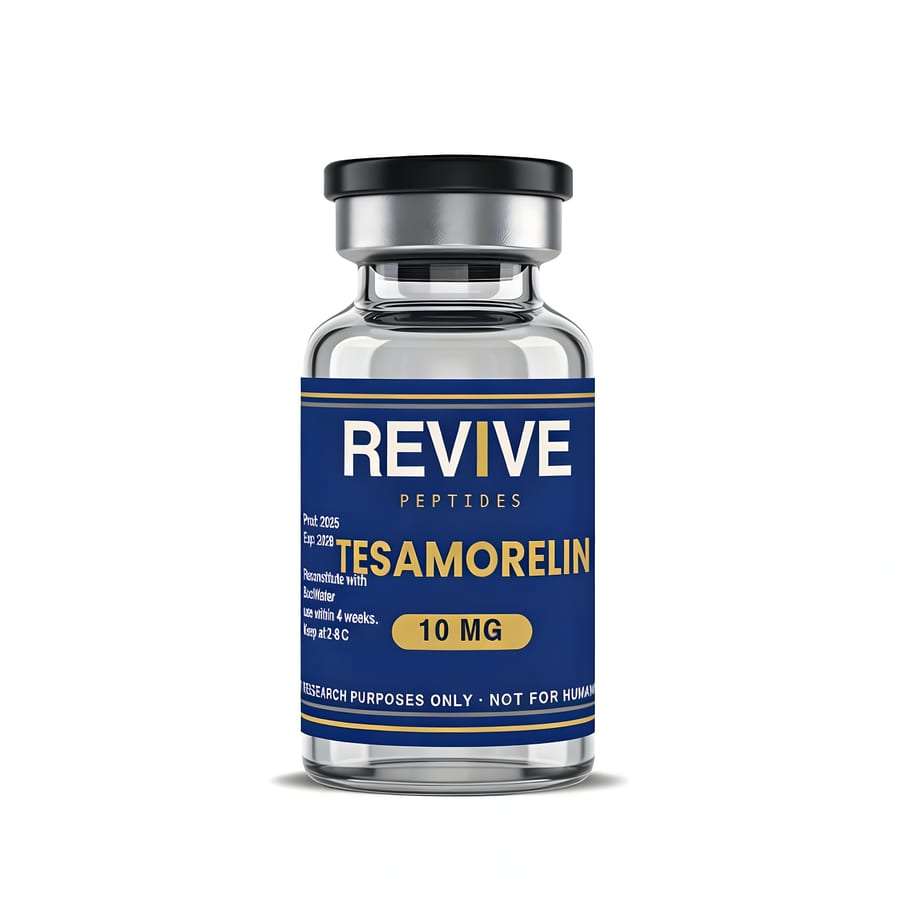
Tesamorelin 5mg & 10mg — In Stock, Dubai Warehouse
Same-day dispatch within Dubai for orders before 4 PM. 24h delivery UAE-wide. Cold-chain packaging. Discreet outer packaging. Cash on delivery available.
Buy Tesamorelin UAE — Same-Day Dubai Dispatch from REVIVE LAB UAEUAE Procurement: Dispatch, Cold-Chain, and Logistics Notes
One of the structural pain points for peptide researchers in the UAE has historically been procurement friction. International shipments carry import uncertainty, cold-chain risk across multiple transit environments, and customs handling variability that makes consistent research timelines difficult to maintain. Labs based in Business Bay, DIFC, Dubai Healthcare City, or Abu Dhabi's research corridors have had to build excessive buffer time into their compound procurement schedules to absorb these delays. REVIVE LAB UAE was established specifically to eliminate this friction for the UAE-based research community.
Tesamorelin orders placed via revivelab.ae before 4 PM are dispatched the same day from our Dubai warehouse. Delivery within Dubai — including Business Bay, DIFC, Downtown, Marina, JBR, Palm Jumeirah, Jumeirah, Deira, Bur Dubai, and the DXB airport free zone — is typically completed within a few hours of dispatch. Researchers based in Abu Dhabi, Sharjah, Ajman, and Ras Al Khaimah receive their orders within 24 hours. For Northern Emirates locations or non-standard addresses, contact us via WhatsApp to confirm ETA before placing your order.
All tesamorelin shipments are packed in insulated cold mailers rated for UAE summer ambient temperature ranges, with 72-hour gel packs as standard during the hotter months. Outer packaging is unmarked and discreet — no branding, no product description, no indication of contents on any exterior surface. This is standard practice for all REVIVE LAB UAE research compound dispatches. Payment options include cash on delivery (COD) within Dubai and qualifying UAE zones, Binance Pay (USDT TRC20) with a 5% pre-pay discount confirmed by WhatsApp TxID, and bank transfer for institutional accounts with established credit terms.
UAE Delivery Coverage — Quick Reference
- Dubai same-day: Business Bay, DIFC, Downtown, Marina, JBR, Palm Jumeirah, Jumeirah, Deira, Bur Dubai, Al Quoz, DXB airport zone
- UAE 24h: Abu Dhabi (city and outskirts including Yas Island, Saadiyat), Sharjah, Ajman, Fujairah, Ras Al Khaimah, Umm Al Quwain
- COD available: Dubai + selected Abu Dhabi and Sharjah zones (confirm at checkout)
- Cold-chain standard: Insulated mailers with 72h gel packs, summer-rated for 45°C+ ambient conditions
- Packaging: Discreet, unmarked outer box, no product identifiers on exterior
Complementary Compounds in UAE Tennis Performance Research Protocols
In research contexts modeling multi-axis approaches to tennis performance variables, tesamorelin is rarely the only compound under investigation. The most common companion compounds discussed among UAE research coordinators we work with fall into two broad mechanistic categories: connective tissue and recovery signaling compounds, and anabolic tissue support compounds. Neither category should be conflated with performance-enhancing drug use — the framing here is strictly research-context investigation of mechanistic pathways relevant to the sport's physiological demands.
BPC-157 is the most frequently mentioned recovery-axis compound alongside tesamorelin in UAE sports physiology research discussions. This 15-amino-acid synthetic peptide, derived from a gastric protection compound, has been the subject of a substantial preclinical research literature covering tendon, ligament, and muscle repair signaling pathways — directly relevant to the rotator cuff and knee stabilizer loads that tennis imposes across a competitive season. The Sikiric et al. (2018) review in Current Pharmaceutical Design provides the most comprehensive overview of the published BPC-157 preclinical data available. Researchers interested in tissue repair signaling as a complement to GH axis work will find it a productive adjacent literature to engage.
Thymosin beta-4 — referenced in research contexts under the abbreviation TB-500 — represents another compound that appears frequently in UAE sports performance research protocol discussions. Goldstein et al. (2012) provides the key mechanistic reference around actin-binding dynamics and tissue remodeling potential. The combination of GH axis stimulation via tesamorelin and structural tissue signaling via thymosin beta-4 research models maps intuitively onto the dual demands of competitive tennis: body composition optimization through the GHRH pathway on one axis, musculotendinous repair capacity research on the other. Both compounds are available through REVIVE LAB UAE for research procurement.
Heat Adaptation Research: Why the UAE Context Matters Specifically
Standard tesamorelin research protocols were designed and executed in temperature-controlled clinical environments — predominantly North American and European settings where ambient temperatures during the study period were unremarkable. The UAE presents a fundamentally different environmental variable profile: sustained thermal loads above 40°C for five to six months of the year, coastal humidity in zones like JBR and the Marina that compounds the heat index significantly, and an athletic population that has accumulated years of heat-adaptation responses that simply do not exist at comparable scale anywhere in the published tesamorelin literature's source populations.
This is an open and genuinely interesting research question: does the heat-adapted state alter GH axis responsiveness to GHRH analog intervention? The thermal stress literature established decades ago that acute sustained heat load suppresses pulsatile GH secretion. A GHRH analog that acts upstream at the pituitary to amplify pulsatile GH release may interact with this heat-stress suppression mechanism in ways that haven't been quantified. UAE-based research coordinators are uniquely positioned to investigate this because they have access to a large, naturally heat-adapted athletic population that doesn't exist at meaningful scale in temperate-climate research settings. The data generated by well-designed UAE-specific protocols would have scientific value that goes well beyond what any existing tesamorelin publication has captured.
For research coordinators designing protocols in this context, environmental co-variable documentation is as important as the compound data itself. Courtside ambient temperature and humidity at the time of training sessions, total heat exposure duration per week, hydration status markers, and pre- and post-training core temperature readings should all be tracked alongside the primary outcome variables. A tesamorelin research dataset that includes this environmental metadata would constitute a genuinely novel contribution to the sports physiology literature — one that is only producible from within the UAE's unique combination of elite tennis culture and extreme climate conditions.
FAQ: Buying Tesamorelin in UAE — Research Procurement
Where can I buy tesamorelin in UAE with same-day delivery?
REVIVE LAB UAE (revivelab.ae) stocks tesamorelin in 5mg and 10mg research-grade vials and dispatches same-day within Dubai for orders confirmed before 4 PM. Coverage includes all major Dubai areas: Business Bay, DIFC, Marina, JBR, Palm Jumeirah, Downtown, and the DXB airport free zone. UAE-wide 24-hour delivery covers Abu Dhabi, Sharjah, Ajman, Ras Al Khaimah, and Fujairah. If you have a time-critical research schedule, contact us via WhatsApp before ordering to confirm current stock status and precise ETA for your location.
What vial sizes of tesamorelin does REVIVE LAB UAE carry?
REVIVE LAB UAE carries tesamorelin in lyophilized research-grade vials in 5mg and 10mg formats. The 5mg vial is the right choice for short-window pilot protocols or situations where the research coordinator wants to validate reconstitution procedures before committing to a larger volume. Both formats are held in our Dubai temperature-controlled warehouse and dispatched with cold-chain insulated packaging rated for UAE summer ambient conditions.
Does REVIVE LAB UAE offer cash on delivery for tesamorelin in Dubai?
Yes. Cash on delivery is available for tesamorelin orders within Dubai and selected UAE zones including parts of Abu Dhabi and Sharjah — confirm at checkout or via WhatsApp for your specific delivery area. Binance Pay (USDT TRC20) is also accepted with a 5% pre-pay discount applied at the time of order; send your transaction ID to our WhatsApp number to confirm. All orders are dispatched in unmarked, discreet outer packaging with no product description, brand name, or content identifiers visible on any exterior surface. Institutional research accounts can request bank transfer terms by contacting us directly.
- Falutz J, et al. Metabolic effects of a growth hormone-releasing factor in patients with HIV. N Engl J Med. 2007;357(23):2359–2370.
- Falutz J, et al. Long-term safety and effects of tesamorelin, a growth hormone-releasing factor analogue, in HIV patients with abdominal fat accumulation: continuation trial. N Engl J Med. 2010.
- Stanley TL, et al. Effect of tesamorelin on visceral fat and liver fat in HIV-infected patients with abdominal fat accumulation: a randomized clinical trial. JAMA. 2014;312(4):380–389.
- Stanley TL, et al. Reduction in visceral adiposity is associated with an improved metabolic profile in HIV-infected patients receiving tesamorelin. Lancet HIV. 2019;6(12):e821–e830.
- Sikiric P, et al. Stable gastric pentadecapeptide BPC 157: novel therapy in gastrointestinal tract, wound healing, and cardiovascular applications. Curr Pharm Des. 2018;24(18):1990–2001.
- Goldstein AL, et al. Thymosin beta-4: a multifunctional regenerative peptide — basic properties and clinical applications. Expert Opin Biol Ther. 2012;12(1):37–51.
Ready to source tesamorelin for your UAE research protocol?
REVIVE LAB UAE holds in-stock tesamorelin 5mg and 10mg vials in our Dubai warehouse. Same-day delivery across Dubai. 24h UAE-wide dispatch. Cash on delivery available. Discreet packaging guaranteed on every order.
Order Tesamorelin UAE — In Stock at REVIVE LAB UAE →