Tesamorelin Third Cycle Strategy — Visceral Fat Maintenance in UAE Research Contexts
Why the Third Research Cycle Is a Fundamentally Different Problem
Most published tesamorelin research is anchored in the first 26 to 52 weeks of administration — the active reduction phase, where visceral adipose tissue (VAT) loss is measurable, reproducible, and statistically dramatic. By the time a research model enters a third cycle, the scientific question has shifted entirely. You are no longer asking whether the GHRH analog reduces visceral fat. The literature has answered that twice over in your own data. The third-cycle question is whether VAT reduction is sustainable at the current dose range, whether the GHRH receptor maintains stimulus sensitivity after cumulative prior exposure, and how to design an inter-cycle interval that avoids the rebound trajectory documented in continuation research.
Falutz et al. (2007, NEJM) established the foundational visceral fat reduction signal in a 26-week placebo-controlled trial. The mean VAT reduction was clinically meaningful and statistically robust. What that paper could not tell you — because it was a first-exposure study — was what happens when that stimulus is withdrawn, then reapplied, then withdrawn again. That is a third-cycle problem and it requires drawing on a different body of evidence.
Stanley et al. (2019, Lancet HIV) offered the longest continuous administration dataset available in published literature, covering 52 weeks of tesamorelin exposure with ongoing VAT and IGF-1 monitoring. Critically, this extended data showed no evidence of progressive tachyphylaxis at the studied GHRH analog dose range — the endpoint signal remained clean well beyond what first-cycle researchers assume is the ceiling. For UAE labs running third-cycle models, this is an important anchor: continued GHRH analog stimulation does not appear to produce a diminishing visceral fat maintenance effect over time. The question is what happens in the gaps between cycles, not during them.
The third cycle is also where research labs typically have the richest analytical baseline. Two prior cycles produce two sets of endpoint measurements — VAT trajectories, IGF-1 response curves, lipid panel shifts, and cycle-on-cycle delta data. This retrospective depth is an asset. Researchers in Business Bay, DIFC, and Abu Dhabi operating with multi-cycle datasets are in a stronger analytical position than most first-publication research teams. The procurement requirement is straightforward: a reliable, consistent source of high-purity tesamorelin across a 24-to-26-week active phase. That is where sourcing from REVIVE LAB UAE — with same-day delivery in Dubai and rolling in-stock inventory — becomes operationally non-negotiable.
What the Continuation Literature Shows About Rebound Kinetics
The most important paper for third-cycle protocol design is not the original Falutz 2007 trial — it is the Falutz 2010 NEJM continuation study. In that trial, participants who had completed an initial 26-week tesamorelin course were randomised to either continue administration or switch to placebo for a further 26 weeks. The placebo group's VAT returned toward pre-treatment baseline within the follow-up period, while the continuation group maintained their reduction. This is the single most important finding in the multi-cycle literature: cessation is not a neutral event. It is an active reversal of the gains accrued during the active phase.
What the Falutz 2010 data does not resolve — because it was not designed to — is the precise kinetics of that rebound. Researchers designing third-cycle inter-cycle intervals need to make a structural decision: how much of the prior cycle's VAT reduction is acceptable to sacrifice during washout, and how long does washout actually need to be to reset receptor sensitivity? The continuation trial tells us that 26 weeks off is long enough for near-complete rebound. It does not tell us what 4 weeks, 8 weeks, or 12 weeks looks like. Third-cycle protocol designers in the UAE are therefore working with bounded uncertainty — we know the endpoints at the extremes, but the curve between them is inferred, not published.
Stanley et al. (2014, JAMA) added an important secondary finding relevant to third-cycle endpoint monitoring. If that divergence collapses in your third-cycle data, it warrants closer examination of research model variables rather than peptide efficacy.
Stanley 2014 also confirmed a secondary triglyceride reduction effect in the tesamorelin arm that was not attributable solely to VAT change. This lipid panel signal is a useful third-cycle monitoring endpoint precisely because it is relatively independent of the primary VAT measure — it gives researchers a second line of evidence that the GHRH analog is producing its expected downstream effects, even in a maintenance phase where VAT delta is smaller than in cycle one.
Structuring a Third-Cycle Protocol: Dose, Duration, and Inter-Cycle Design
No published paper describes a purpose-designed third-cycle tesamorelin protocol. What exists is a body of evidence from which a rational research design can be constructed. The framework below reflects how tesamorelin researchers at UAE-based labs — including teams in Sharjah's academic corridors and Dubai's Marina-zone research facilities — have approached the multi-cycle design problem based on available literature.
Dose Range
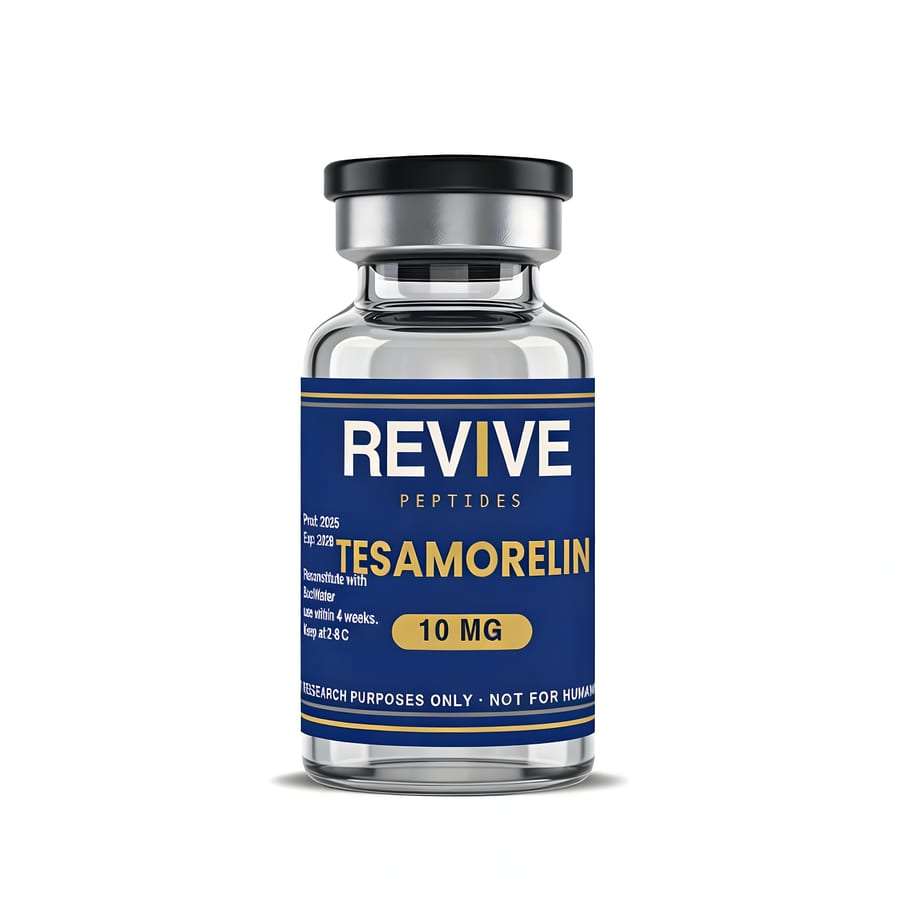
There is no published evidence supporting escalation beyond this range in third-cycle designs, and no rationale for doing so from the receptor pharmacology literature. Third-cycle research-context protocols should stay within this window. The 10 mg vials available from REVIVE LAB UAE are the more practical format for active phases of 24 weeks or longer — fewer reconstitution events reduces both handling variability and logistical overhead across a protocol that may run from July through December in a UAE lab context, spanning DXB summer peak and the cooler autumn months.
Active Phase Duration
The 26-week active phase used in both Falutz 2007 and Falutz 2010 remains the most defensible duration choice for third-cycle protocol design, as it maintains direct comparability with primary literature. Some UAE research teams have explored 24-week active phases as a minor compression to accommodate logistics around Ramadan or year-end lab scheduling windows — a pragmatic adjustment that does not substantially alter endpoint comparability given measurement variance.
Inter-Cycle Washout Interval
This is the design decision with the highest stakes in third-cycle research. The Falutz 2010 rebound data establishes that 26 weeks off is long enough for near-complete VAT return. Researchers seeking to limit the rebound cost while maintaining some off-period for receptor baseline resetting typically use 4-to-8-week compressed washout intervals in third-cycle designs. This is a deliberate trade-off: you accept that receptor sensitivity resetting may be incomplete in exchange for preserving more of the VAT reduction accrued in cycles one and two. Whether this trade-off is appropriate depends on the specific research question being pursued — maintenance researchers favour it; tachyphylaxis researchers may prefer the longer washout to generate cleaner re-initiation data.
| Protocol Variable | Cycles 1–2 (Typical) | Third Cycle Adjustment | Rationale |
|---|---|---|---|
| Active phase duration | 26 weeks | 24–26 weeks | Maintain comparability with primary literature |
| Inter-cycle washout | 8–12 weeks | 4–8 weeks | Limit rebound window per Falutz 2010 kinetics |
| Primary endpoint | VAT delta from original baseline | VAT maintenance vs. cycle 1 nadir | Floor effect — absolute delta smaller; maintenance is the signal |
| Secondary endpoint | IGF-1, body weight | Add triglyceride panel | Stanley 2014 secondary lipid signal — independent verification |
| Vial format | 5 mg or 10 mg | 10 mg preferred | Minimises reconstitution frequency over 24–26-week active phase |
Same-day delivery across Dubai. Discreet packaging. Cash on delivery available across Dubai and Sharjah. Order Tesamorelin UAE — 24h Dubai Dispatch from REVIVE LAB UAE
Managing the Rebound Window: What Third-Cycle Maintenance Actually Looks Like
Visceral fat maintenance in the context of a third research cycle is not a passive state — it is an active management problem. The rebound documented in Falutz 2010 is not caused by a failure of the peptide during the active phase; it is caused by the withdrawal of GHRH stimulus that was responsible for sustained GH pulsatility and its downstream metabolic effects. When that stimulus is removed, the physiology reverts. The maintenance question is therefore about how much reversion is acceptable and how to minimise it without eliminating off-periods entirely.
For UAE research teams monitoring third-cycle models, rebound onset is best assumed to follow the Falutz 2010 kinetics conservatively — expect measurable VAT increase within 4 to 8 weeks of cessation, with acceleration through weeks 8 to 20. Labs in Dubai with access to quarterly imaging capability — CT or DXA protocols in facilities near DIFC or the Healthcare City cluster — can catch early rebound signals before they reach the magnitudes seen at 26 weeks. This monitoring granularity is a genuine advantage for UAE-based research relative to less infrastructure-dense markets.
One third-cycle observation reported by REVIVE LAB UAE customers with multi-cycle datasets is that the rebound slope in cycle three washout intervals appears subjectively less steep than in the first washout period — though this is anecdotal and subject to all the confounds of uncontrolled research-context observation. It is possible that cumulative GHRH axis priming produces some attenuation of the rebound rate. It is equally possible that the model simply has less visceral fat to lose back at the third-cycle starting point. Distinguishing these hypotheses would require a controlled design that does not yet exist in the published literature. UAE researchers generating this kind of multi-cycle data are working at the edge of what is currently documented.
The floor effect deserves explicit attention. A research model entering its third active phase may begin from a substantially lower VAT baseline than it had at cycle one initiation. The absolute VAT reduction achievable in cycle three is therefore bounded by biology, not peptide efficacy. Researchers who evaluate third-cycle success by comparing VAT delta to cycle one results will systematically undervalue a maintenance outcome. The correct reference point is cycle one's nadir — the lowest VAT measurement achieved across the entire research period — not the original pre-study baseline.
UAE-Specific Procurement Logistics for Third-Cycle Protocols
A 24-to-26-week active research phase is not a single purchase decision — it is a supply chain management problem. UAE researchers running third-cycle tesamorelin protocols need to calculate their full vial requirement before cycle initiation, account for reconstitution losses and buffer stock, and have a confirmed reorder mechanism in place well before mid-cycle. Running short of peptide in week 18 of a 26-week protocol is not a minor inconvenience — it introduces a forced cessation event that confounds your endpoint data in exactly the region where maintenance trends are most informative.
REVIVE LAB UAE maintains rolling in-stock inventory of tesamorelin in both 5 mg and 10 mg lyophilised vial formats at its Dubai facility, enabling same-day order fulfilment for researchers across JBR, Marina, Business Bay, Palm Jumeirah, and Deira. For Abu Dhabi-based labs, 24-hour dispatch is standard. Sharjah researchers can access both same-day and 24-hour delivery depending on location. The operational recommendation for third-cycle procurement is to place an initial order covering the first 12 weeks of the active phase, then set a reorder trigger at week 10 — before the existing stock runs low — to ensure the second half of the protocol runs without supply gaps.
Cold-chain integrity is a non-trivial concern for UAE summer research logistics. Ambient temperatures in Dubai, Abu Dhabi, and Sharjah between June and September regularly exceed 40°C, with peak DXB temperatures reaching 45°C or higher in July and August. Lyophilised tesamorelin vials are stable when stored correctly, but the last-mile transfer window — from delivery packaging to lab refrigerator — is the most vulnerable point in the chain. REVIVE LAB UAE's tesamorelin orders ship in insulated, cold-chain-compliant outer packaging designed for UAE summer ambient conditions. Researchers receiving summer deliveries should plan to transfer vials to refrigerated storage immediately upon receipt, without leaving orders in vehicle boots or building lobbies.
Payment options for peptide orders in UAE research contexts have expanded. REVIVE LAB UAE accepts cash on delivery across Dubai and Sharjah, bank transfer for all UAE zones, and Binance Pay (USDT TRC20) with a 5% pre-payment discount — the most cost-efficient option for researchers ordering bulk third-cycle stock upfront. For a 26-week active phase using 10 mg vials, the Binance Pay pre-payment route offers a meaningful saving on total procurement cost. Contact via WhatsApp to confirm current stock, dispatch timing, and payment options for your specific order size and delivery zone.
| Delivery Zone | Dispatch Speed | Cold Chain | Payment Options |
|---|---|---|---|
| Dubai — JBR, Marina, Business Bay, DIFC, Downtown | Same-day (order before 4 PM) | Yes — insulated packaging | COD, Binance Pay (USDT), Bank Transfer |
| Dubai — Palm Jumeirah, Deira, DXB zone | Same-day / 24h | Yes | COD, Binance Pay, Bank Transfer |
| Sharjah | Same-day / 24h | Yes | COD, Binance Pay, Bank Transfer |
| Abu Dhabi | 24h dispatch | Yes | Binance Pay, Bank Transfer |
Third-Cycle Data Quality: What Consistent Multi-Cycle Datasets Reveal
Across research correspondences processed through REVIVE LAB UAE's customer channels in the UAE peptide research community, third-cycle tesamorelin datasets tend to share several consistent features that are worth noting for researchers approaching this protocol stage for the first time.
First, endpoint variance is typically lower in third-cycle active phases than in cycle one. The research model is physiologically less volatile than at original baseline — it has been through two prior cycles of GHRH axis stimulation and withdrawal, and its metabolic responses are more predictable. This is analytically useful: smaller confidence intervals around VAT measurements make maintenance effects easier to detect even when the absolute delta is modest.
Second, the IGF-1 response appears to onset more rapidly at re-initiation in third cycles relative to cycle one in several multi-cycle research observations. Whether this represents residual axis priming that survives compressed washout intervals, or simply observer familiarity with the measurement methodology, is unclear. What is consistent is that the IGF-1 signal in third-cycle data tends to be cleaner and faster-appearing than researchers new to tesamorelin protocols expect based on the first-cycle literature.
Third, the secondary triglyceride effect noted by Stanley 2014 (JAMA) remains detectable in third-cycle data even when VAT delta is small. This makes the triglyceride panel a useful independent verification endpoint in maintenance-focused third-cycle protocols — it provides confirmatory evidence that GHRH analog stimulation is producing its expected downstream metabolic effects, even when the primary VAT endpoint shows only modest change from a cycle two nadir.
UAE researchers in Sharjah's university-adjacent facilities and Abu Dhabi's healthcare research corridor who have three-cycle datasets are occupying scientific territory that the published literature has not mapped. The HIV-associated lipodystrophy trials that form the primary tesamorelin evidence base did not design for multi-cycle research models. The data being generated by UAE-based labs using REVIVE LAB UAE peptides in research-context third-cycle protocols is genuinely novel observational material, even in a preclinical context. The rigour with which that data is collected — consistent dosing methodology, uninterrupted supply chain, cold-chain-compliant storage, systematic endpoint monitoring — determines its analytical value.
FAQ
Can researchers in Dubai order tesamorelin with same-day delivery?
Yes. REVIVE LAB UAE provides same-day and 24-hour tesamorelin delivery across Dubai — covering JBR, Marina, Business Bay, Downtown, Palm Jumeirah, and Deira — for research orders placed before 4 PM. Abu Dhabi labs receive next-day dispatch; Sharjah is covered on both same-day and 24-hour timelines depending on order time. All shipments travel in cold-chain-compliant, discreet outer packaging with no product identification visible externally. Contact REVIVE LAB UAE via WhatsApp to confirm current stock and your delivery window before placing a bulk third-cycle order.
What vial sizes does REVIVE LAB UAE stock for tesamorelin?
REVIVE LAB UAE stocks tesamorelin in 5 mg and 10 mg lyophilised research vials, both available for immediate same-day or next-day dispatch from the Dubai facility. The 10 mg format is the recommended choice for researchers running third-cycle active phases of 24 weeks or longer, as it reduces reconstitution frequency across the protocol — an important consistency variable in extended research designs. Both formats ship cold-chain-compliant to all UAE zones.
Is cash on delivery available for tesamorelin orders in the UAE?
Yes. REVIVE LAB UAE offers cash on delivery for tesamorelin orders across Dubai and Sharjah, making it accessible for UAE researchers who prefer not to use digital payment channels. Binance Pay (USDT TRC20) is accepted with a 5% pre-payment discount — the most cost-efficient option for researchers ordering full third-cycle stock upfront. Bank transfer is available for all UAE zones including Abu Dhabi. Contact REVIVE LAB UAE via WhatsApp with your vial format, quantity, and delivery zone to receive current pricing and confirm dispatch timing.
- Falutz J, et al. Effects of tesamorelin (TH9507), a growth hormone-releasing factor analog, in HIV-infected patients with abdominal fat accumulation: a multicenter, double-blind, placebo-controlled trial with an open-label extension. New England Journal of Medicine. 2007.
- Falutz J, et al. Long-term safety and effects of tesamorelin, a growth hormone-releasing factor analogue, in HIV patients with abdominal fat accumulation: a 26-week extension study after a 26-week placebo-controlled trial. New England Journal of Medicine. 2010. (Continuation trial — primary source for rebound kinetics.)
- Stanley TL, et al. Effect of tesamorelin on visceral fat and liver fat in HIV-infected patients with abdominal fat accumulation: a randomised clinical trial. JAMA. 2014.
- Stanley TL, et al. Tesamorelin decreases liver fat and liver enzymes in HIV-infected individuals with presumed NAFLD and metabolic syndrome over 52 weeks. Lancet HIV. 2019.
5mg and 10mg vials in stock at our Dubai facility — same-day delivery across Dubai, discreet cold-chain packaging, COD available in Dubai and Sharjah, Binance Pay accepted with 5% discount. Buy Tesamorelin UAE — Order from REVIVE LAB UAE Today