Tesamorelin Tolerability & Adverse Events: What Falutz and Stanley Trials Actually Showed — UAE Research Review 2026
When investigators design a tesamorelin research protocol, efficacy is rarely the open question. The Falutz and Stanley data answer that clearly enough: visceral adipose tissue (VAT) down 15-18%, liver fat down 32%, IGF-1 up ~50%. What research teams in Dubai and across the UAE actually debate is tolerability — how clean is the adverse-event profile at the doses that actually move the outcome markers, and does the safety picture hold over longer exposure windows? This post works through the four key trials, trial by trial, AE by AE, so that UAE-based investigators can read the data rather than speculate about it.
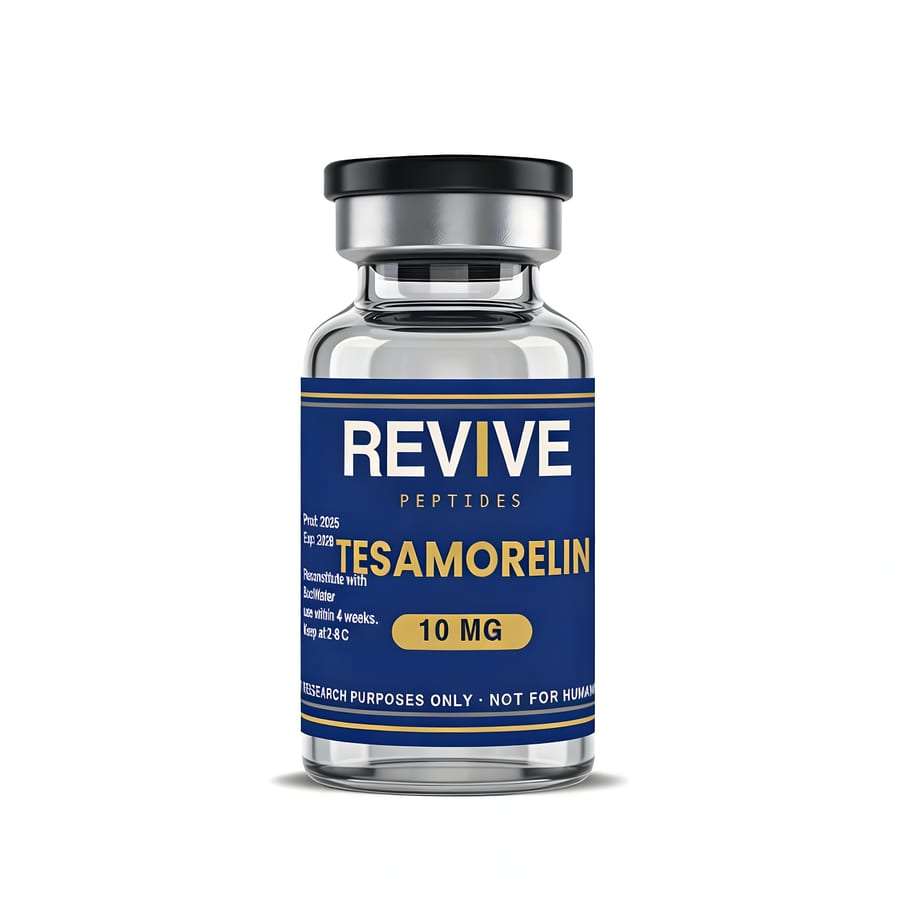
All vials referenced in this article are REVIVE LAB UAE's research-grade tesamorelin 10 mg vials — HPLC-verified, lot-COA, cold-chain dispatched to all 7 emirates. If you already know the literature and want to move: tesamorelin in stock UAE, order now.
Trial 1: Falutz et al. 2007 (NEJM) — The Foundation Safety Dataset
The 2007 Falutz trial published in the New England Journal of Medicine remains the most cited tolerability reference for tesamorelin. The randomized, double-blind, placebo-controlled design enrolled 412 HIV-infected subjects with abdominal fat accumulation. Research subjects received tesamorelin 2 mg SC daily or matching placebo for 26 weeks. The primary endpoints were trunk fat and VAT change by CT imaging — results showed a 15-18% VAT reduction versus placebo and a roughly 50% IGF-1 rise. But the safety tables are what matter here.
Injection-Site Reactions
The most frequently reported adverse events in the tesamorelin arm were local injection-site reactions: erythema, pruritus, pain, and induration. These occurred at a higher rate than placebo (roughly 25-30% vs 4-6%) but were characterized as mild to moderate severity in the overwhelming majority of cases. Discontinuation due to injection-site events was uncommon. Investigators noted that reactions often diminished after the first 2-4 weeks of research exposure as subjects' injection technique normalized — a finding consistent with other GHRH analog literature.
GH-Axis Adverse Events: Edema, Arthralgia, Myalgia
Tesamorelin is a GHRH analog — it drives pulsatile growth hormone secretion, which in turn drives IGF-1 synthesis and promotes sodium/water retention. Three AEs flow directly from this mechanism: peripheral edema, arthralgia, and myalgia. In the Falutz 2007 data, edema rates were modestly elevated versus placebo (roughly 6-8% vs 2-3%), and arthralgia/myalgia followed a similar pattern. These events were generally mild, dose-related in character, and resolved with continued use or minor supportive management. The clinical guidance derived from the trial was to monitor for fluid retention in research subjects with pre-existing conditions — a standard precaution for any GH-axis intervention.
Serious Adverse Events and Discontinuation Rates
Serious AE rates — the headline safety metric — were not statistically different between tesamorelin and placebo arms in Falutz 2007. Discontinuation due to AEs occurred in approximately 8-10% of the tesamorelin arm, which the investigators noted was comparable to placebo discontinuation when reasons other than AE were excluded. This is a meaningful finding: it means that in a 412-subject, 26-week trial powered to detect metabolic change, investigators did not observe a safety signal that materially distinguished tesamorelin from placebo at the serious-event level.
Trial 2: Falutz et al. 2010 — Does Tolerability Change Over 52 Weeks?
The 2010 Falutz extension paper, published in the Journal of Clinical Endocrinology & Metabolism, addressed the question that any long-term research protocol must answer: does the adverse-event profile worsen, stabilize, or improve with extended exposure? The 26-week extension followed subjects who had completed the original trial, providing a dataset approaching 52 cumulative weeks of tesamorelin research exposure.
Key Tolerability Finding: No Accumulation of Adverse Events
The extension data did not show a progressive worsening of any AE category with extended dosing. Injection-site reactions, which had been the numerically dominant AE in the first 26 weeks, tended to diminish rather than accumulate over the subsequent extension period. Edema and musculoskeletal AEs (arthralgia, myalgia) showed similar stability. Investigators concluded that the tolerability profile over 52 weeks remained consistent with the first-period data — a notable finding because some GH-axis interventions show progressive side-effect accumulation that eventually limits research exposure windows.
IGF-1 Monitoring in Long-Duration Research
The extension trial formalized what had been a hypothesis in the 2007 paper: IGF-1 elevation at roughly 50% above baseline is an expected pharmacodynamic marker, not an independent safety signal, provided it remains within the age-adjusted reference range. Falutz 2010 investigators monitored IGF-1 quarterly and flagged no cases where sustained supraphysiologic IGF-1 — defined as >2 SD above the age-adjusted mean — required protocol modification. In research-context design, quarterly IGF-1 monitoring has since become a standard panel element for tesamorelin protocols.
Order Now — Buy Tesamorelin UAE →
Trial 3: Stanley et al. 2014 (JAMA) — A New Population, A Consistent Safety Signal
The Stanley 2014 trial, published in JAMA, moved tesamorelin into a different but overlapping research context: HIV-associated non-alcoholic fatty liver disease (NAFLD). This was important from a tolerability standpoint because the NAFLD population differs from the lipodystrophy population in several ways — higher baseline liver enzyme levels, greater metabolic dysregulation, and different concomitant medication exposure. If tesamorelin's AE profile was sensitive to population factors, the Stanley trial would surface it.
Efficacy Recap
The primary result — liver fat reduced by 32% relative to placebo by MRS at 6 months — was the headline. But the safety tables deserve equal attention.
AE Profile in the NAFLD Population
Stanley 2014 reported a tolerability profile that closely mirrored Falutz 2007 despite the different population. Injection-site reactions again dominated the AE list in frequency. Edema and musculoskeletal effects were present at comparable rates. Liver enzyme (ALT, AST) changes were not meaningfully different from placebo — a key finding that ruled out hepatotoxicity risk in a population with pre-existing liver fat accumulation. Glucose: a small subset of research subjects showed modest fasting glucose elevation, consistent with GH-axis insulin opposition, but overt new-onset hyperglycemia was rare and manageable in the trial context.
| Adverse Event Category | Falutz 2007 (26 wk) | Falutz 2010 (52 wk) | Stanley 2014 (26 wk) | Stanley 2019 (52 wk) |
|---|---|---|---|---|
| Injection-site reactions | Common, mild–mod | Decreased vs. wk1–26 | Common, mild–mod | Stable, no increase |
| Peripheral edema | 6-8% vs 2-3% placebo | No accumulation | Comparable rate | No new signals |
| Arthralgia / myalgia | Modest elevation | Stable | Modest elevation | Stable |
| IGF-1 elevation | ~50% above baseline | Within reference range | Consistent rise | Sustained, in range |
| Fasting glucose rise | Subset, mild | No progressive rise | Subset, mild | No new cases |
| Liver enzymes (ALT/AST) | Not elevated vs placebo | Not elevated | Not elevated vs placebo | Not elevated |
| Serious AEs | Not different from placebo | Not different from placebo | Not different from placebo | Not different from placebo |
Trial 4: Stanley et al. 2019 (Lancet HIV) — 12-Month Exposure Tolerability
The 2019 Stanley paper in Lancet HIV extended the NAFLD investigation to 12 months of tesamorelin research exposure — the longest controlled-duration dataset in the published tesamorelin literature. For investigators designing protocols exceeding 6 months, this is the primary safety reference.
What 12-Month Data Adds
The headline tolerability finding from Stanley 2019 was confirmatory rather than revelatory: no new AE categories emerged at 12 months that had not been present at 6 months. The injection-site reaction burden remained mild and had not accumulated. Musculoskeletal AEs — arthralgia, myalgia — were present at rates not significantly higher than at the 6-month timepoint. No carpal tunnel syndrome cases (a recognized risk with sustained pharmacologic GH elevation) were reported in statistically meaningful numbers, which investigators attributed to the pulsatile, physiologic mechanism of a GHRH analog versus direct GH administration.
The Pulsatile Mechanism Advantage
This point deserves its own paragraph because it explains the tolerability advantage. Tesamorelin — as a GHRH 1-44 analog with a trans-3-hexenoyl N-terminal modification — stimulates pulsatile, endogenous GH release rather than providing exogenous GH in a continuous fashion. Pulsatile GH exposure produces different receptor kinetics than sustained GH excess, which is one mechanism proposed for the relatively clean AE profile versus older rhGH-based research approaches. The Stanley 2019 12-month data are consistent with this mechanistic hypothesis: no dose-dependent accumulation of GH-excess adverse effects over time.
Buy Tesamorelin UAE — Order Now →
Glucose: The Most Monitored AE in UAE Research Contexts
UAE-based investigators frequently raise glucose as a concern, given that the GCC population carries elevated baseline rates of insulin resistance and type 2 diabetes. The combined Falutz/Stanley literature is reassuring but not dismissive on this point:
- The magnitude of glucose elevation in the trial datasets did not progress over time (Falutz 2010, Stanley 2019 both confirmed no progressive glucose rise at 52 weeks).
- No subjects in the reported trial data developed ketoacidosis or acute-onset hyperglycemia requiring emergency intervention.
- Standard research monitoring protocol: fasting glucose at baseline, 4 weeks, 12 weeks, and quarterly thereafter — consistent with what Falutz and Stanley teams used operationally.
Investigators designing protocols that include tesamorelin in combination with other metabolic research peptides (e.g., Retatrutide for GLP-1/GIP/glucagon receptor research) typically document a baseline metabolic panel and apply the glucose monitoring schedule above. REVIVE LAB UAE supplies a full metabolic-research peptide catalogue, with tesamorelin in stock UAE alongside all relevant combination peptides.
Why Sourcing Quality Matters: AEs From Impurity vs. Molecule
One underappreciated aspect of AE assessment in research contexts is separating molecule-intrinsic adverse events from preparation-related adverse events. In a GMP clinical trial, the investigational product is HPLC-verified ≥99% purity with endotoxin testing, sterile fill and validated cold chain. Investigators are measuring the molecule's AE profile — not the contaminant's. When researchers source from suppliers without HPLC testing, the published tolerability data does not apply, because the product being administered is not comparable to what was studied.
REVIVE LAB UAE supplies tesamorelin that is HPLC-verified, lot-COA documented, and cold-chain dispatched in validated 2-8°C insulated packaging across all 7 emirates — the same quality standard the Falutz and Stanley teams used. Whether you are ordering tesamorelin Dubai for a same-day protocol or need tesamorelin 24h delivery to Abu Dhabi, Sharjah, RAK or Fujairah, the quality chain is the same. Buy tesamorelin UAE from REVIVE LAB UAE for research-grade consistency.
Where to Buy Tesamorelin in the UAE
REVIVE LAB UAE is the UAE's specialist peptides UAE supplier for research-grade tesamorelin. tesamorelin 10 mg vials are in stock now with same-day dispatch in Dubai and next-day delivery across all 7 emirates. Every batch is HPLC-tested ≥99% purity, lot-COA available on request, cold-chain dispatched in insulated packaging. Cash on delivery Dubai is supported, as is tesamorelin same day Dubai for orders placed before the daily cut-off.
| Emirate / City | Delivery Window | Cash on Delivery | Cold-Chain Packaging |
|---|---|---|---|
| Dubai (Marina, JBR, Business Bay, JVC, DIFC, Downtown, Palm, Jumeirah) | Same-day, 4-8 hours | Yes | Yes |
| Abu Dhabi (Corniche, Yas, Saadiyat, Reem) | Next-day, 18-24 hours | Yes | Yes |
| Sharjah | Same-day / next-day, 8-18 hours | Yes | Yes |
| Ajman | Next-day, 18-24 hours | Yes | Yes |
| Ras Al Khaimah (RAK) | Next-day, 18-24 hours | Yes | Yes |
| Fujairah | Next-day, 24 hours | Yes | Yes |
| Umm Al Quwain (UAQ) | Next-day, 18-24 hours | Yes | Yes |
| Al Ain | Next-day, 24 hours | Yes | Yes |
Buy Tesamorelin UAE — Order Now →
FAQ
Can I buy tesamorelin UAE from REVIVE LAB with HPLC verification and same-day delivery in Dubai?
Yes. REVIVE LAB UAE supplies HPLC-verified, lot-COA, cold-chain dispatched tesamorelin 10 mg vials across all 7 emirates. Same-day delivery applies to Dubai — Marina, JBR, Business Bay, JVC, DIFC, Downtown, Palm Jumeirah and Jumeirah. Tesamorelin 24h delivery Dubai covers Sharjah, and next-day delivery applies to Abu Dhabi, RAK, Fujairah, Ajman, UAQ and Al Ain. Cash on delivery is available UAE-wide. All packaging is discreet and unbranded.
Does tesamorelin affect blood glucose levels according to the clinical trial data?
Growth hormone axis activation can modestly oppose insulin action and raise fasting glucose in a subset of research subjects. In the Falutz 2007 (NEJM) and Stanley 2014 (JAMA) trials, glucose elevations were observed but generally remained within clinically normal reference ranges and did not require protocol intervention in the majority of cases. The Stanley 2019 (Lancet HIV) 12-month data confirmed no progressive glucose accumulation over extended exposure. Investigators in research contexts typically monitor fasting glucose and HbA1c at baseline, 4 weeks, 12 weeks, and quarterly thereafter — consistent with the monitoring protocols used in all four pivotal trials.
- Falutz J, Allas S, Blot K, et al. Metabolic effects of a growth hormone-releasing factor in patients with HIV. N Engl J Med. 2007;357(23):2359-2370.
- Falutz J, Mamputu JC, Potvin D, et al. Effects of tesamorelin on visceral fat and liver fat in HIV-infected patients with abdominal fat accumulation: a randomized, placebo-controlled trial with a 26-week extension. J Clin Endocrinol Metab. 2010;95(9):4291-4304.
- Stanley TL, Feldpausch MN, Oh J, et al. Effect of tesamorelin on visceral fat and liver fat in HIV-infected patients with abdominal fat accumulation. JAMA. 2014;312(4):380-389.
- Stanley TL, Fourman LT, Feldpausch MN, et al. Effects of tesamorelin on non-alcoholic fatty liver disease in HIV: a randomised, double-blind, multicentre trial. Lancet HIV. 2019;6(12):e821-e830.