Tesamorelin VAT Tracking Protocol: DEXA, MRI & Waist Tape Methodology for UAE Researchers (2026)
2007). But the effect is only as credible as the measurement behind it. Researchers who run a tesamorelin protocol without a standardised VAT-tracking methodology end up with anecdotal observations rather than reproducible data. Waist tape alone is not enough. DEXA alone misses compartment-specific detail. MRI gives the gold-standard answer but requires scheduling and cost trade-offs. Understanding when to use which tool — and how often — is what separates a rigorous tesamorelin investigation from a guess.
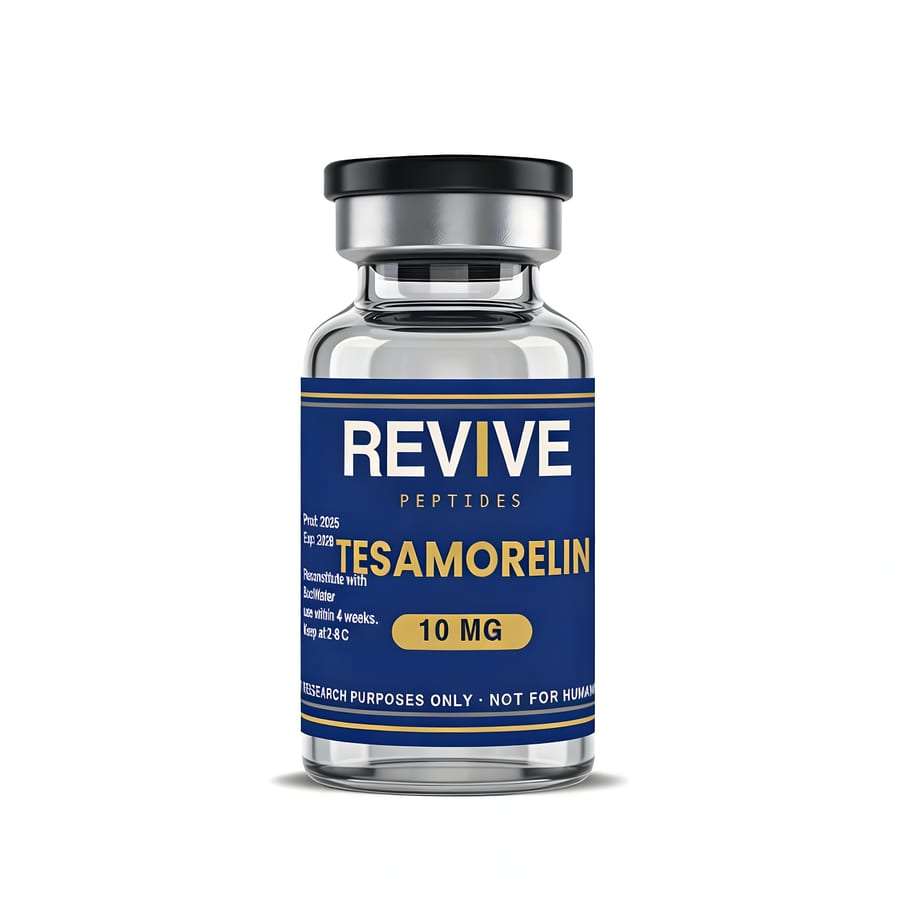
This guide is for investigators, research leads and advanced practitioners in the UAE who want to buy tesamorelin UAE and run it with the same methodological rigour the Falutz and Stanley teams applied in their landmark trials. REVIVE LAB UAE supplies HPLC-verified, lot-COA, cold-chain dispatched tesamorelin across all 7 emirates — the starting point for any protocol is a verified vial, not a gray-market powder.
Why VAT Is the Right Endpoint — and What Tesamorelin Does to It
VAT sits between the organs in the mesenteric and omental depots, is metabolically active, secretes inflammatory adipokines, and correlates far more strongly with insulin resistance, hepatic steatosis and cardiovascular risk than total body fat or BMI. This is why the Falutz team designed their 412-subject NEJM trial around VAT cross-sectional area at the L4-L5 vertebral level as the primary endpoint — not body weight, not BMI, not total adiposity.
Tesamorelin acts as a GHRH analog: it binds pituitary GHRH receptors, amplifies the natural pulsatile release of growth hormone, and thereby raises IGF-1 (by approximately 50% in the Falutz 2007 cohort). That selectivity is the molecule's signature. In the 26-week Falutz extension (2010), the VAT reduction was sustained and reversed on discontinuation, confirming the mechanism rather than a confounding variable. Stanley's 2014 JAMA paper and the 2019 Lancet HIV extension added the hepatic dimension: liver fat dropped 32% versus placebo at 12 months, consistent with the reduction in visceral-depot free fatty acid flux to the portal circulation.
None of that matters to the researcher unless the measurement is done correctly. Below is the methodology, stratified by modality.
Three Measurement Modalities: What Each One Tells You
MRI — The Gold Standard the Trials Used
The Falutz 2007 and 2010 protocols used CT at the L4-L5 intervertebral disc level to produce a cross-sectional area (cm²) of the visceral fat compartment. MRI is the modern equivalent: same anatomical landmark, zero ionising radiation, comparable precision for soft-tissue fat quantification. In the UAE, 1.5T and 3T MRI units are available at major centres including Cleveland Clinic Abu Dhabi, Mediclinic City Hospital Dubai, American Hospital Dubai, and King's College Hospital Dubai. A single axial slice at L4-L5 takes under 10 minutes within a standard abdominal MRI protocol.
The Falutz 2007 baseline mean was approximately 175-190 cm² in the treatment arm; the 26-week reduction was roughly 27-30 cm² absolute. Those are the numbers a well-run UAE protocol should be able to reproduce directionally if dosing and duration are matched.
DEXA — The Practical UAE Field Alternative
Dual-energy X-ray absorptiometry (DEXA) separates lean mass, bone mineral density, and fat mass by compartment. Modern whole-body DEXA software (GE Lunar, Hologic Horizon) includes an android-region visceral fat estimate (VAT mass in grams or VAT area in cm²) derived from trunk fat algorithms.
The practical case for DEXA in UAE research is strong: it takes 8-12 minutes, costs a fraction of MRI, delivers whole-body composition data in the same scan (useful for tracking lean mass, which GH stimulation also affects), and is available at nearly every sports medicine and endocrinology clinic in Dubai and Abu Dhabi. Scanners available in the UAE market include facilities at several Mediclinic sites, Aster Hospitals, Emirates Hospital and specialist body-composition clinics across DIFC, Business Bay and Al Wasl. Investigators should use the same machine for every scan in a given protocol — machine-to-machine variation in DEXA VAT estimates is larger than within-machine longitudinal variation.
Waist Tape — The Weekly Proxy
The Falutz 2007 trial reported waist circumference as a secondary endpoint; the treatment arm showed a reduction of approximately 2-3 cm over 26 weeks versus placebo. The Stanley 2014 JAMA paper similarly tracked waist circumference as a secondary surrogate for the hepatic-NAFLD primary endpoint.
For a tesamorelin research protocol, waist tape is best used as a weekly monitoring proxy between the formal imaging timepoints — not as the primary endpoint. Methodology matters: measure at the midpoint between the iliac crest and the lowest rib (WHO landmark), not at the navel (umbilicus), which produces systematically different readings. Use a non-stretch fibreglass tape, measure at end-tidal exhalation, and always at the same time of day (morning, fasted). A consistent 0.5-1 cm monthly reduction is consistent with the imaging-confirmed VAT changes from the trial literature.
Buy Tesamorelin UAE →
Measurement Frequency: What the Trials Did and What Works in Practice
The Falutz 2007 trial measured VAT (CT) at baseline and week 26. The 2010 extension added a week 52 measurement. Stanley's 2014 JAMA protocol used baseline and 6-month MRI/CT, with the 2019 Lancet HIV extension running to 12 months. In research practice, those are the minimum intervals at which meaningful VAT change is detectable with imaging — week 12-16 is the earliest meaningful checkpoint because tesamorelin's VAT effect accumulates over 3-4 months of sustained GH elevation.
For a practical UAE investigator protocol, the following schedule balances scientific rigour against cost and scheduling burden:
| Timepoint | Primary Measure | Secondary Measure | IGF-1 Blood Draw |
|---|---|---|---|
| Baseline (Week 0) | DEXA or MRI — VAT area (cm²) | Waist circumference (WHO landmark) | Yes — fasted morning IGF-1 |
| Week 4 | Waist tape only | Body weight | Optional (confirms GH response) |
| Week 8 | Waist tape only | Body weight | No |
| Week 12 | DEXA — VAT area (cm²) | Waist circumference; lean mass | Yes — compare to baseline |
| Week 16 | Waist tape only | Body weight | No |
| Week 20 | Waist tape only | Body weight | No |
| Week 26 | DEXA or MRI — VAT area (cm²) | Waist circumference; liver enzymes | Yes — primary endpoint IGF-1 |
| Week 52 (extension) | MRI preferred — VAT area (cm²) | Full body composition; waist | Yes |
The week 12 DEXA serves as the early-signal check: if VAT area has not begun to decline and IGF-1 has not risen from baseline, investigators should review reconstitution integrity, dosing arithmetic, and cold-chain compliance before continuing. A flat IGF-1 at week 12 — when the Falutz 2007 protocol was seeing roughly 40-50% elevations — is almost always a supply-chain or reconstitution issue, not a non-responder profile.
Order Tesamorelin Dubai →
UAE Imaging Infrastructure: Where to Get DEXA and MRI in Dubai and Abu Dhabi
Investigators in the UAE have access to a well-developed imaging infrastructure. For DEXA body composition scans, the following locations have documented availability of whole-body DEXA with VAT software output: Mediclinic City Hospital (Dubai Healthcare City), Emirates Hospital (Jumeirah), Aster Hospital (multiple Dubai locations), and specialist sports medicine clinics in Business Bay and DIFC. Abu Dhabi researchers should check Cleveland Clinic Abu Dhabi radiology or Burjeel Medical City, both of which run Hologic or GE Lunar scanners.
For L4-L5 MRI — the gold-standard VAT endpoint — the same major hospital networks above offer abdominal MRI with radiologist reporting. Scheduling at private hospitals in Dubai typically runs 2-5 business days for non-urgent research requests. For baseline and week-26 scans, booking both at protocol initiation is the operationally sensible approach.
Waist tape measurements require no infrastructure investment — just methodological discipline. Use the WHO landmark (mid-distance between iliac crest and lowest palpable rib), fibreglass tape, end-tidal exhalation, and morning-fasted timing. Measure weekly on the same day of the week. Over 26 weeks, a consistent downward trend in the 0.3-0.5 cm/month range is directionally consistent with the imaging evidence from the Falutz and Stanley cohorts.
Where to Source Tesamorelin in the UAE for a Tracking Protocol
The quality of the vial is the single variable that determines whether a tracking protocol produces meaningful data or noise. Degraded, under-dosed, or contaminated tesamorelin produces a flat IGF-1 at week 12, no DEXA signal at week 26, and no mechanistic insight — just wasted time and money. REVIVE LAB UAE supplies HPLC-verified tesamorelin 5 mg and 10 mg vials with lot-specific certificate of analysis (COA), documented ≥99% purity, mannitol-stabilized lyophilizate, and cold-chain dispatch in validated 2-8°C insulated packaging that holds temperature through any UAE summer transit.
Researchers can buy tesamorelin UAE from REVIVE LAB UAE with same-day Dubai delivery (orders before 4pm, 4-8 hour window across Dubai Marina, JBR, Business Bay, DIFC, JVC, Palm Jumeirah, Downtown, Jumeirah, Emirates Hills and Arabian Ranches). For Abu Dhabi, Sharjah, Ajman, RAK, Fujairah, UAQ and Al Ain, the standard window is next-day tesamorelin 24h delivery. Cash on delivery Dubai is supported, as is cash on delivery across all seven emirates. Tesamorelin discreet packaging — plain, unbranded outer carton — is the default on every shipment.
For the broader peptides UAE research stack — Retatrutide, GHK-Cu, BPC-157, TB-500, Semax, NAD+ — see the full REVIVE LAB UAE catalogue at /products/. But for a tesamorelin VAT-tracking protocol, the starting point is a vial you can trust. That is what REVIVE LAB UAE exists to supply.
Order Now →
FAQ
Where can I buy tesamorelin in the UAE for a VAT-reduction research protocol?
REVIVE LAB UAE stocks HPLC-verified tesamorelin 5 mg and 10 mg vials with lot-COA documentation, dispatched cold-chain to all seven emirates. Researchers in Dubai receive same-day delivery for orders before the daily cut-off, with tesamorelin 24h delivery UAE-wide to Abu Dhabi, Sharjah, RAK and Fujairah. Cash on delivery is available everywhere. See /buy-tesamorelin-uae/ to order.
What vial strengths does REVIVE LAB UAE stock for tesamorelin?
REVIVE LAB UAE stocks tesamorelin 5 mg and 10 mg vials — the two formats used across the published clinical trial literature (Falutz 2007 NEJM; Stanley 2014 JAMA). No other strengths are currently stocked — tesamorelin 1 mg or 2 mg vials are not part of the REVIVE LAB UAE product range.
How quickly can tesamorelin be delivered in Dubai for a research protocol?
REVIVE LAB UAE offers tesamorelin same day Dubai delivery for orders placed before the daily dispatch cut-off, typically 4-8 hours door-to-door inside Dubai (Marina, JBR, Business Bay, DIFC, JVC, Palm Jumeirah, Downtown, Jumeirah, Emirates Hills). For Abu Dhabi, Sharjah and other emirates, tesamorelin 24h delivery is standard. Cash on delivery Dubai is supported across all areas. All vials ship in validated cold-chain insulated packaging, maintaining 2-8°C through the UAE summer.
- Falutz J, Allas S, Blot K, et al. Metabolic effects of a growth hormone-releasing factor in patients with HIV. N Engl J Med. 2007;357(23):2359-2370.
- Falutz J, Mamputu JC, Potvin D, et al. Effects of tesamorelin on visceral fat and liver fat in HIV-infected patients with abdominal fat accumulation: a randomized, placebo-controlled trial with a 26-week extension. J Clin Endocrinol Metab. 2010;95(9):4291-4304.
- Stanley TL, Feldpausch MN, Oh J, et al. Effect of tesamorelin on visceral fat and liver fat in HIV-infected patients with abdominal fat accumulation. JAMA. 2014;312(4):380-389.
- Stanley TL, Fourman LT, Feldpausch MN, et al. Effects of tesamorelin on non-alcoholic fatty liver disease in HIV: a randomised, double-blind, multicentre trial. Lancet HIV. 2019;6(12):e821-e830.