Tesamorelin VAT vs SAT — Research Deep Dive UAE: Why the Depot Distinction Is the Whole Point
1. VAT and SAT: Two Adipose Compartments, Two Entirely Different Research Questions
Adipose tissue is not a single uniform organ. Conflating them produces noise, not signal.
VAT wraps around the intra-abdominal organs — omentum, mesentery, retroperitoneum. SAT sits between the dermis and muscle fascia across the trunk, limbs, and gluteal region. At the cellular level, VAT adipocytes are more metabolically active, more lipolytically reactive to catecholamines, and more prolific secretors of pro-inflammatory adipokines such as IL-6, TNF-alpha, and resistin than their SAT counterparts. They also express higher densities of growth hormone receptors — and this receptor density differential is the mechanistic root of why tesamorelin, a GHRH analog, acts preferentially on VAT.
In research models of GH-axis dysregulation or GH insufficiency, VAT accumulates disproportionately. Restoring GH pulsatility selectively mobilises the visceral depot. SAT, less GH-receptor-dense and less lipolytically primed, shows minimal concurrent change. This is not an incidental side-effect of the mechanism — it is the mechanism. Any research protocol that does not track VAT and SAT separately is not measuring what tesamorelin actually does.
For UAE-based research labs studying metabolic phenotypes in Gulf Arab or South Asian expatriate populations — populations characterised by relatively high VAT accumulation at comparatively lower BMI thresholds than Western reference groups — the VAT/SAT ratio is increasingly used as a sensitive metabolic index. A GHRH analog that shifts this ratio cleanly is a uniquely differentiated research tool in this demographic context.
2. Tesamorelin Mechanism: How a Stabilised GHRH Analog Targets the Visceral Depot
Tesamorelin is a synthetic form of human growth hormone-releasing hormone (GHRH 1-44) stabilised by the addition of a trans-2-hexenoic acid group at the N-terminus. This modification confers resistance to dipeptidyl peptidase-IV (DPP-IV) cleavage, which rapidly inactivates native GHRH. Where endogenous GHRH has a plasma half-life measured in minutes, tesamorelin persists long enough to engage pituitary somatotrophs meaningfully and stimulate pulsatile GH secretion.
This upstream pituitary mechanism is fundamental to understanding why tesamorelin behaves differently from direct GH administration. Tesamorelin acts on somatotrophs, triggering GH release that remains subject to normal physiological feedback loops — somatostatin counter-regulation, hepatic IGF-1 production kinetics, pulsatility architecture. The resulting IGF-1 elevation is buffered by this architecture in a way that exogenous GH is not. The consequence for research interpretation is that IGF-1 elevations under tesamorelin stay within age-adjusted normal ranges at published research doses, rather than reaching the supraphysiological levels associated with direct GH administration.
The VAT-selectivity pathway runs through GH's activation of hormone-sensitive lipase (HSL) in adipocytes. Because VAT expresses higher GH receptor density, the GH pulse triggered by tesamorelin drives preferential lipolysis in the visceral depot. SAT, less receptor-dense and less lipolytically primed, remains relatively undisturbed. This depot specificity is dose-dependent and duration-dependent — and both dimensions are visible in the clinical trial record.
Mechanism Summary: GHRH Analog VAT Selectivity Pathway
| Step | Mechanism | Research Implication |
|---|---|---|
| 1. GHRH analog binds pituitary | Stimulates pulsatile GH secretion from somatotrophs | GH rises are physiological in character, not supraphysiological |
| 2. GH circulates | Activates GH receptors in adipose tissue; higher density in VAT | VAT preferentially targeted over SAT |
| 3. HSL activation in VAT | Hormone-sensitive lipase mobilises stored triglycerides | VAT area decreases measurably over 12–52 weeks |
| 4. Hepatic IGF-1 production | GH stimulates IGF-1 synthesis; rises within 4 weeks | IGF-1 is the primary pharmacodynamic biomarker |
| 5. SAT response | Lower GH receptor density; minimal lipolytic response | SAT area stable — confirms depot selectivity |
3. The Landmark Trial Data: What Falutz and Stanley Actually Measured
The scientific credibility of tesamorelin's VAT selectivity rests on a sequence of well-designed randomised controlled trials. These are not preclinical animal studies or case series — they are Phase III RCTs with pre-specified imaging endpoints, placebo controls, and follow-up periods extending to 52 weeks. Researchers designing protocols should read these directly rather than relying on summaries.
Falutz et al. (2007, NEJM) provided the first major Phase III evidence. Over 26 weeks, subjects receiving tesamorelin demonstrated statistically significant reductions in VAT area — measured by CT cross-section at the L4-L5 level, the imaging gold standard — relative to placebo. Triglycerides fell in parallel with VAT. Critically, limb fat (a SAT-predominant measure) showed no significant reduction, directly confirming compartmental specificity. IGF-1 rose predictably and proportionally, establishing its role as the primary pharmacodynamic biomarker.
Falutz et al. (2010, NEJM) extended the evidence base with a continuation and withdrawal design. Subjects who had responded in the initial phase and continued active treatment maintained VAT reductions through 52 weeks. Those switched to placebo at the continuation phase showed VAT rebound toward baseline within approximately 26 weeks. This rebound kinetic is one of the most practically significant findings in the literature: the VAT reduction is maintenance-dependent, not a permanent structural remodelling. Discontinue the peptide, lose the effect. SAT remained stable in both arms throughout — the depot specificity held across the withdrawal phase.
Stanley et al. (2014, JAMA) brought a refined cardiometabolic lens to the same question. VAT reduction correlated with improvements in triglycerides and a trend toward improved carotid intima-media thickness — downstream markers plausibly mediated by reduced adipokine output from the visceral depot. SAT showed no significant change. This cardiometabolic-adjacency angle distinguishes tesamorelin research from generic GH-secretagogue work and opens adjacent research questions about VAT-as-mediator hypotheses.
Stanley et al. (2019, Lancet HIV) reported longer-term safety and sustained efficacy, with IGF-1 elevations remaining within ranges consistent with physiological GH restoration across extended exposure. Glucose metabolism was monitored carefully across all four trials — GH-axis activation carries known counter-regulatory effects on insulin sensitivity, and this remains a variable that any serious research protocol must track and report.
4. VAT Measurement: Choosing the Right Endpoint Method
Endpoint selection is where most secondary-use research on GHRH analogs falls short. The entire scientific value of tesamorelin as a research tool is compartmental specificity. Collapsing VAT and SAT into a single "total fat" or "body composition" variable discards the most differentiating feature of the compound. Pre-specify VAT area and SAT area as separate endpoints — with a VAT:SAT ratio as a derived selectivity index — or the data will be uninterpretable for the mechanism question.
| Measurement Method | VAT/SAT Discrimination | Notes for Research Use |
|---|---|---|
| CT scan, L4-L5 cross-section | Excellent | Gold standard in all four landmark trials; provides area in cm² |
| Multi-slice MRI (volumetric) | Excellent | No radiation; superior for volumetric total VAT; higher cost |
| DEXA (trunk fat fraction) | Partial | Cannot isolate VAT from retroperitoneal or mesenteric fat; useful supplementary only |
| Ultrasound (visceral depth) | Limited | Operator-dependent; appropriate as low-cost screening proxy, not primary endpoint |
| Waist circumference alone | None | Measures SAT + VAT combined; insufficient to confirm GHRH-mediated VAT selectivity |
For labs in the UAE without on-site CT infrastructure — which applies to most research facilities outside major hospital networks in Dubai Health City, DXB airport medical zones, or Abu Dhabi's Cleveland Clinic campus — MRI-based protocols at contracted imaging facilities provide a viable alternative. Multi-slice MRI volumetric VAT measurement correlates well with CT area measurements and adds the advantage of no ionising radiation exposure across repeated protocol timepoints.
Imaging timepoints should follow the trial template: baseline before any peptide administration, then at 12 weeks (early signal confirmation), 26 weeks (primary endpoint), and 52 weeks if the protocol extends that far. A post-discontinuation imaging window at 12 and 26 weeks post-cessation directly replicates the Falutz 2010 withdrawal design and generates comparable reversibility data.
Source Tesamorelin for Your UAE Research Programme
10 mg lyophilised vials in cold-chain storage. Same-day Dubai dispatch — JBR, Marina, Business Bay, Palm, DXB covered. Discreet packaging standard.
Buy Tesamorelin UAE — 24h Delivery from REVIVE LAB UAE5. Protocol Variables in GHRH Analog Research: Dose, Duration, and Biomarker Cadence
These are the ranges appearing in the peer-reviewed record across the Falutz and Stanley trials — researchers designing protocols should anchor to these published figures rather than extrapolating beyond them.
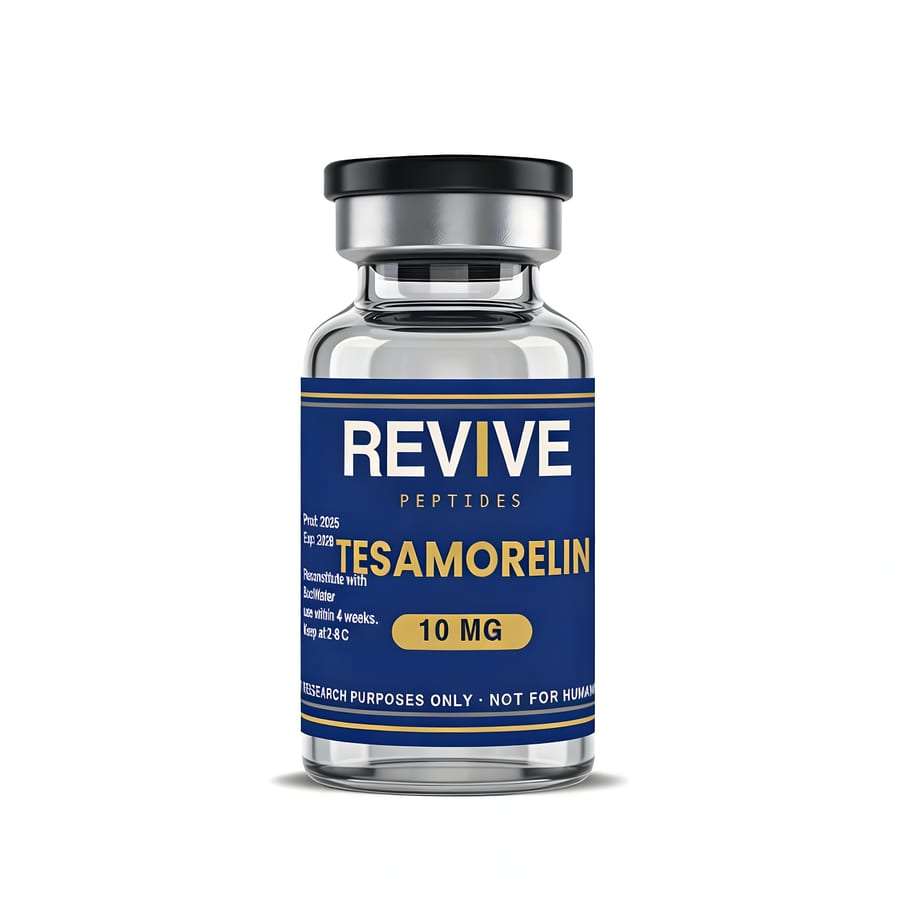
REVIVE LAB UAE stocks tesamorelin in 10 mg lyophilised vials for research procurement. The 10 mg vial is generally preferred for longer research protocols where minimising reconstitution frequency is a practical concern; the 5 mg vial suits shorter experimental windows or labs running multiple concurrent peptide programmes where precise volume management per vial is a priority.
Duration and Reversibility: What the Timelines Indicate
The Falutz 2007 trial used 26 weeks as the primary endpoint window. The continuation trial extended to 52 weeks with active treatment. The Stanley 2019 Lancet HIV paper examined outcomes beyond 52 weeks. For research purposes, 26 weeks represents the minimum exposure required to observe reliable VAT morphology shifts detectable by imaging; shorter protocols may produce measurable IGF-1 changes but may not generate adequate VAT signal for structural endpoint reporting.
The reversibility data from Falutz 2010 frames an important secondary research question: is the VAT reduction effect maintenance-dependent or does it initiate independent metabolic adaptation? The evidence suggests maintenance-dependence — partial VAT rebound occurred within approximately 26 weeks of placebo substitution. SAT remained stable through this withdrawal arc, again confirming depot specificity. This rebound kinetic is under-reported in secondary commentaries on the trial literature and should be explicitly addressed in any protocol design that includes a discontinuation or cycling phase.
Parallel Biomarkers to Track Across the Protocol
- IGF-1 (serum): Primary pharmacodynamic marker; rises within 4 weeks, plateaus mid-protocol, declines post-discontinuation. Track at baseline, week 4, week 12, week 26.
- Fasting glucose and fasting insulin: GH counter-regulation affects insulin sensitivity; monitor at every imaging timepoint at minimum.
- Triglycerides (fasting): Parallel reduction documented in Falutz 2007 and Stanley 2014; useful cardiometabolic co-endpoint.
- VAT area (primary imaging endpoint): CT or MRI at baseline, 12 weeks, 26 weeks, and 52 weeks if protocol extends.
- SAT area (selectivity control): Must be tracked in parallel to confirm depot specificity — not an optional add-on.
- Cortisol and prolactin: Pituitary axis completeness monitoring; document any axis perturbation independent of GH pathway.
IGF-1 should not be used as a proxy for VAT reduction on a week-to-week basis. IGF-1 rises rapidly (often within the first four weeks) while VAT morphology changes accumulate over months. The temporal dissociation between these two variables is mechanistically informative — the pharmacodynamic signal precedes the structural endpoint by a lag of 8–20 weeks depending on the research model. Document both trajectories separately.
6. The UAE Research Context: Gulf Metabolic Phenotypes and What They Mean for GHRH Protocol Design
UAE-based research labs operate in a distinctive epidemiological landscape. Gulf Arab and South Asian expatriate populations — the two largest demographic groups in Dubai and Abu Dhabi — both show patterns of central adiposity and insulin resistance at comparatively lower absolute BMI than Western reference populations. This means VAT accumulation is clinically and research-practically significant at body weights where Western population norms might not flag a metabolic concern.
For researchers studying metabolic phenotypes across Business Bay clinics, DXB-adjacent research facilities, or university-linked labs in Abu Dhabi and Sharjah, this demographic specificity shapes which protocols are most scientifically interesting. A GHRH analog that selectively reduces VAT while preserving SAT is a uniquely differentiated tool in populations where the VAT/SAT imbalance is pronounced at lower BMI thresholds. The protocol design question becomes: can tesamorelin-mediated VAT reduction in Gulf metabolic phenotypes be characterised with the same endpoint structure used in the Western RCTs, or do regional reference ranges for VAT area, IGF-1, and triglycerides require adaptation?
This is an open research question — and one that REVIVE LAB UAE exists to support from a procurement perspective. Labs across the UAE, from JBR-based biotech offices to Marina-area clinical research units to Palm Jumeirah-adjacent private medical facilities, require access to international-standard research compounds without the logistical friction of overseas sourcing: cold-chain integrity, purity documentation, reliable stock availability, and fast last-mile delivery.
7. Sourcing Tesamorelin in the UAE: Operational Requirements for Research Labs
Research compound procurement in the UAE is operationally different from consumer supplement acquisition. Tesamorelin is a lyophilised peptide requiring refrigerated storage (typically 2–8°C) and cold-chain last-mile delivery. In UAE summer conditions — Dubai ambient temperatures routinely exceed 40°C and can spike above 45°C between June and September — uninsulated ambient transport can compromise peptide integrity within hours. This is not a hypothetical concern; it is the primary quality-control failure mode for peptide procurement in Gulf markets.
REVIVE LAB UAE maintains cold-chain storage for all lyophilised peptide inventory and ships tesamorelin with appropriate cold-pack insulation calibrated for UAE ambient temperatures. Orders placed via revivelab.ae/buy-tesamorelin-uae/ are processed for same-day dispatch within Dubai — covering JBR, Dubai Marina, Business Bay, Downtown, Palm Jumeirah, and DXB-adjacent zones — and next-day delivery to Abu Dhabi, Sharjah, Ajman, and the northern emirates.
Procurement Checklist: What to Verify When Sourcing GHRH Analogs in the UAE
- Purity documentation: HPLC purity certificates should be available on request; target ≥98% for research-grade lyophilised peptide material
- Cold-chain compliance: Confirm refrigerated warehouse storage and insulated last-mile delivery — essential in UAE summer months
- Vial labelling accuracy: Lot number, peptide name, mg quantity, lyophilised status, and storage conditions must all be present and legible
- Stock consistency: Mid-protocol sourcing switches introduce uncontrolled batch variability and compromise experimental continuity — confirm reliable inventory before starting a 26-week protocol
- Packaging discretion: Plain, unmarked outer packaging is standard for research compound procurement across the UAE and GCC — confirm before first order
- Payment options: REVIVE LAB UAE accepts standard payment methods and Binance Pay (USDT TRC20) with a 5% pre-pay discount; cash on delivery available for Dubai
For labs running extended protocols that require consistent batch sourcing, REVIVE LAB UAE maintains stable tesamorelin inventory in 10 mg vial formats. Researchers ordering in volume for 26-week or 52-week protocol runs should enquire about batch reservation to ensure mid-protocol continuity. All orders across the UAE ship with discreet, unmarked packaging as standard — no external product labelling, no branding on outer packaging, no peptide content reference on external shipping documentation.
FAQ
Where can I buy tesamorelin in the UAE with fast delivery?
REVIVE LAB UAE stocks tesamorelin 10 mg vials for research use with same-day dispatch from Dubai, reaching JBR, Marina, Business Bay, Palm, and Abu Dhabi within 24 hours. Orders placed before early afternoon qualify for same-day delivery within Dubai. Visit revivelab.ae/buy-tesamorelin-uae/ to order tesamorelin UAE with discreet packaging as standard. Cash on delivery is available for Dubai addresses; Binance Pay (USDT TRC20) is accepted with a 5% pre-pay discount.
Does REVIVE LAB UAE offer discreet packaging for tesamorelin orders?
Yes. All REVIVE LAB UAE tesamorelin orders ship in plain, unmarked outer packaging with no external branding, no product labelling, and no peptide content reference visible on the outside of the shipment. This is consistent with research-compound procurement standards across the UAE and GCC. Cold-chain insulation is included on all tesamorelin orders given UAE ambient temperature conditions. This applies equally to deliveries in Dubai, Abu Dhabi, Sharjah, and the northern emirates.
What vial sizes of tesamorelin does REVIVE LAB UAE stock?
REVIVE LAB UAE carries tesamorelin in 10 mg lyophilised vials. Both are held in refrigerated cold-chain storage and are consistently in stock for same-day or next-day delivery across Dubai, Abu Dhabi, and Sharjah. The 10 mg vial is typically preferred for longer research protocols where reducing reconstitution frequency is a practical priority; the 5 mg vial suits shorter experimental windows or labs managing multiple concurrent peptide programmes. Order at revivelab.ae/buy-tesamorelin-uae/ — tesamorelin in stock UAE, shipped same day.
- Falutz J, et al. Metabolic effects of a growth hormone-releasing factor in patients with HIV. New England Journal of Medicine. 2007;357(23):2359–2370.
- Falutz J, et al. Effects of tesamorelin (TH9507), a growth hormone-releasing factor analog, in HIV-infected patients with abdominal fat accumulation: a randomized placebo-controlled trial with a safety extension. New England Journal of Medicine. 2010;362(3):281–291. [Continuation and withdrawal trial]
- Stanley TL, et al. Effect of tesamorelin on visceral fat and liver fat in HIV-infected patients with abdominal fat accumulation: a randomized clinical trial. JAMA. 2014;312(4):380–389.
- Stanley TL, et al. Reduction in visceral adiposity is associated with an improved metabolic profile in HIV-infected patients receiving tesamorelin. Lancet HIV. 2019;6(12):e821–e830.
Ready to Source Tesamorelin for Your UAE Research Programme?
10 mg vials in cold-chain storage. Same-day delivery Dubai. Discreet packaging. Cash on delivery available. Binance Pay (USDT TRC20) accepted — 5% pre-pay discount.
Order Tesamorelin UAE — In Stock at REVIVE LAB UAE