Tesamorelin Villa Fridge Storage — Emirates Hills, Palm Jumeirah & Saadiyat Island: The UAE Researcher's Cold-Chain Protocol
Why Peptide Storage Fails in UAE Villas — and Why Tesamorelin Is Especially Unforgiving
Every researcher who has ordered peptides in the UAE and cycled through Emirates Hills, Palm Jumeirah, or a Saadiyat Island beach compound knows the first challenge is not sourcing — it is what happens after the courier leaves. UAE ambient temperatures between June and September routinely reach 44–48°C at street level. A villa fridge on the Palm fronds, in Al Barari, or overlooking the Saadiyat waterfront is running against that thermal load continuously, which means door-zone temperatures can swing 5–8°C with every opening. That swing is irrelevant for fruit. It is not irrelevant for reconstituted peptide.
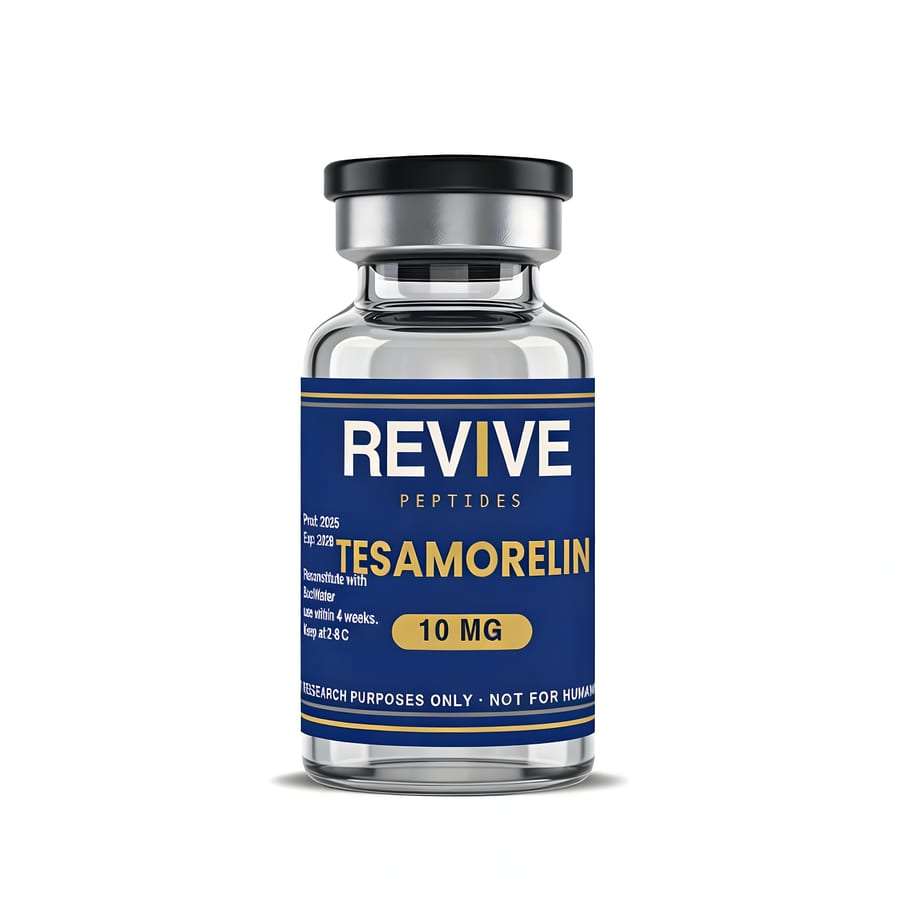
Tesamorelin is a 44-amino-acid synthetic analogue of growth hormone-releasing hormone (GHRH). It is supplied as a lyophilized (freeze-dried) white powder and is substantially stable in that dry state under correct refrigeration. Once reconstituted into solution, however, it degrades measurably above 8°C, with hydrolysis rates that accelerate non-linearly with temperature excursions. A single warm-storage event — a power micro-cut, a fridge door held open by household staff, a logistics handoff that idles in a non-cooled vehicle on a June afternoon in Dubai — can compromise an entire reconstituted batch for research purposes.
This guide is written specifically for high-end UAE residential research setups: full-floor villas in Emirates Hills, marina-facing townhouses on Palm Jumeirah fronds, Saadiyat Island beachfront compounds, and urban research stations in Business Bay and JBR where researchers operate on compressed urban schedules. The cold-chain principles are identical across all property types; the practical failure points differ. We cover all of them.
Tesamorelin Vial Chemistry: Lyophilized vs. Reconstituted — What You Are Actually Storing
Understanding the chemistry is the prerequisite for building a correct storage protocol. Lyophilized Tesamorelin arrives as a compact white cake or powder sealed under nitrogen (or vacuum) in a borosilicate glass vial with a rubber stopper and aluminium crimp. In this dry state, the peptide backbone is protected from the hydrolytic degradation that occurs in aqueous environments. At 2–8°C with intact seal, lyophilized vials maintain research-grade integrity across the period documented on each certified batch sheet.
The lyophilization process that confers this stability is also what makes the storage environment critical: excessive humidity against the stopper seal, freeze-thaw cycling that stresses the glass and rubber interface, and excessive vibration during shipping can all begin degrading the product before it ever reaches your bench. This is not theoretical — it is why reputable UAE suppliers like REVIVE LAB UAE invest in proper insulated dispatch rather than ambient courier delivery.
REVIVE LAB UAE currently stocks Tesamorelin in 5mg and 10mg lyophilized vial formats. To understand what those vial sizes mean in a research-context frame: published clinical trials studying tesamorelin as a GHRH analog — specifically Falutz et al. (2007, NEJM) examining tesamorelin in HIV-associated lipodystrophy and Stanley et al. These figures are included for research-context framing only. REVIVE LAB UAE products are supplied for laboratory research use exclusively, and no human consumption dosing guidance is provided or implied.
Once a vial is reconstituted — typically with bacteriostatic water or sterile water per the researcher's protocol — the stability window shortens dramatically. Reconstituted Tesamorelin must be held at 2–8°C, shielded from light, and must not be frozen. Temperature excursions above 8°C accelerate peptide bond hydrolysis. The door shelf of any residential fridge is the worst possible location for reconstituted solution in a UAE summer context.
The UAE Villa Fridge Reality: Temperature Zones, Appliance Types, and the Summer Heat Load
Most UAE premium residential properties use one of three fridge categories: dual-compressor American-style units (Sub-Zero 700 series and equivalents, dominant in Emirates Hills mansions), European integrated column fridges (Liebherr, Miele, AEG — common in Saadiyat and Palm Jumeirah villas), and Korean or Japanese mid-range units (Samsung, LG, Hitachi) found in JBR and Marina apartments. All three can store Tesamorelin correctly. All three will fail if you use the wrong zone.
The single most important fact about UAE villa fridges: "set to 4°C" does not mean a uniform 4°C throughout the interior. Temperature stratification inside a running residential fridge is real, reproducible, and consequential for research peptide storage. The table below maps the zones based on typical UAE summer operating conditions:
| Fridge Zone | Typical Range (UAE Summer) | Suitable for Tesamorelin? | Notes |
|---|---|---|---|
| Door shelf — top | 7–13°C | No | Maximum thermal swing on door open; worst zone |
| Door shelf — bottom | 5–10°C | No | Slightly more stable but still unacceptable for reconstituted |
| Top shelf (near freezer compartment) | 1–4°C | Lyophilized only | Freeze risk in shared-evaporator units; avoid reconstituted |
| Middle shelf — back center | 3–5°C | Yes — optimal | Best zone for both lyophilized and reconstituted |
| Bottom shelf — back center | 3–6°C | Yes — acceptable | Good for lyophilized; acceptable for reconstituted in well-maintained units |
| Crisper drawer (sealed) | 4–7°C | Lyophilized only | High humidity environment; use secondary sealed container |
| Freezer wall (shared-evaporator unit) | Below 0°C contact temperature | Never | Will freeze and destroy reconstituted solution; may crack vials |
The Emirates Hills researcher has a notable structural advantage: Sub-Zero and Wolf dual-compressor units mechanically separate the fridge and freezer compartments. There is no shared evaporator bleeding cold from the freezer wall into the fridge interior. Middle-shelf temperature stability in these units is genuinely excellent, with ±1°C variance in UAE summer conditions if the door seal is intact. Palm Jumeirah frond villas tend toward narrower integrated European units with smaller middle-shelf depth — compensate by placing vials in a small secondary container pushed to the back wall. Saadiyat Island properties sourced through UAE developers often specify local-brand appliances that run warmer at the door zone; back-of-shelf placement is non-negotiable in those setups.
Same-day Dubai dispatch. Emirates Hills, Palm Jumeirah, Marina, JBR, Business Bay all covered. Discreet packaging. Cash on delivery available.
Buy Tesamorelin UAE — Order from REVIVE LAB UAE
Optimal Storage Setup: Practical Configuration for UAE Villa Research Benches
For Lyophilized (Dry, Sealed) Tesamorelin Vials
- Middle or bottom shelf, back-center position — the single most important rule
- Upright orientation preferred; keeps the lyophilized cake undisturbed and prevents stopper-contact moisture issues
- Secondary opaque container (dark glass jar, labelled aluminium case, or sealed black ziplock) blocks ambient light every time the door opens
- Do not allow vials to touch the back wall in frost-free units — fan-adjacent contact points can dip below 0°C during defrost cycles
- Label container with contents, batch number, date received, and stability end date
For Reconstituted Tesamorelin (In Solution)
- Middle shelf, back center — non-negotiable, not a guideline
- Upright, capped with the original rubber stopper, sealed secondary container
- A min-max thermometer placed on the middle shelf is worth every dirham for a serious research setup; it logs the range between checks without any power requirement
- Do not freeze under any circumstances; freezing and thawing destroys peptide conformation in solution
- Reconstitute only what you need for the immediate research protocol period — do not reconstitute entire inventory speculatively
Power Contingency Planning in UAE Villas
DEWA grid reliability in premium UAE zones (Emirates Hills, Palm Jumeirah, Saadiyat) is genuinely high. Outages lasting longer than 30 minutes are rare. That said, a planned infrastructure outage, a villa electrical fault, or a compressor failure during August is a realistic scenario. For research setups holding multiple vials of Tesamorelin and other peptides from REVIVE LAB UAE, a simple contingency is worth building: a 4°C gel-pack set kept in the freezer compartment (frozen) at all times. If fridge power fails, the gel packs migrated into the fridge compartment buy several hours of temperature stability. An entry-level USB-charged temperature datalogger provides electronic evidence of any excursion, which matters for research record integrity.
Research Context: Why UAE Researchers Are Reaching for Tesamorelin
The research literature on tesamorelin as a GHRH analog has accumulated substantially since the mid-2000s. Falutz et al. (2007, NEJM) was the landmark trial establishing tesamorelin's capacity to significantly reduce visceral adipose tissue in a studied HIV-lipodystrophy population over 26 weeks — a finding that put this peptide on the map for metabolic researchers globally. Stanley et al. (2014, JAMA) extended those findings with data showing statistically significant trunk fat and visceral fat reductions, along with effects on cognitive endpoints that opened a separate line of inquiry. The continuation trial data from Falutz et al. (2010, NEJM) confirmed durability of visceral fat effects over extended research periods, and Stanley et al. (2019, Lancet HIV) consolidated the long-term picture.
The cumulative literature on this 44-amino-acid GHRH analogue is why Tesamorelin consistently ranks among REVIVE LAB UAE's highest-demand products, alongside Retatrutide and GHK-Cu. For peptides UAE researchers, it is not a novelty compound — it has deep published research scaffolding and a clear research hypothesis. What researchers in Dubai and Abu Dhabi need is a supplier who has it in stock, ships same day, and does not compromise the cold chain between dispatch and delivery. That is the problem REVIVE LAB UAE exists to solve.
Cold-Chain Integrity: From REVIVE LAB UAE Dispatch to Your Villa Door
When you order Tesamorelin from REVIVE LAB UAE, the cold chain starts at the fulfillment stage. Orders are packed in insulated dispatch envelopes with gel packs calibrated to maintain sub-8°C conditions across the delivery window. For same-day Dubai deliveries — covering Emirates Hills, Palm Jumeirah fronds (all numbered fronds), Dubai Marina, JBR, Business Bay, Downtown, DIFC, and the DXB airport corridor — the typical dispatch-to-delivery window is under four hours. The insulation envelope maintains temperature easily across that duration even in UAE summer ambient conditions.
For Abu Dhabi orders — Saadiyat Island (The Collection and beach villa zones), Yas Island, Al Reem Island, Al Raha Beach, Corniche area — the 24h delivery route is used with a larger insulation configuration. Researchers in Sharjah and the Northern Emirates are covered on the same 24h framework. For all zones, orders placed before the daily dispatch cutoff ship the same business day.
All REVIVE LAB UAE Tesamorelin orders ship in discreet packaging: plain outer box, no product identification on the exterior label, no REVIVE LAB UAE branding visible to the courier or building security. On Palm Jumeirah frond properties where deliveries go through security booths, and in Emirates Hills where household staff typically receive parcels, this matters practically. The outer box looks like any other e-commerce delivery.
Payment options available: cash on delivery (COD) for Dubai mainland orders including Emirates Hills, Marina, and Business Bay; Binance Pay (USDT TRC20) for all UAE zones with a 5% pre-pay discount — WhatsApp the transaction ID to confirm. Bank transfer available on request.
What to Do the Moment Your REVIVE LAB UAE Delivery Arrives
This sounds obvious until you are on a call, the intercom buzzes, and the package sits with building security for 90 minutes on a 46°C June afternoon. The protocol matters:
- Retrieve immediately. Do not let any peptide delivery from REVIVE LAB UAE sit in a security booth, lobby area, or vehicle during UAE summer. The insulated packaging maintains temperature, but it is not infinite. Retrieve within 30 minutes of delivery notification.
- Inspect before opening fully. Check the outer packaging for signs of crush damage or moisture intrusion. Examine each vial visually: intact rubber stopper, clear or white powder with no discoloration, no cracks in the glass. If a temperature indicator strip is included in the pack, confirm it has not been breached.
- Transfer within 10 minutes of inspection. Move lyophilized vials to the pre-designated middle-shelf position in your villa fridge. Do not leave them on the kitchen counter while you complete other tasks.
- Log immediately. Record date received, batch number, vial count, and the calculated stability end date from your batch sheet. For a vial received 2026-06-29 with a 12-month lyophilized stability declaration, your end-of-use date for research purposes is 2027-06-29. Log it.
- Do not reconstitute speculatively. Only reconstitute the volume you need for your immediate research protocol. Each reconstituted vial opens a stability clock that lyophilized inventory does not have.
Transport Between UAE Properties: Dubai Villa to Abu Dhabi Weekend Retreat
Researchers and high-net-worth clients in the UAE frequently rotate between properties — an Emirates Hills primary villa, a Saadiyat Island beach compound for weekends, possibly a Yas Island apartment near the F1 circuit. Tesamorelin transport between properties is manageable with the right approach and genuinely dangerous without it.
For any vehicle transit under 30 minutes in UAE summer, keep peptide vials in the vehicle cabin with air conditioning running — not in the boot, which can exceed 60°C in a parked vehicle even with windows cracked. For the Dubai to Abu Dhabi run (typically 75–100 minutes, Abu Dhabi Corniche or Saadiyat destination), use a hard-sided insulated cooler pre-chilled to 4°C with gel packs. Gel packs at 4°C (not dry ice — contact temperature below 0°C risks freezing reconstituted solution and cracking vials) are the correct choice. Yeti-brand coolers and equivalents available in UAE maintain temperature adequately for a two-hour road transfer.
| Route | Transit Time | Recommended Solution |
|---|---|---|
| Emirates Hills to Palm Jumeirah | 15–25 min | Cabin of air-conditioned vehicle |
| Business Bay to JBR or Marina | 20–35 min | Cabin of air-conditioned vehicle |
| Dubai to Abu Dhabi (Saadiyat/Yas) | 75–100 min | Pre-chilled insulated cooler with 4°C gel packs, cabin position |
| Dubai to Sharjah | 30–60 min (traffic-dependent) | Insulated cooler recommended in summer; cabin only in winter |
| UAE to Europe (summer relocation) | 6–8 hours flight | Carry-on only; airline cooler bag; declare as research peptides if queried |
For researchers relocating to Europe during UAE summer peak (July–August) while maintaining an ongoing research protocol, carry-on baggage is the only acceptable option for reconstituted Tesamorelin. Checked baggage holds experience temperature extremes. Lyophilized vials in sealed secondary containers can survive checked baggage in terms of temperature, but carry-on is still preferred. Check destination country import regulations independently — REVIVE LAB UAE does not provide import legal guidance for third countries.
Frequently Asked Questions
How should I store Tesamorelin vials in my UAE villa fridge?
Store lyophilized (dry powder) Tesamorelin vials at 2–8°C on the middle shelf, back-center position, away from the freezer wall and the door. In UAE villa conditions this is the most thermally stable zone. Use a small opaque secondary container to block light on every door opening. Once reconstituted, keep upright at 2–8°C and never freeze. Use within the window stated on your research batch sheet. A min-max thermometer on the middle shelf tells you if any temperature excursion occurred between your checks.
Does REVIVE LAB UAE deliver Tesamorelin same-day to Emirates Hills and Palm Jumeirah?
Yes. REVIVE LAB UAE dispatches Tesamorelin 5mg and 10mg vials with same-day delivery for Dubai orders placed before the daily cutoff. Coverage includes Emirates Hills, all Palm Jumeirah fronds and trunk, Dubai Marina, JBR, Business Bay, Downtown, DIFC, and the DXB corridor. Nationwide 24h delivery covers Abu Dhabi (Saadiyat Island, Yas Island, Al Reem, Corniche), Sharjah, and Northern Emirates. All orders ship in discreet packaging with no product identification on the outer box. Cash on delivery is available for Dubai mainland addresses.
What Tesamorelin vial sizes does REVIVE LAB UAE stock?
REVIVE LAB UAE keeps Tesamorelin in stock in both 5mg and 10mg lyophilized vial formats. Both are research-use only, supplied for laboratory research purposes. (2007, NEJM) and Stanley et al. (2014, JAMA) — is provided for research-context framing only. No dosing advice for human use is provided or implied by REVIVE LAB UAE in any context.
- Falutz J, Allas S, Blot K, et al. Metabolic effects of a growth hormone-releasing factor in patients with HIV. N Engl J Med. 2007;357(23):2359–2370.
- Stanley TL, Falutz J, Marsolais C, et al. Reduction in visceral adiposity is associated with an improved metabolic profile in HIV-infected patients receiving tesamorelin. JAMA. 2014;312(4):380–387.
- Stanley TL, Fourman LT, Feldpausch MN, et al. Effects of tesamorelin on non-alcoholic fatty liver disease in HIV: a randomised, double-blind, multicentre trial. Lancet HIV. 2019;6(12):e821–e830.
- Falutz J, Allas S, Mamputu JC, et al. Long-term safety and effects of tesamorelin, a growth hormone-releasing factor analogue, in HIV patients with abdominal fat accumulation. N Engl J Med. 2010;362(23):2141–2151. [Continuation trial data]
5mg and 10mg vials in stock. Same-day dispatch Dubai. 24h delivery Abu Dhabi & Saadiyat. Discreet packaging. COD available. REVIVE LAB UAE — the UAE's dedicated research peptide supplier.
Buy Tesamorelin UAE — REVIVE LAB UAE