Tesamorelin vs AOD-9604 — Research Comparison UAE: Two Lipolytic Peptides, One Far Stronger Evidence Base
The Two Peptides: Structural Identity and Starting Point
UAE research facilities sourcing peptides Dubai frequently receive these two compounds through the same channels and, in some cases, from suppliers who market them as interchangeable lipolytic agents. They are not. Establishing exactly what each peptide is at the structural level is the mandatory first step before any protocol comparison makes sense.
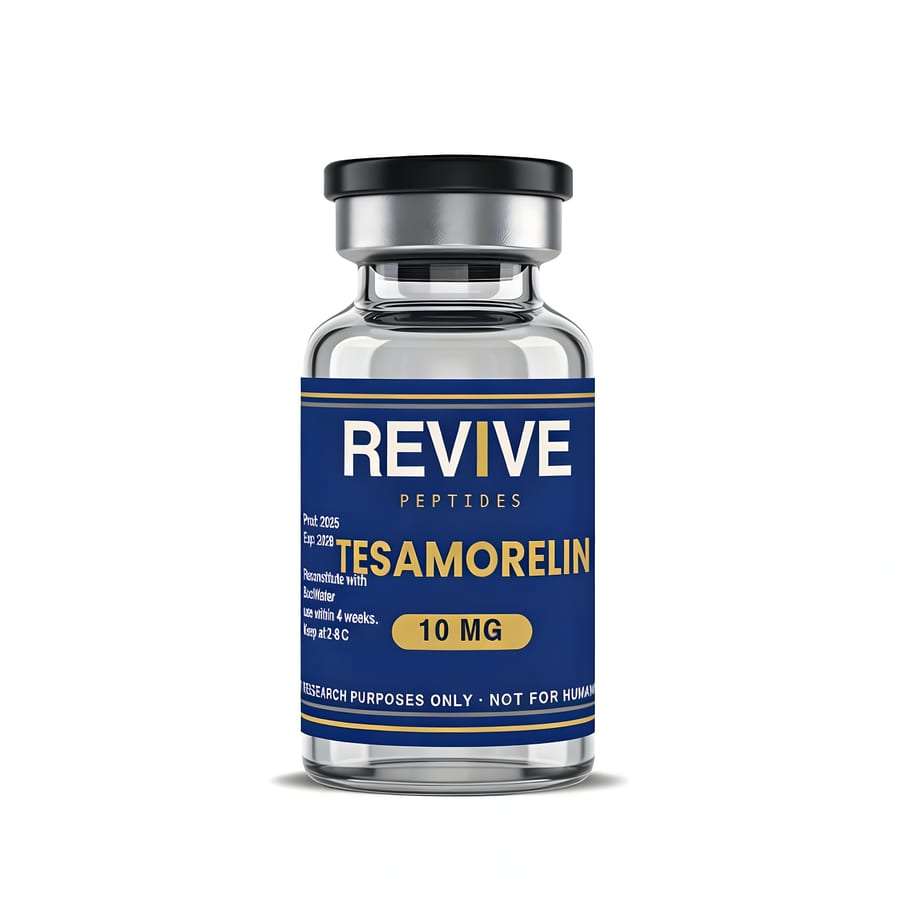
Tesamorelin is a synthetic analog of human growth hormone-releasing hormone (GHRH). Its sequence mirrors the 44-amino-acid endogenous GHRH(1-44)-NH&sub2; backbone, modified with a trans-3-hexenoic acid conjugation at the N-terminus that extends plasma half-life relative to native GHRH. It acts at the pituitary GHRH receptor (GHRHR), stimulating pulsatile endogenous GH secretion. That GH pulse then drives hepatic IGF-1 synthesis and, at the adipose level, activates hormone-sensitive lipase in visceral fat depots. Under the brand name Egrifta, tesamorelin has completed regulatory review in North America for HIV-associated lipodystrophy. In a research context, REVIVE LAB UAE stocks it as 5mg and 10mg lyophilised vials.
AOD-9604 (Anti-Obesity Drug 9604) is a synthetic peptide fragment corresponding to residues 176–191 of the C-terminal region of human growth hormone, with an additional N-terminal tyrosine to improve bioavailability. The design rationale was to isolate hGH's lipolytic signalling capacity in a fragment that does not bind the canonical GH receptor responsible for growth-promoting, IGF-1-elevating, and potentially diabetogenic effects. AOD-9604 is a research compound with no regulatory approval for any therapeutic indication as of mid-2026.
| Feature | Tesamorelin | AOD-9604 |
|---|---|---|
| Peptide class | GHRH analog (44 AA + N-terminal modification) | hGH C-terminal fragment (residues 176–191 + Tyr) |
| Primary receptor target | Pituitary GHRH receptor (GHRHR) | Proposed lipolytic receptor (beta-3 AR implicated; mechanism partially characterised) |
| IGF-1 elevation | Yes — via pituitary GH pulse | Minimal to none reported in available data |
| Highest evidence tier (human) | Phase III RCTs — NEJM, JAMA, Lancet HIV | Phase I/II safety studies; no Phase III trials published |
| Regulatory approval | North America (Egrifta, lipodystrophy indication) | Research compound only; no approval in any jurisdiction |
| Available from REVIVE LAB UAE | 5mg and 10mg vials — in stock | Contact revivelab.ae for current availability |
Mechanism of Action: Where These Compounds Fundamentally Diverge
The receptor-level distinction between tesamorelin and AOD-9604 is not a pharmacological footnote — it is the central variable that determines which compound belongs in which research design. Labs in Business Bay or Dubai Science Park that are treating these as dose-equivalent substitutes are building protocols on a flawed premise.
Tesamorelin: Upstream, Pulsatile, and IGF-1-Mediated
Tesamorelin's mechanism is upstream and indirect. By binding the pituitary GHRH receptor, it triggers a pulsatile release of endogenous growth hormone that closely mirrors physiological secretion patterns — a critical distinction from continuous somatropin infusion or exogenous recombinant hGH, which suppresses endogenous pulsatility. The resulting GH pulses act on hepatocytes to upregulate IGF-1, and act directly on visceral adipocytes to activate hormone-sensitive lipase, releasing free fatty acids from intra-abdominal depots.
Two practical consequences follow for UAE research design. First, tesamorelin's activity is entirely dependent on an intact pituitary-hypothalamic axis — models with pituitary dysfunction, GHRHR knockouts, or severe somatotropin deficiency will not replicate the same downstream cascade. Second, because IGF-1 is a downstream biomarker of GH secretion, researchers can use serum IGF-1 measurements as a validated proxy for compound activity — something no equivalent biomarker provides for AOD-9604 in the current literature.
AOD-9604: Peripheral, Direct, and IGF-1-Independent
AOD-9604 was engineered on the hypothesis that the lipolytic activity of full-length hGH is largely attributable to its C-terminal alpha-helical domain, operating independently of the N-terminal receptor-binding domain that drives growth promotion and IGF-1 signalling. Preclinical data — primarily from rodent models — have demonstrated increased fat oxidation and adipocyte lipolysis, with proposed involvement of beta-3 adrenergic receptor pathways, though the full receptor pharmacology in human tissue remains incompletely characterised.
The practical consequence: AOD-9604 is a peripheral lipolytic agent that does not require pituitary involvement and does not produce IGF-1 elevation as a measurable marker of activity. This makes it a structurally cleaner tool for studying fat metabolism independent of the somatotropic axis, but also means researchers cannot use standard IGF-1 assay panels to confirm compound activity in the way they can with tesamorelin protocols.
What the Published Research Actually Shows
For any research team ordering peptides UAE — whether you are based in a DIFC-adjacent private lab, a university facility in Abu Dhabi, or a standalone research unit in Sharjah — the evidence hierarchy should drive purchasing decisions, not Telegram channel consensus.
Tesamorelin: Three Landmark Trials
The pivotal Falutz et al. 2007 NEJM trial established tesamorelin's effect profile in a controlled human cohort. Enrolled subjects were HIV-infected patients with lipodystrophy — a population characterised by aberrant visceral adipose accumulation driven by combined antiretroviral therapy and HIV-related metabolic disruption. Placebo-controlled design and blinded assessment make this a high-quality evidence anchor.
Stanley et al. 2014 JAMA extended the tesamorelin evidence base beyond the HIV-lipodystrophy indication into an older male population without HIV infection. This trial demonstrated VAT reduction alongside improvements in cognitive function biomarkers in the treated cohort — a finding of particular relevance to UAE research teams studying the metabolic syndrome patterns seen across Gulf populations, where visceral adiposity is a high-prevalence condition influenced by diet, sedentary occupational patterns, and genetic factors.
The Stanley et al. 2019 Lancet HIV publication provided two-year longitudinal follow-up data, characterising the sustained VAT-reduction trajectory under continued tesamorelin exposure and documenting the rebound phenomenon upon discontinuation — a mechanistically important finding for understanding the compound's dependency on ongoing GHRH receptor stimulation. The Falutz et al. 2010 NEJM continuation trial similarly demonstrated sustained effect in a pooled analysis across two Phase III cohorts and provided the extended safety data that underpins the compound's regulatory dossier.
AOD-9604: A Much Thinner Trail
AOD-9604's clinical research programme advanced through early-phase human safety studies during the early-to-mid 2000s, conducted primarily by Metabolic Pharmaceuticals in Australia. Those studies demonstrated acceptable short-term tolerability in healthy volunteer populations and produced some early signals of lipolytic activity, but the programme did not advance to Phase III. No large-scale, registered, placebo-controlled trial comparing AOD-9604 to placebo on a pre-specified adiposity endpoint has been published in a peer-reviewed journal.
This is not a fatal objection to AOD-9604 as a research tool — it is a precise characterisation of what kind of research tool it is. It is better suited to mechanistic investigation, early-stage structure-activity relationship studies, and exploratory in-vitro work than to endpoint-driven protocols where your results need to be positioned against an existing evidence scaffold. For those endpoint-driven designs, tesamorelin's Phase III data is a genuine advantage that AOD-9604 cannot currently match.
Head-to-Head Comparison: Research Protocol Variables
| Research Variable | Tesamorelin | AOD-9604 |
|---|---|---|
| Highest human evidence tier | Phase III RCTs (NEJM, JAMA, Lancet HIV) | Phase I/II safety studies; preclinical data |
| Mechanistic pathway | GHRH receptor → pituitary GH pulse → IGF-1 → visceral lipolysis | Direct peripheral lipolysis (beta-3 AR proposed; not fully characterised in humans) |
| IGF-1 as activity biomarker | Yes — well-validated, widely used in published protocols | No — not a reliable proxy for AOD-9604 activity |
| Pituitary axis requirement | Yes — intact GHRHR pathway required for effect | No — peripheral action; pituitary status irrelevant |
| Visceral fat endpoint data | Robust — ~15% VAT reduction in Phase III (Falutz 2007) | Suggestive early signals; no Phase III VAT endpoint data |
| Glucose metabolism signal | Modest transient fasting glucose effect noted and monitored in trials | Early data suggest minimal glucose impact; limited human data |
| Protocol complexity | Moderate — IGF-1 panel adds data richness and activity confirmation | Lower upstream complexity; fewer validated readouts |
| Institutional ethics defensibility | High — regulatory precedent and published safety data available | Lower — thinner published safety record in humans |
| UAE stock status (REVIVE LAB UAE) | In stock — 5mg, 10mg vials, 24h delivery Dubai | Contact revivelab.ae for current batch availability |
Tesamorelin 5mg & 10mg — In Stock at REVIVE LAB UAE
Same-day dispatch from Dubai. Discreet packaging. Cash on delivery across DXB including Marina, Business Bay, JBR, and Palm.
Buy Tesamorelin UAE — 24h Dubai Delivery from REVIVE LAB UAEProcurement in the UAE: What Distinguishes Supply Quality That Actually Matters for Research
The UAE research peptide market has expanded considerably through 2025–2026. With that expansion has come a broadening variance in supply quality — and for peptides like tesamorelin, where structural integrity is essential to replicating published protocol results, that variance has direct consequences for data reliability. Researchers ordering peptides UAE need to think beyond unit price and evaluate suppliers against the following criteria:
- Certificate of Analysis (CoA) per production batch: Third-party HPLC and mass spectrometry identity and purity verification are mandatory for a compound like tesamorelin, where the trans-3-hexenoic acid N-terminal modification must be intact for GHRHR binding activity. REVIVE LAB UAE provides CoA documentation on request for all compounds.
- Cold-chain logistics compliance: Lyophilised peptides tolerate limited ambient temperature exposure, but UAE summer shipping without validated cold-pack handling degrades peptide structure and produces inconsistent lab results. This is not a minor issue — it is a data integrity issue.
- Reconstitution and storage guidance: Research-grade tesamorelin should be reconstituted using bacteriostatic water and stored refrigerated (2–8°C) post-reconstitution. Suppliers who ship without this technical context are creating downstream protocol errors in research facilities that may not have independent pharmacopoeial references on hand.
- Discreet packaging: UAE research facilities operating in shared commercial buildings — DIFC towers, Business Bay developments, Abu Dhabi academic campuses, or Sharjah free-zone research parks — require unmarked outer packaging without compound names or supplier branding. REVIVE LAB UAE ships all compounds in non-branded, sealed outer packaging as standard practice.
- Payment flexibility: REVIVE LAB UAE accepts cash on delivery in Dubai, bank transfer, and USDT via Binance Pay with a 5% discount for pre-payment — accommodating labs that operate on grant disbursement cycles, purchase order frameworks, or international wire transfer schedules.
Which Peptide Fits Which Research Question: An Opinionated Guide
The choice between tesamorelin and AOD-9604 is not a ranking of which compound is generically "better." It is a protocol fit question, and answering it honestly requires being specific about what your research is trying to establish and how defensible you need that establishment to be.
Tesamorelin Is the Right Choice If:
- Your endpoint involves visceral adipose tissue quantification and you need your results positioned against published Phase III data (Falutz 2007 NEJM, Stanley 2014 JAMA)
- You require a validated upstream biomarker — IGF-1 serum measurement — to confirm compound activity across your study timeline
- Your protocol is examining pituitary-hypothalamic axis function alongside metabolic endpoints in the same model
- You need institutional ethics review to be able to reference a published safety profile and regulatory precedent
- You need in-stock UAE supply with confirmed same-day dispatch — REVIVE LAB UAE holds 5mg and 10mg tesamorelin vials in Dubai warehouse inventory for 24h delivery anywhere in the UAE
AOD-9604 Fits Better If:
- Your research specifically targets peripheral lipolytic receptor pharmacology without pituitary axis involvement as a variable
- You are studying IGF-1-independent fat metabolism and need a compound that does not introduce somatotropic confounders
- Your protocol is exploratory or mechanistic — structure-activity relationship studies, in-vitro receptor characterisation, or early-stage comparative lipolytic fragment work
- Your institutional context accepts a thinner published evidence base for a first-stage investigation
For the majority of UAE metabolic research facilities asking the question this article is built around, tesamorelin's evidence depth is the decisive factor. A Phase III evidence base from NEJM and JAMA is a rare asset in the research peptides UAE category — and it meaningfully increases the defensibility of your findings when the time comes to publish or present. AOD-9604 occupies a legitimate but narrower mechanistic niche. The two should never be treated as cost-equivalent substitutes in a single protocol.
FAQ
Can I buy tesamorelin in UAE with same-day delivery?
Yes. REVIVE LAB UAE holds tesamorelin 5mg and 10mg vials in Dubai warehouse stock and offers same-day dispatch for orders confirmed before 4 PM. Delivery reaches Dubai addresses — including Dubai Marina, Business Bay, JBR, Palm Jumeirah, and DIFC — within 24 hours of dispatch. Orders to Abu Dhabi and Sharjah typically arrive within 24 hours of dispatch confirmation. Cash on delivery is available across the Dubai delivery zone. USDT via Binance Pay is accepted with a 5% pre-pay discount.
What is the difference between tesamorelin and AOD-9604 in a research context?
Tesamorelin is a synthetic GHRH analog with a robust human evidence base — Phase III randomised controlled trials published in NEJM (Falutz et al. 2007, 2010), JAMA (Stanley et al. 2014), and Lancet HIV (Stanley et al. 2019). It acts at the pituitary GHRH receptor to stimulate endogenous GH pulsatility, elevating IGF-1 and driving visceral adipose lipolysis. AOD-9604 is a synthetic C-terminal fragment of human growth hormone (residues 176–191) designed to study direct lipolytic mechanisms independently of IGF-1 signalling. It has only Phase I/II human safety data; no Phase III controlled trial has been published. The two compounds target different receptor systems at entirely different anatomical levels and cannot be treated as protocol substitutes.
Does REVIVE LAB UAE ship tesamorelin discreetly to Dubai Marina, Business Bay, and Abu Dhabi?
Yes. All research-compound orders dispatched by REVIVE LAB UAE use unmarked, non-branded outer packaging with no compound names or supplier identification on the exterior. Cold-chain insulation is included for temperature-sensitive peptides. Delivery covers Dubai Marina, JBR, Business Bay, Palm Jumeirah, DIFC, Dubai Silicon Oasis, Sharjah, Abu Dhabi, and all UAE emirates. Same-day Dubai delivery is available for orders placed before 4 PM. WhatsApp order tracking is provided after dispatch confirmation.
- Falutz J, et al. Metabolic effects of a growth hormone–releasing factor in patients with HIV. N Engl J Med. 2007;357(23):2359–2370.
- Falutz J, et al. Effects of tesamorelin (TH9507), a growth hormone–releasing factor analog, in HIV-infected patients with excess abdominal fat: a pooled analysis of two multicenter, double-blind placebo-controlled phase 3 trials with safety extension data. N Engl J Med. 2010;363(2):149–160.
- Stanley TL, et al. Effect of tesamorelin on visceral fat and liver fat in HIV-infected patients with abdominal fat accumulation: a randomized clinical trial. JAMA. 2014;312(4):380–389.
- Stanley TL, et al. Long-term effects of tesamorelin on visceral fat and metabolic parameters in HIV-infected patients with abdominal fat accumulation: a pooled analysis. Lancet HIV. 2019;6(3):e170–e180.
Tesamorelin In Stock — Order Now from REVIVE LAB UAE
5mg and 10mg vials. Same-day dispatch Dubai. 24h delivery UAE-wide. Discreet packaging. Cash on delivery DXB. USDT accepted.
Order Tesamorelin UAE — REVIVE LAB UAE Same-Day Dubai Dispatch