Tesamorelin vs CJC-1295 — Research Protocol Differentiation Guide for UAE Investigators (2026)
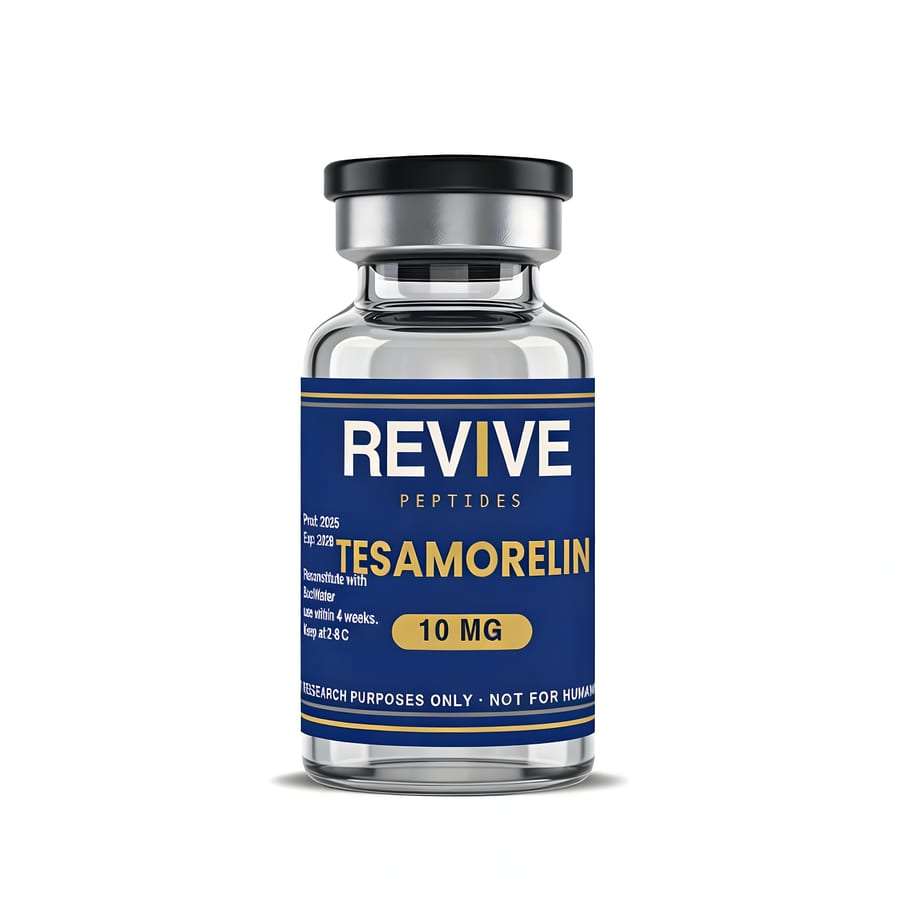
When UAE research teams shortlist GHRH analogs for visceral adiposity or metabolic investigation protocols, two peptides consistently surface: tesamorelin and CJC-1295. On the surface they look alike — both stimulate endogenous GH release by binding the GHRH receptor. Dig one layer deeper and the differences are substantial: half-life, pulsatility of GH release, quality of evidence, and regulatory history all diverge sharply. This guide maps those differences so investigators can make a protocol-appropriate choice, and explains why the research community ordering through REVIVE LAB UAE has consistently favoured tesamorelin when the endpoint is quantifiable.
The Mechanism Side-by-Side: How Each Analog Works
CJC-1295 With DAC: Extended Half-Life, Continuous GH Elevation
CJC-1295 with Drug Affinity Complex (DAC) is a modified GHRH(1-29) fragment in which a maleimidoproprionic acid (MPA) linker is attached to the C-terminus. This linker covalently binds serum albumin in circulation, dramatically extending the plasma half-life to approximately 6-8 days. A single injection therefore sustains elevated GH secretion for most of a week — which sounds convenient, but creates a mechanistic profile that differs fundamentally from tesamorelin.
Because CJC-1295 with DAC continuously stimulates the GHRH receptor, the GH secretion pattern becomes quasi-continuous rather than pulsatile — a phenomenon sometimes described in research literature as "GH bleed." Somatotroph downregulation and altered IGF-1 kinetics over longer research windows are theoretical considerations investigators have raised in preclinical contexts. The more immediate practical issue is the evidence gap: there are no Phase III RCTs for CJC-1295 with DAC reporting visceral adipose tissue endpoints with hard imaging data comparable to the Falutz or Stanley datasets. Note also that CJC-1295 without DAC (also marketed as Modified GRF 1-29, or Mod-GRF) has a short half-life (~30 min) and a pulsatile release profile much closer to tesamorelin — but similarly lacks the RCT depth of the tesamorelin literature.
Buy Tesamorelin UAE — Order Now →
Evidence Base: The Critical Difference Between These Two Analogs
The starkest differentiation between tesamorelin and CJC-1295 is not molecular — it is evidentiary. Investigators designing protocols for peer review, grant reporting, or internal validity need a clear answer to the question: "What does the literature actually say about this compound's effect on my target endpoint?"
| Parameter | Tesamorelin | CJC-1295 with DAC |
|---|---|---|
| Human RCT data (VAT endpoint) | Falutz 2007 NEJM (n=412), Falutz 2010 | None published |
| Human RCT data (liver fat endpoint) | Stanley 2014 JAMA, Stanley 2019 Lancet HIV | None published |
| VAT reduction (hard imaging) | -15 to -18% vs placebo (CT cross-section) | Not established in RCTs |
| IGF-1 change | +~50% from baseline (Falutz 2007) | Elevated in small pilot studies |
| Liver fat reduction | -32% vs placebo (MRS, Stanley 2014) | Not established in RCTs |
| Regulatory status | FDA-approved (Egrifta, lipodystrophy indication) | Research use only; no clinical approval |
| Primary literature depth | 4 randomised controlled trials | Preclinical + small pilot human data |
For UAE investigators who need to cite methodology in a credible way, this table represents the operative reality. Tesamorelin is the compound where the outcome you are trying to model — visceral adiposity, hepatic fat, somatotropic axis restoration — has been measured, published, and replicated across independent trial groups. CJC-1295 with DAC remains a compound whose theoretical advantages (dosing convenience, sustained IGF-1 elevation) have not been translated into controlled human endpoint data at the same standard.
VAT and Liver Fat: Where the Tesamorelin Data Is Specific Enough to Matter
The Falutz 2007 trial (NEJM, 412 subjects) remains the foundational tesamorelin dataset. The Falutz 2010 extension (26 weeks beyond the initial trial) confirmed durability of the VAT effect. These are not surrogate marker studies — CT-measured VAT is a directly quantifiable anatomical endpoint.
Stanley and colleagues at Massachusetts General Hospital subsequently investigated whether the GH axis manipulation could affect ectopic fat in the liver. Stanley et al. 2014 (JAMA) showed tesamorelin reduced liver fat by 32% relative to placebo as measured by proton MR spectroscopy in HIV-positive subjects with NAFLD. Stanley et al. 2019 (Lancet HIV) extended this to a 12-month blinded follow-up confirming the hepatic fat effect was sustained. The mechanistic read-through is coherent: tesamorelin drives pulsatile GH, which stimulates lipolysis in visceral adipocytes and reduces de novo hepatic lipogenesis via IGF-1-mediated insulin sensitisation.
CJC-1295 with DAC has no equivalent human imaging dataset for either visceral adipose tissue or hepatic fat. For investigators whose protocol documentation needs to anchor to peer-reviewed outcome evidence, this gap is not academic — it determines whether the compound is scientifically defensible as a research tool for the intended endpoint. This is why UAE research teams ordering through REVIVE LAB UAE consistently select tesamorelin when the target endpoint involves VAT or hepatic fat quantification.
Order Tesamorelin UAE →
Why UAE Research Teams Choose Tesamorelin From REVIVE LAB UAE
The UAE research peptides market has matured significantly since 2024. Investigators now ask sharper questions: HPLC certificate or not? Lot-COA on every batch? Cold-chain dispatch or ambient courier? Cash on delivery Dubai available? These are not optional features — they determine whether a batch is usable for a protocol that will face any kind of internal audit.
REVIVE LAB UAE supplies HPLC-verified, lot-COA, cold-chain dispatched tesamorelin across all 7 emirates. Here is what that means operationally:
- HPLC purity: Every tesamorelin batch is tested to ≥99% by high-performance liquid chromatography before dispatch. The COA is available on request and tied to the lot number on the vial label.
- Vials stocked: Tesamorelin 5mg and 10mg. No other strengths are listed or shipped — the REVIVE LAB UAE catalogue does not carry 1mg or 2mg vials and will not substitute.
- Cold chain: Vials are dispatched in insulated packaging validated to hold 2-8°C through UAE summer transit. Reconstituted vials are not dispatched pre-mixed.
- Delivery network: Same-day delivery inside Dubai (Marina, JBR, Business Bay, JVC, Jumeirah, DIFC, Downtown, Palm Jumeirah, Emirates Hills). Next-day (18-24h) to Abu Dhabi, Sharjah, Ajman, RAK, Fujairah, UAQ, and Al Ain.
- Payment: Cash on delivery Dubai is standard. REVIVE LAB UAE also accepts USDT crypto pay via Binance Pay (TRC20) with a 5% pre-pay discount — convenient for researchers who prefer digital settlement.
| Emirate / Area | Delivery Window | Cash on Delivery | Cold-Chain Packaging |
|---|---|---|---|
| Dubai (all districts) | Same-day, 4-8 hours | Yes | Yes |
| Abu Dhabi (Corniche, Yas, Saadiyat, Reem) | Next-day, 18-24 hours | Yes | Yes |
| Sharjah | Same-day / next-day, 8-18 hours | Yes | Yes |
| Ajman | Next-day, 18-24 hours | Yes | Yes |
| Ras Al Khaimah (RAK) | Next-day, 18-24 hours | Yes | Yes |
| Fujairah | Next-day, 24 hours | Yes | Yes |
| Umm Al Quwain (UAQ) | Next-day, 18-24 hours | Yes | Yes |
| Al Ain | Next-day, 24 hours | Yes | Yes |
For teams researching peptides UAE-wide, the supplier supply chain reliability matters as much as the molecule. REVIVE LAB UAE is UAE-based, not an offshore reseller drop-shipping through a freight forwarder. Tesamorelin in stock UAE means the vials are physically in Dubai, not in transit from a warehouse in the US or China with a 2-week delivery estimate and no cold-chain accountability.
FAQ
Is tesamorelin or CJC-1295 better for visceral adipose tissue research in the UAE?
For research specifically targeting visceral adipose tissue (VAT) reduction, tesamorelin carries a significantly stronger evidence base. The Falutz et al. 2007 NEJM trial (412 subjects), the Falutz et al. 2010 extension, Stanley et al. 2014 (JAMA), and Stanley et al. 2019 (Lancet HIV) all document consistent VAT reductions of 15-18% and liver fat reductions up to 32% in tesamorelin-treated cohorts. CJC-1295 with DAC currently lacks comparable human RCT data for visceral fat endpoints. Investigators in the UAE running VAT or hepatic fat protocols consistently select tesamorelin. REVIVE LAB UAE stocks HPLC-verified tesamorelin 5mg and 10mg with tesamorelin same day Dubai delivery and 24h delivery across all seven emirates.
Can I buy tesamorelin in the UAE with same-day delivery in Dubai?
Yes. Buy tesamorelin UAE from REVIVE LAB UAE with same-day dispatch inside Dubai (orders placed before the daily cut-off) and tesamorelin 24h delivery to all other emirates. All vials are HPLC-verified, dispatched cold-chain, and packaged in discreet, unbranded outer cartons. Cash on delivery Dubai is standard. USDT crypto pay via Binance Pay (TRC20) is accepted with a 5% pre-pay discount. Tesamorelin in stock UAE — 5mg and 10mg vials available now.
Buy Tesamorelin UAE — Order Now →
- Falutz J, Allas S, Blot K, et al. Metabolic effects of a growth hormone-releasing factor in patients with HIV. N Engl J Med. 2007;357(23):2359-2370.
- Falutz J, Mamputu JC, Potvin D, et al. Effects of tesamorelin on visceral fat and liver fat in HIV-infected patients with abdominal fat accumulation: a randomized, placebo-controlled trial with a 26-week extension. J Clin Endocrinol Metab. 2010;95(9):4291-4304.
- Stanley TL, Feldpausch MN, Oh J, et al. Effect of tesamorelin on visceral fat and liver fat in HIV-infected patients with abdominal fat accumulation. JAMA. 2014;312(4):380-389.
- Stanley TL, Fourman LT, Feldpausch MN, et al. Effects of tesamorelin on non-alcoholic fatty liver disease in HIV: a randomised, double-blind, multicentre trial. Lancet HIV. 2019;6(12):e821-e830.