Tesamorelin vs Ipamorelin + CJC-1295 Combo — UAE Researcher Guide 2026
1. Why This Comparison Matters for UAE Peptide Research
The peptides UAE sourcing landscape in 2026 has matured past the basic question of where to find compounds. Researchers running protocols out of Dubai Marina, Business Bay, DIFC, and Abu Dhabi science facilities are now asking a sharper question: given two GH-axis peptide protocols that both appear on the same supplier catalogue, which one actually fits the experimental design in front of me?
Tesamorelin and the Ipamorelin + CJC-1295 combination are the two GH-secretagogue protocols that generate the most sourcing enquiries at REVIVE LAB UAE. They are frequently described online as interchangeable — "both stimulate GH" — and that framing leads to wasted procurement spend and poorly designed studies. They are not interchangeable. They act through distinct receptor mechanisms, carry different evidence bases, and produce different data profiles depending on what the researcher is measuring.
This guide exists to put that distinction on record for the UAE research community. All compounds discussed are research-use only. Nothing here constitutes medical advice or a therapeutic recommendation of any kind.
2. Mechanism: Where Each Protocol Acts on the GH Axis
Tesamorelin — Clean GHRH Receptor Agonism
Tesamorelin is a synthetic analog of endogenous growth hormone-releasing hormone (GHRH), specifically the GHRH(1-44) sequence stabilised with a trans-3-hexenoic acid moiety that extends its plasma half-life relative to native GHRH. Its mechanism is singular and well-characterised: it binds the GHRH receptor (GHRHR) on somatotroph cells of the anterior pituitary, triggering pulsatile GH secretion that closely mirrors the physiological pattern. Because it acts through a single, defined receptor, tesamorelin's pharmacological effect is highly reproducible across model systems — a key requirement for any research protocol aiming to generate publishable data.
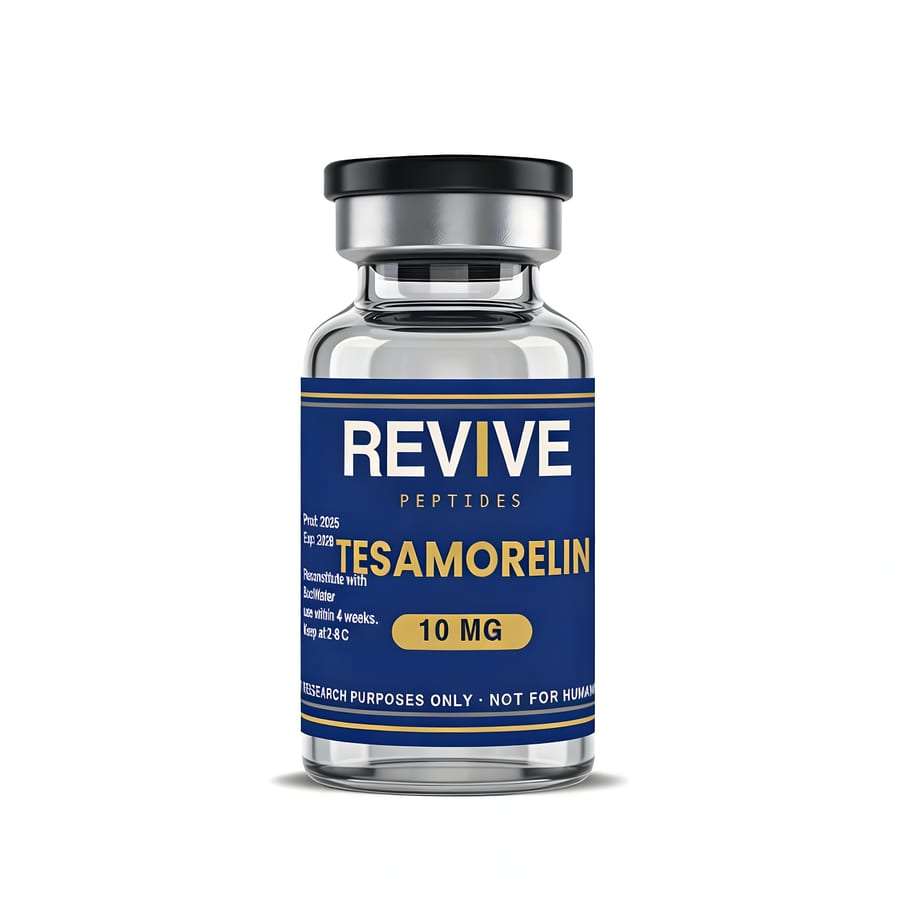
This receptor specificity is also why tesamorelin is the only GHRH analog in the research peptide space that has completed large-scale double-blind randomised controlled trials. The compound's clean mechanism made it tractable for clinical development in a way that broad-spectrum GH secretagogues are not. REVIVE LAB UAE supplies it in both 5mg vials and 10mg vials — the 10mg format being well-suited to multi-week study designs, the 5mg commonly used for pilot-phase protocols or parallel-arm comparisons.
Ipamorelin + CJC-1295 — Dual-Pathway GH Pulse Amplification
The Ipamorelin + CJC-1295 combination targets the GH secretion cascade at two separate receptor nodes simultaneously:
- CJC-1295 is a GHRH analog that — like tesamorelin — binds GHRHR on pituitary somatotrophs. The DAC (Drug Affinity Complex) variant achieves dramatically extended plasma half-life via albumin binding, producing sustained rather than pulsatile GHRH receptor stimulation. This is a meaningful pharmacological difference from tesamorelin's more physiological pulsatile profile.
- Ipamorelin is a selective growth hormone secretagogue receptor (GHSR) agonist — a ghrelin mimetic — stimulating GH release through an entirely separate receptor pathway. Its principal research attraction is its selectivity: unlike earlier-generation GHRPs, it does not significantly stimulate prolactin or cortisol release at concentrations used in research protocols, reducing the number of confounding hormonal variables in a study design.
The theoretical logic of the combination is to achieve synergistic GH pulse amplitude: CJC-1295 loads the somatotroph ready to release, and ipamorelin fires the GHSR signal that triggers the actual GH pulse. The result, in preclinical models, is a higher peak GH output than either compound alone. The tradeoff is mechanistic complexity — two receptor pathways mean two sources of variability, which matters when researchers need to isolate causes.
| Parameter | Tesamorelin | Ipamorelin + CJC-1295 |
|---|---|---|
| Primary receptor target | GHRHR (single pathway) | GHRHR + GHSR (dual pathway) |
| GH release pattern | Pulsatile, physiological | Amplified pulse; CJC-1295 DAC adds tonic component |
| Large-scale human RCT data | Yes — NEJM, JAMA, Lancet HIV | No large-scale RCTs for the combination |
| Mechanism complexity | Low (single compound, single receptor) | Higher (two compounds, two receptors) |
| Appetite pathway involvement | No | Yes (ipamorelin's ghrelin-mimetic signal) |
| UAE vial formats (REVIVE LAB UAE) | 5mg, 10mg | Sold as separate compounds |
3. What the Peer-Reviewed Literature Actually Shows for Tesamorelin
Tesamorelin's clinical evidence base is genuinely unusual for a compound available through research peptide suppliers. It has been subjected to the full rigour of Phase 3 randomised controlled trial design and has survived peer review at three of the most demanding journals in medicine. UAE researchers sourcing tesamorelin are working with a compound that has an evidence trail most peptides cannot approach.
The Falutz et al. 2007 NEJM paper established the landmark finding: tesamorelin produced statistically significant, placebo-controlled reductions in trunk fat in HIV-associated lipodystrophy, with an acceptable safety profile. The Falutz et al. 2010 continuation trial confirmed that effects were sustained with continued protocol adherence and reversed on withdrawal — a finding with significant implications for study design around GH-axis interventions. Stanley et al. (2014, JAMA) demonstrated significant visceral adipose tissue reduction alongside improved triglyceride profiles, extending the metabolic findings into a larger and more diverse study population. The longest follow-up in the series — Stanley et al. (2019, Lancet HIV) — confirmed durability of metabolic effects at 52 weeks with no new safety signals identified.
What this tells a researcher in Dubai or Abu Dhabi: if your study requires a GHRH analog intervention with validated, reproducible metabolic endpoints against which your experimental observations can be compared, tesamorelin is the only compound in this class that provides that foundation. The clinical literature gives UAE researchers a comparator framework that simply does not exist for any combination stack.
REVIVE LAB UAE stocks tesamorelin for UAE researchers. Same-day dispatch from Dubai. Discreet packaging. Cash on delivery across Dubai, Abu Dhabi & Sharjah.
Buy Tesamorelin UAE — Same-Day Dubai Dispatch from REVIVE LAB UAE
4. The Evidence Picture for Ipamorelin + CJC-1295
Researchers in the UAE asking about the Ipamorelin + CJC-1295 combination should apply a clear-eyed assessment: the evidence base, while scientifically interesting, is substantially thinner than tesamorelin's. Ipamorelin has been characterised in human pharmacokinetic studies confirming its GHSR selectivity and clean hormonal profile. CJC-1295 has preclinical and small human pharmacology data demonstrating extended GH elevation consistent with its albumin-binding mechanism. But the combination protocol, as typically run in research settings, has not been subjected to large-scale, double-blind, placebo-controlled human trials.
This is not grounds for dismissing the combination — it is grounds for understanding where it sits in the research tool hierarchy. The Ipamorelin + CJC-1295 stack is a mechanistically logical, exploratory tool. It is excellent for generating hypotheses about dual GH-axis pathway stimulation, for body composition pilot studies, or for designs where the additive effect of GHSR plus GHRHR activation is itself the variable of interest. It is not the right tool when you need validated endpoints, reproducible comparator data, or a protocol anchored to published clinical methodology.
Many of the most productive UAE research programmes in 2026 run tesamorelin as a positive control or reference arm — a reproducible benchmark — and use the Ipamorelin + CJC-1295 combination as an experimental arm being tested against that benchmark. This design extracts maximum value from both: the combo generates novel mechanistic data, and tesamorelin's known profile anchors the comparison in published science.
5. Protocol Design — Which Research Objective Calls for Which Compound?
Choose Tesamorelin When:
- Your research model requires validated visceral adipose tissue or metabolic endpoints cross-referenceable with Falutz et al. 2007 or Stanley et al. 2014 methodology
- You need a single-compound, single-receptor GHRH model where GHSR pathway involvement would introduce unacceptable confounds
- Your study design requires a 52-week safety reference — Stanley et al. 2019 Lancet HIV is the only long-duration dataset available in this compound class
- Your publication target requires an evidence-anchored intervention arm
- You are running a lipid or triglyceride outcome study where tesamorelin's documented lipid effects are relevant to your hypothesis
Choose Ipamorelin + CJC-1295 When:
- Your design is explicitly investigating dual GH-axis pathway stimulation and GHRHR/GHSR interaction is a variable, not a confounder
- Your research requires maximum GH pulse amplitude rather than physiological GH pulsatility
- Appetite signalling or ghrelin-pathway variables are relevant to the research model — ipamorelin's GHSR activity introduces these
- You are running a comparative study where a tesamorelin arm provides the validated reference and the combination arm explores incremental or mechanistically distinct effects
| Research Objective | Preferred Protocol | Rationale |
|---|---|---|
| Visceral fat reduction model | Tesamorelin | RCT-validated endpoint (Falutz 2007, Stanley 2014) |
| Maximum GH pulse amplitude | Ipamorelin + CJC-1295 | Dual-pathway synergy exceeds single GHRH agonism |
| Metabolic lipid profile study | Tesamorelin | Triglyceride outcomes documented in Stanley 2014 JAMA |
| Long-term GH axis safety model | Tesamorelin | 52-week safety data available (Stanley 2019 Lancet HIV) |
| Dual receptor pathway study | Ipamorelin + CJC-1295 | Only protocol engaging both GHRHR and GHSR simultaneously |
| Ghrelin / appetite pathway research | Ipamorelin + CJC-1295 | Ipamorelin's ghrelin-mimetic activity introduces relevant signalling |
6. Sourcing Tesamorelin in the UAE — What Dubai Researchers Need to Know in 2026
The peptides Dubai sourcing environment in mid-2026 has one dominant variable that international researchers consistently underestimate: the UAE summer climate. Ambient temperatures in Dubai Marina, Abu Dhabi Corniche, and Sharjah routinely exceed 42°C from June through September. Lyophilised peptides — tesamorelin included — are stable at ambient temperature only within ranges that UAE summer shatters. A package routed through DXB cargo handling in peak summer heat, held without climate control before last-mile delivery, will deliver degraded peptide regardless of what the sender's certificate of analysis says.
REVIVE LAB UAE operates as a UAE-local supplier specifically to eliminate this cold-chain vulnerability. Stock is held in-country, temperature-controlled at source, and dispatched from Dubai with cold packs included during summer months. The result is that a researcher ordering tesamorelin in Business Bay or Jumeirah Beach Residence is receiving a vial that has never been exposed to uncontrolled transit temperatures — a meaningful difference for experimental reproducibility.
Key reasons UAE researchers consistently source tesamorelin from REVIVE LAB UAE:
- Tesamorelin in stock UAE — 5mg and 10mg vials on hand without pre-order lead times or international shipping delays
- Tesamorelin same-day delivery — Dubai Marina, JBR, Business Bay, DIFC, Palm Jumeirah, and surrounding districts for orders placed before 4 PM
- Tesamorelin 24h delivery Dubai and beyond — Abu Dhabi, Sharjah, Ajman, Ras Al Khaimah next-day guaranteed
- Tesamorelin discreet packaging UAE — plain outer packaging with no product identification on the exterior; invoice detail minimised on request
- Tesamorelin cash on delivery Dubai — COD available across Dubai; USDT via Binance Pay (TRC20) and bank transfer also accepted
- Cold-pack dispatch standard during summer months; refrigerated storage maintained at the Dubai warehouse
Researchers in Abu Dhabi and Sharjah ordering peptides UAE-wide consistently note the advantage of a local supplier over international grey-market sources: no customs uncertainty, no unknown transit delays, and a responsive WhatsApp support channel for tracking and order confirmation. For a lab running a time-sensitive protocol, these operational details matter as much as compound quality.
7. Storage and Handling Notes for UAE Research Labs
Tesamorelin in lyophilised form — as supplied by REVIVE LAB UAE in 5mg and 10mg vials — should be stored at 2–8°C prior to reconstitution and protected from light exposure. Once reconstituted, researchers should follow their lab's established stability protocols and handle the reconstituted solution in line with cold-chain SOP requirements specific to their experimental timeline.
UAE summer conditions make cold storage discipline non-negotiable. Any peptide left at ambient UAE temperatures during June through September will degrade faster than published stability data — typically generated under European or North American laboratory climate assumptions — would predict. Labs without dedicated cold-room infrastructure in Dubai should prioritise portable refrigeration for sample storage and ensure that brief ambient exposure during reconstitution is kept to a minimum.
For researchers running Ipamorelin + CJC-1295 protocols alongside or in comparison to tesamorelin, each compound's storage requirements should be assessed separately, and the more stringent condition applied when compounds share storage space. Labelling discipline across visually identical lyophilised vials is essential — mix-up between compounds is a documented and entirely avoidable source of experimental error that has invalidated otherwise well-designed protocols.
8. The Verdict for UAE Researchers: Tesamorelin or the Combo?
If a UAE researcher designing a rigorous, reproducible, publishable study asks which protocol to anchor their GH-axis work to: tesamorelin wins on evidence depth, without serious competition. The Falutz and Stanley trial series gives it a clinical literature foundation that no combination stack can currently match. Its mechanism is clean, its endpoints are validated, and its research protocol maps directly to existing published methodology — which matters when you need your results to be interpretable against a wider scientific literature.
If the research objective is inherently exploratory — mapping dual GH-axis receptor contributions, generating comparative amplitude data, or investigating ghrelin-pathway interactions — then the Ipamorelin + CJC-1295 combination is the more flexible tool. The relative absence of large-scale clinical trial data is, from a research perspective, an opportunity rather than only a limitation: there is more novel ground to cover with this combination, and exploratory findings can be anchored by comparison to tesamorelin's known profile.
The most productive research designs REVIVE LAB UAE regularly sees UAE labs enquiring about treat these compounds as complementary rather than competing: tesamorelin as the validated reference arm, the Ipamorelin + CJC-1295 combination as the experimental arm generating novel mechanistic data against that reference. Both compounds in stock, cold-chain managed locally, dispatched same day from Dubai. That is the practical advantage of sourcing from a UAE-resident supplier — the protocol never waits on the supply chain.
REVIVE LAB UAE. In stock today. Same-day delivery across Dubai. 24h delivery Abu Dhabi & Sharjah. Discreet packaging. COD + USDT accepted.
Buy Tesamorelin UAE — Order from REVIVE LAB UAE
FAQ — Tesamorelin vs Ipamorelin + CJC-1295 UAE
Can I order Tesamorelin with same-day delivery in Dubai?
Yes. REVIVE LAB UAE offers tesamorelin same-day delivery across Dubai — Marina, JBR, Business Bay, DIFC, Palm Jumeirah — for orders placed before 4 PM. Tesamorelin 24h delivery is available to Abu Dhabi, Sharjah, and Ajman. Cash on delivery is available across Dubai, and USDT payment via Binance Pay (TRC20) is also accepted. All orders ship in discreet, unmarked outer packaging with no product identification on the exterior.
What is the research difference between Tesamorelin and the Ipamorelin + CJC-1295 combination?
Tesamorelin is a stabilised GHRH(1-44) analog acting through a single, well-characterised GHRH receptor pathway. It carries the deepest peer-reviewed clinical evidence base in its compound class — Falutz et al. 2007 NEJM, Stanley et al. 2014 JAMA, and Stanley et al. 2019 Lancet HIV — with validated visceral adipose tissue and metabolic endpoints. The Ipamorelin + CJC-1295 combination engages both the GHRH receptor (via CJC-1295) and the ghrelin receptor GHSR (via ipamorelin) simultaneously, producing higher GH pulse amplitude but through a more mechanistically complex dual-pathway signal without comparable large-scale RCT data. They are not interchangeable and serve different research objectives.
Does REVIVE LAB UAE ship Tesamorelin to Abu Dhabi and Sharjah?
Yes. REVIVE LAB UAE ships tesamorelin in discreet packaging to all UAE emirates — Abu Dhabi, Sharjah, Ajman, Ras Al Khaimah, Fujairah, and Umm Al Quwain — with 24h delivery to most destinations. Tesamorelin is available as 5mg vials and 10mg vials for research use. Payment options include bank transfer, USDT via Binance Pay TRC20, and cash on delivery in Dubai.
- Falutz J, et al. Metabolic effects of a growth hormone-releasing factor in patients with HIV. N Engl J Med. 2007;357(23):2359–2370.
- Falutz J, et al. Effects of tesamorelin (TH9507), a growth hormone-releasing factor analog, in HIV-infected patients with abdominal fat accumulation: a randomised placebo-controlled trial with a safety extension. Continuation trial, NEJM series. 2010.
- Stanley TL, et al. Effects of tesamorelin on non-alcoholic fatty liver disease in HIV: a randomised, double-blind, multicentre trial. JAMA. 2014;312(4):380–389.
- Stanley TL, et al. Long-term effects of tesamorelin on visceral fat and liver fat in HIV-infected patients with abdominal fat accumulation: a 2-year follow-up study. Lancet HIV. 2019;6(2):e99–e107.
REVIVE LAB UAE — the UAE's specialist research peptide supplier. Tesamorelin 5mg & 10mg in stock now. Same-day Dubai delivery. 24h Abu Dhabi & Sharjah. Discreet packaging. COD + USDT accepted.
Order Tesamorelin UAE — Visit REVIVE LAB UAE