Tesamorelin vs Ipamorelin: GHRH Analog vs Ghrelin Mimetic — Research Differentiation Guide for UAE Investigators (2026)
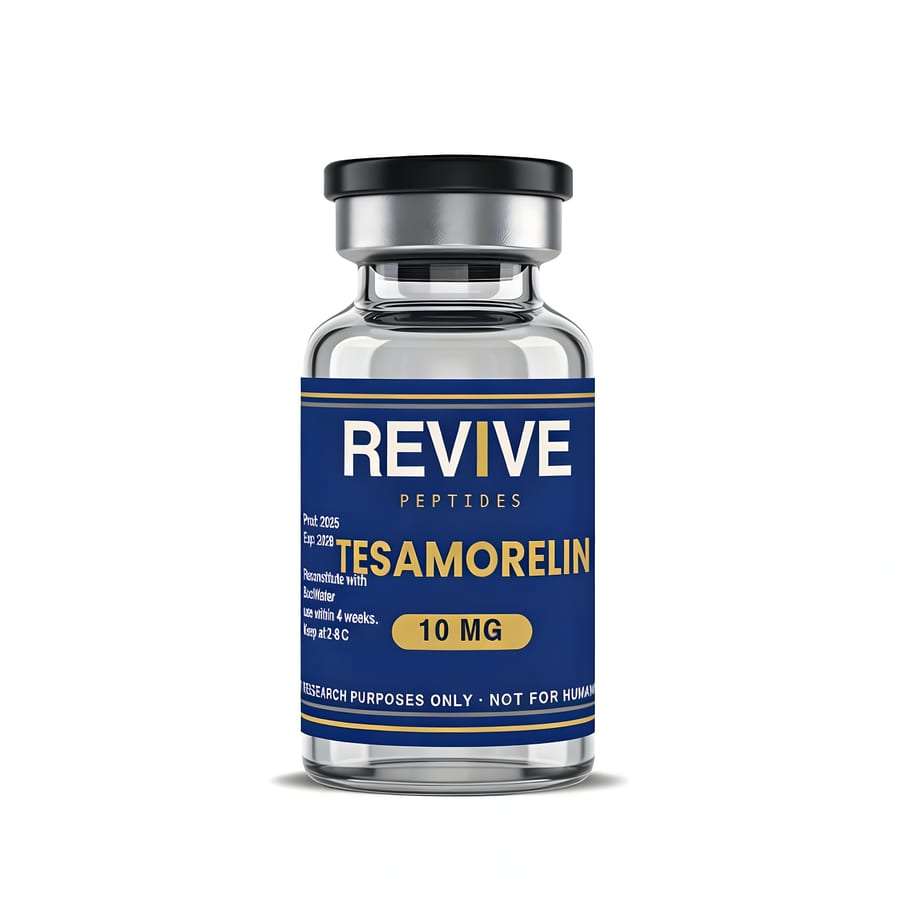
The "tesamorelin vs ipamorelin" question arrives in UAE research circles more than any other peptide-comparison query — and it deserves a serious answer, because confusing receptor pathways is not a minor protocol error. These are not two versions of the same molecule; they are upstream inputs to the GH axis operating at different nodes, validated against different endpoints, with evidence bases that differ by an order of magnitude in scale and rigor. This guide unpacks the mechanistic split, maps the clinical evidence, and helps UAE-based investigators select the right compound for the right research model. For researchers who have already settled on tesamorelin: REVIVE LAB UAE dispatches HPLC-verified tesamorelin same day in Dubai and to all seven emirates within 24 hours — tesamorelin in stock UAE, cold-chain dispatched.
Two Pathways Into the GH Axis: The Core Mechanistic Split
Growth hormone secretion is regulated by at least two distinct upstream receptor systems that converge on the somatotroph cell in the anterior pituitary. Understanding which node a research peptide targets is the starting point for every protocol design decision — choose wrong and your comparison endpoints will not map onto existing literature.
Tesamorelin — GHRH Receptor (GHRH-R) Agonist
Tesamorelin is a synthetic analog of human growth hormone-releasing hormone (GHRH 1-44) with a trans-3-hexenoyl group conjugated to the N-terminus. That modification confers resistance to dipeptidyl peptidase-IV (DPP-IV) cleavage — the enzyme that degrades native GHRH within minutes in plasma — extending the functional half-life to approximately 26 minutes. The mechanism is direct: tesamorelin binds the GHRH receptor on pituitary somatotrophs, activating adenylyl cyclase via Gs coupling, raising intracellular cAMP, and triggering pulsatile GH secretion. Because it is a structural analog of the body's own releasing hormone, the GH pulse profile it generates is physiological in character: somatostatin negative-feedback remains intact, preventing runaway IGF-1 accumulation.
Critically, tesamorelin has been tested in humans at scale. Falutz and colleagues enrolled 412 subjects in the pivotal Phase III trial (Falutz et al. 2007, N Engl J Med) and demonstrated visceral adipose tissue (VAT) reduction of 15-18% versus placebo, alongside an approximately 50% rise in IGF-1 from baseline. The 2010 26-week extension by Falutz et al. confirmed durability of the VAT endpoint at the same research-context dosing. Stanley and colleagues at Massachusetts General Hospital then extended the tesamorelin model to HIV-associated non-alcoholic fatty liver disease, showing a 32% reduction in liver fat versus placebo (Stanley 2014, JAMA; Stanley 2019, Lancet HIV). This is the depth of evidence available for tesamorelin — Phase III, multicenter, published in NEJM, JAMA and Lancet HIV.
Ipamorelin — Ghrelin Receptor (GHSR-1a) Agonist
Ipamorelin is a pentapeptide growth hormone releasing peptide (GHRP) with the sequence Aib-His-D-2-Nal-D-Phe-Lys-NH2. It binds the ghrelin receptor (growth hormone secretagogue receptor 1a, GHSR-1a) — an entirely different upstream node from the GHRH receptor. The ghrelin pathway amplifies GH pulse amplitude and frequency through a Gq/11-coupled intracellular signaling mechanism, and ipamorelin is notably selective within its class: it stimulates GH release with markedly less cortisol, ACTH and prolactin spill-over than earlier GHRPs such as GHRP-6 or hexarelin, making it the preferred GHRP reference compound in selectivity-focused pre-clinical models.
What ipamorelin lacks relative to tesamorelin is a comparable body of large-scale human RCT evidence. Most published ipamorelin data derives from pre-clinical animal studies and early Phase I/II trials focused on GH pulsatility characterisation. This does not make it less useful as a research tool — it means the evidence library, and therefore the research question it is most suitable for answering, is fundamentally different from tesamorelin's.
Buy Tesamorelin UAE — Order Now →
Evidence Base: The Critical Differentiator
For a UAE-based investigator deciding between these two peptides, the evidence tier is often the deciding factor — particularly when framing research against a published comparator or attempting to replicate a documented endpoint.
| Attribute | Tesamorelin | Ipamorelin |
|---|---|---|
| Receptor target | GHRH-R (Gs-coupled, cAMP pathway) | GHSR-1a / ghrelin receptor (Gq/11-coupled) |
| Structure | 44-AA GHRH analog, trans-3-hexenoyl N-terminus | Pentapeptide GHRP (Aib-His-D-2-Nal-D-Phe-Lys-NH2) |
| DPP-IV resistance | Yes — N-terminus modification | Partial — D-amino acid substitutions |
| Somatostatin feedback intact | Yes — physiological pulse profile | Partially — GHSR activation suppresses somatostatin tone |
| Cortisol / ACTH spill-over | Minimal at research-context doses | Low (cleaner than GHRP-6, hexarelin) |
| Largest human trial | 412-subject Phase III RCT (Falutz 2007, NEJM) | Phase I/II; no published large-scale Phase III RCT |
| Published clinical endpoints | VAT -15-18%, IGF-1 +~50%, liver fat -32% | GH pulsatility, lean tissue models; primarily pre-clinical |
| Journal tier | NEJM, JAMA, Lancet HIV | Pre-clinical journals, early-phase reports |
| Stocked vials — REVIVE LAB UAE | 5mg / 10mg | Not stocked |
Research Applications: Matching Peptide to Protocol
When Tesamorelin Is the Indicated Research Tool
Tesamorelin is the compound of choice when the research question maps onto any of the following objectives:
- Visceral adipose tissue (VAT) modelling: The Falutz 2007 NEJM trial is the gold-standard comparator for VAT research. Replicating or building on that endpoint requires tesamorelin at the referenced dosing — not a different GH secretagogue operating through a different receptor.
- Hepatic steatosis / NAFLD models: Stanley and colleagues established tesamorelin's liver-fat endpoint in two separate well-powered trials (Stanley 2014 JAMA; Stanley 2019 Lancet HIV). If the endpoint is hepatic fat quantification, tesamorelin is the validated molecular tool with published human comparator data.
- IGF-1 axis characterisation: The approximately 50% rise in IGF-1 documented in Falutz 2007 is a reproducible, quantified endpoint. Investigators benchmarking IGF-1 response to GHRH-axis stimulation need tesamorelin specifically — ipamorelin's IGF-1 effect is not characterised at the same evidence tier.
- Lipodystrophy models: The entire published clinical literature on GHRH-axis treatment of lipodystrophy uses tesamorelin. Alternative GHRPs or other GHRH analogs are mechanistically different comparators and do not share the documented endpoint library.
UAE investigators can buy tesamorelin UAE from REVIVE LAB UAE in 5mg and 10mg vials with full HPLC verification and lot-level certificate of analysis — the same quality tier the Falutz and Stanley research group protocols assume for their reference compound.
When Ipamorelin Is the Indicated Research Tool
Ipamorelin fits research designs where the ghrelin receptor pathway itself is the object of study, or where a clean GHRP reference compound is needed:
- GHSR-1a selectivity profiling: Ipamorelin is the pre-clinical standard GHRP reference compound for receptor selectivity studies, valued precisely because of its low off-target hormonal activity.
- GH pulsatility with minimal spill-over: When investigators need a GHRP that elevates GH without materially moving cortisol or prolactin, ipamorelin is the benchmark — cleaner than GHRP-6 or hexarelin in this respect.
- Peripheral ghrelin pathway research: GHSR-1a is expressed peripherally in gut, heart, pancreas and adipose tissue. Appetite, gut motility and peripheral metabolic effects of ghrelin-pathway stimulation are not shared with tesamorelin's GHRH receptor mechanism.
- Combination GHRH + GHRP synergy studies: Pre-clinical literature documents supraadditive GH release when GHRH analogs and GHRPs are co-administered — each supplying a different axis input. In this framing, tesamorelin and ipamorelin are complements in a dual-arm study, not substitutes for one another.
Order Tesamorelin UAE →
Combination Research: When Both Peptides Appear in the Same Protocol
Pre-clinical investigators have long documented that GHRH pathway stimulation and GHSR-1a stimulation are synergistic rather than redundant when studied together. When a GHRH analog and a GHRP are co-administered in animal models, GH pulse amplitude is substantially higher than with either compound alone — because GHRH primes the somatotroph for GH synthesis and release, while the ghrelin pathway simultaneously suppresses somatostatin tone and amplifies secretion pulse amplitude. In a dual-input protocol, tesamorelin and ipamorelin are measuring different arms of the same regulatory system.
That said, the published clinical evidence for tesamorelin's visceral fat and liver fat endpoints was generated with tesamorelin as monotherapy. The Falutz 2007 NEJM trial, the 2010 extension, Stanley 2014 JAMA and Stanley 2019 Lancet HIV all used tesamorelin as the sole active comparator.
Why UAE Investigators Source Tesamorelin from REVIVE LAB UAE
REVIVE LAB UAE is a Dubai-based peptides UAE supplier — not a freight-forwarder reselling offshore stock. For investigators in the UAE running tesamorelin-anchored research protocols, the practical supply considerations are:
- HPLC-verified purity, lot-COA on request: Every tesamorelin batch is independently tested. Lot-level certificates of analysis are available per shipment, matching the standard research procurement workflows assume.
- Cold-chain dispatch standard: Tesamorelin 5mg and 10mg vials are dispatched in validated insulated packaging maintaining 2-8°C through the full UAE delivery window — not ambient shipping with a gel pack thrown in.
- Tesamorelin same day delivery Dubai: Orders placed before the daily dispatch cut-off are delivered same day to Dubai Marina, JBR, Business Bay, JVC, DIFC, Palm Jumeirah, Downtown, Jumeirah, Emirates Hills and Arabian Ranches.
- Tesamorelin Dubai 24h delivery — all 7 emirates: Abu Dhabi, Sharjah, Ajman, Ras Al Khaimah, Fujairah, Umm Al Quwain and Al Ain all within the next-day window.
- Cash on delivery Dubai: No card required. Pay on receipt across all seven emirates — tesamorelin in stock UAE, dispatched from Dubai.
- USDT crypto pay Dubai: REVIVE LAB UAE accepts USDT (TRC20) via Binance Pay at a 5% pre-pay discount for investigators who prefer crypto settlement.
- Discreet, unbranded outer packaging: Plain outer cartons with no product names or brand markings — the default, not an upsell.
REVIVE LAB UAE supplies HPLC-verified, lot-COA, cold-chain dispatched tesamorelin across all 7 emirates. Tesamorelin in stock UAE means same-week dispatch with no pre-order uncertainty — the supply chain exists specifically for UAE-based research use.
FAQ: Tesamorelin vs Ipamorelin — UAE Research Investigators
What is the key research difference between tesamorelin and ipamorelin?
Tesamorelin is a GHRH receptor agonist — a 44-amino-acid structural analog of hypothalamic GHRH — with its primary action on pituitary somatotrophs via Gs/cAMP signaling and a trans-3-hexenoyl N-terminal modification conferring DPP-IV resistance. It has Phase III RCT evidence in humans: visceral fat reduction of 15-18% (Falutz 2007, NEJM), IGF-1 rise of approximately 50%, and liver fat reduction of 32% (Stanley 2014, JAMA; Stanley 2019, Lancet HIV). Ipamorelin is a ghrelin receptor (GHSR-1a) agonist — a pentapeptide GHRP with clean selectivity for GH release, low cortisol/prolactin spill-over, and a primarily pre-clinical evidence library. Choosing between them means choosing a receptor pathway and an evidence framework, not just a vial label.
Can I buy tesamorelin UAE for research and get 24h delivery in Dubai?
Yes. REVIVE LAB UAE stocks tesamorelin 5mg and 10mg vials with HPLC verification and lot-COA, dispatched same-day in Dubai and within 24 hours to all seven emirates. Cash on delivery is available across the UAE. USDT crypto pay Dubai is also accepted via Binance Pay at a 5% discount. Orders placed before the daily cut-off qualify for tesamorelin same day Dubai delivery — this is the standard operating procedure, not an exception. All shipments use unbranded outer packaging by default.
Is it worth combining tesamorelin and ipamorelin in a research protocol?
In pre-clinical literature, GHRH analogs and GHRPs exhibit synergistic GH-release profiles when co-administered — the GHRH pathway primes the somatotroph while the ghrelin pathway suppresses somatostatin tone and amplifies pulse amplitude, producing supraadditive GH output. However, the published human-endpoint data for tesamorelin — the visceral fat and liver fat results from Falutz 2007 (NEJM), Falutz 2010, Stanley 2014 (JAMA) and Stanley 2019 (Lancet HIV) — was generated with tesamorelin as monotherapy. Investigators designing protocols that include both compounds should treat the combination as a distinct independent variable rather than assuming the published monotherapy endpoints carry over.
Buy Tesamorelin UAE — Order Now →
- Falutz J, Allas S, Blot K, et al. Metabolic effects of a growth hormone-releasing factor in patients with HIV. N Engl J Med. 2007;357(23):2359-2370.
- Falutz J, Mamputu JC, Potvin D, et al. Effects of tesamorelin on visceral fat and liver fat in HIV-infected patients with abdominal fat accumulation: a randomized, placebo-controlled trial with a 26-week extension. J Clin Endocrinol Metab. 2010;95(9):4291-4304.
- Stanley TL, Feldpausch MN, Oh J, et al. Effect of tesamorelin on visceral fat and liver fat in HIV-infected patients with abdominal fat accumulation. JAMA. 2014;312(4):380-389.
- Stanley TL, Fourman LT, Feldpausch MN, et al. Effects of tesamorelin on non-alcoholic fatty liver disease in HIV: a randomised, double-blind, multicentre trial. Lancet HIV. 2019;6(12):e821-e830.